Imagine you’re the founder of a fast-growing mobile app.
After months of planning, your marketing team launches its biggest advertising campaign yet.
Within a few weeks, the numbers look incredible.
- 150,000 new app installs.
- Thousands of new user registrations.
- Social media is buzzing.
- Investors congratulate you on the rapid growth.
It feels like success.
Then your finance team walks into the meeting with a very different story.
Despite acquiring thousands of customers, the company has lost money.
Not just a little.
Millions.
How can a business gain customers and still become less profitable?
The answer lies in one of the most important—and most misunderstood—metrics in modern business:
Customer Lifetime Value (LTV).
Growth Can Be Deceptive
Many people assume that more customers automatically mean more revenue.
It sounds logical.
If one hundred customers are good, then one hundred thousand must be even better.
But businesses don’t survive on customer counts.
They survive on profitable customers.
Consider two companies.
The first spends $500,000 on advertising and acquires 50,000 customers.
The second spends the same amount but acquires only 12,000 customers.
At first glance, the first company appears to be winning.
Yet six months later, the second company reports significantly higher profits.
Why?
Because the value of a customer isn’t measured on the day they arrive.
It’s measured over the entire relationship they have with the business.
That’s where Customer Lifetime Value becomes essential.
The Coffee Shop That Explains Everything
Imagine two cafés located across the street from each other.
The first café attracts hundreds of tourists every day.
Most customers buy one coffee, take a photo, and never return.
The second café serves fewer people.
But many customers visit every morning before work.
Some have been coming for years.
Which café has the more valuable customers?
The answer has very little to do with today’s sales.
It has everything to do with tomorrow’s.
A customer who spends $5 once contributes $5 to the business.
A customer who spends $5 every weekday for three years contributes thousands of dollars.
From the owner’s perspective, those two customers are not equal.
Neither are they equal in the eyes of investors, marketers, or business analysts.
That’s the idea behind Customer Lifetime Value.
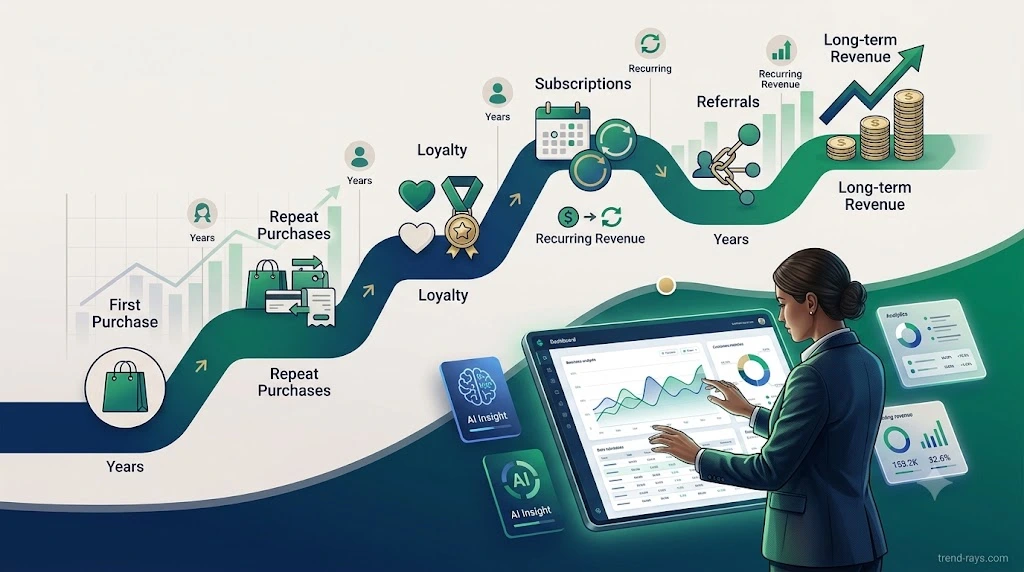
It’s an attempt to estimate the total value a customer is likely to generate throughout their relationship with a business—not just during their first purchase.
Why Businesses Think in Years Instead of Days
When customers first discover a company, they rarely reveal their true value immediately.
Someone might install a fitness app today and ignore it tomorrow.
Another person might subscribe next week, renew every year, and recommend the app to friends.
Both users began with the same install.
Their long-term impact is completely different.
This is why experienced businesses spend far more time studying customer behavior after acquisition than celebrating download numbers.
Acquiring a customer is only the beginning of the story. Before businesses can evaluate whether a customer becomes profitable over time, they first need to understand where that customer came from and which marketing campaign deserves credit. That’s where mobile attribution becomes essential.
The relationship that follows is where real value is created.
Downloads Don’t Pay the Bills
One of the easiest mistakes a growing company can make is celebrating vanity metrics.
Downloads.
Website visits.
Followers.
App installs.
Email sign-ups.
These metrics often look impressive on a dashboard, but without proper attribution it’s difficult to know which campaigns actually generated valuable customers. If you’re unfamiliar with attribution, our guide on how mobile attribution works explains why install numbers alone rarely tell the full story.
These numbers can create the illusion of progress.
But they don’t automatically create sustainable businesses.
A million app installs mean very little if users uninstall the app tomorrow.
Likewise, a smaller customer base can generate extraordinary profits if those customers remain loyal for years.
This is why successful companies often ask a different question:
“How valuable will this customer become?”
Instead of:
“How many customers did we acquire today?”
That shift in thinking changes almost every business decision that follows.
Every Customer Has a Different Story
Imagine you run an online clothing store.
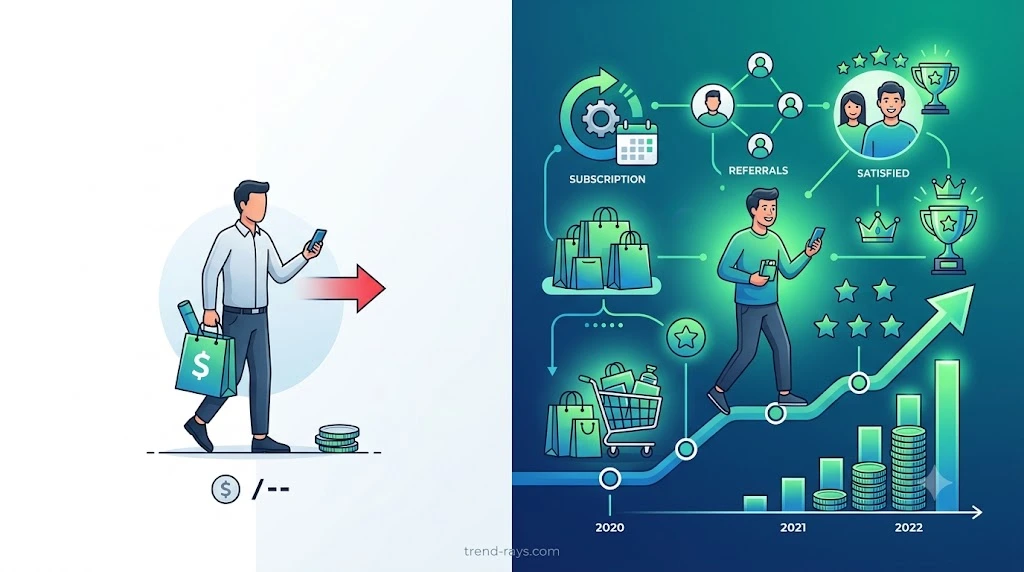
On Monday, two customers place their first order.
At first glance, they look identical.
Both spend $75.
Both arrive through the same advertising campaign.
Both complete their purchase within ten minutes.
If you were only looking at today’s sales report, you would assume these customers are equally valuable.
But fast forward one year.
The first customer never returns.
The second customer buys new clothes every season, subscribes to your newsletter, recommends your brand to two friends, and eventually spends more than $1,200.
The difference between those two customers wasn’t visible on the day they made their first purchase.
It only became clear over time.
Businesses that understand this difference make very different decisions from those that don’t.
They stop asking,
“How much did this customer spend today?”
and start asking,
“How much value is this customer likely to create over the years?”
That single question has transformed the way modern companies approach marketing, customer service, product development, and long-term growth.
Why Companies Invest in Customers Before They Become Profitable
One of the most surprising realities of modern business is that companies often expect to lose money on a customer’s first transaction.
That sounds counterintuitive.
Why would any business willingly spend more to acquire a customer than it earns from the first sale?
The answer lies in confidence.
If a company believes that a customer will continue purchasing over months or years, the initial loss becomes an investment rather than a mistake.
Think about subscription services.
When a streaming platform offers a free trial or a heavily discounted first month, it knows that many users won’t generate immediate profit.
The company is betting on the future.
If enough customers continue subscribing, the early discount pays for itself many times over.
The same principle applies to ecommerce stores offering generous welcome discounts, banks providing cash bonuses for opening accounts, and ride-sharing apps giving free credits to first-time users.
These businesses aren’t focused solely on the first transaction.
They’re investing in the lifetime relationship.
The Businesses That Master Lifetime Value
Once you begin looking through the lens of Customer Lifetime Value, you’ll notice it everywhere.
A coffee chain rewards frequent visitors with loyalty points because repeat customers are more valuable than one-time buyers.
A software company offers free onboarding because customers who successfully learn the product are more likely to remain subscribers.
A gaming studio continuously releases new content to keep players engaged for years rather than weeks.
An airline creates premium membership programs because loyal travelers generate significantly more revenue than occasional passengers.
Although these companies operate in completely different industries, they’re solving the same challenge.
They’re trying to increase the long-term value of every customer they acquire.
Customer Lifetime Value isn’t limited to one business model.
It’s one of the few metrics that matters almost everywhere.
The Hidden Cost of Chasing New Customers
Acquiring new customers is exciting.
Growth charts move upward.
Advertising campaigns generate fresh traffic.
Marketing teams celebrate successful launches.
But there’s a hidden danger.
Some businesses become so focused on acquiring new customers that they forget to keep the ones they already have.
Imagine filling a bucket with water while a hole in the bottom keeps growing larger.
You can pour in more and more water, but the bucket never becomes full.
Customer retention works the same way.
If existing customers leave as quickly as new ones arrive, the business must spend increasing amounts of money just to maintain its current size.
Companies with high Customer Lifetime Value usually don’t grow faster simply because they acquire more customers.
They grow because they keep customers longer.
That’s often the less visible—but far more profitable—side of sustainable growth.
Lifetime Value Is About Relationships, Not Transactions
It’s tempting to think of Customer Lifetime Value as a mathematical formula.
In reality, it’s a reflection of something much more human.
Every purchase represents a decision to trust a business.
Every renewal represents continued satisfaction.
Every recommendation reflects confidence in the product.
When businesses improve customer experiences, solve real problems, and consistently deliver value, Lifetime Value tends to increase naturally.
That’s why LTV isn’t just a finance metric.
It’s a mirror of the relationship between a company and its customers.
Businesses that focus only on transactions often struggle to build lasting success.
Businesses that focus on relationships create customers who return again and again—and that’s where long-term profitability begins.
Before We Talk About the Formula…
At this point, you don’t need a spreadsheet to understand Customer Lifetime Value.
You already understand the core idea.
Some customers create value for a day.
Others create value for years.
The purpose of calculating LTV isn’t to reduce customers to numbers.
It’s to help businesses make smarter decisions based on the long-term impact of those relationships.
Now that we’ve explored the concept, we can finally answer the practical question:
How do businesses actually calculate Customer Lifetime Value, and why are there several different ways to do it?
So… How Do Companies Actually Calculate Customer Lifetime Value?
Now that we understand why Customer Lifetime Value matters, it’s natural to ask the next question:
“Is there one formula that every business uses?”
Surprisingly, the answer is no.
There isn’t a universal Lifetime Value formula that works for every company.
A coffee shop doesn’t measure customer value the same way a streaming platform does.
A SaaS business doesn’t calculate LTV like an ecommerce store.
A mobile gaming company looks at completely different customer behaviors than an airline or an insurance company.
The goal isn’t to memorize a single equation.
The goal is to estimate how much value a customer is likely to generate over time.
Different businesses simply use different methods to answer that question.
The Simplest Way to Think About Lifetime Value
Imagine you own a neighborhood bakery.
A regular customer visits every Saturday.
They usually spend around $20.
On average, they’ve been shopping with you for five years.
Without using any complicated mathematics, you can already make a reasonable estimate.
That customer has spent roughly:
- Around $20 per visit
- About 52 visits each year
- Over five years
You don’t need advanced analytics to realize that one loyal customer is worth thousands of dollars.
That’s the basic idea behind Lifetime Value.
You’re estimating the long-term financial relationship instead of focusing on a single purchase.
Why There Are Multiple LTV Formulas
As businesses become more sophisticated, their calculations become more sophisticated too.
That’s because every industry behaves differently.
A subscription business knows exactly how much customers pay each month.
An ecommerce company deals with unpredictable purchases.
A mobile game earns money through in-app purchases and advertising.
A bank might keep customers for decades.
Trying to force all of these businesses into one formula would produce misleading results.
Instead, companies choose the calculation that best reflects their business model.
Method 1: Historical Customer Lifetime Value
Historical LTV looks backward.
It asks:
“How much has this customer already spent with us?”
This approach uses real transaction data.
It’s simple, reliable, and easy to understand.
For example, if a customer has spent $850 since joining your business, their historical Lifetime Value is currently $850.
The advantage is accuracy because the money has already been earned.
The limitation is that it doesn’t predict future behavior.
It’s like driving a car while looking only in the rear-view mirror.
Method 2: Predictive Customer Lifetime Value
Predictive LTV looks forward.
Instead of asking:
“What has this customer spent?”
it asks:
“What is this customer likely to spend in the future?”
To answer that question, businesses analyze patterns such as:
- Purchase frequency
- Average order value
- Subscription renewals
- Customer retention
- Product usage
- Engagement levels
- Demographics
- Historical behavior of similar customers
Modern companies often combine these signals with machine learning to estimate future revenue.
Although predictions are never perfect, they allow businesses to make smarter decisions long before all the revenue has actually been generated.
Why Predictive LTV Has Become So Important
Imagine two customers both spend $50 today.
Looking only at today’s sales report, they appear identical.
But an AI model recognizes something interesting.
One customer behaves almost exactly like thousands of previous customers who eventually became premium subscribers.
The other behaves like customers who typically never return.
Even though today’s purchase is the same, their predicted Lifetime Values are dramatically different.
That insight changes everything.
Instead of treating both customers equally, the business can personalize marketing, customer support, onboarding, and promotions based on their expected long-term value.
This is one reason why artificial intelligence has become such an important part of modern customer analytics.
The Formula Most People Learn First
Although there are many ways to calculate Lifetime Value, one simplified approach is commonly used to explain the concept.
It combines three basic ideas:
- How much a customer spends on average.
- How often they purchase.
- How long they remain a customer.
Together, these factors provide a useful estimate of long-term customer value.
This simplified model is excellent for learning the concept, but mature businesses often build much more sophisticated models that account for refunds, profit margins, retention curves, churn, subscription renewals, and many other variables.
The formula is a starting point—not the final destination.
Numbers Help You Estimate.
Behavior Helps You Understand.
One of the biggest misconceptions about Lifetime Value is that it’s purely a finance calculation.
In reality, the numbers only tell part of the story.
The real question isn’t:
“How much is this customer worth?”
It’s:
“Why are some customers becoming more valuable than others?”
That answer rarely comes from spreadsheets alone.
It comes from understanding customer behavior.
Why do some people stay?
Why do others leave?
Why do certain onboarding experiences increase retention?
Why do loyal customers recommend your business?
Lifetime Value isn’t just an accounting metric.
It’s a window into the quality of the relationship between a business and its customers.
Before We Compare LTV with Customer Acquisition Cost…
Knowing how much a customer is worth is only half of the equation.
The next question is even more important.
How much did it cost to acquire that customer in the first place?
A customer with a Lifetime Value of $2,000 sounds fantastic.
Until you discover it cost $2,400 to acquire them.
That’s why businesses almost never evaluate Customer Lifetime Value in isolation.
They compare it with another metric that may be even more influential:
Customer Acquisition Cost (CAC).
And when these two metrics are analyzed together, they reveal whether a business is building sustainable growth—or quietly losing money while appearing successful.
The Metric That Can Make—or Break—a Business: LTV vs. CAC
Imagine opening two businesses on the same street.
Both companies attract exactly 1,000 new customers this month.
Both generate $100,000 in revenue.
Both appear equally successful.
Yet one company is quietly heading toward bankruptcy.
The other is building a business that investors are eager to fund.
How is that possible?
Because revenue tells only half the story.
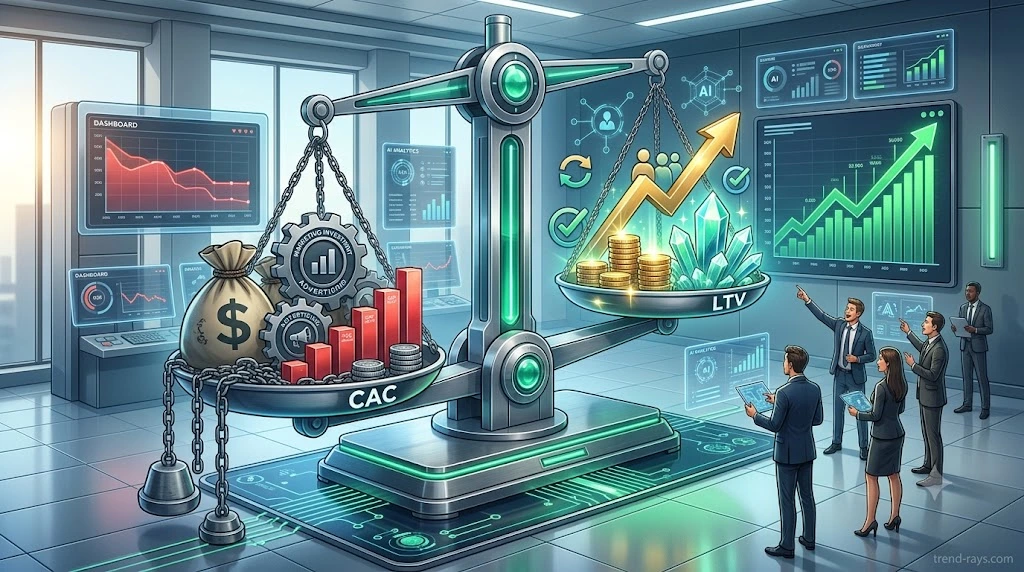
To understand whether growth is sustainable, businesses compare two numbers that are far more meaningful together than they are individually:
- Customer Lifetime Value (LTV) — How much value a customer is expected to generate over time.
- Customer Acquisition Cost (CAC) — How much it costs to acquire that customer.
One measures value.
The other measures investment.
The relationship between the two reveals whether a business is creating wealth or simply spending money to create the illusion of growth.
Why LTV Alone Can Be Misleading
Imagine a software company proudly announces:
“Our average Customer Lifetime Value is $4,000.”
That sounds impressive.
But there’s an important question missing.
How much did it cost to acquire those customers?
If each customer cost $5,000 to acquire, the business loses money on every new customer despite having a high Lifetime Value.
Now imagine another company.
Its average Customer Lifetime Value is only $800.
At first glance, it seems much weaker.
But acquiring each customer costs just $90.
Although the Lifetime Value is smaller, the business earns significantly more profit from every customer relationship.
This is why experienced leaders rarely discuss LTV without mentioning CAC.
One metric tells you what a customer is worth.
The other tells you what it took to earn that relationship.
Think Like an Investor
Imagine you’re considering investing in two startups.
Startup A acquires customers aggressively.
Its advertising is everywhere.
Downloads are growing rapidly.
The founders proudly celebrate their explosive growth.
Startup B grows more slowly.
Its marketing budget is smaller.
Its customer acquisition appears less impressive.
Which company deserves your investment?
You ask a simple question.
“What happens after someone becomes a customer?”
Startup A reveals that it spends nearly all of its revenue acquiring more users.
Most customers leave within a few months.
Startup B shows that customers remain subscribers for years.
Existing customers generate enough profit to fund future growth without relying entirely on outside investment.
Suddenly, the slower-growing company looks much more attractive.
Investors don’t simply buy growth.
They buy sustainable growth.
That’s why Lifetime Value and Customer Acquisition Cost appear in almost every serious investment discussion.
The LTV:CAC Ratio
Rather than looking at the two metrics separately, businesses often compare them using a ratio.
Imagine this example.
A customer generates approximately $900 in Lifetime Value.
The business spends $300 to acquire that customer.
The relationship between those numbers is approximately 3:1.
For many subscription businesses and SaaS companies, this is often considered a healthy benchmark because the customer is expected to generate substantially more value than the cost of acquiring them.
Now consider another company.
Its Lifetime Value is $600.
Customer Acquisition Cost is $550.
Although the business technically earns more than it spends, the margin leaves very little room for salaries, product development, customer support, taxes, infrastructure, or unexpected costs.
The company may still struggle financially despite appearing profitable on paper.
Why Bigger Isn’t Always Better
Many founders assume the solution is simple.
Increase advertising.
Acquire more customers.
Grow faster.
But scaling a business without understanding unit economics can magnify existing problems.
Imagine opening one restaurant that loses a small amount of money every day.
Now imagine opening one hundred identical restaurants.
The business becomes larger.
But it also loses money much faster.
The same principle applies to customer acquisition.
Scaling an unprofitable acquisition strategy rarely fixes the problem.
It usually accelerates it.
Healthy growth begins with profitable economics—not just larger marketing budgets.
Companies That Can Afford to Spend More
One of the biggest competitive advantages in business comes from understanding Customer Lifetime Value.
Imagine two ecommerce companies selling similar products.
Company A knows its average customer spends repeatedly over five years.
Company B measures only the first purchase.
Which company can confidently spend more on advertising?
Company A.
Even if it loses money on the first order, it understands that many customers will return again and again.
This allows it to outbid competitors, invest more aggressively in customer acquisition, and still build a profitable business over the long term.
To an outside observer, Company A may appear reckless.
In reality, it simply understands its customers better.
Why This Changes Marketing Forever
When businesses understand Lifetime Value, marketing stops being about getting the cheapest clicks.
Instead, it becomes about finding the right customers.
Some customers buy once.
Others become loyal advocates.
Some request constant support.
Others quietly generate years of predictable revenue.
Although acquiring both groups may cost the same amount, their long-term contribution to the business is dramatically different.
This changes everything.
Advertising decisions become smarter.
Product improvements become more targeted.
Customer service becomes an investment rather than an expense.
Retention becomes just as important as acquisition.
Lifetime Value shifts the conversation from “How many customers did we get?” to “What kind of customers are we attracting?”
That’s a far more valuable question.
Before We Explore How Companies Increase Customer Lifetime Value…
By now, one idea should be clear.
Customer Lifetime Value isn’t a number businesses calculate once and forget.
It’s something they actively try to improve.
Some companies double their Lifetime Value without doubling their customer base.
Others increase profits while reducing advertising budgets.
How?
Not by finding more customers.
By creating better experiences for the customers they already have.
That’s where the next chapter begins.
How Successful Companies Increase Customer Lifetime Value
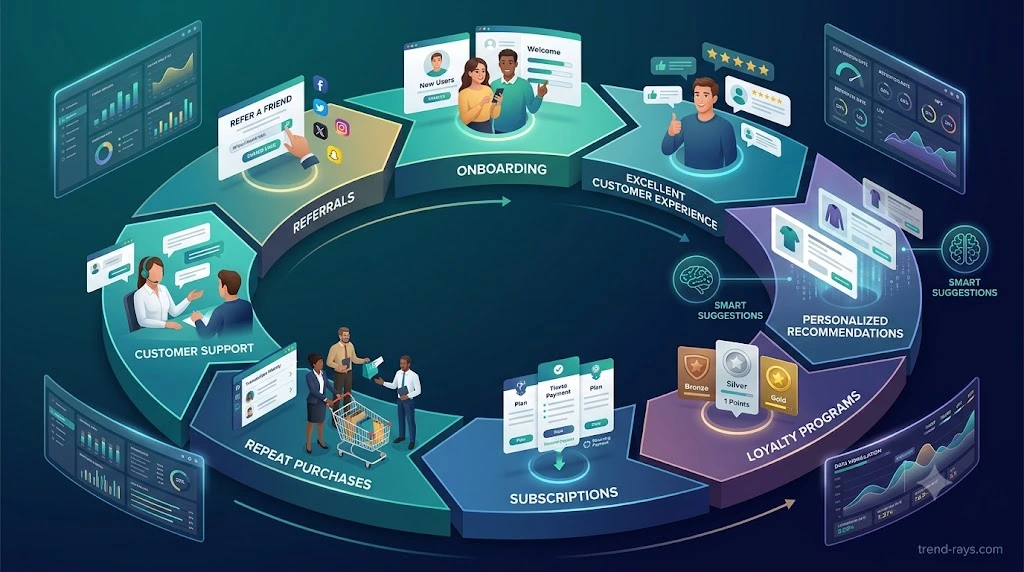
If Customer Lifetime Value is one of the most important business metrics, the next question is obvious.
Can businesses actually increase it?
Absolutely.
In fact, some of the world’s most successful companies spend just as much time increasing the value of existing customers as they do finding new ones.
This often surprises people.
Marketing receives most of the attention because acquiring customers is easy to measure.
Retention is quieter.
Loyalty is slower.
Customer relationships take time to build.
But over the long run, those relationships often create far more value than another advertising campaign.
Let’s look at how businesses approach this challenge.
They Don’t Chase Every Customer
One of the biggest misconceptions in marketing is that every customer has the same value.
They don’t.
Some customers make a single purchase and disappear.
Others become loyal buyers for years.
Some refer friends.
Some leave positive reviews.
Some subscribe to premium plans.
Some become advocates who introduce the brand to entirely new audiences.
Successful businesses understand that these customers are fundamentally different.
Instead of trying to maximize the number of customers, they focus on attracting customers who are more likely to stay, return, and grow with the business.
Growth becomes more intentional rather than simply bigger.
They Make the First Experience Memorable
Think about the last app, website, or service that impressed you immediately.
Perhaps everything worked exactly as expected.
Perhaps getting started felt effortless.
Perhaps the product solved your problem within minutes.
That first experience matters more than many businesses realize.
Customers often decide whether they’ll continue using a product surprisingly early in the relationship.
A confusing setup process, slow performance, or unclear value can cause users to leave before they experience the product’s real benefits.
That’s why many companies invest heavily in onboarding.
Not because onboarding directly generates revenue, but because it increases the likelihood that customers will remain engaged long enough to become valuable over time.
They Solve New Problems Before Customers Ask
Businesses with high Customer Lifetime Value rarely stop after the first sale.
Instead, they continue asking an important question:
“What else can we help this customer achieve?”
A project management platform may introduce collaboration tools.
A fitness app may add meal planning.
An ecommerce company may recommend products based on previous purchases.
A streaming platform constantly refreshes its content library.
Each improvement gives customers another reason to stay.
Over time, the relationship becomes stronger because the business continues creating value rather than simply selling products.
They Build Habits, Not Just Transactions
Some products become part of a person’s daily routine.
Morning coffee.
Music streaming.
Cloud storage.
Email.
Navigation apps.
Team collaboration software.
Once a product becomes a habit, customers are less likely to switch.
This isn’t necessarily because competitors are worse.
It’s because changing routines requires effort.
Successful companies understand this.
Instead of asking,
“How do we make one more sale?”
they ask,
“How do we become part of our customer’s everyday life?”
That shift dramatically increases Customer Lifetime Value.
They Listen More Than They Advertise
Marketing can attract attention.
Listening builds loyalty.
Businesses that consistently improve Customer Lifetime Value often pay close attention to customer feedback.
Support tickets.
Product reviews.
Feature requests.
Cancellation reasons.
Usage patterns.
Rather than viewing these as complaints, they treat them as opportunities to improve.
Small improvements made repeatedly over several years often produce far greater results than one large marketing campaign.
Customers notice when businesses genuinely respond to their needs.
Trust grows.
And trust often leads to longer customer relationships.
They Understand That Retention Is a Growth Strategy
Many businesses think of retention as something managed by customer support teams.
In reality, retention influences almost every department.
Product teams improve usability.
Engineers increase reliability.
Designers reduce friction.
Marketing sets realistic expectations.
Customer success teams help users achieve better outcomes.
Finance teams monitor long-term profitability.
Everyone contributes.
Retention isn’t a department.
It’s a company-wide strategy.
And when customers remain longer, Customer Lifetime Value naturally increases.
The Small Improvements That Compound Over Time
One of the most fascinating aspects of Customer Lifetime Value is that small improvements can produce surprisingly large long-term results.
Imagine reducing customer churn by just a few percentage points.
Or increasing the average purchase frequency slightly.
Or improving onboarding so that more users reach their first success within the first week.
Each individual improvement might seem modest.
Together, they can dramatically change the economics of an entire business.
This is why successful companies rarely search for one magic solution.
They focus on continuously improving dozens of small experiences that, over time, strengthen customer relationships.
Customer Lifetime Value Is Really About Trust
It’s tempting to think that Customer Lifetime Value is measured in dollars.
In reality, those dollars are the result of something much harder to earn.
Trust.
People continue buying from businesses they trust.
They recommend brands they trust.
They subscribe to services they trust.
They forgive occasional mistakes from businesses that have consistently delivered value.
Every positive interaction strengthens that relationship.
Every broken promise weakens it.
Viewed through that lens, Customer Lifetime Value becomes more than a financial metric.
It becomes an indicator of how successfully a business creates lasting relationships with the people it serves.
Before We Look at Real Companies…
The ideas we’ve explored so far explain why Lifetime Value grows.
The next step is seeing these principles in action.
How does Amazon justify spending heavily to acquire Prime members?
Why does Netflix invest billions in content?
Why are gaming companies willing to give new players free rewards?
Why do SaaS companies offer free trials?
Although these businesses operate in different industries, they’re all making decisions based on the same underlying principle:
A customer’s first purchase is only the beginning of the relationship.
Understanding that principle explains many of the strategies used by today’s most successful companies.
This long-term investment mindset is also one of the reasons advertisers spend billions acquiring mobile users through reward platforms and performance marketing campaigns. Understanding the economics behind reward apps helps explain why businesses are willing to absorb short-term costs for long-term growth.
Customer Lifetime Value in the Real World

By now, you’ve probably noticed something.
Customer Lifetime Value isn’t just a marketing metric.
It’s a way of thinking about business.
Once you understand it, you’ll begin seeing it everywhere—from the apps on your phone to the companies you interact with every day.
Let’s look at a few familiar examples.
Why Amazon Is Happy to Make Less Money Today
Imagine ordering a product from Amazon for the first time.
The delivery is fast.
The return process is simple.
The packaging is reliable.
A few days later, you receive recommendations for products that genuinely interest you.
Eventually, you subscribe to Amazon Prime.
Suddenly, you’re not just making one purchase.
You’re buying books, electronics, groceries, household items, streaming movies, and cloud storage through the same ecosystem.
Did Amazon make all of its profit from your first order?
Probably not.
The company is far more interested in the hundreds—or even thousands—of dollars you might spend over the coming years.
That’s why Amazon invests heavily in convenience, logistics, customer service, and loyalty programs.
Each improvement increases the likelihood that you’ll come back.
From Amazon’s perspective, keeping an existing customer is often more valuable than constantly finding new ones.
Why Netflix Invests Billions in New Content
People often wonder why Netflix spends enormous amounts of money producing original films and television series.
The answer isn’t simply entertainment.
It’s retention.
Imagine subscribing to Netflix because of one popular series.
After finishing it, you discover another show that interests you.
Then a documentary.
Then a movie.
Then a new season of your favorite series.
Every additional piece of content creates another reason to stay subscribed.
Netflix isn’t only competing for your attention this month.
It’s trying to remain part of your routine for years.
Every extra month increases your Lifetime Value.
Why Spotify Wants to Know Your Favorite Music
The first time you open Spotify, it begins learning your listening habits.
Favorite artists.
Playlists.
Genres.
Daily routines.
The more personalized the experience becomes, the harder it feels to leave.
If another music service offered the same songs but none of your playlists or recommendations, switching would require rebuilding years of listening history.
That personalization creates convenience.
Convenience creates loyalty.
Loyalty increases Customer Lifetime Value.
Why Mobile Games Give Away Free Rewards
Have you ever installed a mobile game and immediately received free coins, bonus characters, or welcome rewards?
At first, it seems like the developer is giving away money.
In reality, they’re investing in your experience.
The first few minutes determine whether you’ll continue playing.
If those early moments feel rewarding, you’re more likely to return tomorrow.
And next week.
And next month.
Many successful mobile games generate most of their revenue from players who remain engaged over long periods—not from users who uninstall the game after a single session.
The free rewards aren’t random generosity.
They’re designed to encourage a long-term relationship.
Why SaaS Companies Love Free Trials
Software companies often allow people to use their products for free before asking for payment.
On the surface, this looks risky.
The company is providing value without immediate revenue.
But think about what happens during a successful trial.
A team uploads documents.
Creates projects.
Invites coworkers.
Integrates other software.
Learns new workflows.
By the time the trial ends, the software has become part of the business.
The subscription fee no longer feels like buying a product.
It feels like maintaining an important part of daily operations.
That’s exactly what the company hoped would happen.
Why Airlines Care About Frequent Flyers
Have you ever noticed that airlines reward passengers who fly most often?
Priority boarding.
Airport lounges.
Extra baggage allowance.
Free upgrades.
Exclusive offers.
These benefits aren’t simply rewards for loyalty.
They’re investments in future revenue.
An airline knows that someone who flies every week for business is worth far more over several years than someone taking one holiday flight.
Loyalty programs help strengthen that long-term relationship.
Why Reward Apps Need Lifetime Value Too
Even reward apps—the very apps that encourage users to complete offers—depend on Customer Lifetime Value.
When an advertiser pays for a new user, they’re making an assumption.
They believe that acquiring this customer today will generate enough future value to justify the advertising cost.
That’s why many reward offers don’t pay users immediately.
The advertiser often waits until important milestones are completed.
They want confirmation that the customer is genuine and likely to become valuable over time.
This is where Customer Lifetime Value and mobile attribution work together.
Every completed offer eventually needs to be attributed to the correct advertising campaign before businesses can evaluate its long-term profitability. Our complete guide to mobile attribution explains how advertisers connect installs, in-app events, and customer value across different marketing channels.
Attribution answers the question:
“Where did this customer come from?”
Customer Lifetime Value answers the next question:
“Was acquiring this customer actually worth the investment?”
Together, they help businesses decide where future advertising budgets should go.
Different Industries. The Same Principle.
Although these companies operate in completely different markets, they all rely on the same idea.
Amazon focuses on repeat purchases.
Netflix focuses on subscription retention.
Spotify focuses on daily engagement.
Gaming companies focus on long-term player activity.
SaaS businesses focus on recurring subscriptions.
Airlines focus on customer loyalty.
Reward apps focus on profitable user acquisition.
The products are different.
The business models are different.
But the underlying question never changes.
“How can we create a relationship that continues delivering value for both the customer and the business?”
That’s the real purpose of Customer Lifetime Value.
It isn’t simply a calculation.
It’s a framework for making better long-term decisions.
Before We Talk About AI…
For decades, businesses estimated Customer Lifetime Value using historical data and spreadsheets.
Today, that approach is changing.
Artificial intelligence can identify patterns long before humans notice them.
Instead of simply measuring what customers have already done, companies are beginning to predict what customers are likely to do next.
That shift is transforming everything from advertising and personalization to customer support and product development.
And it’s shaping the future of Customer Lifetime Value itself.
How Artificial Intelligence Is Changing Customer Lifetime Value

For decades, businesses calculated Customer Lifetime Value by looking backward.
They analyzed purchase history.
They reviewed subscription records.
They measured how long previous customers stayed.
Then they used those historical numbers to estimate the value of future customers.
It worked reasonably well.
But it had one major limitation.
Businesses had to wait.
Sometimes for months.
Sometimes for years.
Only then could they truly understand how valuable a customer had become.
Artificial intelligence is changing that.
Instead of waiting for the future to unfold, companies are increasingly using AI to recognize patterns that suggest what a customer is likely to do next.
It’s not about predicting the future with certainty.
It’s about making better decisions with the information available today.
From Looking Back to Looking Ahead
Imagine two people install the same budgeting app on the same day.
Both create an account.
Both explore a few features.
At first glance, they seem almost identical.
But behind the scenes, AI notices subtle differences.
One user completes the onboarding process, links a bank account, enables notifications, and returns several times during the first week.
The other skips setup, ignores reminders, and opens the app only once.
Although their current spending is identical, their behavior tells two very different stories.
Historical reporting would simply record what they’ve done.
Predictive AI asks a different question:
“Which of these users is more likely to become a loyal customer?”
That shift allows businesses to act sooner rather than later.
AI Doesn’t Guess. It Learns from Patterns.
There’s a common misconception that artificial intelligence makes random predictions.
In reality, modern AI systems learn from enormous amounts of historical data.
If a company has observed millions of customer journeys over several years, it begins to recognize recurring patterns.
For example, it might discover that customers who complete a product tutorial within the first three days are far more likely to remain active six months later.
Or it may notice that users who make a second purchase within thirty days often become long-term customers.
These patterns aren’t guarantees.
They’re probabilities.
But even a modest improvement in prediction can help businesses make smarter decisions at scale.
Personalization Begins with Understanding Value
Think about the last time an app recommended a product that genuinely interested you.
Or when a streaming service suggested a movie that matched your taste surprisingly well.
Those experiences often feel personal.
Behind the scenes, they’re driven by data.
Companies use signals such as browsing behavior, purchase history, engagement, and preferences to better understand what customers are likely to value.
The goal isn’t simply to increase sales.
It’s to make the experience more relevant.
When customers feel understood, they’re more likely to stay.
And when they stay, Customer Lifetime Value naturally increases.
Helping Customers Before They Leave
One of the most valuable applications of AI isn’t identifying your best customers.
It’s identifying customers who are quietly drifting away.
Imagine a subscription service notices that a long-time customer has stopped logging in.
Historically, the company might not react until the subscription is cancelled.
AI can recognize warning signs much earlier.
Perhaps usage has declined steadily.
Perhaps important features are no longer being used.
Perhaps support requests have increased.
Instead of waiting for the cancellation, the company can intervene.
A helpful email.
A product tutorial.
A special offer.
A conversation with customer support.
Sometimes a small action at the right moment is enough to rebuild the relationship.
Smarter Marketing, Not More Marketing
For years, many businesses believed the solution to growth was simple:
Spend more on advertising.
AI is encouraging a different mindset.
Instead of showing the same campaign to everyone, companies increasingly focus on relevance.
Someone considering their first purchase may need education.
A loyal customer may appreciate exclusive benefits.
A returning customer might simply need a reminder.
Different customers require different experiences.
AI helps businesses understand those differences more efficiently.
The result isn’t necessarily more marketing.
It’s often better marketing.
The Human Side of Predictive Analytics
It’s easy to think of Customer Lifetime Value as a technical metric.
But every prediction represents a real person making real decisions.
Will they trust this business again?
Will the product continue solving their problem?
Will they recommend it to someone else?
Artificial intelligence can identify patterns.
It cannot replace genuine customer relationships.
Businesses that rely only on algorithms often overlook something important.
People remain loyal because they feel respected, supported, and consistently receive value.
Technology can strengthen those relationships.
It cannot create them on its own.
What the Future Might Look Like
As AI becomes more capable, Customer Lifetime Value will continue evolving.
Businesses may move beyond static reports and toward systems that update customer value continuously.
Marketing budgets could adjust automatically based on changing customer behavior.
Customer support teams may receive early warnings when valuable customers appear at risk of leaving.
Product teams might identify which new features increase long-term engagement before those trends become obvious.
These possibilities aren’t science fiction.
Many businesses are already moving in this direction.
The technology will continue improving.
But the underlying goal will remain the same.
To understand customers more deeply and serve them better over time.
Customer Lifetime Value Is Ultimately About People
Throughout this guide, we’ve discussed formulas, business metrics, investment decisions, advertising, and artificial intelligence.
Yet all of these ideas point back to one simple truth.
Businesses succeed when they build relationships that continue creating value for both sides.
Customers return because they trust the product.
Companies grow because they continue earning that trust.
Customer Lifetime Value simply gives businesses a way to measure that relationship over time.
The numbers matter.
The technology matters.
But neither exists without the people behind them.
And perhaps that’s the most important lesson of all.
Up Next: Frequently Asked Questions About Customer Lifetime Value
Even after understanding the concept, readers often have practical questions.
- Is a high LTV always good?
- What is a healthy LTV:CAC ratio?
- Can small businesses calculate LTV?
- What’s the difference between LTV and CLV?
- How often should businesses recalculate LTV?
Let’s answer the questions that business owners, marketers, founders, and students ask most often.
Frequently Asked Questions About Customer Lifetime Value (LTV)
1. Is Customer Lifetime Value the same as Customer Lifetime Profit?
No.
Although the two concepts are closely related, they measure different things.
Customer Lifetime Value estimates the total value or revenue a customer is expected to generate during their relationship with a business.
Customer Lifetime Profit goes one step further by considering the costs of serving that customer, such as product costs, customer support, shipping, infrastructure, and marketing.
A customer may generate significant revenue but still produce relatively little profit if servicing that customer is expensive.
For this reason, many mature businesses evaluate both revenue and profitability when making strategic decisions.
2. Is a high Customer Lifetime Value always a good thing?
Not necessarily.
A high Lifetime Value is encouraging only when the cost of acquiring and retaining customers remains reasonable.
For example, if a business spends more to acquire customers than those customers are expected to generate over time, a high LTV alone doesn’t guarantee a healthy business.
Customer Lifetime Value should always be interpreted alongside other metrics, especially Customer Acquisition Cost (CAC), retention, and profitability.
3. How often should businesses calculate Customer Lifetime Value?
There is no universal schedule.
Fast-moving industries such as ecommerce, mobile apps, and digital subscriptions often monitor Lifetime Value continuously or review it monthly.
Businesses with longer customer relationships—such as financial services or enterprise software—may update Lifetime Value less frequently because customer behavior changes more slowly.
The key is consistency.
Regular reviews help businesses identify trends before they become larger problems.
4. Can small businesses benefit from Customer Lifetime Value?
Absolutely.
Customer Lifetime Value isn’t only for large corporations with dedicated analytics teams.
A local gym, dental clinic, accounting firm, or independent online store can also estimate how much a typical customer contributes over several years.
Even a simple understanding of repeat purchases and customer retention can help small businesses make smarter marketing and pricing decisions.
5. What’s the difference between LTV and CLV?
In many discussions, LTV (Lifetime Value) and CLV (Customer Lifetime Value) are used interchangeably.
Some organizations use CLV when referring specifically to customer value and reserve LTV for broader financial discussions, while others treat both abbreviations as identical.
The important point is to understand the underlying concept rather than focusing on the terminology.
6. Can Customer Lifetime Value decrease?
Yes.
Customer Lifetime Value isn’t fixed.
Changes in customer behavior can reduce it over time.
For example:
- Customers purchase less frequently.
- Subscription cancellations increase.
- Competitors attract loyal customers away.
- Average order values decline.
- Customer satisfaction decreases.
Because customer relationships evolve, businesses regularly reassess Lifetime Value instead of assuming it remains constant.
7. Which industries rely most heavily on Customer Lifetime Value?
Almost every customer-focused business benefits from understanding Lifetime Value.
Industries where LTV plays a particularly important role include:
- SaaS and cloud software
- Ecommerce
- Mobile applications
- Subscription services
- Banking and financial services
- Telecommunications
- Online education
- Health and fitness platforms
- Travel and hospitality
- Insurance
Any organization investing in customer acquisition can benefit from understanding the long-term value of those customers.
8. Does Artificial Intelligence replace Customer Lifetime Value calculations?
No.
Artificial intelligence doesn’t replace Lifetime Value.
It improves how businesses estimate it.
Traditional calculations often rely on historical averages.
AI helps identify patterns that suggest how different customers may behave in the future, allowing businesses to make more informed decisions while recognizing that predictions remain estimates rather than certainties.
9. Why do investors care so much about Customer Lifetime Value?
Investors look beyond current revenue.
They want to understand whether a business can grow sustainably.
A company with healthy customer retention, efficient acquisition costs, and strong Lifetime Value often has a more predictable business model than one relying solely on constant customer acquisition.
For this reason, Customer Lifetime Value frequently appears in investment discussions, particularly for subscription businesses, SaaS companies, and technology startups.
10. What’s the biggest misconception about Customer Lifetime Value?
The biggest misconception is that Customer Lifetime Value is just another marketing metric.
In reality, it influences decisions across an entire organization.
Marketing teams use it to evaluate campaigns.
Product teams use it to improve customer experiences.
Finance teams use it to forecast long-term revenue.
Executives use it to guide strategic planning.
Investors use it to assess business quality.
Ultimately, Customer Lifetime Value is less about measuring past transactions and more about understanding the long-term relationship between a business and its customers.
Final Thoughts
At first glance, Customer Lifetime Value appears to be a financial formula.
But as we’ve explored throughout this guide, it represents something much deeper.
It encourages businesses to think beyond immediate sales and short-term growth.
Instead of asking, “How much did we earn today?”, Customer Lifetime Value encourages a more meaningful question:
“How can we create enough value that customers choose to stay with us tomorrow, next year, and beyond?”
The businesses that consistently succeed rarely win because they acquire the most customers.
They win because they build relationships that continue creating value over time.
Whether you’re a founder, marketer, product manager, investor, or simply someone curious about how modern businesses grow, understanding Customer Lifetime Value provides a valuable framework for making smarter long-term decisions.
As digital products, artificial intelligence, and customer expectations continue evolving, the tools used to estimate Lifetime Value will undoubtedly change.
The underlying principle, however, is unlikely to change.
Businesses grow when they earn trust, deliver consistent value, and build relationships that last.
Customer Lifetime Value simply gives us a way to measure the strength of those relationships.
Appendix: Customer Lifetime Value Glossary (A–Z)
Business and marketing professionals often use dozens of related metrics when discussing Customer Lifetime Value. Understanding these terms makes it much easier to interpret business reports, marketing dashboards, and investment discussions.
A
Annual Recurring Revenue (ARR)
Annual Recurring Revenue represents the predictable subscription revenue a business expects to generate over one year from active customers.
ARR is commonly used by SaaS companies and subscription-based businesses to evaluate long-term growth.
Average Order Value (AOV)
Average Order Value measures the average amount customers spend during each purchase.
Increasing AOV often contributes to higher Customer Lifetime Value because customers generate more revenue with every transaction.
Average Revenue Per User (ARPU)
Average Revenue Per User estimates how much revenue each active customer generates during a specific period.
Businesses often compare ARPU with retention and Customer Lifetime Value to understand long-term profitability.
C
Churn Rate
Churn Rate measures the percentage of customers who stop using a product or service during a given period.
A high churn rate usually reduces Customer Lifetime Value because customers leave before generating significant long-term value.
Cohort Analysis
Cohort Analysis studies groups of customers who share a common characteristic—such as signing up during the same month—to understand how behavior changes over time.
Instead of viewing all customers together, businesses analyze each cohort separately to identify retention patterns and long-term trends.
Customer Acquisition Cost (CAC)
Customer Acquisition Cost estimates how much a business spends to acquire one new customer through advertising, sales, promotions, and marketing.
CAC is frequently compared with Customer Lifetime Value to determine whether customer acquisition is financially sustainable.
Customer Journey
The Customer Journey describes every interaction a person has with a business, from initial awareness through long-term loyalty.
Understanding this journey helps businesses identify opportunities to improve Customer Lifetime Value.
Customer Retention
Customer Retention measures a business’s ability to keep customers over time.
Higher retention usually leads to stronger Customer Lifetime Value because customers continue purchasing rather than leaving after their first interaction.
G
Gross Margin
Gross Margin represents the percentage of revenue remaining after direct production or service costs have been deducted.
Many businesses calculate profit-based Customer Lifetime Value using Gross Margin instead of total revenue.
I
Incrementality
Incrementality measures whether marketing activities generated additional customer actions that would not have occurred naturally.
Rather than simply attributing conversions, incrementality helps businesses understand the true impact of advertising on long-term customer growth.
L
Lifetime Value (LTV)
Lifetime Value estimates the total value a customer is expected to generate during their relationship with a business.
It helps organizations make better decisions regarding marketing investment, retention strategies, customer experience, and long-term planning.
M
Marketing Mix Modeling (MMM)
Marketing Mix Modeling is a statistical approach that evaluates how different marketing channels contribute to business outcomes.
Unlike traditional attribution, MMM focuses on broader trends rather than individual customer journeys.
Monthly Recurring Revenue (MRR)
Monthly Recurring Revenue measures predictable subscription revenue earned each month.
MRR helps subscription businesses monitor growth and forecast future income.
P
Payback Period
The Payback Period estimates how long it takes for a business to recover the cost of acquiring a customer.
Shorter payback periods generally improve cash flow and reduce financial risk.
Predictive Lifetime Value
Predictive Lifetime Value uses historical customer behavior, statistical models, and artificial intelligence to estimate future customer value.
Unlike historical LTV, predictive models focus on expected future behavior rather than completed transactions.
R
Recurring Revenue
Recurring Revenue refers to predictable income generated from subscriptions, memberships, or other ongoing customer relationships.
Businesses with stable recurring revenue often place greater emphasis on Customer Lifetime Value than one-time sales.
Retention Rate
Retention Rate measures the percentage of customers who continue using a product or service over a specific period.
Improving retention is one of the most effective ways to increase Customer Lifetime Value.
Return on Ad Spend (ROAS)
Return on Ad Spend compares revenue generated from advertising with advertising costs.
While ROAS evaluates campaign performance, Customer Lifetime Value evaluates the long-term value of acquired customers.
Together, they help businesses make more informed marketing decisions.
S
Subscription Economy
The Subscription Economy refers to business models where customers pay recurring fees for ongoing access to products or services.
Examples include streaming platforms, SaaS software, fitness memberships, and digital publications.
Customer Lifetime Value plays a central role in measuring success within subscription businesses.
U
Unit Economics
Unit Economics examines the profitability of serving one individual customer or selling one unit of a product.
Healthy unit economics often depend on maintaining a strong balance between Customer Lifetime Value and Customer Acquisition Cost.
Final Thoughts
Customer Lifetime Value rarely exists in isolation.
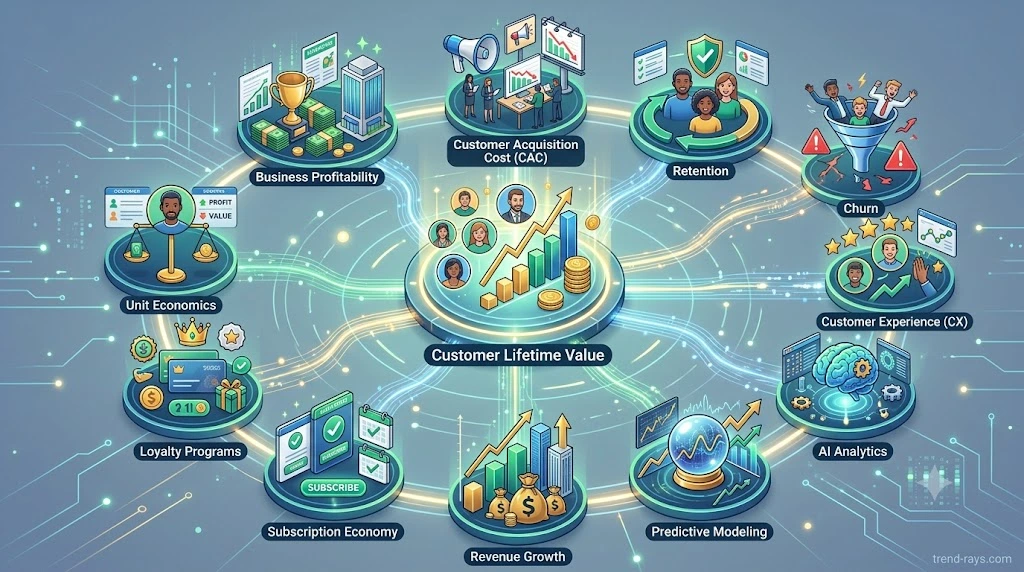
It’s connected to retention, acquisition costs, recurring revenue, churn, customer experience, and long-term business strategy.
As you continue exploring digital marketing, SaaS, ecommerce, mobile applications, and business analytics, you’ll encounter these terms repeatedly.
Understanding how they relate to one another provides a stronger foundation than memorizing individual definitions.
Instead of viewing them as separate metrics, think of them as different ways of understanding the same goal:
Building a business that creates lasting value for both customers and the organization.