
Imagine downloading a mobile game after clicking an advertisement.
A few minutes later, you complete the game’s tutorial and receive an in-game reward.
Behind the scenes, several companies instantly know that you installed the app, opened it for the first time, completed the required action, and qualified for the reward.
How?
The answer is mobile attribution.
Although most smartphone users have never heard the term, mobile attribution is one of the most important technologies powering today’s app economy.
Every day, billions of dollars in advertising budgets depend on it.
Without mobile attribution, businesses would struggle to answer some of the most important questions in digital marketing:
- Which advertisement convinced someone to install an app?
- Which marketing campaign generated the most valuable users?
- Which influencer, website, or reward platform should receive credit for the installation?
- Which advertising channels are profitable?
- Which campaigns are wasting marketing budgets?
For users, mobile attribution usually remains invisible.
You simply click an advertisement, install an app, and continue using it.
For advertisers, however, every installation represents valuable business data.
Knowing where users come from—and whether they become long-term customers—allows companies to invest marketing budgets more effectively.
This is especially important in industries where customer acquisition costs can be substantial.
A mobile game studio, fintech company, food delivery service, shopping platform, or streaming app may spend millions of dollars each month acquiring new users.
Without accurate attribution, those businesses would have little confidence that their advertising investments were generating meaningful results.
Mobile attribution solves this problem by connecting a user’s journey across multiple stages, from the moment they interact with an advertisement to the actions they take after installing an app.
It helps advertisers measure campaign performance, optimize marketing strategies, reduce fraud, and understand which customer acquisition channels produce the greatest long-term value.
It’s also the technology that makes many reward apps possible.
When you complete an offer in a reward app, the platform needs reliable evidence that you actually installed the advertised app, reached the required milestone, or completed the requested action.
Mobile attribution provides that verification.
Without it, advertisers couldn’t confidently pay publishers, reward platforms couldn’t approve rewards, and users would have far less trust in the system.
In other words, mobile attribution acts as the invisible bridge connecting advertisers, app developers, offer walls, reward platforms, analytics providers, and users into a single measurable ecosystem.
Throughout this guide, we’ll explore how mobile attribution works, why businesses depend on it, how attribution platforms such as AppsFlyer, Adjust, Branch, and Singular measure app installs, how privacy changes are reshaping attribution technology, and why understanding attribution helps explain the economics behind today’s mobile app industry.
Whether you’re a curious smartphone user, an aspiring digital marketer, a mobile developer, an affiliate publisher, or someone wondering why a reward offer didn’t track correctly, this guide will provide a clear, practical understanding of one of the most important technologies behind modern mobile advertising.
What Is Mobile Attribution?
Mobile attribution is the process of determining which marketing activity deserves credit when someone installs and uses a mobile app.
In simple terms, it answers one important question:
“How did this user discover and install the app?”
Although the answer sounds straightforward, the technology behind it is surprisingly sophisticated.
A user might see an advertisement on YouTube, click a Facebook ad, install the app from the App Store, open it several hours later, complete a purchase the next day, and continue using the app for months.
From the advertiser’s perspective, understanding that journey is essential.
Without attribution, the company would know that someone installed the app—but it wouldn’t know why.
Did the installation come from a search advertisement?
A social media campaign?
An influencer?
A reward app?
An offer wall?
A referral program?
Or did the user simply discover the app organically?
Mobile attribution connects those events into a measurable customer journey.
It helps advertisers understand which marketing efforts are producing valuable customers and which campaigns are simply consuming advertising budgets without delivering meaningful results.
A Simple Real-World Analogy
Imagine a local restaurant wants to attract more customers.
To promote its business, the restaurant distributes three different discount coupons:
- Blue coupons through a local newspaper.
- Green coupons through a nearby gym.
- Red coupons through a community event.
At the end of the month, hundreds of customers visit the restaurant.
The owner wants to know:
- Which coupon attracted the most customers?
- Which group spent the most money?
- Which promotion should receive a larger budget next month?
Because each coupon has a unique color, the restaurant can easily measure which marketing campaign performed best.
The coupon acts as an identifier.
Mobile attribution works in a very similar way.
Instead of colored coupons, digital advertising campaigns use unique tracking information that allows advertisers to determine where users originated before installing an app.
Now Replace Coupons With Smartphones
Let’s apply the same idea to a mobile app.
Suppose a gaming company launches advertisements on several platforms at the same time.
One campaign appears on YouTube.
Another runs on Instagram.
Another is promoted through a reward app.
A fourth is shared by an influencer.
Thousands of people eventually install the game.
Without attribution, every installation would look identical.
The company would have no reliable way to determine which campaign actually convinced users to install the app.
That would make it almost impossible to improve future marketing decisions.
Mobile attribution solves this problem by connecting the advertisement a user interacted with to the actions they perform after installing the app.
This allows marketers to identify the sources that generate the highest-quality users rather than simply counting installations.
Attribution Goes Beyond the Install
Many people assume attribution only measures app downloads.
In reality, modern attribution platforms track much more than installations.
Depending on the advertiser’s goals, attribution can help measure events such as:
- First app launch
- User registration
- Tutorial completion
- Game level progression
- Subscription purchases
- In-app purchases
- Account verification
- Trial activations
- Shopping orders
- Financial account funding
- Long-term customer retention
Each of these actions provides valuable insight into customer behavior.
For example, two advertising campaigns may generate the same number of app installs.
However, one campaign produces users who uninstall the app after a few minutes, while the other attracts users who continue using the app for several months and make multiple purchases.
Although both campaigns generated installs, only one created meaningful business value.
Attribution helps advertisers identify these differences.
Attribution Is About Measuring Customer Journeys
Rather than viewing each event independently, attribution connects them into a continuous timeline.
A typical journey might look like this:
- A user sees an advertisement.
- The user clicks the advertisement.
- The App Store or Google Play Store opens.
- The user installs the app.
- The app launches for the first time.
- The attribution software records the installation.
- The user creates an account.
- The user completes a purchase.
- The advertiser measures the campaign’s performance.
Instead of analyzing isolated actions, attribution helps businesses understand the complete customer journey from first interaction to long-term engagement.
This broader perspective allows marketers to optimize campaigns based on customer quality rather than simply maximizing download numbers.
Why Attribution Matters to Reward Apps
If you’ve ever completed an offer through a reward app, you’ve already benefited from mobile attribution—even if you didn’t realize it.
Suppose a reward app promises cash for reaching Level 25 in a mobile game.
Several important questions immediately arise:
- Did the user install the correct game?
- Was the installation completed through the correct campaign?
- Was the app installed within the required time?
- Did the user reach Level 25?
- Was the campaign completed legitimately?
Mobile attribution helps answer these questions by recording and verifying the relationship between the advertisement, the installation, and the completed milestones.
Once those conditions are confirmed, the advertiser can confidently approve payment, the reward platform can issue the reward, and the user receives their earnings.
Without reliable attribution, advertisers would struggle to distinguish legitimate campaign completions from fraudulent activity, making reward-based marketing far less practical.
Attribution Isn’t Surveillance
One common misconception is that attribution software “watches everything users do.”
That’s not how modern attribution works.
Its purpose isn’t to monitor every aspect of a person’s digital life.
Instead, attribution focuses on measuring specific interactions related to advertising campaigns and app performance.
What information is collected, how it is processed, and the privacy protections that apply depend on factors such as the platform, applicable laws, user permissions, and the technologies being used.
In recent years, privacy-focused changes introduced by companies like Apple and Google have significantly influenced how attribution systems operate.
We’ll explore those changes—and their impact on advertisers, developers, and users—in a later section of this guide.
Key Takeaways
Mobile attribution is the technology that connects advertising campaigns with app installs and meaningful user actions.
Rather than simply counting downloads, it helps businesses understand where customers came from, how they engage with an app, and which marketing investments generate the greatest long-term value.
For reward apps, attribution provides the verification needed to ensure that completed offers are genuine and that rewards are paid accurately.
Understanding this concept forms the foundation for everything else we’ll discuss throughout this guide.
Why Mobile Attribution Exists
At first glance, mobile attribution might seem like an analytics tool that simply counts app installations.
In reality, it serves a much larger purpose.
Modern businesses don’t invest millions of dollars in advertising because they want more downloads—they invest because they want profitable, long-term customers.
Knowing that an app was installed is only the beginning.
The more important questions are:
- Which advertisement influenced the installation?
- Which campaign produced the customer?
- How much did it cost to acquire that customer?
- Will the customer continue using the app?
- Will they eventually generate enough revenue to justify the advertising investment?
Mobile attribution exists to answer those questions.
Without it, businesses would have very little insight into whether their marketing budgets were producing meaningful results.
The Problem Before Mobile Attribution
Imagine you’re responsible for marketing a new mobile banking app.
You decide to invest $5 million promoting the app across multiple channels over the next three months.
Your campaigns include:
- Google Ads
- Apple Search Ads
- TikTok
- YouTube
- Influencer partnerships
- Reward apps
- Affiliate publishers
At the end of the campaign, your analytics dashboard reports:
500,000 new app installs.
On the surface, that sounds like a success.
But one critical question remains unanswered:
Which marketing channel actually generated those installs?
Did Google Ads drive the highest-value customers?
Were influencer campaigns worth the investment?
Did reward apps deliver engaged users?
Without attribution, every install looks identical.
You know users arrived—but you don’t know what brought them there.
Making future marketing decisions would become little more than educated guesswork.
Marketing Without Attribution Is Like Flying Blind
Consider an airline pilot attempting to fly through thick clouds with no instruments.
The destination may still be reachable, but the journey becomes far more uncertain and risky.
Marketing without attribution works in much the same way.
Companies continue spending money on advertising, but they lose visibility into what’s actually working.
Questions that should have straightforward answers become difficult to solve:
- Which campaign generated the highest-quality users?
- Which advertisements should receive more budget?
- Which marketing channels should be paused?
- Which audience segments convert best?
- Which creatives encourage long-term engagement?
Without reliable measurement, improving campaign performance becomes nearly impossible.
Downloads Don’t Equal Business Success
Many businesses eventually discover that download numbers alone can be misleading.
Imagine two advertising campaigns.
Campaign A
- 100,000 installs
- Most users uninstall the app within 24 hours
- Few purchases
- Minimal engagement
Campaign B
- 40,000 installs
- High daily engagement
- Strong customer retention
- Frequent in-app purchases
- Long-term subscriptions
If success were measured only by installation volume, Campaign A would appear to be the winner.
But from a business perspective, Campaign B may generate significantly greater revenue over time.
Mobile attribution helps companies distinguish between quantity and quality, allowing them to invest in campaigns that produce valuable customers rather than simply large numbers of downloads.
Attribution Makes Advertising Measurable
One of the greatest advantages of digital marketing is measurability.
Unlike traditional advertising—where it can be difficult to determine whether a billboard, television commercial, or magazine advertisement directly influenced a purchase—mobile attribution provides detailed performance insights.
Businesses can analyze metrics such as:
- App installs
- Registration rates
- Subscription conversions
- In-app purchases
- Customer retention
- Revenue generated
- Lifetime Value (LTV)
- Return on Ad Spend (ROAS)
- Customer Acquisition Cost (CAC)
Instead of making assumptions, marketers use data to guide future investment decisions.
Attribution Helps Prevent Advertising Fraud
Not every app install represents a real customer.
Unfortunately, digital advertising has long been targeted by fraudulent activity.
Examples include:
- Automated bots generating fake installs.
- Device farms simulating real users.
- Click spam designed to steal attribution credit.
- Click injection attacks.
- Duplicate installations created to claim multiple rewards.
Without verification systems, advertisers could end up paying for users who never intended to use the app—or who never existed at all.
Mobile attribution platforms help identify suspicious patterns, verify legitimate conversions, and reduce fraudulent claims.
Although no system can eliminate fraud entirely, attribution technology plays a critical role in protecting advertising budgets.
We’ll explore fraud prevention techniques in greater detail later in this guide.
Attribution Helps Businesses Improve Over Time
Advertising isn’t a one-time activity.
Successful companies constantly refine their campaigns based on performance data.
Suppose a gaming company discovers that users acquired through one campaign:
- spend more time playing,
- complete more levels,
- make more in-app purchases,
- and remain active for six months.
Meanwhile, users acquired through another campaign uninstall the game after only a few days.
Attribution makes these differences visible.
Armed with this information, marketers can shift budgets toward higher-performing campaigns, improve audience targeting, and test new creative strategies.
Over time, these incremental improvements can significantly increase marketing efficiency and profitability.
Why Reward Apps Depend on Attribution
Reward apps are built on trust.
Advertisers need confidence that rewards are only paid for genuine campaign completions.
Users expect to receive rewards after meeting the advertised requirements.
Reward platforms need reliable evidence before approving payments.
Mobile attribution provides the common source of truth that connects these stakeholders.
When a user installs an app through a reward offer and completes the required milestone, attribution technology helps verify that the campaign conditions have been satisfied.
Only then can advertisers release payment, reward platforms approve earnings, and users receive their rewards.
Without attribution, disputes would become far more common, fraudulent activity would increase, and advertisers would have far less confidence in incentive-based marketing.
Attribution Powers the Entire Mobile App Economy
Although users rarely notice it, attribution has become one of the foundational technologies behind the modern app ecosystem.
It enables businesses to:
- measure advertising performance,
- understand customer journeys,
- optimize marketing budgets,
- improve user acquisition strategies,
- detect fraudulent activity,
- reward legitimate publishers,
- and make informed business decisions based on measurable data.
From mobile games and shopping apps to fintech platforms, streaming services, and reward apps, countless businesses rely on attribution every day to connect marketing investment with real business outcomes.
Without it, the mobile advertising industry as we know it would be far less efficient, far less transparent, and far more difficult to scale.
Key Takeaways
Mobile attribution exists because businesses need more than installation numbers—they need actionable insights.
By connecting advertising campaigns with customer behavior, attribution allows companies to measure performance, optimize spending, reduce fraud, and identify the marketing strategies that generate lasting value.
For reward apps, it serves as the verification layer that makes advertiser-funded rewards possible, ensuring that completed offers are measured accurately and trusted by everyone involved.
The Complete Mobile Attribution Journey: From Ad Click to Reward Payment
At this point, we’ve discussed what mobile attribution is and why businesses rely on it.
Now let’s follow the complete journey of a single user.
Imagine you’re scrolling through your favorite social media platform and see an advertisement for a mobile game.
The advertisement promises bonus rewards for new players.
You decide to tap the advertisement.
Although the action feels almost instantaneous, dozens of technical processes begin working together behind the scenes.
Understanding each step reveals how mobile attribution connects advertisers, app stores, analytics platforms, reward apps, and users into one measurable system.
Step 1: The Advertisement Is Displayed
Everything begins with a marketing campaign.
An advertiser—perhaps a game developer, shopping platform, fintech company, or streaming service—launches advertisements across multiple channels.
These might include:
- Google Ads
- Apple Search Ads
- TikTok
- YouTube
- Reward Apps
- Offer Walls
- Affiliate Websites
- Influencer Campaigns
Every advertisement is assigned unique campaign information.
This information helps identify exactly where future users originated.
At this stage, no installation has occurred.
The advertiser is simply creating opportunities for potential customers to discover the app.
Step 2: The User Clicks the Advertisement
After viewing the advertisement, the user decides to interact with it.
This click becomes the first measurable event in the attribution process.
Instead of directing the user straight to the App Store or Google Play Store, the click typically passes through a tracking system.
That tracking system records important information such as:
- Campaign ID
- Advertising Network
- Publisher
- Creative ID
- Device Information
- Timestamp
- Country
- Operating System
Think of this as creating a digital receipt.
The receipt doesn’t identify the customer personally—it records how the customer entered the marketing funnel.
Without this step, advertisers would struggle to determine which campaign deserved credit if the user later installed the app.
Step 3: The App Store Opens
After the tracking information is recorded, the user is redirected to the appropriate app store.
Depending on the device, this could be:
- Apple App Store
- Google Play Store
From the user’s perspective, this feels seamless.
The transition often happens in less than a second.
Behind the scenes, however, attribution systems are preparing to determine whether the installation originated from the recorded advertisement.
Step 4: The User Installs the App
The user downloads and installs the application.
Although installation is a significant milestone, attribution doesn’t stop here.
An install alone doesn’t reveal whether the user will become valuable to the advertiser.
Many users install apps out of curiosity and never return.
This is why modern attribution platforms continue monitoring additional events after installation.
Step 5: The User Opens the App for the First Time
The first launch is one of the most important moments in the attribution process.
During this event, the app communicates with its integrated Software Development Kit (SDK) or attribution framework.
The SDK helps record essential information needed to connect the installation with the earlier advertisement.
This communication allows attribution platforms to determine whether the installation matches an eligible marketing campaign.
If a valid match is found, the installation receives attribution credit.
Step 6: Attribution Matching Begins
This is where the “magic” of mobile attribution happens.
The attribution platform compares information collected during the advertisement click with information received when the app launches.
Its objective is simple:
Determine whether this installation originated from a previously recorded advertising interaction.
Depending on the platform and privacy environment, this matching may rely on:
- Advertising identifiers
- Privacy-preserving attribution methods
- Device signals
- Campaign identifiers
- Time windows
- Aggregated reporting
We’ll explore these methods in greater detail later in this guide.
For now, it’s enough to understand that attribution platforms are attempting to answer one question:
“Did this user install the app because of this specific advertisement?”
Step 7: The User Completes Important Events
Modern attribution extends far beyond installations.
Advertisers often define additional events that indicate genuine customer engagement.
Examples include:
- Creating an account
- Completing a tutorial
- Reaching Level 20
- Making an in-app purchase
- Starting a subscription
- Funding a financial account
- Completing identity verification
- Placing a shopping order
Each completed event provides more insight into the quality of the acquired customer.
This allows advertisers to measure long-term value rather than simply counting downloads.
Step 8: Campaign Performance Is Measured
As thousands—or even millions—of users complete similar journeys, attribution platforms begin generating performance reports.
Marketers can evaluate metrics such as:
- Install volume
- Registration rate
- Cost Per Install (CPI)
- Customer Acquisition Cost (CAC)
- Customer Lifetime Value (LTV)
- Return on Ad Spend (ROAS)
- Retention
- Revenue
- Conversion Rate
Instead of guessing which campaigns are successful, businesses rely on measurable data to guide future decisions.
Campaigns producing high-value customers often receive increased budgets, while underperforming campaigns may be paused or redesigned.
Step 9: Reward Verification Takes Place
If the installation originated from a reward platform or offer wall, an additional verification step occurs.
The advertiser confirms that campaign requirements have been satisfied.
Depending on the offer, this may involve verifying:
- Correct application installed
- New user eligibility
- Required game level reached
- Registration completed
- Purchase made
- Time requirements met
Only after these conditions are validated does the campaign become eligible for payment.
This verification helps protect advertisers against invalid claims while ensuring legitimate users receive their rewards.
Step 10: The Reward Is Approved
Once verification is complete, the advertiser notifies the reward platform that the campaign has been successfully completed.
The reward platform then credits the user’s account according to its payment schedule.
From the user’s perspective, the journey ends with a completed reward.
For the advertiser, however, the journey is only beginning.
The business continues monitoring whether the newly acquired customer remains active, generates revenue, and contributes to long-term profitability.
That ongoing relationship ultimately determines whether the original advertising investment was worthwhile.
The Entire Attribution Journey at a Glance
Advertisement
      │
      ▼
User Clicks Ad
      │
      ▼
Tracking Link Records Campaign
      │
      ▼
App Store Opens
      │
      ▼
App Installed
      │
      ▼
First App Launch
      │
      ▼
SDK Sends Attribution Data
      │
      ▼
Attribution Platform Matches Campaign
      │
      ▼
User Completes Required Events
      │
      ▼
Advertiser Verifies Campaign
      │
      ▼
Reward Platform Approves Reward
      │
      ▼
Business Measures Long-Term Customer Value
Why This Journey Matters
Although the process appears highly technical, its purpose is remarkably straightforward.
Mobile attribution helps answer a single business question:
“Which marketing effort successfully acquired this customer?”
Everything else—from campaign optimization and fraud prevention to reward approvals and marketing analytics—depends on answering that question accurately.
Whether you’re installing a game through a reward app, subscribing to a streaming service, opening a digital banking account, or downloading a shopping app, mobile attribution quietly measures the journey behind the scenes.
Without it, advertisers would struggle to evaluate campaign performance, reward platforms couldn’t confidently approve incentives, and businesses would find it far more difficult to invest their marketing budgets efficiently.
Click Attribution Explained: How Advertisers Decide Which Ad Gets Credit
Imagine you’re planning to buy a new smartphone.
Before making your purchase, you might:
- Read a review on a technology website.
- Watch a YouTube comparison video.
- See an Instagram advertisement.
- Search Google for reviews.
- Click an affiliate recommendation.
- Finally visit the manufacturer’s website and place your order.
Now imagine you’re the smartphone manufacturer.
One important question immediately arises:
Which marketing effort convinced you to buy the phone?
Was it the YouTube review?
The Google search?
The Instagram advertisement?
Or the affiliate website?
Each interaction influenced your decision in some way.
Determining which one deserves credit is the purpose of click attribution.
Why Click Attribution Matters
Every year, companies spend billions of dollars advertising mobile apps.
If marketers don’t know which advertisements are actually producing customers, they can’t invest their budgets effectively.
Consider a company promoting a new food delivery app.
Its advertising budget is divided across:
- Google Ads
- Facebook Ads
- TikTok
- YouTube
- Reward Apps
- Influencers
- Affiliate Websites
Thousands of users eventually install the app.
The company now faces an important business question:
Which advertising channel should receive credit for each installation?
Without a consistent attribution model, every marketing platform could claim responsibility for the same customer.
That would make campaign reporting unreliable and budgeting decisions much more difficult.
Click attribution provides a structured method for assigning credit.
The Customer Journey Is Rarely Simple
Many people assume users click one advertisement and immediately install an app.
In reality, customer journeys are often much more complex.
Imagine this sequence:
Monday
A user sees a YouTube advertisement but doesn’t install the app.
Tuesday
The same user clicks a Google Search advertisement.
Still no installation.
Wednesday
The user discovers the app through a reward platform.
They install the app and begin using it.
Now the advertiser must decide:
Who deserves the credit?
The YouTube campaign?
Google Search?
Or the reward platform?
Different attribution models answer this question in different ways.
Last-Click Attribution
Last-click attribution is one of the most widely used attribution models in mobile marketing.
Under this model, the final eligible advertisement a user clicks before installing the app receives full credit for the conversion.
Using the previous example:
- Monday: YouTube
- Tuesday: Google Search
- Wednesday: Reward App
- Installation occurs immediately afterward.
The reward app receives 100% of the attribution credit because it generated the final qualifying click before the install.
Why Businesses Use Last-Click Attribution
It is:
- Simple to implement.
- Easy to understand.
- Consistent across large campaigns.
- Practical for performance marketing.
For reward apps and affiliate campaigns, last-click attribution is particularly common because advertisers want to reward the marketing partner that directly generated the installation.
However, it also has limitations.
Earlier interactions that helped influence the customer’s decision receive no credit.
First-Click Attribution
First-click attribution takes the opposite approach.
Instead of rewarding the final interaction, it assigns full credit to the first marketing touchpoint that introduced the customer to the app.
Using the same journey:
- Monday: YouTube
- Tuesday: Google Search
- Wednesday: Reward App
- Installation
The YouTube advertisement receives full credit because it was the user’s first recorded interaction.
This model emphasizes awareness rather than conversion.
Businesses often use it when evaluating which marketing channels are most effective at introducing new customers to their brand.
Multi-Touch Attribution
Customer decisions are rarely influenced by a single advertisement.
Modern buyers often interact with multiple campaigns before making a decision.
Multi-touch attribution attempts to recognize that reality by distributing credit across several interactions instead of assigning everything to just one.
For example:
- YouTube may receive 30%.
- Google Search receives 30%.
- Reward App receives 40%.
Although the exact percentages vary depending on the attribution model, the principle remains the same:
Multiple marketing interactions contributed to the final conversion.
This approach provides a more complete view of the customer journey, although it is also more complex to implement and interpret.
View-Through Attribution
Not every customer clicks an advertisement.
Sometimes people simply see an advertisement, remember the brand, and later install the app without clicking anything.
This is known as a view-through conversion.
For example:
A user watches a mobile game advertisement while browsing social media.
They don’t interact with it.
Later that evening, they search for the game’s name and install it.
Some attribution systems allow advertisers to measure whether simply viewing the advertisement influenced the eventual installation.
Because this type of attribution is less direct than click-based attribution, advertisers often apply stricter reporting rules and shorter attribution windows.
Why Different Attribution Models Produce Different Results
Imagine a company spends $10 million promoting its mobile app.
Depending on the attribution model used, the same installation could be credited to completely different marketing channels.
That means:
- Google Ads may appear highly successful under one model.
- Reward apps may perform better under another.
- Social media campaigns may receive more credit in multi-touch reporting.
None of the models are universally “correct.”
Each answers a different business question.
Some focus on awareness.
Others prioritize conversion.
Others attempt to measure the entire customer journey.
The most appropriate choice depends on the advertiser’s objectives and reporting strategy.
Which Attribution Model Do Reward Apps Usually Use?
Reward platforms typically rely on attribution methods that clearly identify whether a specific offer generated a qualifying installation.
In many campaigns, this means the final eligible interaction before the install receives credit.
This approach reduces ambiguity and helps advertisers verify that rewards are issued only when campaign requirements are satisfied.
However, the exact implementation depends on the advertiser, the attribution platform, campaign rules, privacy requirements, and the technologies being used.
Attribution Models Continue to Evolve
The mobile advertising industry is changing rapidly.
Privacy regulations, operating system updates, and new measurement technologies are encouraging advertisers to move beyond traditional attribution methods.
Today, many businesses combine multiple approaches, including:
- Click attribution
- View-through attribution
- Incrementality testing
- Marketing Mix Modeling (MMM)
- Privacy-preserving measurement
- AI-assisted attribution analysis
Rather than relying on a single measurement technique, organizations increasingly use several complementary methods to understand campaign performance more accurately.
Key Takeaways
Click attribution is the process of deciding which marketing interaction deserves credit when a user installs an app or completes a valuable action.
Different attribution models—such as last-click, first-click, multi-touch, and view-through attribution—offer different perspectives on the customer journey.
Understanding these models helps explain why advertisers measure campaigns differently, why marketing reports sometimes disagree, and how reward platforms determine which advertising partners should receive credit for successful conversions.
In the next section, we’ll explore how attribution platforms connect app installations with specific devices and campaigns while adapting to today’s privacy-focused mobile ecosystem.
Install Attribution Explained: How Platforms Connect an App Install to an Advertisement
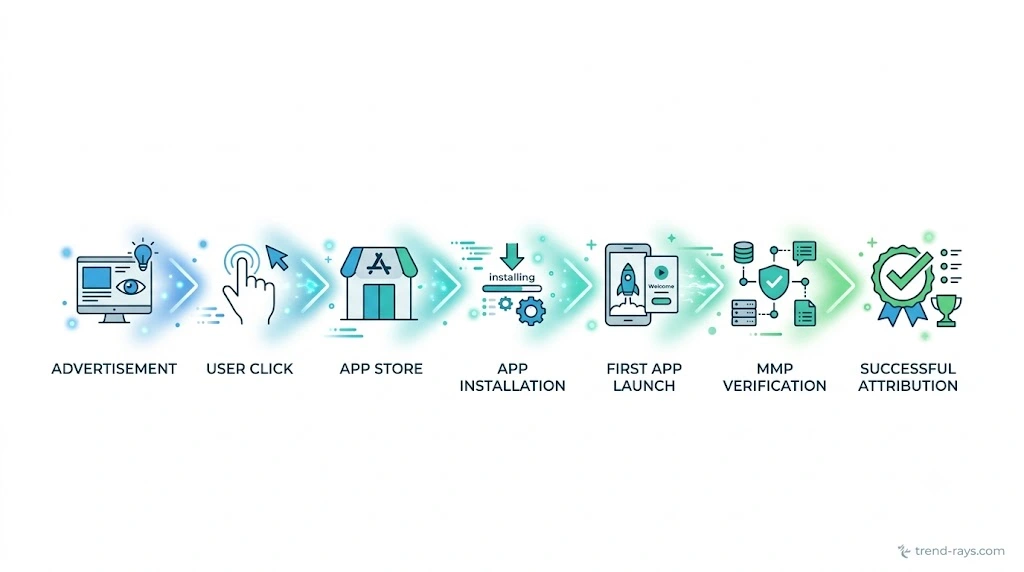
Click attribution answers one important question:
Which advertisement should receive credit?
Install attribution answers the next one:
How does the system know that the person who clicked the advertisement is the same person who later installed the app?
This is where mobile attribution becomes much more technical.
An advertiser might receive millions of advertisement clicks every day.
Thousands—or even millions—of people may install the app during the same period.
The attribution platform’s job is to determine which installation belongs to which advertisement while respecting modern privacy requirements.
Without accurate install attribution, advertisers could pay the wrong publishers, reward apps could approve incorrect rewards, and marketing reports would become unreliable.
The Challenge of Matching Clicks to Installs
Imagine an advertiser launches a campaign promoting a fitness app.
Within one hour:
- 500,000 people see the advertisement.
- 35,000 users click it.
- 12,000 install the app.
- 6,500 create an account.
- 2,000 purchase a premium subscription.
Those numbers are useful—but they don’t explain who came from where.
Which installs came from:
- Google Ads?
- TikTok?
- A reward app?
- A YouTube creator?
- An affiliate website?
The attribution platform has to connect every valid install with the correct advertising interaction.
This process is called install matching.
Install Attribution Is Like Claiming a Checked Bag at an Airport
A useful way to understand install attribution is to imagine checking luggage before boarding a flight.
When you hand over your suitcase, the airline attaches a baggage tag containing a unique identifier.
Hours later, after landing in another city, the baggage system uses that identifier to return the correct suitcase to its owner.
Without the baggage tag, thousands of identical suitcases would be almost impossible to match accurately.
Install attribution works in a similar way.
When a user clicks an advertisement, the attribution system records information about that interaction.
Later, when the app launches for the first time, the platform compares the new information with previously recorded click data.
If enough evidence matches, the installation receives attribution credit.
The goal isn’t simply to record that an install happened.
The goal is to determine which marketing campaign influenced that install.
Deterministic Attribution
The most accurate form of install attribution is known as deterministic attribution.
Deterministic matching relies on identifiers or signals that allow the attribution platform to confidently associate an app install with a previous advertising interaction.
When supported by the platform, permissions, and privacy settings, deterministic matching can provide a high level of confidence because it compares directly related information rather than making statistical assumptions.
From an advertiser’s perspective, this is the preferred approach because it reduces uncertainty and improves reporting accuracy.
However, modern privacy initiatives have reduced the availability of certain identifiers that attribution systems historically relied upon.
As a result, deterministic attribution is no longer possible in every situation.
Probabilistic Attribution
When deterministic matching isn’t available, attribution platforms may rely on probabilistic attribution.
Instead of matching a single unique identifier, probabilistic attribution evaluates multiple non-personal signals to estimate whether an advertisement interaction and an app installation are likely connected.
These signals can include factors such as:
- Device characteristics
- Operating system
- App version
- Country or region
- Time of the advertisement click
- Time of installation
- Campaign information
- Network characteristics
Rather than producing absolute certainty, probabilistic attribution estimates the likelihood that two events belong to the same user journey.
Because this approach involves statistical analysis rather than direct matching, privacy regulations and platform policies increasingly influence when and how it can be used.
Why Timing Matters
One of the most important factors in install attribution is time.
Suppose a user clicks an advertisement today but doesn’t install the app until six months later.
Should that original advertisement still receive credit?
Most advertisers would probably say no.
For this reason, attribution platforms use attribution windows.
An attribution window defines how long a click remains eligible to receive credit for a future installation.
For example:
- A campaign might use a 24-hour window.
- Another may allow seven days.
- Some campaigns extend the window even further, depending on their objectives.
If the install occurs after the attribution window expires, the earlier advertisement typically no longer qualifies for attribution.
We’ll examine attribution windows in more detail later in this guide.
First Launch Is More Important Than Installation
Many readers assume attribution happens the moment an app finishes downloading.
In practice, the first app launch is often the more important event.
Why?
Because this is usually when the app begins communicating with its integrated attribution software.
During the first launch, the app can report campaign-related events, initialize analytics, and begin measuring user activity according to the advertiser’s implementation.
Without the first launch, the attribution platform may not receive enough information to complete the matching process.
This is why some reward offers require users to open the app after installing it rather than simply downloading it.
Why Reward Apps Depend on Accurate Install Attribution
Consider a reward offer that says:
“Install the app and reach Level 15 to earn a reward.”
Several important questions must be answered before payment can be approved:
- Was the correct app installed?
- Was it installed through the correct campaign?
- Was the user eligible?
- Was it a new installation?
- Was the required milestone completed?
Install attribution provides the foundation for answering those questions.
Without accurate attribution, advertisers could accidentally pay for duplicate installs, publishers could receive incorrect commission, and users might experience reward disputes.
Reliable install matching helps ensure that every participant in the campaign receives appropriate credit.
Privacy Has Changed How Install Attribution Works
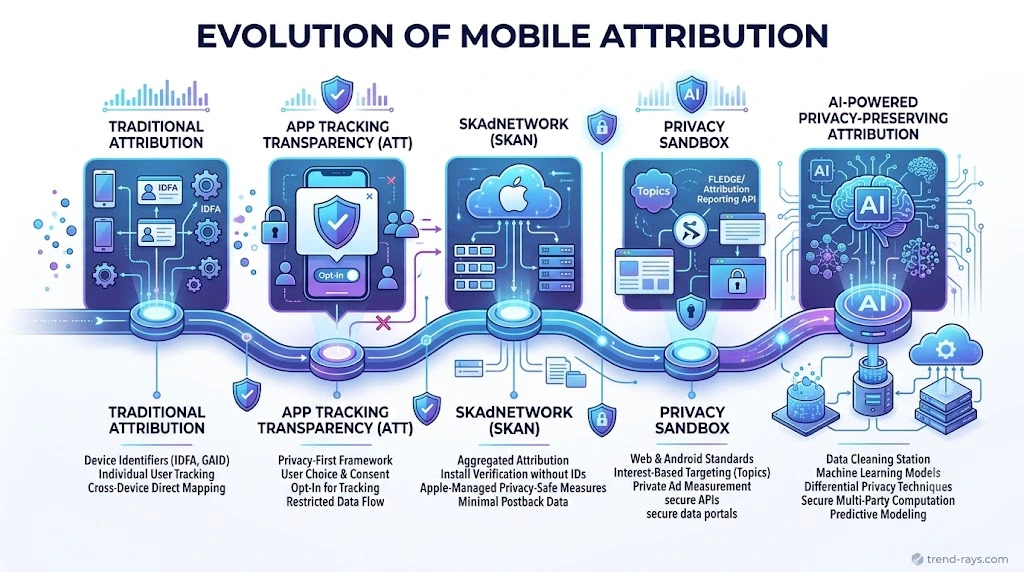
Over the past several years, mobile platforms have introduced significant privacy enhancements that affect attribution technology.
Companies such as Apple and Google have developed new privacy-focused frameworks that reduce reliance on traditional tracking methods while still allowing advertisers to measure campaign performance in more privacy-conscious ways.
As a result, today’s attribution platforms increasingly combine multiple measurement techniques rather than depending on a single method.
The objective remains the same:
Measure advertising effectiveness while better protecting user privacy.
We’ll explore these privacy changes—including Apple’s App Tracking Transparency (ATT), SKAdNetwork, and Android’s Privacy Sandbox—in dedicated sections later in this guide.
Matching Isn’t Perfect
One common misconception is that attribution systems always know exactly where every installation came from.
In reality, attribution involves balancing measurement accuracy with privacy requirements.
Some installations can be matched with a high degree of confidence.
Others may remain unattributed because:
- The attribution window expired.
- Privacy settings limited available signals.
- Required campaign information was unavailable.
- The install occurred outside campaign rules.
- The user discovered the app organically rather than through advertising.
This is one reason why advertisers evaluate attribution reports alongside other measurement techniques rather than relying on a single source of truth.
Key Takeaways
Install attribution is the process of connecting an app installation with the marketing interaction that influenced it.
To accomplish this, attribution platforms compare information recorded during the advertisement click with information available when the app launches, using methods that align with current privacy requirements.
Accurate install attribution enables advertisers to measure campaign performance, reward legitimate publishers, optimize marketing budgets, and ensure that users who complete reward offers receive the credit they deserve.
Understanding install attribution prepares us for the next major component of the mobile advertising ecosystem: the specialized platforms that perform this measurement every day.
In the next section, we’ll examine Mobile Measurement Partners (MMPs)—the companies behind many of the attribution systems used by app developers, advertisers, and reward platforms worldwide.
Mobile Measurement Partners (MMPs): The Technology Behind Mobile Attribution
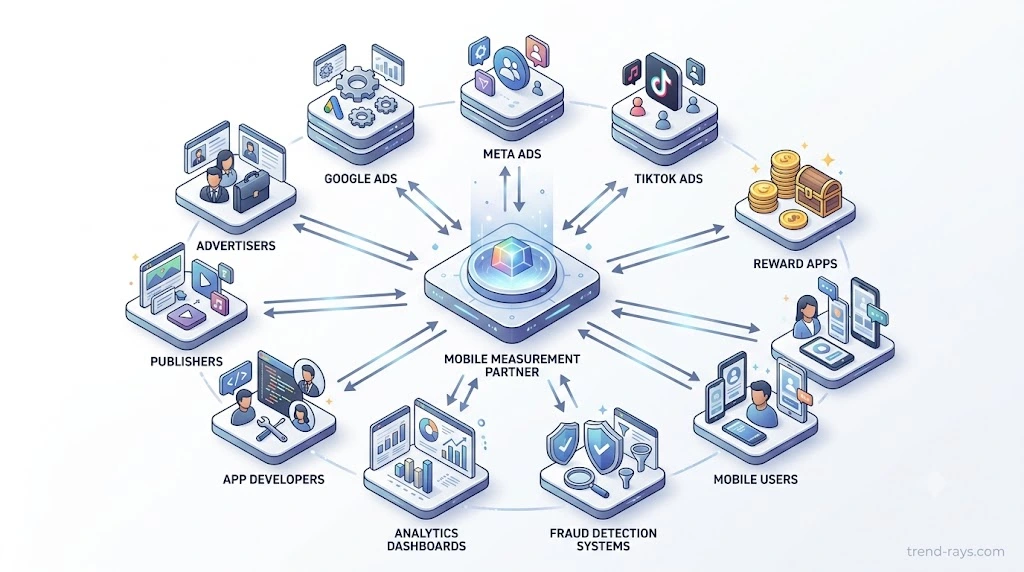
By now, we’ve seen that mobile attribution involves far more than simply counting app installs.
Advertisers need to measure campaigns across multiple advertising networks, publishers need accurate conversion reporting, developers need reliable analytics, and reward platforms need trustworthy verification before approving payments.
Managing all of these responsibilities internally would be extremely complex.
This is where Mobile Measurement Partners, commonly known as MMPs, become essential.
An MMP is a specialized software platform that helps app developers and advertisers measure, verify, and analyze how users discover, install, and engage with mobile applications.
Rather than relying on reports from individual advertising platforms, businesses use MMPs as an independent measurement layer that provides consistent attribution across multiple marketing channels.
Think of an MMP as an impartial referee.
Every advertising network naturally wants to demonstrate that its campaigns perform well.
Instead of accepting those reports independently, businesses use an MMP to evaluate campaign performance using a standardized measurement system.
This allows advertisers to compare results more accurately and make better marketing decisions.
Why Do Businesses Need an MMP?
Imagine a global mobile game launching a major advertising campaign.
The marketing team promotes the game through:
- Google Ads
- Apple Search Ads
- Meta Ads
- TikTok Ads
- YouTube
- Influencer campaigns
- Affiliate publishers
- Reward apps
- Offer walls
Each platform generates its own reports.
Google shows one number of conversions.
TikTok reports another.
Meta reports something different.
Affiliate platforms claim additional installs.
Without a centralized measurement platform, comparing these reports would quickly become confusing.
Questions arise such as:
- Which platform is reporting the most accurate data?
- Did two advertising networks claim credit for the same install?
- Which campaigns produced customers who actually generated revenue?
- Which publisher deserves commission?
- Which reward platform should receive payment?
An MMP helps answer these questions by collecting attribution data from multiple sources and applying consistent measurement rules.
Instead of relying on isolated reports, advertisers receive a unified view of campaign performance.
What Does an MMP Actually Do?
Although different platforms offer different capabilities, most Mobile Measurement Partners perform several core functions.
Attribution
The primary responsibility of an MMP is determining which advertisement or marketing channel deserves credit for an installation or conversion.
This forms the foundation of campaign measurement.
Campaign Analytics
Beyond attribution, MMPs provide detailed reporting on campaign performance.
Businesses can evaluate:
- App installs
- Registrations
- Purchases
- Revenue
- Customer retention
- Lifetime Value (LTV)
- Return on Ad Spend (ROAS)
- Customer Acquisition Cost (CAC)
These insights help marketers understand which campaigns produce the highest-value users rather than simply the highest number of downloads.
Fraud Detection
Digital advertising attracts fraudulent activity because advertisers invest billions of dollars every year.
Many MMPs include sophisticated fraud detection systems that help identify suspicious behavior such as:
- Fake installs
- Click spam
- Click injection
- Device farms
- Automated bots
- Emulator traffic
- Duplicate attribution claims
Although no fraud detection system is perfect, these tools help reduce invalid advertising spend and improve campaign integrity.
We’ll explore fraud prevention techniques in a dedicated section later in this guide.
Deep Linking
Many MMPs also provide deep linking capabilities.
Instead of directing every user to the same destination, deep links can send users to a specific screen within an app.
For example:
A shopping app advertisement promoting running shoes can open directly to the running shoe category instead of the app’s home screen.
This creates a smoother user experience and often improves conversion rates.
We’ll examine deep linking in detail later in this article.
Marketing Analytics
Modern MMPs go beyond installation tracking.
They help businesses understand the complete customer journey by measuring post-install events such as:
- Tutorial completion
- Purchases
- Subscriptions
- Account creation
- Retention
- Revenue generation
- Lifetime customer value
This allows advertisers to optimize campaigns based on customer quality instead of installation volume alone.
Popular Mobile Measurement Partners
Several companies have become industry leaders in mobile attribution and measurement.
Each platform offers its own features, integrations, and enterprise capabilities, but they all aim to solve the same core challenge: measuring mobile marketing performance accurately.
Some of the best-known Mobile Measurement Partners include:
AppsFlyer
One of the most widely adopted attribution platforms, AppsFlyer provides mobile attribution, campaign analytics, fraud prevention, privacy-focused measurement, deep linking, and marketing intelligence for businesses of all sizes.
It is commonly used by gaming companies, ecommerce brands, fintech apps, travel platforms, and enterprise advertisers.
Adjust
Adjust focuses on mobile attribution, analytics, audience measurement, and fraud prevention.
It serves many global brands and emphasizes privacy-conscious measurement while helping marketers optimize acquisition campaigns across multiple advertising channels.
Branch
Branch is particularly well known for its deep linking technology.
In addition to attribution, it enables businesses to create seamless user journeys that move users from advertisements, emails, websites, or social media directly into specific locations within a mobile application.
Singular
Singular combines attribution with marketing analytics, cost aggregation, reporting, and campaign optimization.
Many organizations use it to consolidate advertising data from multiple networks into a single performance dashboard.
Kochava
Kochava provides attribution, analytics, audience measurement, campaign optimization, and fraud detection solutions for enterprise advertisers operating across numerous digital marketing channels.
Do Small App Developers Need an MMP?
Not necessarily.
A simple mobile application with limited advertising activity may initially rely on basic analytics provided by app stores or advertising platforms.
However, as marketing campaigns become more sophisticated—and budgets increase—accurate attribution becomes increasingly valuable.
Businesses spending substantial amounts on customer acquisition often benefit from independent measurement because it helps them optimize budgets, compare advertising channels fairly, and make data-driven decisions.
MMPs Are Becoming More Important as Privacy Evolves
The mobile advertising landscape has changed significantly in recent years.
Privacy initiatives introduced by Apple and Google have reduced access to some traditional tracking methods.
As a result, Mobile Measurement Partners have continued evolving to support privacy-focused measurement frameworks while still providing advertisers with meaningful campaign insights.
Modern MMPs now invest heavily in:
- Privacy-preserving attribution
- Aggregated reporting
- Predictive analytics
- Machine learning
- Fraud detection
- AI-assisted campaign optimization
- Server-side measurement
Rather than simply tracking installs, today’s MMPs help businesses navigate an increasingly privacy-conscious mobile ecosystem.
Why Reward Apps Depend on MMPs
Reward apps promise users compensation for completing specific offers.
To maintain trust, those rewards must be verified accurately.
When a user installs an advertised app and reaches a required milestone, the advertiser needs reliable confirmation before approving payment.
An MMP helps provide that measurement layer by connecting advertising interactions with verified app events according to campaign rules.
Although the exact implementation varies between advertisers and platforms, Mobile Measurement Partners play a critical role in ensuring that reward campaigns are measured consistently and transparently.
Without reliable attribution infrastructure, reward apps would struggle to verify legitimate completions, advertisers would have less confidence in incentive-based marketing, and users would encounter more disputes over pending or rejected rewards.
Key Takeaways
Mobile Measurement Partners are specialized technology platforms that sit at the center of the mobile advertising ecosystem.
They help advertisers measure campaign performance, attribute app installs, analyze customer behavior, detect fraud, support deep linking, and evaluate long-term marketing success across multiple advertising channels.
For businesses investing in mobile user acquisition, MMPs provide an independent and standardized measurement system that transforms millions of advertising interactions into actionable business insights.
In the next section, we’ll examine the different attribution methods used by these platforms—including deterministic matching, probabilistic attribution, device fingerprinting, and modern privacy-preserving measurement techniques—to understand how attribution works under today’s evolving privacy landscape.
Attribution Methods Explained: How Platforms Match Users to Advertising Campaigns
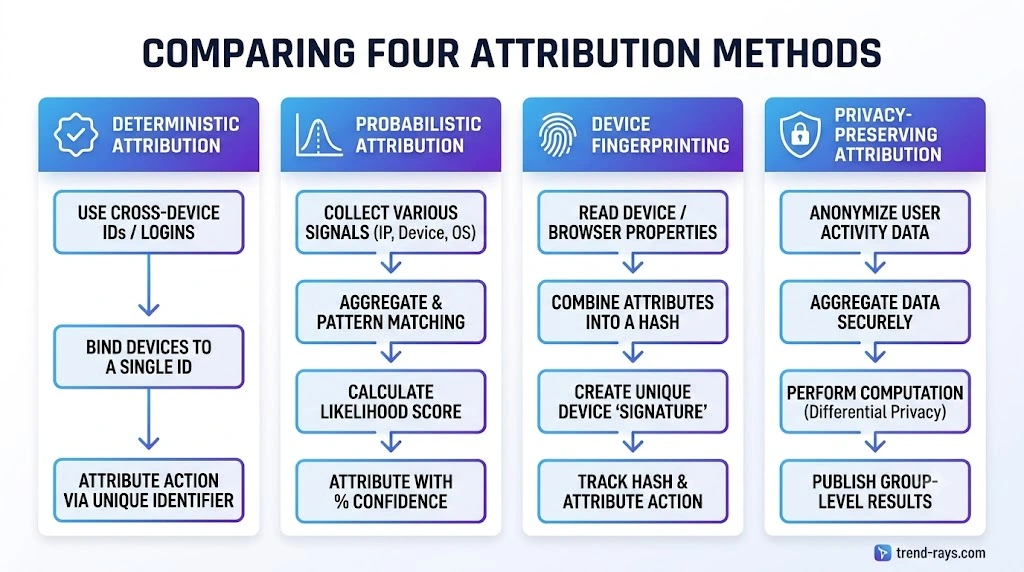
By now, we’ve learned that Mobile Measurement Partners (MMPs) help determine which advertisements deserve credit for app installs and conversions.
But an important question still remains:
How do these platforms actually connect a user who clicked an advertisement with the same user who later installed the app?
The answer depends on the attribution method being used.
Over the years, the mobile advertising industry has developed several different approaches for matching advertising interactions with app installations.
Some methods provide extremely high confidence, while others estimate the probability that two events belong to the same user journey.
Recent privacy changes introduced by Apple and Google have also transformed how these methods operate, encouraging the industry to adopt more privacy-conscious measurement techniques.
Understanding these attribution methods helps explain why some campaigns track perfectly, why others experience limitations, and why the future of mobile attribution looks very different from the past.
1. Deterministic Attribution
Deterministic attribution is generally considered the most reliable method because it attempts to match advertising interactions using information that allows a high degree of confidence, subject to platform permissions and privacy controls.
Instead of making statistical estimates, deterministic attribution compares matching information recorded during the advertising journey.
When a valid match is found, the attribution platform can confidently associate the installation with the advertising campaign.
Think of It Like a Boarding Pass
Imagine boarding an airplane.
Your boarding pass contains a unique barcode.
When you board the aircraft, the airline scans that barcode to confirm your identity and your assigned flight.
There is very little uncertainty because the information matches directly.
Deterministic attribution works in a similar way.
Rather than estimating who someone might be, it attempts to confirm that the app installation belongs to the same advertising interaction using available matching signals.
Because of its accuracy, advertisers generally prefer deterministic attribution whenever it is available.
Advantages
- High confidence measurement
- More accurate campaign reporting
- Better fraud detection
- Reliable conversion attribution
- Improved optimization decisions
Limitations
Modern privacy protections mean deterministic attribution is not always possible.
Access to some identifiers now depends on operating system policies, user permissions, and platform-specific privacy frameworks.
As a result, advertisers increasingly combine deterministic measurement with other attribution techniques.
2. Probabilistic Attribution
When deterministic matching isn’t available, attribution platforms may use probabilistic attribution.
Rather than looking for a direct match, probabilistic attribution evaluates multiple signals to estimate whether two events likely belong to the same user journey.
Instead of asking:
“Can we prove these events belong together?”
It asks:
“How likely is it that these events belong together?”
The platform analyzes available information—such as timing, campaign context, and device characteristics—to calculate the likelihood of a valid match.
Because this approach relies on probability rather than certainty, it naturally involves more uncertainty than deterministic attribution.
Everyday Example
Imagine arriving at a conference where everyone wears similar business attire.
You recognize someone from across the room.
You aren’t completely certain it’s the same person, but based on their appearance, voice, location, and previous interactions, you’re reasonably confident.
That’s essentially how probabilistic attribution works.
It combines multiple clues instead of relying on one definitive identifier.
Advantages
- Helps measure campaigns when direct matching isn’t possible
- Supports broader campaign analysis
- Adapts to evolving privacy environments
- Improves reporting coverage
Limitations
- Lower confidence than deterministic attribution
- Greater dependence on statistical modeling
- Increasingly influenced by platform privacy policies
3. Device Fingerprinting
Historically, some attribution systems also used a technique known as device fingerprinting.
Instead of relying on a single identifier, device fingerprinting attempts to distinguish devices using combinations of technical characteristics.
Examples of characteristics may include:
- Device model
- Operating system version
- Screen resolution
- Language settings
- Time zone
- Network characteristics
- Browser or app configuration
Individually, these characteristics are not unique.
Combined, however, they can sometimes create a distinctive profile.
Because fingerprinting raises important privacy considerations, platform providers and regulators have increasingly limited or discouraged its use in many contexts.
Today, advertisers generally focus on privacy-preserving attribution methods rather than depending heavily on fingerprinting.
4. Privacy-Preserving Attribution
The mobile advertising industry has undergone a major transformation.
Instead of collecting increasingly detailed user information, modern attribution systems are moving toward approaches that measure campaign performance while reducing the amount of user-specific data involved.
Privacy-preserving attribution aims to balance two objectives:
- Give advertisers meaningful campaign insights.
- Better protect user privacy.
Rather than focusing on identifying every individual user, these systems often emphasize aggregated reporting, delayed reporting, and campaign-level measurement.
This allows advertisers to evaluate marketing performance without relying on the same tracking techniques that were common a decade ago.
5. Server-to-Server Attribution
As privacy requirements continue evolving, many businesses are adopting server-to-server attribution.
Instead of relying entirely on information collected from the user’s device, parts of the attribution process occur between secure servers operated by trusted platforms.
This approach can improve:
- Reliability
- Data consistency
- Security
- Measurement resilience
Server-side communication has become increasingly important for enterprise advertisers seeking long-term measurement solutions in a privacy-first ecosystem.
No Single Method Solves Every Problem
A common misconception is that attribution platforms choose one method and use it forever.
In reality, modern Mobile Measurement Partners combine multiple techniques depending on:
- Operating system
- Device type
- Privacy permissions
- Campaign configuration
- Platform capabilities
- Regulatory requirements
The objective is always the same:
Measure advertising effectiveness as accurately as possible while respecting current privacy standards.
As technology evolves, attribution methods continue adapting alongside changes introduced by operating systems, regulators, and advertising platforms.
Why Attribution Methods Matter for Reward Apps
For reward platforms, accurate attribution is essential.
Suppose a user installs a mobile game through a reward offer.
Before approving payment, the advertiser needs confidence that:
- The installation originated from the correct campaign.
- The user met the campaign requirements.
- The conversion was legitimate.
- The reward wasn’t generated through fraudulent activity.
Attribution methods help provide that confidence.
The more accurately campaigns can be measured, the more confidently advertisers can approve rewards and optimize future marketing investments.
Looking Ahead: Attribution in a Privacy-First World
The future of attribution isn’t about tracking more information.
It’s about measuring campaign effectiveness more intelligently.
Artificial intelligence, aggregated reporting, predictive analytics, privacy-preserving APIs, and server-side technologies are gradually reshaping how mobile attribution works.
Advertisers are moving away from relying on a single measurement technique and toward combining multiple complementary approaches that provide meaningful business insights while respecting user privacy.
This evolution will continue as mobile operating systems, regulations, and advertising technologies develop over the coming years.
Key Takeaways
Mobile attribution is not powered by a single tracking technique.
Instead, it combines several attribution methods—including deterministic matching, probabilistic attribution, privacy-preserving measurement, and server-side technologies—to connect advertising campaigns with app installs and user actions.
Each method has its own strengths, limitations, and use cases.
Understanding these approaches helps explain why attribution systems behave differently across platforms, why privacy changes have transformed the industry, and why modern measurement is increasingly focused on balancing marketing insights with user privacy.
In the next section, we’ll explore Deep Linking—the technology that not only brings users into an app but can also take them directly to a specific screen or offer, creating a smoother user experience and improving conversion rates.
Deep Linking Explained: How Apps Open the Right Screen Instead of the Home Page
Imagine you receive a text message from your favorite shopping app announcing a 50% discount on running shoes.
You tap the link expecting to see the discounted products.
Instead, the app simply opens its home page.
Now you have to search for the shoes yourself.
Many users would give up before finding the offer.
Now imagine a different experience.
You tap the same link and the app opens directly to the exact running shoe collection featured in the promotion.
The discount is already visible, the products are ready to browse, and purchasing takes only a few taps.
That smoother experience is made possible by deep linking.
Deep linking allows users to be taken directly to a specific location inside a mobile app instead of always landing on the app’s home screen.
Although it may seem like a small improvement, deep linking plays a major role in user experience, marketing performance, and conversion rates.
It is also an important companion technology to mobile attribution.
What Is a Deep Link?
A deep link is a special type of link that opens a particular page, feature, or piece of content within an app.
Instead of launching the app’s default home screen, it guides users directly to the destination the advertiser wants them to see.
Examples include:
- A specific product page in an ecommerce app.
- A hotel listing in a travel app.
- A movie inside a streaming platform.
- A promotional offer in a shopping app.
- A game event or tournament.
- A bank account signup page.
- A referral rewards screen.
The objective is simple:
Reduce unnecessary steps between the advertisement and the desired action.
The fewer barriers users encounter, the more likely they are to complete the intended action.
Why Deep Linking Matters
Imagine an advertiser spends thousands of dollars promoting a special offer.
If every user lands on the app’s home page after installing it, many may become confused or lose interest before finding the advertised promotion.
This creates friction.
Deep linking removes that friction.
Instead of asking users to search manually, the app immediately presents the relevant content.
For businesses, this often leads to:
- Better user experience
- Higher engagement
- Faster conversions
- Improved customer satisfaction
- More efficient advertising campaigns
Even small improvements in conversion rates can have a significant impact when campaigns involve millions of users.
Types of Deep Links
Although the term “deep link” is often used broadly, there are several different types.
Understanding these differences helps explain why advertisers and Mobile Measurement Partners use different linking strategies.
Standard Deep Links
A standard deep link opens a specific location inside an app only if the app is already installed.
For example:
A user receives a promotional link for a new playlist in a music streaming app.
If the app is already installed, tapping the link opens the playlist immediately.
If the app is not installed, the link may not work as intended or may direct the user elsewhere, depending on the implementation.
Deferred Deep Links
Deferred deep links solve one of the biggest challenges in mobile marketing.
Imagine a user clicks an advertisement for a travel app but hasn’t installed the app yet.
Instead of losing the destination information, a deferred deep link preserves the intended experience.
The journey typically looks like this:
- The user taps the advertisement.
- They are redirected to the App Store or Google Play Store.
- The app is installed.
- The user opens the app for the first time.
- Instead of showing the home screen, the app opens directly to the hotel, destination, or promotion featured in the original advertisement.
From the user’s perspective, the transition feels seamless.
Behind the scenes, the attribution platform and deep linking technology work together to recreate the intended destination after installation.
Contextual Deep Links
Some modern deep links can also carry additional context.
For example, the app may know that the user arrived through:
- A summer sale campaign.
- A referral invitation.
- A reward app.
- An influencer promotion.
- A loyalty program.
- A regional marketing campaign.
This information helps personalize the user experience while giving marketers better insight into campaign performance.
How Deep Linking Works with Mobile Attribution
Deep linking and attribution solve different problems—but they often work together.
Attribution answers:
Which advertisement brought the user to the app?
Deep linking answers:
Where inside the app should the user go?
Consider this example.
A user clicks a reward offer for a mobile game that requires reaching Level 10.
The attribution platform records the advertising interaction.
The user installs the game.
When they open it for the first time, the deep link takes them directly to the introductory event associated with the campaign.
Meanwhile, the attribution platform continues measuring installs, milestones, and campaign performance.
Together, these technologies create a smoother experience for both users and advertisers.
Why Reward Apps Benefit from Deep Linking
Reward platforms often promote thousands of different campaigns.
Each campaign may involve:
- A different app.
- A different promotional offer.
- Different onboarding instructions.
- Different milestones.
Deep linking helps users reach the correct starting point more efficiently.
Instead of searching through menus, users can be directed toward:
- Tutorial screens.
- Registration pages.
- Bonus events.
- Referral programs.
- Limited-time promotions.
Reducing unnecessary navigation not only improves user experience but can also increase campaign completion rates.
Deep Linking in Everyday Apps
Even if you’ve never heard the term before, you’ve probably used deep links many times.
Examples include:
- Opening a product directly from an online advertisement.
- Viewing a specific restaurant in a food delivery app.
- Opening a shared playlist in a music app.
- Joining a meeting through a calendar invitation.
- Opening a friend’s profile from a social media notification.
- Accessing a limited-time promotion in a shopping app.
These experiences feel natural because deep linking quietly handles the navigation behind the scenes.
Common Challenges
Although deep linking improves user experience, implementation isn’t always straightforward.
Developers may need to consider:
- Whether the app is already installed.
- Different operating systems.
- App version compatibility.
- Campaign configuration.
- Privacy requirements.
- Expired promotional links.
- User permissions.
Modern Mobile Measurement Partners provide tools that help developers manage many of these challenges while integrating deep linking with attribution reporting.
The Future of Deep Linking
As mobile experiences become increasingly personalized, deep linking continues evolving.
Future developments are likely to focus on:
- AI-powered personalization.
- Cross-device experiences.
- Better privacy protections.
- Improved onboarding journeys.
- Smarter campaign routing.
- Context-aware recommendations.
Rather than simply opening a page, tomorrow’s deep links may dynamically adapt to each user’s preferences and campaign context while respecting modern privacy standards.
Key Takeaways
Deep linking allows users to open a specific location within an app instead of always landing on the home screen.
When combined with mobile attribution, it creates a smoother customer journey by connecting advertising campaigns with personalized in-app experiences.
For advertisers, deep linking can improve engagement and conversion rates.
For reward apps, it helps users reach the correct offers and onboarding flows more efficiently.
Together, attribution and deep linking form two essential technologies behind today’s mobile advertising ecosystem.
In the next section, we’ll explore Attribution Windows—the time limits that determine whether an advertisement is still eligible to receive credit for an app install or conversion, and why these windows can directly affect whether a reward offer is approved.
Attribution Windows Explained: Why Timing Matters in Mobile Attribution
Imagine you click an advertisement for a new mobile game today.
Instead of installing it immediately, you decide to wait.
A week later, you remember the advertisement, search for the game yourself, install it, and begin playing.
Now comes an important question:
Should the original advertisement still receive credit for your installation?
There is no universal answer.
Instead, advertisers define a period of time during which an advertisement remains eligible to receive credit for a future install or conversion.
This period is known as the attribution window.
Simply put, an attribution window is the maximum amount of time between a user’s interaction with an advertisement and the action the advertiser wants to measure.
If the action happens within that time frame, the advertisement may receive attribution credit.
If it happens after the window expires, the installation or conversion may no longer be attributed to that campaign.
Why Attribution Windows Exist
Without attribution windows, advertising reports would quickly become unreliable.
Imagine a user clicks an advertisement in January but doesn’t install the app until October.
Should that January advertisement still receive credit?
Probably not.
Many other marketing interactions may have influenced the user’s decision during those nine months.
Attribution windows help advertisers establish fair and consistent measurement rules.
They answer an important business question:
“How long should we continue connecting future user actions to a previous advertisement?”
Without a defined time limit, campaigns could continue claiming credit long after their actual influence had ended.
A Real-World Analogy
Imagine you receive a coupon for a local coffee shop.
The coupon clearly states:
Valid for 30 days.
If you visit the coffee shop within those 30 days, the discount is applied.
If you return six months later with the same coupon, the promotion has expired.
The coffee shop isn’t saying you never received the coupon.
It’s simply saying that the promotional period has ended.
Attribution windows work in much the same way.
Advertisements don’t remain eligible forever.
They receive credit only during the campaign’s defined measurement period.
Different Campaigns Use Different Attribution Windows
Not every mobile app follows the same rules.
The appropriate attribution window depends on factors such as:
- Business model
- Advertising objective
- Customer decision cycle
- Campaign budget
- Industry
- App category
For example:
A casual mobile game encouraging quick installs may use a relatively short attribution window because users often make decisions immediately.
By contrast, a financial services app or enterprise software platform may allow a longer decision period because customers typically spend more time researching before installing or registering.
Rather than applying one universal standard, advertisers choose attribution windows that best match their campaign goals.
Click Attribution Windows
The most common type of attribution window begins when a user clicks an advertisement.
Suppose an advertiser defines a seven-day click attribution window.
The sequence might look like this:
- Monday: User clicks the advertisement.
- Wednesday: User installs the app.
- Thursday: User opens the app.
Because the installation occurred within seven days of the click, the campaign may receive attribution credit.
Now consider a different scenario.
- Monday: User clicks the advertisement.
- Two weeks later: User installs the app.
If the campaign only allows a seven-day attribution window, the original click may no longer qualify for credit.
View-Through Attribution Windows
Some campaigns also measure users who view an advertisement without clicking it.
Because simply seeing an advertisement is generally considered a weaker marketing signal than actively clicking one, view-through attribution windows are often shorter than click attribution windows.
For example:
A user watches a video advertisement but doesn’t interact with it.
Later that day, they search for the app independently and install it.
Depending on the advertiser’s measurement rules, the viewed advertisement may still receive partial attribution credit if the installation occurs within the defined view-through window.
Attribution Windows in Reward Apps
Attribution windows are particularly important in reward-based marketing.
Imagine a reward platform offers:
Install the app and reach Level 20 to earn $15.
Many users assume they can install the app whenever they want.
In reality, advertisers often define specific campaign timing requirements.
For example:
- The installation must occur within a certain period after clicking the offer.
- The first app launch may need to happen promptly after installation.
- Required milestones must often be completed before the campaign expires.
If these timing requirements aren’t met, the campaign may no longer qualify for rewards—even if the user eventually completes the task.
This is one reason users sometimes encounter pending or rejected rewards.
Why Longer Isn’t Always Better
Some readers assume advertisers should simply use very long attribution windows.
However, longer windows create several challenges.
Over time, users interact with additional advertisements, websites, influencers, and marketing campaigns.
As more interactions occur, it becomes increasingly difficult to determine which advertisement truly influenced the final installation.
Shorter attribution windows often produce more reliable reporting because the relationship between the advertisement and the conversion remains clearer.
The ideal window depends on the campaign rather than following one fixed rule.
How Attribution Windows Improve Campaign Measurement
Attribution windows help advertisers:
- Measure campaign effectiveness consistently.
- Compare advertising channels fairly.
- Reduce duplicate attribution claims.
- Improve budget allocation.
- Minimize reporting disputes.
- Evaluate customer acquisition more accurately.
Instead of allowing advertisements to claim conversions indefinitely, attribution windows create predictable measurement rules for everyone involved.
Common Misconceptions
One of the most common misunderstandings is that clicking an advertisement permanently reserves attribution credit.
That isn’t how attribution works.
Attribution credit depends on several factors, including:
- Campaign configuration.
- Attribution model.
- Privacy framework.
- Measurement platform.
- Campaign eligibility.
- Attribution window.
Another misconception is that every advertiser uses identical timing rules.
In reality, attribution windows vary widely depending on business objectives and campaign design.
Best Practices for Users Completing Reward Offers
If you’re using reward apps, timing can significantly affect whether your offer tracks correctly.
Some practical habits include:
- Start the installation soon after clicking the offer.
- Open the app promptly after installation.
- Follow the campaign instructions carefully.
- Complete required milestones within the specified time limits.
- Avoid interrupting the installation process by switching devices or app stores unless the offer explicitly allows it.
While following these steps doesn’t guarantee successful tracking, it helps reduce common attribution issues.
Key Takeaways
Attribution windows define how long an advertisement remains eligible to receive credit for a future installation or conversion.
They help advertisers measure campaigns fairly, improve reporting accuracy, reduce disputes, and optimize marketing budgets.
For reward apps, attribution windows also determine whether users complete campaign requirements within the period defined by the advertiser.
Understanding attribution windows helps explain why some offers track successfully while others may not, even when users believe they completed all the required tasks.
In the next section, we’ll explore one of the most common questions users ask:
Why Reward Offers Don’t Track—including the technical, behavioral, and campaign-related reasons why legitimate-looking offers sometimes fail to receive attribution.
Why Reward Offers Don’t Track: Understanding the Most Common Attribution Issues
One of the most frequent questions asked by reward app users is:
“I completed the offer. Why didn’t I receive my reward?”
From the user’s perspective, the situation can feel frustrating.
You clicked the offer, installed the app, completed the required milestone, and expected the reward to appear automatically.
Instead, the offer remains pending—or worse, it’s rejected.
It’s easy to assume that something went wrong or that the platform intentionally refused to pay.
In reality, the explanation is often much more technical.
Reward platforms usually don’t decide on their own whether an offer should be approved.
Instead, they rely on information provided through attribution systems, campaign rules, and advertiser verification.
If the required conditions aren’t confirmed, the reward may not be credited automatically.
Understanding the most common attribution issues can help explain why this happens.
1. The Installation Wasn’t Properly Attributed
Every reward campaign begins with attribution.
When you click an offer, the advertiser expects the installation to be linked to that specific campaign.
If the attribution platform cannot confidently connect the install with the recorded advertising interaction, the campaign may never receive attribution credit.
Without attribution, the advertiser has no reliable way to confirm that the installation originated from the reward offer.
As a result, the reward cannot be verified automatically.
2. The App Was Already Installed
Many reward campaigns are designed specifically for new users.
If the app has previously been installed on the same device or account, the advertiser may classify the installation as an existing user rather than a new acquisition.
From the advertiser’s perspective, the objective is to pay for acquiring new customers—not for users who already have a relationship with the app.
Even if you uninstall the app and install it again, the campaign may still recognize it as an existing installation depending on the campaign rules and available attribution signals.
3. Campaign Requirements Were Not Fully Completed
Installing the app is often only the first step.
Many reward campaigns require additional actions before payment becomes eligible.
Examples include:
- Creating an account.
- Completing a tutorial.
- Reaching a specific game level.
- Making a qualifying purchase.
- Verifying an email address.
- Funding a financial account.
- Maintaining activity for several days.
If any required milestone is incomplete, the advertiser may not report the campaign as successfully finished.
4. The Attribution Window Expired
As discussed earlier, advertisements only remain eligible for attribution during the campaign’s defined attribution window.
Suppose you click an offer today but wait several weeks before installing the app.
If the campaign’s attribution window has already expired, the installation may no longer be associated with the original reward offer.
Even though the app was eventually installed, the timing no longer satisfies the advertiser’s campaign rules.
5. Privacy Settings Limited Attribution
Modern mobile operating systems include privacy features that give users greater control over how apps measure advertising performance.
Depending on platform policies, permissions, and campaign configuration, these privacy protections can affect the amount of attribution information available to advertisers.
This doesn’t necessarily prevent offers from tracking, but it can influence how attribution is measured and reported.
As privacy technologies continue evolving, advertisers increasingly rely on privacy-preserving measurement methods alongside traditional attribution techniques.
6. Network Interruptions
Attribution depends on communication between multiple systems.
During the installation and first app launch, information may need to be exchanged between:
- The mobile app.
- Attribution platform.
- Advertising network.
- Reward platform.
- Advertiser.
Temporary network interruptions, unstable internet connections, or incomplete initialization processes may occasionally affect campaign reporting.
Although these situations are relatively uncommon, they illustrate how multiple systems must work together successfully before an offer can be verified.
7. Campaign Rules Were Not Followed
Every reward offer includes specific conditions established by the advertiser.
Examples may include:
- Install only through the provided link.
- Use the supported app store.
- Complete the offer within the required timeframe.
- Meet the specified milestone.
- Follow regional eligibility requirements.
If the campaign conditions aren’t satisfied, the advertiser may determine that the offer doesn’t qualify for payment.
For this reason, carefully reading the offer requirements before beginning a campaign is always recommended.
8. Fraud Prevention Systems Flagged the Activity
Advertisers invest heavily in fraud prevention because fraudulent installs can significantly increase marketing costs.
To protect advertising budgets, attribution platforms often monitor for suspicious activity.
Examples may include:
- Repeated installations.
- Automated activity.
- Device farms.
- Emulator usage.
- Artificial click patterns.
- Other behaviors that appear inconsistent with legitimate campaign participation.
It’s important to understand that fraud detection systems are designed to protect advertisers and legitimate users alike.
Being flagged doesn’t necessarily mean a user intentionally violated campaign rules, but unusual activity may require additional verification depending on the advertiser’s policies.
We’ll explore fraud detection technologies in greater detail in the next section.
9. Reporting Delays
Not every reward is approved instantly.
Some advertisers verify campaign completions in batches rather than in real time.
This means a completed offer may remain in a pending state while verification is still in progress.
The exact review process varies between advertisers and reward platforms.
In some cases, rewards appear within minutes.
In others, verification may take several days depending on campaign requirements.
A pending reward doesn’t automatically indicate that tracking has failed.
It may simply mean that the advertiser hasn’t completed its validation process yet.
How to Improve the Chances of Successful Tracking
Although no method guarantees perfect attribution, following good practices can reduce common issues.
Before starting a reward offer:
- Read all campaign requirements carefully.
- Install the app through the official campaign link.
- Complete the installation promptly after clicking the offer.
- Launch the app after installation.
- Finish all required milestones within the specified timeframe.
- Maintain a stable internet connection during installation and onboarding.
- Avoid interrupting the installation process unless the campaign instructions indicate otherwise.
These habits help create a smoother attribution journey and reduce the likelihood of avoidable campaign issues.
Attribution Isn’t Perfect
One important point is often overlooked.
Mobile attribution is designed to measure advertising performance—not to guarantee that every campaign will track perfectly under every circumstance.
Modern attribution systems balance several competing priorities:
- Accurate campaign measurement.
- Fraud prevention.
- User privacy.
- Platform policies.
- Technical limitations.
As a result, occasional attribution challenges are an expected part of the mobile advertising ecosystem.
The industry continues improving measurement technologies, but no attribution system can eliminate every edge case.
Key Takeaways
Most reward offers that fail to track are not caused by a single issue.
Instead, successful attribution depends on a combination of campaign rules, timing, technical communication, privacy frameworks, advertiser verification, and user actions.
Understanding these factors helps explain why some offers are approved immediately while others remain pending or fail to qualify.
Rather than viewing attribution as a simple “tracked” or “not tracked” process, it’s more accurate to think of it as a coordinated system involving advertisers, attribution platforms, reward providers, and mobile operating systems—all working together to verify legitimate campaign completions.
In the next section, we’ll look deeper into advertising fraud and fraud detection, exploring how attribution platforms identify suspicious activity and why fraud prevention is essential to protecting billions of dollars in mobile advertising budgets.
Advertising Fraud and Fraud Detection: How Mobile Attribution Protects Advertisers
Every year, businesses invest billions of dollars promoting mobile apps.
Gaming companies, banks, ecommerce platforms, streaming services, travel apps, and subscription businesses all depend on digital advertising to acquire new customers.
Where large advertising budgets exist, fraud inevitably follows.
If advertisers paid for every reported install without verification, fraudulent actors could generate fake conversions and drain marketing budgets within a very short period.
This is why fraud detection has become one of the most important responsibilities of modern Mobile Measurement Partners (MMPs).
The goal isn’t simply to reject suspicious activity.
The goal is to ensure that advertisers pay only for genuine users who complete legitimate campaigns.
Why Fraud Detection Matters
Imagine a mobile game developer launches a global advertising campaign with a budget of $10 million.
The campaign generates:
- Millions of advertisement impressions
- Hundreds of thousands of clicks
- Thousands of app installs
- Thousands of in-app purchases
If even a small percentage of those installs are fraudulent, the financial impact can be significant.
Money spent on fake users is money that cannot be invested in acquiring real customers.
Over time, widespread fraud can reduce advertiser confidence, increase acquisition costs, and make reward-based marketing far less sustainable.
Fraud detection helps protect both advertisers and legitimate publishers by improving the accuracy of campaign measurement.
What Is Advertising Fraud?
Advertising fraud occurs when someone attempts to generate advertising events that do not represent genuine user interest or legitimate campaign performance.
Instead of attracting real customers, fraudulent activity creates misleading signals that may appear valuable but provide little or no business value.
Examples can include:
- Artificially generated installs
- Automated traffic
- Invalid clicks
- Manipulated campaign interactions
- Duplicate conversion claims
Although the specific techniques evolve over time, the objective is generally the same:
Receive advertising credit or payment without delivering a legitimate new customer.
Common Types of Mobile Advertising Fraud
Fraud detection platforms monitor many different patterns of suspicious activity.
Below are some of the most widely recognized categories.
Click Spam
Click spam involves generating extremely large numbers of advertising clicks in the hope that some future installs will be incorrectly attributed to those clicks.
Rather than genuinely influencing customer decisions, the fraudulent activity attempts to claim attribution credit after the fact.
Because attribution platforms analyze click timing, campaign behavior, and other measurement signals, unusual click patterns may be investigated before attribution is confirmed.
Click Injection
Click injection is a more sophisticated form of attribution fraud in which a fraudulent interaction attempts to occur just before an app installation so that it appears to have generated the conversion.
Modern attribution platforms use multiple verification techniques to reduce the effectiveness of these attacks.
Fake Installs
Some fraudulent activity attempts to simulate app installations that never represent genuine customer acquisition.
From an advertiser’s perspective, these installs provide no long-term value because they do not result in real engagement, purchases, or customer retention.
Campaign analytics, behavioral analysis, and fraud detection models help identify abnormal installation patterns that differ from typical user behavior.
Automated Traffic
Not every advertisement interaction originates from a real person.
Some invalid activity may be generated through automated systems rather than genuine users.
Because advertisers are paying to reach actual customers, attribution platforms attempt to distinguish legitimate human engagement from artificial traffic using a variety of analytical techniques.
Duplicate Attribution Claims
Sometimes multiple marketing channels may appear to deserve credit for the same installation.
Without standardized attribution rules, different advertising networks could potentially report the same conversion.
Mobile Measurement Partners help resolve these situations by applying consistent attribution models and verification logic.
How Attribution Platforms Detect Suspicious Activity
Modern fraud detection relies on much more than a single rule.
Instead, attribution platforms evaluate numerous signals to determine whether campaign activity appears consistent with legitimate user behavior.
Depending on the platform and campaign configuration, analysis may include factors such as:
- Campaign timing
- Conversion patterns
- Install behavior
- Geographic consistency
- Device characteristics
- Event sequencing
- Historical performance
- Statistical anomalies
Rather than relying on one indicator, fraud detection systems evaluate multiple pieces of information before identifying potentially invalid activity.
This layered approach helps improve measurement accuracy while reducing false positives.
Machine Learning Is Changing Fraud Detection
As advertising ecosystems become more complex, many attribution platforms now incorporate machine learning to identify unusual campaign behavior.
Instead of relying only on fixed rules, machine learning models can analyze large volumes of campaign data and recognize patterns that may indicate suspicious activity.
These systems continue improving over time as they evaluate new campaign behavior, emerging fraud techniques, and evolving advertising environments.
Machine learning does not eliminate fraud entirely, but it helps advertisers respond more effectively to increasingly sophisticated threats.
Why Reward Apps Need Strong Fraud Protection
Reward apps create a unique challenge.
Advertisers intentionally offer financial incentives for completing campaigns.
While this attracts legitimate users, it can also increase attempts to claim rewards that do not meet campaign requirements.
Reliable attribution and fraud detection help ensure that:
- Advertisers pay for genuine campaign completions.
- Legitimate publishers receive appropriate commission.
- Reward platforms maintain advertiser trust.
- Honest users continue benefiting from sustainable reward programs.
Without effective fraud prevention, advertisers would become less willing to invest in incentive-based marketing campaigns.
Fraud Prevention Benefits Honest Users
Some users become frustrated when additional verification delays a reward.
However, fraud prevention ultimately benefits the broader ecosystem.
By reducing invalid advertising activity, advertisers can:
- Invest more confidently in user acquisition.
- Continue offering attractive reward campaigns.
- Improve campaign quality.
- Build stronger partnerships with publishers.
- Support long-term sustainability of reward platforms.
Although verification processes may occasionally require additional time, they help protect both advertisers and legitimate users.
Fraud Detection Continues to Evolve
Advertising fraud changes constantly.
As fraud techniques become more sophisticated, attribution platforms continue developing new measurement technologies, analytical models, and privacy-conscious verification methods.
Future fraud prevention will increasingly rely on:
- Artificial intelligence
- Predictive analytics
- Server-side verification
- Privacy-preserving measurement
- Behavioral analysis
- Cross-platform risk assessment
Rather than focusing on a single detection method, modern attribution systems combine multiple approaches to improve campaign integrity while respecting evolving privacy expectations.
Key Takeaways
Fraud detection is a fundamental part of mobile attribution.
It helps advertisers distinguish genuine customer acquisition from invalid or suspicious activity, improving campaign accuracy and protecting marketing investments.
For reward apps, fraud detection also supports fair reward distribution by helping verify legitimate campaign completions before payments are approved.
Although no system can eliminate fraud entirely, continuous improvements in analytics, machine learning, and privacy-aware measurement are making mobile advertising more transparent, trustworthy, and sustainable for advertisers, publishers, and users alike.
In the next section, we’ll examine how privacy has transformed mobile attribution, including Apple’s App Tracking Transparency (ATT), SKAdNetwork, Google’s Privacy Sandbox, and the future of privacy-preserving measurement.
How Privacy Has Changed Mobile Attribution: From Traditional Tracking to Privacy-Preserving Measurement
For many years, mobile attribution relied on the ability to connect advertising interactions with app installations using a variety of technical signals.
As smartphones became central to everyday life, concerns about digital privacy also grew.
Users wanted greater transparency, more control over how their data was used, and clearer choices about personalized advertising.
Governments introduced stronger privacy regulations.
Technology companies redesigned their platforms.
The mobile advertising industry was forced to adapt.
Today, mobile attribution still exists—but it operates in a very different environment than it did a decade ago.
Rather than focusing solely on identifying individual users, modern attribution increasingly emphasizes privacy-preserving measurement that balances marketing insights with user privacy.
Why Privacy Became a Major Industry Focus
Every mobile app collects some information in order to function.
Examples include:
- App preferences
- Login sessions
- Device settings
- Performance diagnostics
- Crash reports
- Notifications
- Advertising measurement
Over time, users became more aware of how digital information could be collected, shared, and analyzed.
This led to growing expectations around:
- Greater transparency
- User consent
- Better security
- Data minimization
- Privacy controls
As a result, both regulators and technology companies introduced changes that reshaped how advertisers measure campaign performance.
Apple’s App Tracking Transparency (ATT)
One of the most significant changes occurred when Apple introduced App Tracking Transparency (ATT).
ATT gives users greater control over whether apps can request permission for certain types of cross-app tracking.
Instead of allowing tracking automatically, supported apps must request permission from users before accessing certain tracking capabilities governed by Apple’s policies.
This represented a major shift for the mobile advertising industry.
For advertisers, attribution became more complex because measurement strategies increasingly needed to account for user choices and platform privacy requirements.
For users, ATT provided greater visibility and control over tracking permissions.
SKAdNetwork: Apple’s Privacy-Focused Attribution Framework
To help advertisers continue measuring campaign performance while enhancing privacy protections, Apple introduced SKAdNetwork.
Rather than providing the same level of user-specific attribution available through some historical approaches, SKAdNetwork emphasizes aggregated, privacy-conscious campaign measurement.
Its design aims to help advertisers understand campaign effectiveness without exposing unnecessary individual user information.
Although the reporting model differs from traditional attribution, it still enables marketers to evaluate advertising performance at the campaign level.
Modern Mobile Measurement Partners have adapted their platforms to support SKAdNetwork reporting alongside other attribution methods.
Google’s Privacy Sandbox
Google is also developing new privacy-focused technologies for Android through the Privacy Sandbox initiative.
The objective is similar:
Support digital advertising and measurement while reducing reliance on older tracking approaches.
Privacy Sandbox introduces new APIs and measurement frameworks intended to improve user privacy while allowing advertisers to continue evaluating campaign performance in privacy-conscious ways.
Because these technologies continue evolving, businesses increasingly rely on flexible attribution strategies that can adapt as platform capabilities change.
Attribution Has Shifted from Individual Tracking to Campaign Measurement
Historically, advertisers often focused on measuring individual user journeys whenever platform capabilities allowed.
Today, many measurement systems place greater emphasis on understanding campaign performance at a broader level.
Instead of asking:
“Exactly which advertisement influenced this specific individual?”
Modern privacy-focused approaches increasingly ask:
“How did this marketing campaign perform overall?”
This shift allows advertisers to optimize marketing investments while reducing dependence on highly granular user-level measurement.
Privacy Doesn’t Mean Attribution Has Disappeared
One common misconception is that privacy updates completely eliminated mobile attribution.
That isn’t true.
Attribution continues to play a central role in mobile marketing.
What has changed is how attribution is performed.
Rather than depending on a single measurement technique, today’s attribution platforms combine multiple approaches depending on:
- Platform capabilities
- Privacy permissions
- Campaign configuration
- Reporting requirements
- Regulatory expectations
Modern attribution is more adaptive, privacy-conscious, and diversified than earlier implementations.
How Mobile Measurement Partners Adapted
The industry’s leading Mobile Measurement Partners have invested heavily in developing new measurement technologies that align with evolving privacy standards.
Modern MMP platforms increasingly support:
- Privacy-preserving attribution
- Aggregated reporting
- Server-to-server measurement
- Machine learning
- Predictive analytics
- SKAdNetwork integration
- Privacy Sandbox readiness
- Fraud prevention
Rather than replacing attribution, these innovations help ensure that campaign measurement remains useful while respecting modern privacy expectations.
What This Means for Reward Apps
Reward apps also operate within this changing privacy landscape.
Advertisers still need to verify installations and completed offers.
Users still expect rewards after successfully completing campaign requirements.
The difference is that verification increasingly relies on privacy-aware measurement techniques rather than older tracking approaches alone.
As attribution technology continues evolving, reward platforms must balance three important goals:
- Accurate campaign verification
- User privacy
- Fair reward distribution
Maintaining that balance is essential for preserving trust across the entire reward app ecosystem.
The Future of Privacy and Attribution
Privacy will continue shaping the future of mobile advertising.
Over the next several years, we can expect greater adoption of:
- Privacy-preserving APIs
- Artificial intelligence
- Predictive measurement
- Aggregated analytics
- Secure server-side technologies
- Privacy-first campaign optimization
Rather than collecting more information about individuals, advertisers will increasingly focus on extracting better insights from responsibly measured campaign data.
Success in modern mobile marketing will depend not only on effective attribution but also on maintaining user trust.
Key Takeaways
Privacy has fundamentally transformed the mobile attribution industry.
Frameworks such as Apple’s App Tracking Transparency (ATT), SKAdNetwork, and Google’s Privacy Sandbox have encouraged advertisers and Mobile Measurement Partners to move toward more privacy-conscious measurement techniques.
Although the methods have changed, the core objective remains the same:
Help businesses understand which marketing efforts are effective while giving users greater transparency and control over how advertising measurement works.
As privacy expectations continue evolving, the future of attribution will be defined by innovation, responsible data practices, and technologies that balance meaningful marketing insights with user privacy.
Next: In the final major chapter, we’ll bring everything together by following a complete reward app campaign—from an advertiser creating an offer to a user receiving a reward—and show how attribution, deep linking, fraud detection, privacy, and campaign measurement all work together in a real-world mobile advertising ecosystem.
Mobile Attribution in Reward Apps: A Complete Real-World Walkthrough
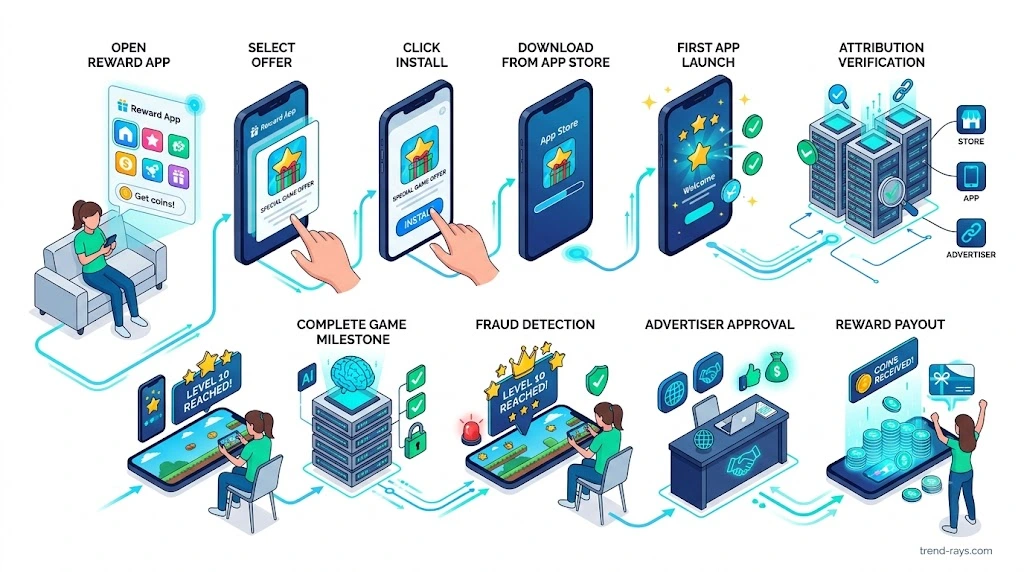
Throughout this guide, we’ve explored mobile attribution from many different angles.
We’ve discussed attribution models, install matching, Mobile Measurement Partners (MMPs), deep linking, attribution windows, fraud detection, and privacy-focused measurement.
Now let’s bring everything together by following a realistic reward app campaign from beginning to end.
This example simplifies certain technical details, but it accurately illustrates how the major components of the mobile advertising ecosystem work together.
Stage 1: The Advertiser Wants New Users
Imagine a mobile game studio has just released a new strategy game.
The developers have spent years building the game, but creating a great product is only part of the challenge.
People need to discover it.
To attract new players, the company allocates a marketing budget of $2 million.
Rather than relying on a single advertising platform, the company promotes the game through multiple channels, including:
- Google Ads
- Apple Search Ads
- Meta Ads
- TikTok
- YouTube
- Affiliate publishers
- Reward apps
- Offer walls
The advertiser defines its campaign goals.
For example:
- New users only
- Install the game
- Reach Level 15
- Complete the milestone within seven days
Every campaign is configured with attribution rules, reporting requirements, and payment conditions.
Stage 2: The Reward Platform Publishes the Offer
A reward platform partners with the advertiser.
It publishes the campaign inside its app.
Users browsing available offers now see something like:
Install Empire Kingdoms, reach Level 15 within seven days, and earn $20.
From the user’s perspective, it looks like a simple task.
Behind the scenes, however, the offer already contains campaign identifiers, attribution information, reward conditions, and tracking parameters.
Stage 3: A User Clicks the Offer
Sarah is browsing the reward app during her lunch break.
The strategy game catches her attention.
She taps the offer.
At that moment, several systems immediately begin working together.
The click is recorded.
Campaign information is associated with the interaction.
The attribution platform stores the necessary measurement data.
A timestamp is created.
The reward platform now knows that Sarah began the campaign.
This entire process usually happens in milliseconds.
Sarah simply sees the app store open.
Stage 4: Installation Begins
Sarah downloads the game from the official app store.
The installation completes successfully.
However, contrary to popular belief, downloading the app doesn’t automatically guarantee reward eligibility.
The attribution process has only just begun.
When Sarah launches the game for the first time, the integrated attribution SDK begins communicating with the Mobile Measurement Partner.
The platform now attempts to determine whether this installation matches the earlier campaign click.
If the installation satisfies the advertiser’s attribution rules, the campaign receives attribution credit.
Stage 5: Deep Linking Improves the Experience
Instead of opening a generic home screen, the game welcomes Sarah with the exact beginner event promoted in the advertisement.
She immediately sees:
- Starter rewards
- Tutorial missions
- Beginner bonuses
- Limited-time campaign
She doesn’t need to search through menus.
The deep link guides her directly to the intended experience.
The smoother onboarding increases the likelihood that she’ll continue playing.
Stage 6: Gameplay Becomes Business Data
Sarah spends several evenings playing the game.
During that time, the advertiser measures important milestones.
Examples include:
- First app launch
- Account creation
- Tutorial completion
- Level progression
- Session duration
- In-game purchases
- Daily retention
Notice what isn’t happening.
The advertiser isn’t simply counting installs.
Instead, it is evaluating whether Sarah becomes a valuable long-term player.
This information helps determine whether the advertising investment was worthwhile.
Stage 7: Fraud Detection Runs Quietly in the Background
Throughout the campaign, fraud detection systems continuously analyze campaign activity.
They monitor for unusual patterns that could indicate invalid advertising activity.
Sarah never notices these systems because she’s participating normally.
Her installation, gameplay, and progression follow expected patterns.
As a result, the campaign continues without interruption.
Meanwhile, advertisers gain greater confidence that marketing budgets are being spent on genuine users rather than artificial activity.
Stage 8: Campaign Verification
A few days later, Sarah reaches Level 15.
The advertiser verifies that:
- The app was installed correctly.
- The installation met campaign requirements.
- The milestone was completed.
- The campaign remained within the attribution window.
- No verification issues were detected.
Once these conditions are satisfied, the advertiser reports a successful campaign completion.
Stage 9: Reward Approval
The reward platform receives confirmation from the advertiser.
Sarah’s account is credited with the promised reward.
From Sarah’s perspective, the process appears remarkably simple.
She installed a game.
Played for several days.
Reached the required level.
Received her reward.
Behind that simple experience, however, dozens of technologies collaborated to verify the campaign accurately.
Stage 10: The Story Doesn’t End There
Although Sarah’s reward has been paid, the advertiser continues analyzing campaign performance.
Questions now include:
- Does Sarah continue playing after Level 15?
- Does she make purchases?
- Does she recommend the game to friends?
- Does she remain active after 30 days?
- Was the advertising investment profitable?
These long-term insights influence future marketing decisions.
If reward app users consistently become loyal customers, the advertiser may increase campaign budgets.
If users uninstall the game immediately after receiving rewards, campaign strategies may change.
Mobile attribution doesn’t simply measure installations.
It helps businesses understand customer quality over time.
Everything Working Together
Let’s review the complete journey.
Advertiser launches campaign
            │
            ▼
Reward platform publishes offer
            │
            ▼
User clicks advertisement
            │
            ▼
Campaign information recorded
            │
            ▼
App Store opens
            │
            ▼
App installed
            │
            ▼
First app launch
            │
            ▼
Attribution platform verifies installation
            │
            ▼
Deep link improves onboarding
            │
            ▼
User completes required milestone
            │
            ▼
Fraud detection validates campaign
            │
            ▼
Advertiser confirms completion
            │
            ▼
Reward platform credits user
            │
            ▼
Advertiser continues measuring long-term value
Why This Entire Process Matters
Every successful reward campaign depends on multiple technologies working together.
Advertisers need confidence that they are paying for genuine customer acquisition.
Reward platforms need reliable verification before issuing payments.
Mobile Measurement Partners provide standardized campaign measurement.
Deep linking creates smoother user experiences.
Fraud detection protects marketing budgets.
Privacy frameworks help balance campaign measurement with user expectations.
None of these technologies operate in isolation.
Together, they form the infrastructure that powers today’s mobile app economy.
The next time you install an app through a reward platform and receive a successful payout, you’ll know that far more happened than a simple download.
Behind the scenes, an entire ecosystem collaborated to verify, measure, and reward that single installation.
Key Takeaways
Mobile attribution is much more than a tracking technology.
It is the foundation that connects advertisers, app developers, Mobile Measurement Partners, reward platforms, publishers, and users into one measurable ecosystem.
Without attribution, advertisers couldn’t accurately measure campaigns, reward platforms couldn’t confidently verify offers, and businesses would struggle to invest advertising budgets efficiently.
Understanding this ecosystem not only explains how reward apps work—it also provides valuable insight into the technology driving billions of dollars in mobile advertising every year.
What Businesses Do with Attribution Data: Turning Installs into Better Marketing Decisions
Once an advertiser knows where app installs come from, the next challenge begins.
Collecting attribution data is only the first step.
The real value comes from using that data to make smarter business decisions.
Modern companies don’t simply count downloads.
They analyze user behavior after installation to understand which marketing campaigns generate loyal, profitable customers.
This is where mobile attribution becomes a business intelligence tool rather than just a tracking system.
Looking Beyond Installation Numbers
Imagine two advertising campaigns.
Campaign A
- 100,000 app installs
- Very few users return after the first day
- Minimal purchases
- Low long-term engagement
Campaign B
- 40,000 app installs
- High daily activity
- Strong customer retention
- Frequent subscriptions and purchases
If success were measured only by installation volume, Campaign A would appear to be the winner.
However, Campaign B may generate significantly more revenue over time.
This is why successful businesses evaluate what happens after the install.
Measuring Customer Acquisition Cost (CAC)
One of the first metrics marketers analyze is Customer Acquisition Cost (CAC).
CAC answers a simple question:
How much did it cost to acquire one new customer?
For example:
- Advertising spend: $50,000
- New customers acquired: 2,500
Customer Acquisition Cost:
$20 per customer
Businesses compare CAC across different advertising channels to identify where they can acquire customers most efficiently.
Lower CAC is generally desirable—but only if those customers also provide long-term value.
Understanding Customer Lifetime Value (LTV)
Customer Lifetime Value (LTV) estimates how much revenue a customer is expected to generate throughout their relationship with the business.
Imagine two users.
User A installs a game, plays for one day, and never returns.
User B installs the same game, remains active for a year, purchases premium content, and recommends the game to friends.
Although both users count as installs, their business value is dramatically different.
LTV helps advertisers understand this difference.
Many companies are willing to spend more to acquire customers with higher long-term value.
Return on Ad Spend (ROAS)
Another important metric is Return on Ad Spend (ROAS).
ROAS helps businesses evaluate whether advertising campaigns generate enough revenue to justify their cost.
For example:
- Campaign cost: $100,000
- Revenue generated: $350,000
Although this is a simplified example, it demonstrates why attribution matters.
Without knowing which campaign generated the revenue, advertisers couldn’t calculate whether their marketing investments were profitable.
Measuring Retention
Acquiring a customer is only the beginning.
Successful businesses also want customers to keep using their apps.
Retention measures how many users remain active after specific periods, such as:
- Day 1
- Day 7
- Day 30
- Day 90
High retention often indicates that users find lasting value in the app.
Low retention may suggest problems with onboarding, product quality, or campaign targeting.
Cohort Analysis
Rather than evaluating all users together, marketers often organize users into cohorts.
A cohort is simply a group of users who share a common characteristic.
For example:
- Users acquired in June.
- Users from TikTok campaigns.
- Users from reward apps.
- Users from Google Ads.
Comparing cohorts helps businesses identify which acquisition channels consistently produce the most valuable customers.
A/B Testing Marketing Campaigns
Attribution data also supports experimentation.
Suppose an advertiser creates two versions of the same advertisement.
Version A emphasizes competitive gameplay.
Version B highlights free rewards.
Both campaigns run simultaneously.
By comparing attribution data, marketers can identify which message attracts higher-quality users.
Over time, thousands of small improvements like this can significantly improve campaign performance.
Budget Optimization
One of the most practical uses of attribution data is budget allocation.
Imagine a company spends:
- $500,000 on Google Ads.
- $300,000 on TikTok.
- $200,000 on reward apps.
After analyzing attribution reports, marketers discover that reward app users generate the highest long-term value despite receiving the smallest budget.
The company may decide to increase investment in reward campaigns while reducing spending on lower-performing channels.
This ability to reallocate budgets based on measurable performance is one of the primary reasons attribution has become so valuable.
Product Improvements
Attribution data isn’t useful only for marketing teams.
Product managers also use it to improve the app itself.
For example, they might discover that:
- Users abandon onboarding at a specific step.
- New players struggle with an early game level.
- Registration forms reduce conversion rates.
- Tutorial completion strongly predicts long-term retention.
These insights help businesses improve the overall user experience, benefiting both customers and future marketing campaigns.
Attribution Supports Better Business Decisions
Ultimately, attribution is about much more than determining which advertisement generated an install.
It helps businesses answer strategic questions such as:
- Which customers are most valuable?
- Which campaigns deserve larger budgets?
- Which marketing channels produce loyal users?
- Which advertisements should be redesigned?
- Which onboarding experiences improve retention?
- Which acquisition strategies support long-term growth?
Instead of making decisions based on assumptions, companies can rely on measurable evidence.
Key Takeaways
Attribution data becomes truly valuable when businesses use it to improve decision-making.
By combining metrics such as Customer Acquisition Cost (CAC), Lifetime Value (LTV), Return on Ad Spend (ROAS), retention, cohort analysis, and campaign testing, advertisers gain a much deeper understanding of customer behavior than installation numbers alone can provide.
This data-driven approach helps organizations optimize marketing budgets, improve products, strengthen customer acquisition strategies, and build sustainable long-term growth.
The final sections of this guide will answer the most common questions about mobile attribution and provide a glossary of essential terms to help you quickly understand the language used throughout the mobile advertising industry.
Frequently Asked Questions (FAQs)
1. What is mobile attribution?
Mobile attribution is the process of determining which marketing activity led a user to install and engage with a mobile app.
For example, a user may discover an app through a Google advertisement, a TikTok video, a reward platform, or an influencer recommendation. Attribution helps identify which of these interactions deserves credit for the installation or another important event, such as registration, a purchase, or a subscription.
Advertisers use attribution to measure campaign performance, optimize marketing budgets, detect fraud, and understand customer behavior after installation.
Without attribution, businesses would know how many installs they received but would have little insight into which marketing efforts produced those results.
2. Why is mobile attribution important?
Mobile attribution allows businesses to understand whether their advertising investments are producing meaningful results.
Instead of simply counting app downloads, companies can evaluate which campaigns generate loyal users, long-term engagement, subscriptions, purchases, and revenue.
This information helps marketers improve advertising efficiency, reduce wasted spending, identify successful campaigns, and make more informed business decisions.
For reward apps, attribution also helps verify that users completed offers through the correct campaign before rewards are approved.
3. What is the difference between attribution and analytics?
Although the two terms are often used together, they serve different purposes.
Attribution focuses on identifying how a user arrived at the app.
Analytics focuses on understanding what the user does after arriving.
For example:
- Attribution answers: “Which advertisement generated this install?”
- Analytics answers: “How long did the user stay? Did they make a purchase? Did they return next week?”
Most successful mobile businesses use both attribution and analytics together to gain a complete understanding of customer acquisition and user behavior.
4. What is a Mobile Measurement Partner (MMP)?
A Mobile Measurement Partner (MMP) is a specialized technology platform that measures mobile advertising performance across multiple marketing channels.
MMPs help advertisers:
- Attribute app installs
- Measure campaign performance
- Detect advertising fraud
- Analyze customer behavior
- Support deep linking
- Generate marketing reports
Well-known MMP providers include AppsFlyer, Adjust, Branch, Singular, and Kochava.
Rather than relying on individual advertising platforms, businesses use MMPs as an independent source of campaign measurement.
5. Does mobile attribution track everything I do?
No.
A common misconception is that attribution systems monitor every activity performed on a smartphone.
In reality, attribution focuses on measuring interactions related to advertising campaigns and app performance according to platform capabilities, user permissions, and applicable privacy requirements.
Modern attribution increasingly emphasizes campaign-level measurement and privacy-preserving technologies rather than comprehensive individual tracking.
6. Why do reward apps sometimes fail to track?
Reward offers may fail to track for several reasons.
Common causes include:
- Attribution issues
- Campaign eligibility requirements
- Expired attribution windows
- Existing app installations
- Incomplete campaign milestones
- Privacy-related measurement limitations
- Advertiser verification delays
In many cases, the reward platform depends on the advertiser’s attribution system to confirm successful campaign completion before issuing rewards.
7. Can advertisers see my personal information?
Modern attribution systems are increasingly designed around privacy-conscious measurement.
Exactly what information is available depends on factors such as:
- Mobile operating system
- Privacy permissions
- Attribution platform
- Applicable laws
- Campaign configuration
Many modern attribution frameworks focus on campaign performance rather than exposing detailed personal information about individual users.
8. What is an attribution window?
An attribution window is the period during which an advertisement remains eligible to receive credit for an installation or conversion.
For example, if an advertiser uses a seven-day attribution window, an installation that occurs within seven days of clicking the advertisement may receive attribution credit.
If the installation occurs after that period expires, the campaign may no longer qualify under the advertiser’s attribution rules.
Attribution windows help create fair and consistent measurement across advertising campaigns.
9. What is the difference between deterministic and probabilistic attribution?
Deterministic attribution attempts to match an app installation with a previous advertising interaction using signals that allow a high degree of confidence, subject to platform permissions and privacy controls.
Probabilistic attribution is different. Instead of relying on a direct match, it evaluates multiple available signals to estimate whether an advertisement and an app installation are likely connected.
Both approaches have advantages and limitations. Deterministic attribution generally offers higher confidence when available, while probabilistic attribution helps extend campaign measurement in situations where direct matching isn’t possible. Modern attribution platforms often combine multiple techniques depending on the operating system, campaign configuration, and privacy environment.
10. What is a deep link?
A deep link is a special link that opens a specific page or feature inside a mobile app instead of simply opening the app’s home screen.
For example, tapping a shopping advertisement might take you directly to a discounted product rather than requiring you to search for it manually.
Deep linking improves the user experience by reducing unnecessary steps between an advertisement and the desired action. When combined with mobile attribution, deep links help advertisers create smoother onboarding experiences and improve campaign performance.
11. What is deferred deep linking?
Deferred deep linking allows users to reach the intended destination inside an app even if they don’t have the app installed when they click the advertisement.
A typical journey looks like this:
- User clicks an advertisement.
- The app is downloaded from the app store.
- The user opens the app for the first time.
- Instead of landing on the home screen, they are taken directly to the content promoted in the original advertisement.
This creates a seamless experience while preserving important campaign context across the installation process.
12. What is SKAdNetwork?
SKAdNetwork is Apple’s privacy-focused attribution framework for measuring the performance of app advertising campaigns.
Instead of relying on the same level of user-specific attribution used by some historical approaches, SKAdNetwork provides advertisers with campaign-level measurement while helping protect user privacy.
It allows marketers to evaluate advertising effectiveness without depending on extensive individual tracking and has become an important part of modern iOS campaign measurement.
13. What is App Tracking Transparency (ATT)?
App Tracking Transparency (ATT) is Apple’s privacy framework that gives users greater control over certain types of cross-app tracking.
Apps that wish to perform tracking covered by Apple’s policies must request permission from users.
ATT changed how many advertisers measure campaign performance on iOS, encouraging the industry to adopt more privacy-preserving attribution methods while still providing meaningful marketing insights.
14. What is an organic install?
An organic install is an app installation that is not attributed to a paid advertising campaign.
Examples include users who:
- Search for an app in the App Store or Google Play.
- Visit the developer’s website directly.
- Receive a recommendation from a friend.
- Discover the app through unpaid media coverage.
Organic installs are valuable because they don’t require direct advertising spend, although they may still be influenced by broader brand awareness and marketing efforts.
15. Can reinstalling an app qualify me for another reward?
In many cases, no.
Many reward campaigns are designed specifically to acquire new users. If an app has already been installed on the same device or account, reinstalling it may not qualify as a new installation under the advertiser’s campaign rules.
However, eligibility requirements differ between campaigns. Users should always read the specific terms and conditions before assuming a reinstall will qualify for another reward.
16. Why are some rewards marked as pending?
A pending reward usually means the advertiser is still verifying that the campaign requirements have been completed successfully.
Depending on the campaign, verification may include confirming:
- A valid installation.
- New user eligibility.
- Completion of required milestones.
- Compliance with campaign timing requirements.
- Successful attribution.
Pending status does not automatically indicate a problem. In many cases, it simply means the advertiser’s validation process has not yet finished.
Cookies have historically been important for web analytics and browser-based advertising, but mobile attribution works differently.
Native mobile apps generally rely on app-specific attribution technologies rather than traditional browser cookies. Depending on the platform, operating system, and privacy framework, attribution may involve SDKs, server-to-server communication, campaign identifiers, or privacy-preserving measurement frameworks.
As privacy regulations and platform policies continue evolving, mobile attribution has become increasingly independent of traditional cookie-based tracking.
18. What is an attribution SDK?
An attribution SDK (Software Development Kit) is a library that app developers integrate into their mobile applications.
The SDK helps measure important events such as:
- First app launch
- Registrations
- Purchases
- Subscriptions
- Level completions
- Other conversion events
It communicates with the Mobile Measurement Partner (MMP), allowing advertisers to measure campaign performance and user engagement while following the platform’s privacy requirements.
19. What is server-to-server attribution?
Server-to-server attribution moves part of the measurement process away from the user’s device and into secure communication between trusted servers.
This approach can improve reliability, reduce dependence on client-side signals, and better support modern privacy-focused measurement.
Many enterprise advertisers increasingly combine server-side measurement with other attribution methods to improve reporting consistency.
20. Can artificial intelligence improve mobile attribution?
Artificial intelligence is becoming increasingly important in the mobile advertising ecosystem.
Rather than replacing attribution, AI helps advertisers analyze large volumes of campaign data more efficiently.
Common applications include:
- Campaign optimization
- Fraud detection
- Predictive analytics
- Budget allocation
- Audience segmentation
- Performance forecasting
As privacy restrictions continue evolving, AI is expected to play an even greater role in helping advertisers make informed marketing decisions from aggregated campaign data.
21. Is mobile attribution completely accurate?
No attribution system is perfect.
Modern attribution platforms balance several competing priorities, including:
- Measurement accuracy
- User privacy
- Platform policies
- Fraud prevention
- Campaign configuration
- Regulatory requirements
Some installs can be matched with high confidence, while others may remain unattributed or require privacy-preserving reporting methods.
For this reason, advertisers often use attribution alongside analytics, experimentation, and broader marketing measurement techniques rather than relying on a single source of truth.
22. What industries use mobile attribution?
Although mobile attribution is closely associated with gaming, it supports a wide range of industries.
Common examples include:
- Mobile gaming
- Ecommerce
- Financial technology (FinTech)
- Food delivery
- Ride-sharing
- Streaming services
- Health and fitness
- Travel and hospitality
- Education
- Productivity software
- Subscription apps
Any business investing in mobile user acquisition can benefit from understanding which marketing efforts generate valuable customers.
23. Is mobile attribution only useful for large companies?
No.
Large enterprises often rely on sophisticated attribution platforms because they manage significant advertising budgets, but smaller businesses can also benefit from attribution.
Even modest campaigns become more effective when marketers understand:
- Which advertising channels produce installs.
- Which campaigns generate paying customers.
- Where marketing budgets should be increased or reduced.
As businesses grow, attribution becomes increasingly valuable for optimizing customer acquisition.
24. What skills are useful for a career in Mobile AdTech?
Mobile attribution sits at the intersection of marketing, analytics, and software engineering.
Professionals working in Mobile AdTech often develop skills such as:
- Digital marketing
- Performance marketing
- Mobile analytics
- SQL and data analysis
- Product analytics
- A/B testing
- Privacy compliance
- Attribution platforms
- Marketing automation
- Data visualization
Because mobile advertising continues evolving rapidly, professionals who combine analytical thinking with technical knowledge are increasingly in demand.
25. What is the future of mobile attribution?
The future of mobile attribution will likely focus less on identifying individual users and more on measuring campaign effectiveness in privacy-conscious ways.
Key trends include:
- Privacy-preserving measurement
- Artificial intelligence
- Predictive analytics
- Aggregated reporting
- Server-side technologies
- Machine learning
- Cross-channel measurement
- Incrementality testing
- Marketing Mix Modeling (MMM)
Rather than disappearing, attribution is evolving.
The industry’s goal remains the same: helping businesses understand which marketing efforts are effective while respecting user privacy and adapting to changing technology platforms.
Final Thoughts
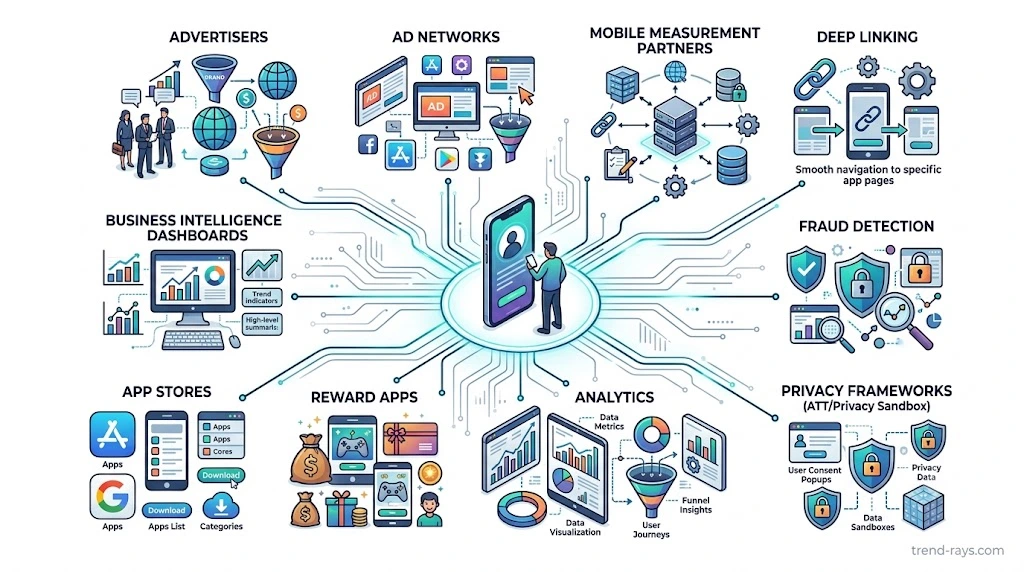
Mobile attribution is one of the most important technologies behind today’s app economy, yet most users never notice it.
Every time someone clicks an advertisement, installs an app, completes a reward offer, or makes an in-app purchase, attribution helps connect those actions into measurable business insights.
Throughout this guide, we’ve explored how attribution works, the role of Mobile Measurement Partners, deep linking, attribution windows, fraud detection, privacy-focused measurement, and the real-world workflows that power reward apps and mobile advertising.
Whether you’re a marketer optimizing advertising budgets, a developer integrating an attribution SDK, a business evaluating customer acquisition, or simply a user curious about how reward apps verify offers, understanding mobile attribution provides valuable insight into the technology driving billions of dollars in mobile commerce.
As privacy expectations and mobile platforms continue evolving, attribution will continue adapting—but its core purpose will remain unchanged:
Helping businesses measure marketing performance, improve customer acquisition, and make better decisions through responsible, data-driven measurement.
Appendix: Mobile Attribution Glossary (A–Z)
This glossary explains the most common terms used throughout the mobile attribution and mobile advertising industry. If you’re new to the topic, use it as a quick reference while reading this guide.
A
Ad Impression
An ad impression is recorded each time an advertisement is displayed to a user, regardless of whether the user interacts with it.
Ad Network
An ad network connects advertisers with publishers, helping businesses distribute advertisements across websites, mobile apps, games, and other digital platforms.
App Tracking Transparency (ATT)
Apple’s privacy framework that gives users control over whether apps can request permission for certain types of cross-app tracking.
Attribution
The process of determining which marketing interaction deserves credit for an app install, purchase, registration, or another conversion event.
Attribution Model
A predefined set of rules that determines how conversion credit is assigned among one or more marketing touchpoints.
Attribution SDK
A software library integrated into a mobile app that reports attribution and conversion events to a Mobile Measurement Partner.
Attribution Window
The period during which an advertisement remains eligible to receive credit for a future installation or conversion.
B
Behavioral Analytics
The analysis of how users interact with an app after installation, including engagement, retention, and purchases.
Budget Optimization
The process of reallocating advertising spend toward campaigns and channels that deliver better business outcomes.
C
Campaign
A structured advertising initiative designed to achieve specific marketing objectives, such as app installs or subscriptions.
Click Attribution
An attribution method that assigns credit based on a qualifying advertisement click.
Click Injection
A form of advertising fraud that attempts to claim attribution credit immediately before an app installation.
Click Spam
Fraudulent generation of large numbers of advertisement clicks in an attempt to claim attribution for future installs.
Cohort
A group of users who share a common characteristic, such as installation date or acquisition source.
Conversion
A valuable action completed by a user, such as installing an app, registering, subscribing, or making a purchase.
Conversion Rate
The percentage of users who complete a desired action after interacting with an advertisement.
Customer Acquisition Cost (CAC)
The average amount spent to acquire one new customer.
Customer Journey
The sequence of interactions a user experiences before and after becoming a customer.
D
Deep Link
A link that opens a specific page or feature inside a mobile app instead of the default home screen.
Deferred Deep Link
A deep link that preserves the intended destination even if the app must first be installed.
Deterministic Attribution
An attribution approach that matches advertising interactions with app installs using signals that allow a high degree of confidence.
Device Fingerprinting
A historical attribution technique that estimates device identity using combinations of technical characteristics. Its use has become more limited because of evolving privacy standards.
F
First-Click Attribution
An attribution model that assigns all conversion credit to the first qualifying marketing interaction.
Fraud Detection
The process of identifying invalid or suspicious advertising activity to protect campaign integrity.
I
Incrementality
A measurement approach that estimates whether advertising generated additional conversions that would not have happened otherwise.
Install Attribution
The process of connecting an app installation with the marketing interaction that influenced it.
In-App Event
A measurable action performed within an app, such as registration, completing a tutorial, or making a purchase.
L
Last-Click Attribution
An attribution model that assigns conversion credit to the final qualifying advertisement click before installation or conversion.
Lifetime Value (LTV)
An estimate of the total revenue a customer is expected to generate throughout their relationship with a business.
M
Marketing Mix Modeling (MMM)
A statistical approach used to evaluate how different marketing channels contribute to business results, often without relying on user-level attribution.
Mobile Attribution
The process of measuring which marketing activities lead to app installs and other conversion events.
Mobile Measurement Partner (MMP)
A specialized platform that measures mobile advertising performance across multiple marketing channels.
Multi-Touch Attribution
An attribution model that distributes conversion credit across multiple marketing interactions.
O
Organic Install
An app installation that is not attributed to a paid advertising campaign.
P
Predictive Analytics
The use of historical data and statistical models to forecast future user behavior or campaign performance.
Privacy Sandbox
Google’s initiative to develop privacy-focused technologies for digital advertising and measurement on Android.
Probabilistic Attribution
An attribution method that estimates the likelihood that an advertisement and an installation belong to the same user journey using multiple available signals.
R
Retention
The percentage of users who continue using an app after installation over a defined period.
Return on Ad Spend (ROAS)
A metric that compares advertising revenue with advertising costs to evaluate campaign profitability.
Reward App
A mobile application that offers users incentives for completing advertiser-defined tasks such as installing an app or reaching a milestone.
S
SDK (Software Development Kit)
A collection of tools and libraries that developers integrate into applications to provide specific functionality, including attribution measurement.
Server-to-Server Attribution
An attribution approach that relies on communication between trusted servers rather than depending entirely on the user’s device.
SKAdNetwork
Apple’s privacy-focused attribution framework for measuring iOS advertising campaigns.
U
User Acquisition (UA)
The process of attracting new users to an app through paid or organic marketing efforts.
User Retention
The ability of an app to keep users engaged over time after installation.
V
View-Through Attribution
An attribution method that may assign conversion credit after a user views—but does not click—an advertisement, subject to campaign rules and attribution windows.
Final Glossary Note
Mobile attribution combines marketing, analytics, software engineering, privacy, and business intelligence into one rapidly evolving field.
Understanding these core terms makes it much easier to interpret advertising reports, evaluate campaign performance, understand reward app tracking, and follow developments in the mobile advertising industry.
As privacy technologies and measurement frameworks continue evolving, new terminology will emerge, but the concepts explained in this glossary provide a strong foundation for understanding the modern mobile attribution ecosystem.