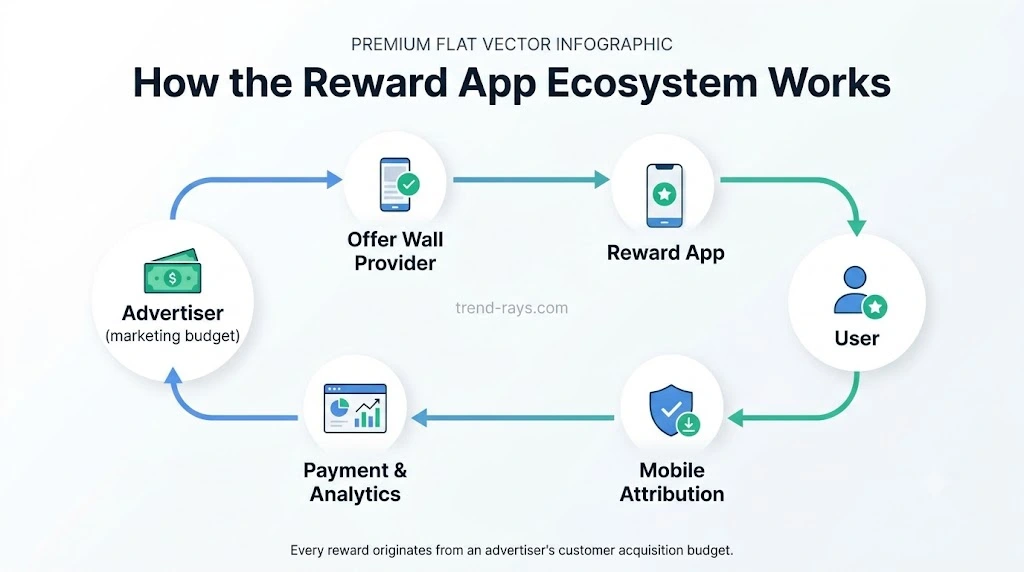
Most people think reward apps are about making money.
In reality, they’re about spending money.
Every day, companies around the world invest millions of dollars trying to convince people to install mobile apps, play games, subscribe to services, open financial accounts, or make online purchases.
Reward apps are simply one small part of that much larger economy.
When you receive $20 for reaching Level 25 in a mobile game or earn cash for opening a new banking app, it may seem like the company is giving money away.
But businesses don’t spend marketing budgets randomly.
Behind every reward is a carefully calculated investment based on customer behavior, advertising costs, expected future revenue, and sophisticated economic models designed to answer one fundamental question:
“Will this customer generate more revenue than it costs to acquire them?”
That single question drives nearly every marketing decision made by modern app developers, game studios, subscription services, e-commerce companies, and financial technology businesses.
Understanding this principle changes how you see reward apps.
They’re not isolated earning platforms.
They’re one component of the global performance marketing economy, where companies compete to acquire valuable customers as efficiently as possible.
Reward Apps Are Really an Advertising Product
One of the biggest misconceptions about reward apps is believing that their primary business is paying users.
It isn’t.
Their real business is helping advertisers solve a very expensive problem:
Finding new customers.
Imagine you’ve spent three years developing a mobile game.
Your development team has created stunning graphics, engaging gameplay, multiplayer features, and hundreds of levels.
The game launches on the App Store and Google Play.
Then… nothing happens.
Thousands of new apps are released every day.
Even an excellent product can disappear among millions of competitors if nobody knows it exists.
This is where marketing begins.
Game studios don’t simply hope players discover their app organically.
They actively invest in acquiring users through advertising.
Some buy Google App Campaigns.
Others advertise on TikTok, YouTube, Meta, Apple Search Ads, influencer partnerships, affiliate programs, referral campaigns, or reward platforms.
Every one of these channels has the same objective:
Acquire users who are likely to become long-term customers.
Reward apps are simply another customer acquisition channel—one where advertisers share part of their marketing budget with users who complete qualifying actions.
The Global User Acquisition Economy
To understand why reward apps exist, you first need to understand the scale of modern mobile advertising.
The mobile app industry has become one of the most competitive digital marketplaces in the world.
Every category is crowded:
- Mobile games compete with thousands of new releases each year.
- Financial apps compete for customers opening new accounts.
- Streaming platforms compete for subscribers.
- Shopping apps compete for loyal buyers.
- Food delivery services compete for repeat orders.
- Productivity apps compete for monthly subscriptions.
Building a great app is only the beginning.
The much harder challenge is attracting users.
For many companies, customer acquisition becomes one of the largest ongoing business expenses.
Some businesses spend more on marketing than they do on software development.
Others allocate millions of dollars each month to user acquisition campaigns because attracting profitable customers is essential for long-term growth.
Reward platforms exist because they provide one more way to reach those potential customers.
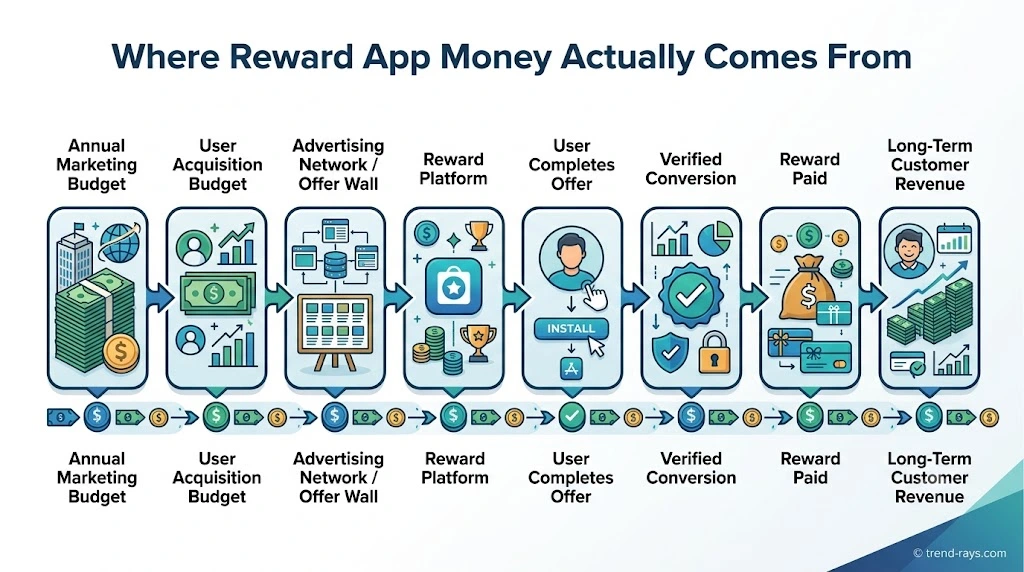
Every Reward Represents an Investment
Imagine you receive a reward worth $40 after completing a campaign.
It’s tempting to think:
“The company just paid me forty dollars.”
From the advertiser’s perspective, however, that payment is viewed very differently.
It isn’t an expense with no purpose.
It’s an investment.
The advertiser expects that, over time, your relationship with the app may generate more value than the amount spent acquiring you.
Perhaps you’ll:
- watch advertisements,
- purchase virtual currency,
- subscribe to premium features,
- recommend the app to friends,
- make repeat purchases,
- or remain an active customer for years.
If those future revenues exceed the acquisition cost, the campaign becomes profitable.
If they don’t, the advertiser adjusts its strategy.
This constant balancing of acquisition costs and expected future revenue lies at the heart of reward app economics.
Why This Guide Is Different
Most articles about reward apps focus on practical questions such as:
- Which apps pay the most?
- Which platforms are legitimate?
- How do you withdraw your earnings?
Those are useful questions, but they only explain the surface.
This guide takes a different approach.
Instead of reviewing individual apps, we’ll examine the economic forces that make the entire industry possible.
You’ll learn:
- why companies spend millions acquiring users,
- how customer acquisition budgets are calculated,
- why one player may be worth hundreds of dollars while another isn’t,
- how lifetime value influences marketing decisions,
- why advertisers compare acquisition costs with future revenue,
- how reward apps fit into performance marketing,
- and why this business model continues to grow despite increasing competition.
By the end of this guide, you’ll understand not only how reward apps work, but why the economics behind them make sense.
Once you understand those principles, you’ll never look at mobile advertising—or reward apps—in quite the same way again.
Where We’ll Begin
Every reward app campaign starts with a single business objective:
Acquiring a customer.
But what exactly does it mean to “acquire” a customer?
Why are businesses willing to spend money before they’ve earned anything in return?
And how do companies decide how much a new user is actually worth?
Those questions lead us to one of the most important concepts in modern business:
Customer Acquisition.
Customer Acquisition: The Foundation of the Entire Reward App Economy
Every successful business shares one common challenge.
It needs customers.
Without customers, even the best products eventually fail.
A mobile game with incredible graphics won’t generate revenue if nobody downloads it.
A financial app offering competitive interest rates won’t grow if people never open an account.
A streaming service can’t build a subscriber base if potential customers don’t know it exists.
Creating a great product is only half the battle.
The other half is convincing people to try it.
That process is known as customer acquisition.
Although the term sounds technical, the idea is surprisingly simple.
Customer acquisition is the process of attracting new people to a business and encouraging them to become users or paying customers.
Almost every company in the world spends money on customer acquisition.
The only difference is how they choose to acquire those customers.
Every Business Buys Customers in Different Ways
Imagine you own a small coffee shop.
You could wait for people to discover your business naturally.
Eventually, some customers would.
But growth would likely be slow.
Instead, you decide to advertise.
Perhaps you:
- distribute flyers,
- run local social media advertisements,
- partner with food delivery apps,
- sponsor a community event,
- or launch a loyalty program.
Each of those activities costs money.
You’re spending today in the hope of earning more tomorrow.
Mobile app companies operate in exactly the same way.
The difference is scale.
Instead of reaching hundreds of potential customers, they’re often trying to reach millions.
Customer Acquisition Is an Investment, Not an Expense
One of the biggest misconceptions in business is viewing marketing purely as a cost.
Successful companies see it differently.
Imagine spending $30 to acquire a new customer.
If that customer eventually spends $300, your original marketing expense wasn’t simply money lost.
It was an investment that generated future revenue.
Businesses constantly evaluate this relationship.
They’re willing to spend money today because they expect to earn significantly more over the lifetime of the customer.
This simple principle explains why companies are comfortable investing millions of dollars in advertising each year.
Why Mobile Apps Need Continuous Customer Acquisition
Unlike physical products, mobile apps compete in an incredibly crowded marketplace.
Every day, thousands of new apps are launched across app stores.
Many existing apps also lose users over time.
Some people uninstall games after a few days.
Others switch to competing apps.
Some stop using a service altogether.
To continue growing—or even maintain their existing user base—companies must consistently attract new users.
This creates a continuous cycle:
- Launch advertising campaigns.
- Acquire new users.
- Measure campaign performance.
- Improve marketing strategies.
- Repeat the process.
Without ongoing customer acquisition, even successful apps can gradually lose momentum.
Not Every User Has the Same Value
Here’s where reward app economics become especially interesting.
Imagine two new players install the same mobile game.
Player A
- Plays for one day.
- Never opens the game again.
- Makes no purchases.
- Uninstalls the app.
Player B
- Plays several times each week.
- Watches rewarded advertisements.
- Purchases premium items.
- Recommends the game to friends.
- Continues playing for two years.
From the advertiser’s perspective, these two users are dramatically different.
Although both installed the same app, one created very little value while the other became a highly profitable customer.
This is why businesses don’t simply count downloads.
They measure the long-term value of the people behind those downloads.
Acquiring Customers Isn’t Just About Mobile Games
While reward apps often promote games, customer acquisition extends far beyond the gaming industry.
Companies in many sectors compete for new users every day.
Examples include:
- Digital banking platforms
- Investment apps
- Cryptocurrency exchanges
- Food delivery services
- Ride-sharing apps
- Streaming platforms
- Language learning apps
- Fitness subscriptions
- E-commerce marketplaces
- Productivity software
Each of these businesses asks essentially the same question:
“How much can we afford to spend acquiring one new customer?”
The answer depends on how valuable that customer is expected to become over time.
Why Businesses Compete So Aggressively
Imagine two competing food delivery apps launching in the same city.
Both know that many customers tend to stick with the first service they regularly use.
Winning a customer today may mean keeping that customer for years.
That’s why businesses often compete aggressively during the acquisition stage.
It’s common to see offers such as:
- free delivery,
- welcome discounts,
- bonus reward points,
- cashback promotions,
- referral bonuses,
- and limited-time incentives.
These promotions aren’t acts of generosity.
They’re customer acquisition strategies designed to encourage people to choose one service over another.
Reward app campaigns operate on exactly the same principle.
Customer Acquisition Has Become One of the World’s Largest Industries
As smartphones became part of everyday life, acquiring mobile users evolved into a massive global industry.
Entire businesses now specialize in helping advertisers:
- attract users,
- measure campaign performance,
- prevent fraud,
- optimize advertising budgets,
- analyze customer behavior,
- and improve long-term profitability.
Reward apps are only one piece of this much larger ecosystem.
Behind every campaign are advertising platforms, analytics providers, attribution technologies, marketing agencies, and performance measurement tools working together to help businesses grow.
Customer Acquisition Is Only Half the Equation
At this point, customer acquisition seems straightforward.
Businesses spend money to gain users.
But one important question remains:
How do companies decide whether acquiring a customer is actually worth the cost?
The answer lies in another fundamental business concept:
Customer Lifetime Value (LTV).
Without understanding LTV, businesses have no reliable way to determine whether their marketing investments are profitable.
In the next section, we’ll explore why one mobile user can sometimes be worth hundreds—or even thousands—of dollars over the course of their relationship with a company.
Why One Mobile User Can Be Worth Hundreds—or Even Thousands—of Dollars
Imagine two people install the same mobile app today.
Both downloads appear identical on an analytics dashboard.
Both count as one new user.
Both arrived through the same advertising campaign.
From a distance, they look equally valuable.
But over the next three years, their behavior becomes completely different.
The first person opens the app once, explores it for a few minutes, and never returns.
The second person uses the app every week.
They purchase premium features.
They recommend it to friends.
They watch advertisements.
They renew subscriptions.
Eventually, they become one of the company’s most valuable customers.
Although both users cost the advertiser the same amount to acquire, the value they generate is dramatically different.
This simple observation explains one of the most important ideas in modern business:
Not all customers are equally valuable.
Understanding this principle is essential for understanding why reward apps—and digital advertising in general—exist.
Businesses Don’t Buy Downloads—They Invest in Relationships
Many people assume app developers care most about download numbers.
Downloads are certainly important.
Without them, there are no users.
But downloads alone don’t pay salaries, fund product development, or satisfy investors.
What businesses really want is an ongoing relationship with the customer.
Consider a music streaming service.
A single app install generates almost no immediate value.
However, if that user:
- subscribes to a premium plan,
- continues paying every month,
- creates playlists,
- invites friends,
- and remains a customer for several years,
their total contribution to the business becomes far greater than the initial installation.
The same idea applies across many industries.
Companies invest in acquiring users because they expect those relationships to generate future revenue.
Revenue Doesn’t Always Come From Purchases
One common misconception is that businesses only earn money when customers buy something.
In reality, modern apps generate revenue in many different ways.
For example, a free mobile game may earn income through:
- in-app purchases,
- rewarded video advertisements,
- banner advertising,
- battle passes,
- cosmetic upgrades,
- premium memberships,
- sponsorships,
- and brand partnerships.
A productivity app may generate revenue through monthly subscriptions.
An online marketplace may earn commissions on every transaction.
A banking app may profit from financial products and long-term customer relationships.
Although the revenue models differ, the economic principle remains the same:
The longer users remain active and engaged, the greater their potential value.
Introducing Customer Lifetime Value (LTV)
This brings us to one of the most important metrics in digital marketing:
Customer Lifetime Value, often abbreviated as LTV.
Customer Lifetime Value estimates the total revenue a business expects to earn from a customer throughout the entire relationship—not just during the first day or first purchase.
Think of LTV as looking beyond the first interaction.
Instead of asking:
“How much did this user spend today?”
Businesses ask:
“How much value is this customer likely to generate over months or even years?”
That broader perspective helps companies make smarter marketing decisions.
Why Lifetime Value Matters So Much
Imagine two subscription services.
Service A
The average customer subscribes for one month before cancelling.
Service B
The average customer remains subscribed for four years.
Even if both services charge the same monthly fee, the long-term revenue generated by each customer is completely different.
Service B can afford to spend much more attracting new customers because it expects to recover those marketing costs over a much longer period.
This is why companies with strong customer retention often invest aggressively in advertising.
They’re confident that long-term revenue will justify those investments.
Real-World Examples of High Lifetime Value
Different industries have dramatically different customer values.
For example:
A casual puzzle game may earn only a few dollars from the average player.
A streaming platform may generate hundreds of dollars over several years through recurring subscriptions.
A financial services company could earn even more through long-term customer relationships and multiple financial products.
Business software providers often retain customers for many years, creating substantial lifetime value from each account.
These differences explain why some advertisers are willing to pay significantly more than others to acquire new users.
The expected long-term return determines how much they can invest upfront.
Why Lifetime Value Changes Over Time
Customer Lifetime Value isn’t fixed.
It evolves as businesses improve their products and services.
Companies work continuously to increase LTV by:
- improving user experience,
- adding new features,
- encouraging repeat purchases,
- strengthening customer loyalty,
- reducing cancellations,
- increasing engagement,
- and expanding premium offerings.
Every improvement that encourages users to stay longer or spend more increases their overall value.
As Lifetime Value grows, marketing budgets often grow as well.
Reward Apps Benefit From High Lifetime Value
Now the connection becomes clear.
When an advertiser believes a new customer could generate substantial long-term revenue, spending money to acquire that customer becomes much easier to justify.
Instead of viewing a reward as a cost, businesses view it as part of a long-term investment strategy.
If acquiring one valuable customer today leads to years of future revenue, sharing part of the acquisition budget through a reward platform can make excellent business sense.
This is one of the primary economic reasons reward apps continue to exist.
Lifetime Value Alone Doesn’t Determine Profitability
Knowing that a customer may generate hundreds of dollars sounds encouraging.
But businesses still need to answer another critical question:
“How much did it cost us to acquire that customer?”
If acquiring a customer costs more than the revenue they eventually generate, the campaign loses money regardless of Lifetime Value.
That’s why successful companies always evaluate Lifetime Value alongside another equally important metric:
Customer Acquisition Cost (CAC).
Together, these two metrics determine whether a marketing campaign creates sustainable business growth or drains valuable resources.
In the next section, we’ll explore Customer Acquisition Cost in detail and explain why advertisers obsess over the relationship between CAC and LTV.
Customer Acquisition Cost (CAC): The Number Every Advertiser Watches
If Customer Lifetime Value tells a business how much a customer is worth, there’s another question every marketing team asks before launching a campaign:
“How much will it cost us to acquire that customer?”
This question is answered by one of the most important metrics in modern business:
Customer Acquisition Cost, commonly known as CAC.
Customer Acquisition Cost measures the average amount a company spends to gain one new customer.
At first glance, the idea seems simple.
But for businesses investing millions of dollars in advertising, CAC influences almost every marketing decision they make.
It determines:
- how much they can spend on advertising,
- which marketing channels deserve more investment,
- how campaigns are optimized,
- and ultimately whether the business grows profitably or loses money.
For reward apps, CAC is one of the hidden economic forces that determines why some offers pay far more than others.
Customer Acquisition Is More Than Advertising
Many people assume Customer Acquisition Cost refers only to the money spent on advertisements.
In reality, acquiring a customer involves much more.
Depending on the business, CAC may include:
- advertising campaigns,
- influencer partnerships,
- affiliate commissions,
- reward platform payouts,
- referral bonuses,
- marketing software,
- sales teams,
- promotional discounts,
- creative production,
- campaign management,
- and analytics tools.
Every expense directly related to bringing in new customers contributes to the overall acquisition cost.
That’s why businesses constantly look for channels that deliver the best results at the lowest sustainable cost.
A Simple Example
Imagine a mobile game studio launches a new advertising campaign.
During one month it spends:
- $40,000 on mobile advertising,
- $15,000 on influencer marketing,
- $10,000 on reward app campaigns,
- and $5,000 on creative production.
The total customer acquisition investment is:
$70,000.
If those campaigns successfully bring in:
10,000 new players,
the average Customer Acquisition Cost is:
$7 per user.
This doesn’t mean every player cost exactly $7.
Some users may have been acquired for much less.
Others may have required significantly higher spending.
CAC simply provides the average cost across the entire campaign.
Why Advertisers Obsess Over CAC
Imagine two different marketing channels.
Channel A
Average acquisition cost:
$5 per customer
Channel B
Average acquisition cost:
$18 per customer
If both groups of users generate similar long-term revenue, the choice is obvious.
Channel A delivers customers more efficiently.
Over time, advertisers naturally shift larger portions of their marketing budgets toward channels that consistently acquire valuable users at lower costs.
This constant comparison explains why businesses invest across multiple acquisition channels simultaneously.
They’re continually searching for the most efficient way to grow.
Reward Apps Compete Against Other Marketing Channels
One of the biggest misconceptions about reward platforms is thinking they operate in isolation.
They don’t.
Every reward campaign competes against other advertising channels for the same marketing budget.
An advertiser deciding how to spend its acquisition budget may compare:
- Google App Campaigns,
- Apple Search Ads,
- Meta advertising,
- TikTok campaigns,
- YouTube advertising,
- influencer marketing,
- affiliate marketing,
- referral programs,
- mobile advertising networks,
- and reward platforms.
If reward platforms consistently deliver high-quality users at an attractive acquisition cost, advertisers often continue investing in them.
If another channel performs better, budgets may gradually shift in that direction.
This ongoing competition helps explain why campaign availability and reward values change over time.
Lower CAC Doesn’t Always Mean Better Marketing
At first, it might seem logical to assume the lowest acquisition cost is always the best outcome.
But experienced marketers know that’s not necessarily true.
Imagine two campaigns.
Campaign A acquires customers for just $3 each.
Campaign B acquires customers for $12 each.
If Campaign B’s customers remain active for years, make regular purchases, and generate substantially higher revenue, spending more to acquire them may actually produce better long-term profitability.
This is why marketers rarely evaluate CAC in isolation.
Instead, they compare it with Customer Lifetime Value.
The Relationship Between CAC and LTV
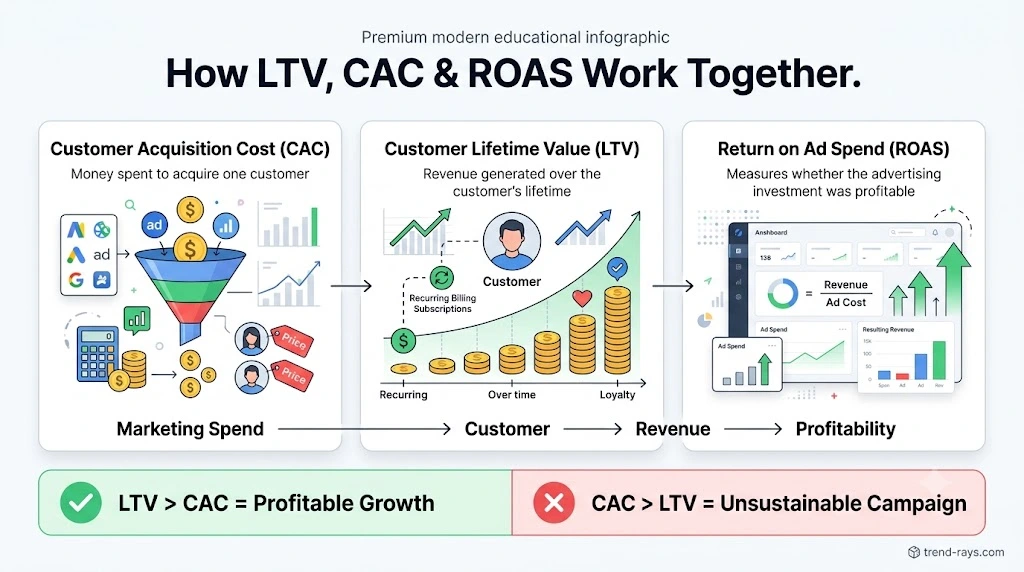
Think of Customer Lifetime Value (LTV) and Customer Acquisition Cost (CAC) as two sides of the same equation.
LTV asks:
“How much value will this customer create?”
CAC asks:
“How much did it cost to acquire them?”
Neither number means much on its own.
A customer worth $500 isn’t necessarily profitable if acquiring them costs $600.
Likewise, acquiring customers for only $2 each isn’t a great achievement if they generate almost no future revenue.
Successful businesses seek a healthy balance between these two metrics.
When Lifetime Value comfortably exceeds Customer Acquisition Cost, advertising becomes a sustainable engine for growth.
Why This Relationship Drives Reward App Economics
Everything we’ve discussed so far leads directly back to reward apps.
Suppose an advertiser estimates that a new customer will generate $150 over the next several years.
If the total cost of acquiring that customer—including advertising, reward payouts, and campaign management—is only $25, the investment may produce an attractive return.
From the advertiser’s perspective, paying rewards isn’t simply giving money away.
It’s part of a carefully calculated acquisition strategy designed to generate long-term profit.
The reward you receive is only one small component of a much larger economic calculation happening behind the scenes.
CAC Changes Constantly
Customer Acquisition Cost isn’t fixed.
It changes as market conditions evolve.
Factors that influence CAC include:
- advertising competition,
- seasonal demand,
- economic conditions,
- privacy regulations,
- campaign performance,
- user behavior,
- platform algorithms,
- and advertiser budgets.
During periods of intense competition—such as major shopping seasons or popular game launches—acquisition costs often increase as businesses compete for the same audiences.
This dynamic environment requires advertisers to monitor campaigns continuously and adjust spending accordingly.
The Metric That Connects Everything
By now, we’ve explored two of the most important concepts in digital marketing:
- Customer Lifetime Value (LTV) tells businesses how much revenue a customer is expected to generate.
- Customer Acquisition Cost (CAC) tells businesses how much it costs to acquire that customer.
Together, these metrics help determine whether a marketing campaign creates long-term value.
But marketers still need one final measurement to evaluate success:
“For every dollar we spend on advertising, how much revenue do we earn in return?”
That question introduces another essential concept:
Return on Ad Spend (ROAS).
ROAS brings Lifetime Value and Customer Acquisition Cost together into a practical performance metric that helps businesses decide where future marketing budgets should be invested.
In the next section, we’ll explore how ROAS influences advertising decisions and why it ultimately determines whether reward app campaigns continue running, expand, or disappear altogether.
Return on Ad Spend (ROAS): The Metric That Determines Whether Campaigns Survive
Imagine you’re the marketing director for a mobile game.
Over the past month, your company has spent $500,000 acquiring new players through multiple advertising channels.
Some users came from Google Ads.
Others arrived through TikTok.
Some installed the game after watching YouTube creators.
Others joined through reward platforms and offer walls.
At the end of the month, your finance team asks a simple question:
“Was that half-million dollars well spent?”
Downloads alone can’t answer that question.
Neither can Customer Acquisition Cost.
Even Lifetime Value only provides part of the picture.
What businesses really need to know is whether their advertising investment generated a profitable return.
That is exactly what Return on Ad Spend (ROAS) measures.
What Is ROAS?
Return on Ad Spend, commonly abbreviated as ROAS, measures how much revenue a business earns for every dollar spent on advertising.
Instead of asking:
“How many people installed our app?”
ROAS asks:
“How much money did those users generate compared with what we spent to acquire them?”
This shifts the focus away from downloads and toward profitability.
A campaign that attracts thousands of users isn’t necessarily successful.
A campaign that generates sustainable revenue is.
Why Downloads Don’t Guarantee Success
Imagine two advertising campaigns.
Campaign A
- Acquired 100,000 new players.
- Generated very little spending inside the game.
- Most users stopped playing within a few days.
Campaign B
- Acquired only 20,000 players.
- Many became long-term users.
- They purchased premium items.
- They watched rewarded advertisements.
- They remained active for over a year.
Although Campaign A attracted far more users, Campaign B may have produced significantly higher revenue.
This is why experienced marketers rarely celebrate download numbers alone.
Quality almost always matters more than quantity.
ROAS Connects Every Marketing Decision
Every acquisition channel eventually answers to ROAS.
Whether a company spends money on:
- Google App Campaigns,
- Apple Search Ads,
- Meta Ads,
- TikTok,
- YouTube,
- influencer partnerships,
- affiliate programs,
- referral campaigns,
- or reward platforms,
the same question remains:
“Did this investment generate an acceptable return?”
If the answer is yes, budgets often increase.
If the answer is no, campaigns may be paused, redesigned, or cancelled.
In other words, ROAS doesn’t simply measure campaign performance.
It directly influences where future marketing budgets are allocated.
Why Reward App Campaigns Continue Running
Many users assume reward campaigns disappear randomly.
In reality, advertisers regularly review campaign performance.
Suppose a reward platform consistently delivers users who:
- remain active,
- make purchases,
- recommend the app,
- and generate strong long-term revenue.
Even if those users initially cost more to acquire, the advertiser may continue investing because the overall return remains profitable.
On the other hand, if users obtained through a particular campaign rarely engage with the app or generate meaningful revenue, the advertiser may reduce the budget or stop the campaign entirely.
Reward availability is often a reflection of business performance rather than chance.
Short-Term Results vs Long-Term Profitability
One of the challenges advertisers face is that profitability isn’t always immediate.
A user who installs a budgeting app today may not become profitable until months later.
A mobile game player may begin making purchases only after reaching advanced levels.
A streaming subscriber may remain active for several years.
Because of this, advertisers frequently evaluate campaigns over different time horizons.
Some measure returns after:
- one day,
- seven days,
- thirty days,
- ninety days,
- or even a full year.
Looking only at immediate results can produce misleading conclusions.
Successful businesses balance short-term performance with long-term customer value.
Why ROAS Differs Between Industries
Not every business expects the same return.
Consider a few examples.
A casual mobile game may aim to recover its advertising costs relatively quickly through advertisements and in-app purchases.
A subscription-based software company may willingly wait many months before becoming profitable because recurring subscriptions create predictable long-term revenue.
A financial services company may continue earning revenue from a customer for years through multiple products.
Each industry operates with different economics.
As a result, acceptable ROAS targets vary depending on the business model.
The Continuous Optimization Cycle
ROAS isn’t measured once and forgotten.
Modern marketing teams monitor campaign performance continuously.
If a campaign performs well, they may:
- increase budgets,
- expand to new countries,
- test additional audiences,
- or introduce new creative assets.
If performance declines, they may:
- pause campaigns,
- reduce spending,
- adjust targeting,
- improve onboarding,
- or redesign the offer.
This constant optimization explains why reward app offers, payouts, and campaign availability frequently change.
Behind every adjustment is an advertiser responding to real performance data.
Why Artificial Intelligence Is Becoming Essential
Managing thousands of advertising campaigns manually is no longer practical.
Large companies often run campaigns across dozens of countries, multiple platforms, and millions of potential users.
Artificial intelligence increasingly helps marketers:
- predict campaign performance,
- identify valuable audiences,
- optimize advertising bids,
- detect fraud,
- forecast Lifetime Value,
- improve Return on Ad Spend,
- and allocate budgets more efficiently.
Rather than replacing marketers, AI enables them to make faster and more informed decisions based on enormous volumes of data.
As these systems become more advanced, reward campaigns are likely to become even more targeted and efficient.
ROAS Explains Why Reward Apps Exist
At this point, the economics become much clearer.
Advertisers don’t continue funding reward campaigns because they enjoy giving away money.
They continue because, when managed effectively, these campaigns help acquire profitable customers.
As long as the revenue generated by those customers exceeds the total cost of acquiring them, reward platforms remain a viable part of the marketing mix.
In other words, every successful reward campaign is ultimately supported by one simple business principle:
The return must justify the investment.
One More Question Remains
We’ve now explored the three metrics that shape almost every advertising decision:
- Customer Lifetime Value (LTV) measures the long-term value of a customer.
- Customer Acquisition Cost (CAC) measures how much it costs to acquire that customer.
- Return on Ad Spend (ROAS) measures whether the investment ultimately pays off.
But modern marketers still face another challenge.
Even if a campaign generates an excellent return, how do they decide where to find the next customer?
Should they invest in Google Ads?
TikTok?
Influencers?
Referral programs?
Reward platforms?
Or something else entirely?
The answer lies in understanding the mobile user acquisition ecosystem—the network of marketing channels that compete every day to deliver valuable customers.
In the next section, we’ll explore how businesses choose between these channels and why reward apps have earned a permanent place within the broader user acquisition strategy.
The Mobile User Acquisition Ecosystem: Where Reward Apps Fit In
Imagine you’ve just launched a brand-new mobile game.
Your development team spent two years designing characters, building levels, fixing bugs, testing gameplay, and polishing every feature.
Launch day finally arrives.
The game is live on the App Store and Google Play.
Now comes the difficult part.
Finding players.
Building a great app doesn’t automatically create an audience.
Every successful mobile company eventually faces the same challenge:
“Where should we spend our marketing budget to acquire new users?”
The answer is rarely limited to a single advertising platform.
Instead, businesses combine multiple acquisition channels, each serving different goals and attracting different types of users.
Reward apps are one of those channels—but they’re far from the only one.
The Challenge of Discoverability
The mobile app market has become one of the most competitive digital marketplaces in the world.
Millions of apps compete for attention.
Every day, new games, productivity tools, shopping apps, streaming services, and financial platforms are released.
Even exceptional products can struggle if people never discover them.
This creates an enormous demand for user acquisition.
Companies aren’t just competing to build better products.
They’re competing for visibility.
Every download begins with someone discovering an app somewhere.
Marketing exists to make that discovery happen.
There Is No Single Best Acquisition Channel
One of the biggest misconceptions about mobile marketing is believing there’s one perfect way to acquire users.
In reality, experienced marketers spread their budgets across multiple channels.
Each has different strengths.
Some generate massive reach.
Others produce higher-quality users.
Some scale quickly.
Others build stronger long-term loyalty.
Successful businesses rarely depend on only one source of new customers.
Diversification reduces risk and allows marketers to compare performance across channels.
Search Advertising
When people search for apps, products, or services online, search advertising allows businesses to appear in front of users actively looking for solutions.
This type of marketing often reaches people with strong purchase intent because they’re already searching for something specific.
Search campaigns can be highly effective, but competition for popular keywords often drives advertising costs upward.
As more businesses compete for the same audience, acquiring customers through search becomes increasingly expensive.
Social Media Advertising
Social media platforms allow advertisers to introduce products to audiences who may not have been actively searching for them.
Instead of responding to existing demand, these campaigns often create interest through engaging videos, images, or interactive content.
Social advertising also enables businesses to reach highly specific audiences based on interests, demographics, behaviors, and previous online activity.
While these platforms offer enormous reach, competition for attention continues to grow every year.
Influencer Marketing
Many companies collaborate with creators who already have trusted relationships with their audiences.
Rather than displaying a traditional advertisement, influencers demonstrate products through reviews, tutorials, gameplay, or personal recommendations.
For certain industries—especially gaming—this can produce highly engaged users because recommendations feel more authentic than conventional advertising.
However, influencer campaigns can also be difficult to measure consistently, making performance analysis an important part of the strategy.
Referral Programs
Some businesses encourage existing customers to invite friends.
Both participants often receive rewards when successful referrals occur.
Referral programs work because people generally trust recommendations from friends and family more than traditional advertisements.
In many cases, referred customers remain active longer and generate higher Lifetime Value than users acquired through other channels.
Affiliate Marketing
Affiliate marketing rewards publishers, websites, bloggers, and creators for generating customers or sales.
Instead of paying for advertising impressions alone, businesses compensate affiliates only when measurable actions occur.
This performance-based model shares many similarities with reward apps.
The difference is that affiliates promote products to audiences, while reward platforms reward users directly for completing campaigns.
Both operate within the broader performance marketing economy.
Reward Platforms
Reward apps occupy a unique position within the acquisition ecosystem.
Instead of relying solely on advertisements, they motivate users with incentives.
Advertisers benefit by acquiring measurable users.
Platforms generate revenue by facilitating campaigns.
Users receive rewards for completing qualifying actions.
From the advertiser’s perspective, reward apps represent another customer acquisition channel that can be evaluated alongside every other marketing option.
If campaigns generate profitable customers, investment continues.
If performance declines, budgets shift elsewhere.
Why Companies Rarely Choose Just One Channel
Imagine relying entirely on social media advertising.
If platform algorithms change, advertising costs increase, or audience engagement falls, customer acquisition could slow dramatically.
The same risk exists with any individual marketing channel.
Successful companies reduce that risk by diversifying.
A typical acquisition strategy might include:
- search advertising,
- social media campaigns,
- influencer partnerships,
- affiliate marketing,
- referral programs,
- content marketing,
- app store optimization,
- email marketing,
- and reward platforms.
Each channel contributes differently to long-term growth.
The goal isn’t to find a single winner.
It’s to build a balanced system that consistently attracts profitable customers.
Measuring Every Acquisition Channel
Using multiple channels creates another challenge.
How do businesses know which one deserves credit for each new customer?
Suppose someone:
- watches a YouTube review,
- later searches for the app on Google,
- sees a social media advertisement,
- then finally installs the app through a reward platform.
Which marketing channel deserves recognition?
Answering that question isn’t always straightforward.
Businesses rely on sophisticated attribution technologies to connect customer actions with the campaigns that influenced them.
Without accurate measurement, companies would struggle to invest marketing budgets effectively.
The Economics Behind Channel Selection
Choosing an acquisition channel isn’t about popularity.
It’s about economics.
Marketing teams compare channels using questions like:
- Which delivers the highest-quality users?
- Which generates the strongest Lifetime Value?
- Which produces the best Return on Ad Spend?
- Which scales efficiently?
- Which reaches new audiences?
- Which supports long-term growth?
Reward platforms compete using exactly the same criteria.
They’re not judged by how many rewards they distribute.
They’re judged by the business value they create for advertisers.
Every Channel Competes for the Same Budget
Perhaps the most important lesson is this:
All acquisition channels ultimately compete for the same marketing budget.
Every dollar spent on reward platforms is a dollar that could have been invested elsewhere.
Likewise, every dollar spent on search advertising or influencer marketing is measured against competing opportunities.
Marketing budgets constantly move toward channels that deliver the strongest long-term results.
That’s why reward apps continue evolving.
To remain competitive, they must consistently prove they can acquire valuable customers efficiently and profitably.
The Next Layer of the Economics
By now, we’ve explored:
- why businesses acquire customers,
- how Lifetime Value shapes marketing,
- why Customer Acquisition Cost matters,
- how Return on Ad Spend determines campaign success,
- and where reward apps fit within the broader acquisition ecosystem.
But one question still remains.
Even after choosing the right acquisition channel, how do advertisers decide exactly how much to pay for each install, registration, subscription, or completed game milestone?
The answer lies in one of the most widely used pricing systems in digital marketing:
Performance-based advertising models, including Cost Per Install (CPI), Cost Per Action (CPA), Cost Per Click (CPC), and Cost Per Mille (CPM).
These pricing models determine how money moves through the advertising ecosystem—and ultimately why reward app offers vary so dramatically from one campaign to another.
Performance-Based Advertising: How Every Marketing Dollar Is Priced
By now, we’ve seen that businesses invest heavily in acquiring new customers.
We’ve explored how marketers evaluate:
- Customer Lifetime Value (LTV),
- Customer Acquisition Cost (CAC),
- and Return on Ad Spend (ROAS).
But another important question remains.
“How does an advertiser actually pay for advertising?”
Contrary to popular belief, companies don’t simply hand money to advertising platforms and hope for the best.
Instead, they choose from several pricing models, each designed to match different business objectives.
Some advertisers pay only when someone clicks an advertisement.
Others pay when an app is installed.
Some pay only after a customer completes a valuable action.
Others pay simply to display advertisements to large audiences.
Understanding these pricing models helps explain why reward app campaigns exist—and why some offers pay dramatically more than others.
Not Every Advertisement Is Priced the Same Way
Imagine you’re promoting a brand-new mobile game.
Your objective is to acquire loyal players, not just attract attention.
Should you pay every time someone sees your advertisement?
Or only when someone installs the game?
Or only after they reach Level 20 and prove they’re actively playing?
The answer depends on your business goals.
Different objectives require different pricing models.
That’s why digital advertising has evolved several payment structures instead of relying on a single approach.
Cost Per Mille (CPM): Paying for Visibility
One of the oldest advertising models is Cost Per Mille, commonly known as CPM.
“Mille” is the Latin word for one thousand.
Under this model, advertisers pay for every one thousand advertisement impressions.
An impression simply means the advertisement was displayed.
Whether someone clicks the advertisement or ignores it, the advertiser still pays for the exposure.
CPM works well when the primary objective is brand awareness.
Large companies launching new products often use CPM campaigns to introduce their brand to as many people as possible.
However, visibility alone doesn’t guarantee new customers.
That’s why many businesses combine CPM with more performance-focused advertising models.
Cost Per Click (CPC): Paying for Interest
Sometimes advertisers care less about visibility and more about engagement.
This is where Cost Per Click (CPC) becomes useful.
Instead of paying when advertisements are displayed, businesses pay only when someone actually clicks.
Clicks suggest curiosity.
The user has shown enough interest to visit a landing page, website, or app store listing.
However, clicks still don’t guarantee business results.
Someone may click an advertisement and immediately leave without installing the app or making a purchase.
For this reason, many app developers prefer even more measurable pricing models.
Cost Per Install (CPI): Paying for New Users
For mobile apps, one of the most common acquisition models is Cost Per Install (CPI).
Rather than paying for impressions or clicks, advertisers pay only when a verified app installation occurs.
This creates stronger alignment between advertisers and advertising platforms.
Instead of rewarding attention alone, CPI rewards actual user acquisition.
From a game developer’s perspective, this is often far more valuable than simply generating website traffic.
After all, an installed app has the potential to become an active customer.
But even CPI has limitations.
Installing an app doesn’t guarantee meaningful engagement.
Many users install applications and never open them again.
That’s why the industry continued evolving.
Cost Per Action (CPA): Paying for Real Business Outcomes
Today, many reward app campaigns operate using Cost Per Action (CPA).
Rather than paying for installations alone, advertisers pay only after users complete specific actions.
Depending on the campaign, those actions might include:
- creating an account,
- reaching a game milestone,
- making a purchase,
- subscribing to a premium service,
- opening a financial account,
- completing identity verification,
- or placing a first order.
CPA reduces advertiser risk because payment occurs only after users demonstrate meaningful engagement.
Instead of buying installs, businesses purchase measurable progress toward their commercial objectives.
This is one of the primary reasons reward app campaigns often require players to reach certain levels before rewards are approved.
Why Reward Apps Prefer CPA Campaigns
Imagine you’re promoting a strategy game.
You could pay every time someone installs it.
But what if half those users uninstall the game within five minutes?
You’ve spent marketing money without gaining long-term players.
Now imagine a different approach.
Instead of paying immediately, you reward users only after they reach Level 25.
Anyone who invests enough time to reach that milestone is far more likely to understand the game, remain engaged, and potentially become a paying customer.
Although the advertiser may pay a larger reward, the users acquired are often significantly more valuable.
That’s why milestone-based campaigns have become increasingly common across reward platforms.
Different Business Goals Require Different Pricing Models
No single pricing model is universally better than another.
Each serves different marketing objectives.
| Pricing Model | Primary Goal | Typical Outcome |
|---|---|---|
| CPM | Maximum visibility | Brand awareness |
| CPC | Generate interest | Website visits |
| CPI | Acquire app installs | New users |
| CPA | Achieve measurable actions | Business growth |
Experienced marketers often combine multiple pricing models within the same overall strategy.
For example, a company may use CPM to build awareness, CPC to attract interested visitors, CPI to grow its user base, and CPA to optimize long-term profitability.
Why Some Reward Offers Pay So Much More
At this point, the reward differences become much easier to understand.
Suppose an advertiser only wants someone to install an app.
The required commitment is relatively small.
Now imagine another campaign requiring:
- multiple gameplay sessions,
- advanced milestones,
- identity verification,
- or a subscription.
The advertiser receives a much stronger indication that the customer is genuinely engaged.
Because those actions create greater business value, advertisers are often willing to allocate larger acquisition budgets.
The reward isn’t determined by how difficult the task feels.
It’s determined by the economic value that action creates for the business.
The Future of Performance-Based Advertising
As artificial intelligence, machine learning, and advanced attribution technologies continue improving, performance marketing is becoming increasingly precise.
Advertisers can now evaluate campaigns using hundreds of data points instead of relying on simple download counts.
Future pricing models may become even more sophisticated, rewarding quality, retention, customer satisfaction, and long-term engagement rather than isolated actions.
For reward platforms, this means campaigns are likely to become more personalized, better optimized, and increasingly focused on acquiring users who create lasting value.
Pricing Models Explain the Mechanics—But Not the Decisions
We’ve now explored how advertisers pay for marketing.
But another important question remains.
Even after choosing a pricing model like CPA or CPI, how do companies decide which users they actually want?
Why do some people receive offers worth $5 while others see rewards exceeding $100?
Why are identical campaigns available in one country but not another?
The answer lies in one of the most fascinating aspects of modern digital marketing:
Audience segmentation and customer targeting.
Advertisers don’t simply buy users.
They invest in acquiring the right users—those most likely to generate long-term value.
In the next section, we’ll explore how businesses identify those valuable audiences and why personalization plays such a critical role in the economics of reward apps.
Audience Segmentation: Why Some Users Are Worth More Than Others
Imagine two people receive an advertisement for the same mobile app.
Both own smartphones.
Both have internet access.
Both are interested in trying new apps.
At first glance, they seem equally valuable.
But from an advertiser’s perspective, they may be completely different customers.
One person may become a loyal user who stays active for years.
The other may uninstall the app after only a few minutes.
Although advertisers can’t predict individual behavior with complete certainty, they can analyze patterns across millions of users.
Those patterns help businesses estimate which audiences are more likely to generate long-term value.
This process is known as audience segmentation.
It’s one of the most important—and often misunderstood—concepts in modern digital marketing.
What Is Audience Segmentation?
Audience segmentation is the practice of dividing potential customers into groups that share similar characteristics.
Instead of showing identical campaigns to everyone, advertisers organize audiences based on factors that help improve marketing performance.
These characteristics may include:
- geographic location,
- language,
- device type,
- operating system,
- age group,
- interests,
- previous purchasing behavior,
- app usage patterns,
- engagement history,
- and many other non-personal campaign signals.
The goal isn’t simply to collect information.
The goal is to deliver marketing campaigns to people who are most likely to find them relevant.
Why Advertisers Don’t Value Every User Equally
Imagine you’re promoting a premium financial application.
Would you advertise equally to every internet user in the world?
Probably not.
Instead, you’d likely focus your budget on audiences that are more likely to open an account, use financial products, and remain long-term customers.
The same principle applies across every industry.
Businesses don’t purchase users simply because they exist.
They invest in acquiring users who are most likely to create future value.
That’s why advertisers often assign different acquisition budgets to different audience segments.
The expected value of the customer influences how much they’re willing to spend.
Geography Can Significantly Influence Advertising Budgets
One of the most visible examples of audience segmentation is geography.
Advertisers frequently allocate different budgets to different countries.
Why?
Because customer behavior, purchasing power, advertising competition, and business opportunities vary around the world.
For example:
- Some regions have higher subscription rates.
- Others generate stronger advertising revenue.
- Certain countries have intense competition among advertisers.
- Emerging markets may prioritize rapid user growth over immediate profitability.
As a result, the same advertising campaign may have completely different acquisition budgets depending on where new users are located.
This is one reason reward app offers often vary by country.
Device Type Also Matters
Not every smartphone user behaves the same way.
Advertisers often analyze differences between:
- Android and iOS users,
- entry-level and premium devices,
- tablets and smartphones,
- newer operating systems and older versions.
These differences don’t determine the value of an individual person.
Instead, they help advertisers understand broader trends across large populations.
If historical campaign data suggests one audience consistently generates stronger long-term engagement, advertisers may increase investment toward similar users.
Past Behavior Helps Predict Future Behavior
Modern marketing increasingly relies on data rather than assumptions.
Suppose an advertiser discovers that users who regularly engage with puzzle games tend to remain active longer in strategy games.
That insight may influence future campaign targeting.
Likewise, businesses often study patterns such as:
- retention,
- purchase frequency,
- subscription renewals,
- session length,
- and long-term engagement.
These patterns don’t guarantee future outcomes.
However, they help advertisers make more informed investment decisions.
Artificial Intelligence Makes Segmentation More Sophisticated
Years ago, audience segmentation relied primarily on simple demographic information.
Today, artificial intelligence and machine learning allow businesses to analyze enormous amounts of campaign data.
Instead of manually creating audience groups, AI systems can identify subtle patterns that humans might overlook.
For example, modern advertising platforms may evaluate:
- engagement trends,
- campaign performance,
- predicted retention,
- conversion probability,
- customer lifetime forecasts,
- and behavioral similarities.
These systems help advertisers allocate marketing budgets more efficiently by identifying audiences with a higher likelihood of long-term value.
Why Reward App Offers Differ Between Users
Now the differences between reward app offers become easier to understand.
Suppose two people open the same reward platform.
One may receive a campaign worth $25.
Another may see an offer worth $90.
This doesn’t necessarily mean one person is “better” than the other.
Instead, advertisers may be responding to factors such as:
- campaign availability,
- geographic targeting,
- operating system,
- device compatibility,
- advertiser demand,
- previous installations,
- audience eligibility,
- and expected customer value.
Reward amounts reflect marketing strategy—not personal worth.
Segmentation Benefits Businesses and Users
Audience segmentation isn’t designed solely to improve advertiser profits.
When implemented responsibly, it can also improve the user experience.
Instead of showing completely irrelevant campaigns, advertisers can present offers that are more closely aligned with users’ interests, devices, or eligibility.
That creates a better experience for everyone involved.
Businesses waste less advertising budget.
Users see more relevant opportunities.
Reward platforms can improve campaign performance.
The entire ecosystem becomes more efficient.
Why Advertisers Never Stop Learning
Audience segmentation isn’t a one-time process.
Businesses continuously analyze campaign performance to understand which audiences generate the strongest long-term results.
Every completed campaign produces new data.
That information helps advertisers:
- refine targeting,
- improve acquisition strategies,
- optimize marketing budgets,
- reduce wasted spending,
- and increase Return on Ad Spend.
In many ways, every advertising campaign becomes a learning opportunity.
The better businesses understand their customers, the more effectively they can invest future marketing budgets.
The Economics Behind Every Offer
At first glance, reward app offers may appear random.
One campaign pays $8.
Another pays $120.
Some disappear after only a few days.
Others remain available for months.
Behind each of these differences is a combination of economic decisions involving:
- expected customer value,
- acquisition costs,
- campaign objectives,
- market competition,
- audience segmentation,
- and long-term profitability.
Every reward represents the outcome of countless calculations performed by advertisers attempting to invest their marketing budgets wisely.
One Final Piece Completes the Picture
We’ve now explored how businesses:
- estimate customer value,
- measure acquisition costs,
- evaluate advertising performance,
- choose pricing models,
- and identify valuable audiences.
But one essential question remains.
Even if advertisers know exactly who they want to acquire, how do they verify that a campaign actually worked?
How can they confirm that a user installed an app through the correct campaign, completed the required milestones, and genuinely qualifies for a reward?
The answer lies in one of the most important technologies in the entire mobile advertising ecosystem:
Mobile Attribution.
Without attribution, advertisers couldn’t measure campaign success, reward platforms couldn’t verify offers, and performance marketing as we know it simply wouldn’t function.
The next section explores the invisible technology that connects every click, install, milestone, and reward.
Mobile Attribution: The Invisible Technology That Makes Reward Apps Possible
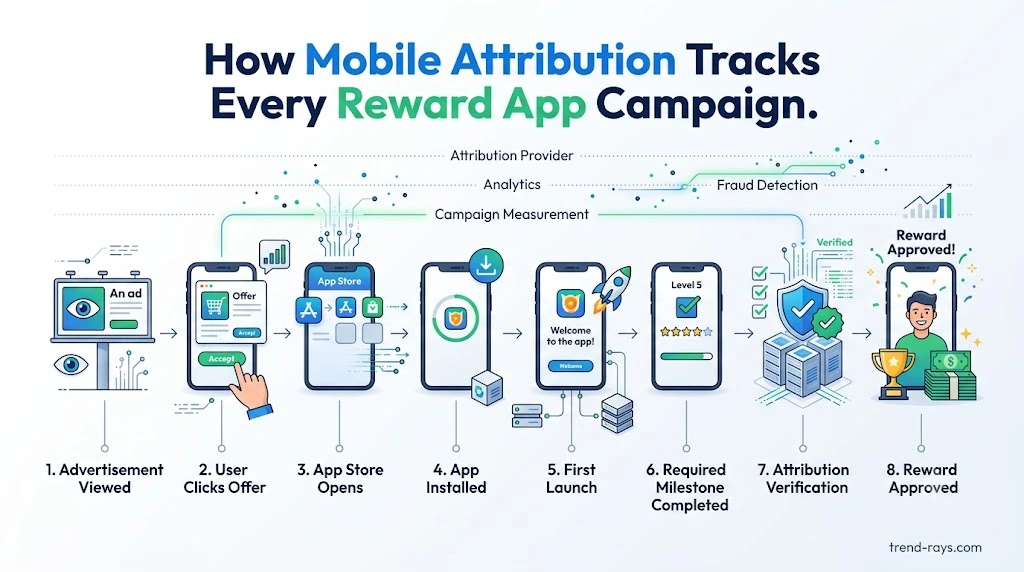
Imagine you open a reward app and accept an offer to install a new mobile game.
You tap the offer.
The App Store opens.
You download the game.
You launch it for the first time.
A few days later, you reach Level 25 exactly as the campaign requires.
Finally, the reward appears in your account.
From a user’s perspective, the process feels simple.
But behind the scenes, something far more complex has happened.
Several independent companies have worked together to verify that every step occurred correctly.
Without this verification, advertisers couldn’t know where new users came from, reward platforms couldn’t approve payouts, and fraud would become almost impossible to prevent.
The technology responsible for connecting all these events is known as mobile attribution.
Although most users never notice it, mobile attribution is one of the most important foundations of the modern mobile advertising industry.
What Is Mobile Attribution?
At its simplest, mobile attribution is the process of identifying which marketing campaign deserves credit for acquiring a new user.
Think of it like a package delivery service.
When you order something online, the parcel passes through multiple locations before reaching your home.
At every stage, tracking systems record where the package has been and where it needs to go next.
Mobile attribution works in a similar way.
Instead of tracking parcels, it tracks marketing events.
It helps advertisers understand:
- where a user first discovered an app,
- which campaign influenced the installation,
- whether required milestones were completed,
- and which marketing channel should receive credit for the conversion.
Without attribution, advertisers would be investing millions of dollars with very little idea which campaigns were actually producing results.
Following a User’s Journey
To understand attribution more clearly, imagine a typical reward app campaign.
A user:
- Opens a reward platform.
- Selects an offer.
- Visits the app store.
- Downloads the app.
- Launches it for the first time.
- Plays until reaching the required milestone.
- Receives the reward.
Although this appears to be one continuous journey, several different organizations are involved.
These may include:
- the advertiser,
- the reward platform,
- the offer wall,
- the app store,
- attribution technology providers,
- analytics systems,
- and fraud detection services.
Attribution technology helps coordinate information between these participants so that each campaign can be measured accurately.
Why Advertisers Need Attribution
Imagine spending $2 million on advertising without knowing which campaigns actually generated customers.
You wouldn’t know:
- which platform performed best,
- which advertisements attracted valuable users,
- where your budget was being wasted,
- or which campaigns deserved additional investment.
Attribution provides those answers.
It enables advertisers to compare acquisition channels using measurable data instead of guesswork.
This is one reason performance marketing has become so effective.
Marketing decisions are increasingly driven by evidence rather than assumptions.
Why Reward Apps Depend on Attribution
Reward platforms also rely heavily on attribution.
Suppose a campaign promises a reward after reaching Level 30.
Before approving payment, the platform must confirm that:
- the installation originated from the correct campaign,
- the required milestones were completed,
- campaign rules were followed,
- and the user qualifies for the reward.
Without attribution, advertisers would have no reliable way to verify legitimate campaign completions.
Rewards could be claimed incorrectly, campaign performance would become unreliable, and advertisers would lose confidence in the system.
Attribution creates trust between everyone involved.
Attribution Helps Prevent Fraud
Unfortunately, not every marketing campaign attracts genuine users.
Some individuals attempt to manipulate campaigns using automated software, duplicate accounts, or other forms of invalid activity.
Advertisers lose money when rewards are issued for users who never intended to become real customers.
Modern attribution systems work alongside fraud detection technologies to identify suspicious behavior.
While no system is perfect, continuous improvements help reduce invalid traffic and improve campaign quality.
Protecting advertisers from fraud ultimately helps preserve marketing budgets for legitimate users.
Attribution Is More Than Counting Installs
Many people assume attribution simply records app downloads.
In reality, modern attribution measures much more.
Advertisers increasingly analyze events such as:
- first app launch,
- account registration,
- completed tutorials,
- gameplay milestones,
- subscriptions,
- purchases,
- retention,
- and long-term engagement.
These additional signals help businesses understand not only where users came from but also how valuable those users become over time.
This information supports better marketing decisions and more efficient advertising budgets.
Privacy Has Changed Mobile Attribution
In recent years, growing awareness of digital privacy has transformed the way attribution works.
Operating systems and regulators have introduced new privacy protections that limit certain forms of user tracking.
As a result, advertisers increasingly rely on privacy-conscious measurement methods, aggregated reporting, and statistical modeling to understand campaign performance while respecting user privacy.
Although the underlying technology continues evolving, the goal remains the same:
To measure marketing effectiveness as accurately and responsibly as possible.
Why Accurate Attribution Benefits Everyone
Attribution isn’t only valuable for advertisers.
It improves the entire ecosystem.
Businesses gain clearer insights into campaign performance.
Reward platforms can verify offers more reliably.
Developers receive better information about user quality.
Users benefit from more relevant campaigns and a healthier marketplace supported by sustainable advertising investments.
When attribution works effectively, every participant can make better decisions based on trustworthy data.
Attribution Connects Every Concept We’ve Learned
Throughout this guide, we’ve explored:
- Customer Acquisition
- Lifetime Value
- Customer Acquisition Cost
- Return on Ad Spend
- Performance Pricing Models
- Audience Segmentation
Mobile attribution brings all of these concepts together.
Without accurate attribution:
- Customer Acquisition Costs couldn’t be measured accurately.
- Return on Ad Spend calculations would become unreliable.
- Audience segmentation would lose valuable performance data.
- Reward platforms couldn’t verify campaign completion.
- Advertisers couldn’t identify their most effective acquisition channels.
In many ways, attribution acts as the central nervous system of modern mobile marketing.
It quietly connects every participant while ensuring marketing investments remain measurable and accountable.
The Future of Mobile Attribution
As artificial intelligence, machine learning, and privacy technologies continue evolving, attribution systems are becoming more intelligent and more privacy-aware.
Future attribution solutions are expected to rely even more on predictive analytics, aggregated measurement, fraud prevention, and privacy-preserving technologies.
Rather than simply recording historical campaign data, these systems will increasingly help advertisers forecast customer quality, optimize acquisition strategies, and allocate budgets more effectively.
For reward platforms, this means better campaign quality, improved fraud prevention, and more sustainable relationships between advertisers and users.
The Bigger Picture
At this point, we’ve uncovered the complete economic engine behind reward apps.
We’ve seen how businesses determine customer value, calculate acquisition costs, evaluate advertising performance, choose pricing models, identify valuable audiences, and verify campaign success.
But one final question remains.
Why has this industry grown so rapidly—and where is it heading next?
To answer that, we need to examine the future of mobile advertising itself.
Artificial intelligence, privacy regulations, changing consumer behavior, and new marketing technologies are already reshaping how companies acquire users.
The next section explores the future of reward app economics and what businesses, marketers, developers, and users should expect in the years ahead.
The Future of Reward App Economics: How Technology, Privacy, and AI Are Reshaping Mobile Advertising
The reward apps available today are very different from those that existed just a few years ago.
Advertising platforms have become more sophisticated.
Privacy regulations have changed how campaigns are measured.
Artificial intelligence now influences everything from audience targeting to budget allocation.
Consumer expectations continue evolving.
Behind every reward app is an industry adapting to constant technological and economic change.
While the basic goal remains the same—acquiring valuable customers efficiently—the methods used to achieve that goal are becoming increasingly advanced.
Understanding these changes helps explain not only where reward apps are today, but also where they’re likely heading in the future.
Artificial Intelligence Is Transforming User Acquisition
Modern advertising campaigns generate enormous amounts of information.
Every day, marketers analyze millions of interactions, including:
- advertisement impressions,
- clicks,
- app installs,
- gameplay milestones,
- purchases,
- retention rates,
- and customer lifetime value.
Manually interpreting this volume of data would be nearly impossible.
Artificial intelligence increasingly assists marketers by identifying patterns that help improve campaign performance.
Rather than replacing human decision-making, AI enables marketing teams to:
- predict customer quality,
- estimate future Lifetime Value,
- optimize advertising bids,
- allocate budgets more efficiently,
- personalize campaigns,
- and identify opportunities for improvement much faster than traditional analysis.
As AI systems continue advancing, reward campaigns are likely to become increasingly personalized and data-driven.
Privacy Is Becoming a Competitive Advantage
Over the past several years, digital privacy has become one of the most important issues in online advertising.
Consumers increasingly expect greater transparency regarding how their information is collected and used.
Technology companies and regulators have responded by introducing stronger privacy protections and limiting certain forms of tracking.
For advertisers, this creates both challenges and opportunities.
Marketing teams must now measure campaign performance while respecting evolving privacy standards.
Instead of relying solely on individual-level tracking, businesses increasingly use:
- aggregated reporting,
- privacy-preserving attribution,
- statistical modeling,
- and predictive analytics.
Companies that successfully balance effective measurement with responsible privacy practices are likely to earn greater trust from both users and business partners.
The Quality of Users Matters More Than the Quantity
For many years, marketing success was often measured by simple growth metrics.
More downloads.
More installs.
More registrations.
Today, businesses are placing greater emphasis on customer quality.
Rather than asking:
“How many users did we acquire?”
Many companies now ask:
“How many valuable customers did we acquire?”
This shift reflects a broader understanding that sustainable growth depends on long-term engagement rather than short-term acquisition numbers.
Reward platforms are adapting to this trend by supporting campaigns focused on meaningful milestones rather than simple app installations.
Fraud Detection Will Continue Improving
As performance marketing grows, so do attempts to manipulate advertising systems.
Invalid traffic, automated software, fake accounts, and other forms of advertising fraud remain significant challenges for the industry.
Fortunately, fraud detection technologies continue evolving.
Artificial intelligence, behavioral analysis, and advanced verification systems help advertisers identify suspicious activity more quickly than ever before.
Although completely eliminating fraud is unlikely, continuous improvements strengthen confidence in performance marketing and help ensure advertising budgets are directed toward genuine users.
Personalization Will Become More Sophisticated
Not every user has the same interests, goals, or preferences.
Future reward campaigns are expected to become increasingly personalized.
Rather than presenting identical offers to everyone, platforms may prioritize campaigns based on factors such as:
- device compatibility,
- geographic availability,
- previous campaign participation,
- user interests,
- and advertiser objectives.
This benefits both sides.
Users receive more relevant opportunities.
Advertisers reach audiences more likely to generate long-term value.
Businesses Will Continue Diversifying Acquisition Channels
Few companies today rely on a single source of new customers.
Instead, businesses spread acquisition budgets across multiple channels to reduce risk and improve overall performance.
Reward platforms will likely continue operating alongside:
- search advertising,
- social media marketing,
- influencer partnerships,
- affiliate marketing,
- referral programs,
- app store optimization,
- content marketing,
- and emerging advertising technologies.
Rather than replacing these channels, reward platforms function as one component of a much broader customer acquisition strategy.
Measurement Will Become Even More Important
Marketing budgets continue growing, and businesses increasingly demand evidence that every advertising dollar is producing measurable value.
Future campaigns are likely to place even greater emphasis on metrics such as:
- Customer Lifetime Value,
- Customer Acquisition Cost,
- Return on Ad Spend,
- retention,
- engagement,
- and long-term profitability.
Businesses that understand these metrics—and invest based on reliable data—are generally better positioned to compete in an increasingly crowded marketplace.
Why Reward Apps Are Likely to Remain Relevant
Some people assume reward apps are a temporary trend.
However, the underlying economic principle has existed for decades.
Businesses have always invested in acquiring customers.
The tools have changed.
The technology has improved.
The measurement systems have become more sophisticated.
But the fundamental objective remains the same:
Acquire valuable customers efficiently while generating sustainable long-term profit.
As long as companies continue competing for new users, there will likely be demand for marketing channels capable of delivering measurable business results.
Reward platforms represent one such channel.
Their future success will depend not only on attracting users, but also on continuing to demonstrate value for advertisers.
The Bigger Lesson
Throughout this guide, we’ve explored far more than reward apps.
We’ve examined the economic principles that influence nearly every modern digital business.
We’ve learned how companies:
- invest in customer acquisition,
- estimate customer lifetime value,
- calculate acquisition costs,
- measure advertising performance,
- evaluate marketing channels,
- use performance-based pricing,
- segment audiences,
- verify campaign results,
- and adapt to changing technologies.
Although these concepts may initially seem technical, they all revolve around one simple business principle:
Companies invest in marketing because they expect long-term customer value to exceed the cost of acquiring those customers.
Everything else—from reward apps to attribution technology—is designed to support that objective.
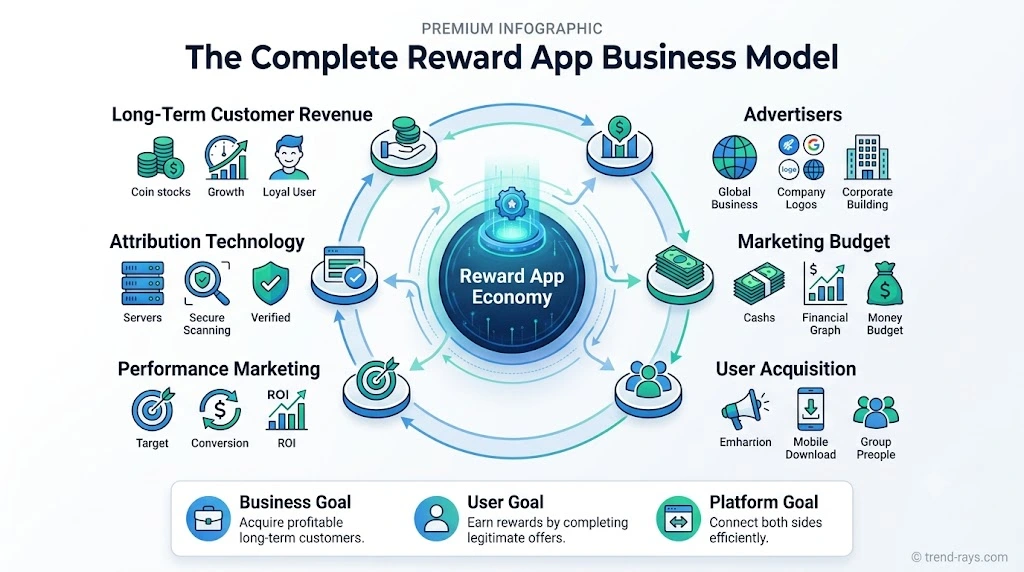
Final Thoughts
The next time you see a reward offering cash for installing a mobile game or completing a financial app registration, you’ll know that the payment isn’t random.
It reflects months—sometimes years—of economic planning, advertising strategy, customer research, campaign optimization, and performance analysis.
Behind every reward lies an entire ecosystem of advertisers, developers, analytics providers, attribution platforms, marketing technologies, and business decisions working together toward a shared goal:
Finding valuable customers in the most efficient way possible.
Understanding these economics doesn’t just explain how reward apps work.
It also provides valuable insight into the broader world of digital marketing, mobile advertising, and modern business strategy.
Whether you’re a curious user, an aspiring marketer, an app developer, or simply interested in how today’s digital economy operates, these principles offer a foundation for understanding one of the fastest-growing sectors of the online marketplace.
What’s Next?
If you’ve reached this point, you now understand the complete economic framework behind reward apps—from customer acquisition and advertising budgets to attribution technology and performance marketing.
To deepen your understanding, consider exploring these related guides:
- How Reward Apps Make Money – Learn how advertisers, offer walls, attribution platforms, and reward apps work together to create a sustainable business model.
- Legit Money Making Game Apps – Discover trustworthy reward apps while understanding the business logic behind their offers.
- Offer Walls Explained (Coming Soon) – A deep dive into how offer walls connect advertisers, publishers, and users.
- Mobile Attribution Explained (Coming Soon) – Explore the technology that measures installs, campaign performance, and user journeys.
- Customer Acquisition Cost (CAC) Explained (Coming Soon) – Learn how businesses calculate and optimize the cost of acquiring new customers.
- Customer Lifetime Value (LTV) Explained (Coming Soon) – Understand why long-term customer relationships drive modern marketing decisions.
Together, these resources build a complete knowledge base around performance marketing, mobile advertising, and the economics of digital customer acquisition.
Following One Dollar: How Money Flows Through the Reward App Ecosystem
By this point, we’ve explored the economics, technology, and marketing strategies behind reward apps.
But let’s simplify everything into a single journey.
Imagine an advertiser decides to spend $1 million acquiring new customers for a mobile game.
Where does that money actually go?
And how does a portion of it eventually become the reward you receive?
Following that money reveals how every participant in the ecosystem contributes to the final outcome.
Step 1: The Advertiser Sets a Marketing Budget
Everything begins with the advertiser.
This could be:
- a mobile game studio,
- a fintech company,
- a shopping platform,
- a streaming service,
- or any business looking to acquire new customers.
Instead of waiting for users to discover their app naturally, the company allocates part of its annual marketing budget toward customer acquisition.
For many businesses, this represents one of the largest investments they make each year.
The objective isn’t simply to generate downloads.
It’s to acquire profitable long-term customers.
Step 2: The Budget Is Distributed Across Multiple Channels
Rarely does a company invest its entire budget into a single advertising platform.
Instead, marketers spread spending across several acquisition channels.
A typical budget might be divided among:
- search advertising,
- social media campaigns,
- influencer marketing,
- affiliate marketing,
- referral programs,
- app store advertising,
- content marketing,
- and reward platforms.
Each channel competes for a share of the same acquisition budget.
Campaign performance determines where future investment goes.
Step 3: Advertising Partners Deliver Potential Customers
Once campaigns begin, advertising partners start introducing users to the app.
Some people discover the app through:
- Google Search,
- YouTube,
- TikTok,
- Facebook,
- influencer videos,
- blog articles,
- or reward platforms.
Every channel has one responsibility:
Deliver qualified users who are likely to become valuable customers.
Now the reward app enters the picture.
The advertiser isn’t creating money out of thin air.
Instead, part of the existing customer acquisition budget is allocated to reward campaigns.
That budget helps cover:
- platform operations,
- campaign management,
- fraud prevention,
- attribution services,
- publisher commissions,
- and user rewards.
The cash you receive isn’t separate from the advertising budget.
It’s one carefully planned component of it.
Step 5: The User Completes the Required Action
After accepting an offer, the user completes the required campaign objective.
Depending on the campaign, this may involve:
- installing an app,
- reaching a specific game level,
- registering an account,
- subscribing to a service,
- making a purchase,
- or completing another measurable milestone.
Only after these requirements are verified does the advertiser recognize the acquisition as successful.
Step 6: Attribution Verifies the Journey
Before rewards are approved, attribution systems verify that the required conditions have been met.
These systems help confirm:
- where the user originated,
- which campaign influenced the installation,
- whether milestones were completed correctly,
- and whether the conversion qualifies for payment.
This verification protects both advertisers and reward platforms while ensuring campaigns remain measurable.
Step 7: Business Revenue Begins
The story doesn’t end when the reward is paid.
In many ways, it’s only beginning.
If the newly acquired customer continues using the app, the business may eventually generate revenue through:
- subscriptions,
- in-app purchases,
- advertisements,
- premium features,
- marketplace commissions,
- financial products,
- or repeat transactions.
Over months or even years, that customer may generate significantly more revenue than the original acquisition cost.
Step 8: The Cycle Starts Again
Marketing isn’t a one-time activity.
Businesses continuously evaluate campaign performance.
If customer acquisition remains profitable, budgets often increase.
If campaigns underperform, strategies change.
This creates a continuous cycle:
- Invest in marketing.
- Acquire customers.
- Measure performance.
- Analyze profitability.
- Improve campaigns.
- Reinvest.
Every successful reward campaign is part of this ongoing optimization process.
The Entire Ecosystem at a Glance
Although reward apps may appear simple from a user’s perspective, they’re actually supported by an interconnected business ecosystem.
Advertiser
        │
        ▼
Marketing Budget
        │
        ▼
Advertising Channels
        │
        ▼
Reward Platform / Offer Wall
        │
        ▼
User Completes Campaign
        │
        ▼
Attribution Verification
        │
        ▼
Reward Issued
        │
        ▼
Long-Term Customer Revenue
        │
        ▼
Campaign Analysis
        │
        ▼
Future Marketing Investment
Every participant depends on the others.
Advertisers need profitable customers.
Reward platforms need successful campaigns.
Users receive incentives for participating.
Attribution providers measure performance.
Analytics platforms generate insights.
Together, they form a self-reinforcing economic system where every dollar is expected to generate measurable business value.
Why Understanding the Money Flow Matters
Once you understand how marketing budgets move through this ecosystem, reward apps no longer seem mysterious.
The rewards users receive aren’t random giveaways.
They’re carefully planned investments funded by businesses seeking sustainable growth.
Every reward represents a calculated decision based on customer acquisition, expected lifetime value, campaign performance, and long-term profitability.
That’s the real economics behind reward apps.
Understanding this complete flow also explains why reward amounts change, why campaigns appear and disappear, and why advertisers continually optimize their marketing strategies.
Glossary of Key Reward App and Mobile Marketing Terms
If you’re new to digital advertising or reward apps, you’ll likely encounter unfamiliar marketing terms throughout this guide.
This glossary provides simple definitions of the concepts that power the reward app ecosystem.
Advertiser
A business that pays to promote its app, product, or service with the goal of acquiring new customers.
Ad Impression
A single instance of an advertisement being displayed to a user, regardless of whether the user interacts with it.
Affiliate Marketing
A performance-based marketing model in which publishers or partners earn commissions for generating qualified customers or sales for advertisers.
Attribution
The process of determining which marketing campaign or advertising channel deserves credit for acquiring a customer or generating a conversion.
Audience Segmentation
The practice of dividing potential customers into groups based on shared characteristics to improve marketing effectiveness.
Campaign
A planned marketing initiative with a defined objective, budget, audience, and performance metrics.
Churn Rate
The percentage of users who stop using an app or service over a specific period.
A lower churn rate generally indicates better customer retention.
Conversion
A completed action that an advertiser considers valuable, such as installing an app, registering an account, making a purchase, or subscribing to a service.
Cost Per Action (CPA)
An advertising pricing model in which advertisers pay only after users complete a predefined action.
Cost Per Click (CPC)
An advertising model where advertisers pay only when users click on an advertisement.
Cost Per Install (CPI)
A pricing model in which advertisers pay for verified app installations rather than impressions or clicks.
Cost Per Mille (CPM)
A pricing model where advertisers pay for every one thousand advertisement impressions.
“Mille” is the Latin word for one thousand.
Customer Acquisition
The process of attracting and converting new users into customers.
Customer Acquisition Cost (CAC)
The average amount a business spends to acquire one new customer across its marketing activities.
Customer Lifetime Value (LTV)
An estimate of the total revenue a customer is expected to generate throughout their relationship with a business.
Fraud Detection
Technologies and processes used to identify invalid installs, fake accounts, automated activity, and other fraudulent behavior that could distort campaign performance.
In-App Purchase
A digital purchase made within a mobile application, such as virtual currency, premium features, subscriptions, or cosmetic items.
Mobile Attribution
Technology that connects advertising campaigns with app installs and user actions, helping advertisers measure campaign performance accurately.
Offer Wall
A section within a reward app where users can browse campaigns and earn rewards by completing specific tasks defined by advertisers.
Organic User
A customer who discovers and installs an app without interacting with a paid advertising campaign.
Performance Marketing
A marketing approach in which advertisers pay based on measurable outcomes such as clicks, installs, registrations, purchases, or subscriptions.
Publisher
A website, app, creator, or platform that displays advertisements or promotional campaigns on behalf of advertisers.
Reward apps often act as publishers within the performance marketing ecosystem.
Retention
A measure of how successfully a business keeps customers actively using its product over time.
High retention often leads to greater Customer Lifetime Value.
Return on Ad Spend (ROAS)
A marketing metric that measures how much revenue is generated for every dollar spent on advertising.
Reward Platform
An application or website that connects advertisers with users by offering rewards for completing verified marketing campaigns.
User Acquisition (UA)
The process of gaining new users through paid or organic marketing channels.
User Acquisition is a core function of modern mobile marketing.
User Engagement
The level of interaction users have with an app, including session frequency, time spent, purchases, gameplay progression, and other meaningful activities.
Verification
The process of confirming that a campaign’s requirements have been completed correctly before rewards are approved.
Verification helps protect advertisers, platforms, and legitimate users from invalid activity.
Why These Terms Matter
Although each concept serves a different purpose, they work together within a single customer acquisition system.
For example:
- An advertiser launches a campaign.
- A reward platform promotes that campaign through an offer wall.
- Attribution verifies the installation and completed actions.
- The advertiser measures CAC, LTV, and ROAS.
- If the campaign is profitable, additional marketing budget is invested to acquire more customers.
Understanding these relationships makes it much easier to see how reward apps fit into the broader world of digital advertising and performance marketing.
Frequently Asked Questions (FAQ)
1. Why do reward apps pay users to complete tasks?
Reward apps don’t create money themselves. Instead, they receive marketing budgets from advertisers that want to acquire new customers. When a business wants more app installs, game players, subscribers, or account registrations, it allocates part of its customer acquisition budget to performance marketing campaigns.
Reward platforms share a portion of that budget with users who successfully complete the required actions. From the advertiser’s perspective, the reward isn’t a gift—it’s a customer acquisition expense. If the newly acquired customer generates more long-term value than the cost of acquiring them, the campaign becomes profitable.
2. Why do some reward app offers pay much more than others?
Reward values are determined by business economics rather than task difficulty.
Advertisers consider factors such as expected Customer Lifetime Value (LTV), Customer Acquisition Cost (CAC), campaign objectives, competition, geographic targeting, and the likelihood that users will remain engaged.
A campaign requiring a user to reach an advanced game level or open a financial account generally creates more business value than a simple app installation. As a result, advertisers are often willing to allocate larger acquisition budgets to those campaigns, leading to higher rewards.
3. Why are the same offers worth different amounts in different countries?
Advertising markets differ significantly around the world.
Businesses consider purchasing power, local competition, customer behavior, marketing costs, and expected long-term revenue when planning campaigns.
If customers in one country historically generate higher Lifetime Value, advertisers may invest more aggressively in acquiring users there. Conversely, campaigns in emerging markets may operate under different budget constraints.
For this reason, identical offers often have different payouts depending on where the user is located.
4. Why do advertisers require users to reach specific game levels?
Installing an app doesn’t necessarily create a valuable customer.
Many users install games, open them once, and never return.
Requiring players to reach milestones such as Level 20 or Level 30 provides stronger evidence that they’re genuinely engaging with the product.
Users who invest more time are generally more likely to continue playing, watch advertisements, make in-app purchases, or become long-term customers. Milestone-based campaigns help advertisers reduce wasted marketing spend while improving overall campaign quality.
5. How do reward apps verify that I completed an offer?
Reward apps typically rely on attribution technology and campaign verification systems.
These technologies help confirm that the installation originated from the correct campaign, the required milestones were completed, and campaign rules were followed.
Depending on the offer, verification may occur almost immediately or require additional processing time. Successful verification ensures advertisers only pay for legitimate campaign completions while helping protect the ecosystem from fraud.
6. Why do some rewards remain pending for several days?
Pending rewards are usually part of the advertiser’s verification process.
Businesses often review completed campaigns to confirm that all eligibility requirements have been satisfied before approving payment.
Some campaigns also include validation periods to detect fraudulent activity, duplicate accounts, or invalid conversions.
Although waiting can be frustrating, verification helps maintain advertiser confidence and supports long-term sustainability for reward platforms.
7. Can advertisers lose money on reward campaigns?
Yes.
Not every campaign produces profitable results.
If the total cost of acquiring customers exceeds the revenue those customers eventually generate, advertisers may experience negative returns on their marketing investment.
This is why businesses carefully monitor Customer Acquisition Cost (CAC), Customer Lifetime Value (LTV), and Return on Ad Spend (ROAS). Campaigns that consistently underperform are often paused, redesigned, or discontinued.
8. Why do reward app offers disappear unexpectedly?
Reward campaigns operate within fixed marketing budgets.
Once an advertiser reaches its acquisition target, exhausts its budget, or decides to optimize campaign performance, offers may be paused or removed.
Seasonality, changing business priorities, campaign performance, and competitive market conditions can also influence campaign availability.
The disappearance of an offer doesn’t necessarily indicate a problem—it often reflects normal marketing optimization.
9. Are reward apps part of affiliate marketing?
Many reward platforms share characteristics with affiliate marketing because both operate within the broader performance marketing ecosystem.
The main difference is that affiliate publishers usually promote products to audiences through websites, blogs, or social media, whereas reward platforms encourage users to complete campaigns directly in exchange for incentives.
Although the business models differ, both rely on measurable customer acquisition and advertiser-funded performance payments.
10. Will reward apps continue to exist in the future?
No one can predict the future with certainty, but the underlying business principle behind reward apps has existed for decades.
Businesses will continue competing to acquire profitable customers, and performance marketing remains one of the most measurable ways to achieve that goal.
While technologies, privacy standards, attribution systems, and artificial intelligence will continue evolving, the demand for efficient customer acquisition channels is likely to remain. Reward platforms that consistently deliver valuable users while adapting to changing technologies are therefore well positioned to remain relevant within the broader digital marketing ecosystem.