Introduction
Artificial intelligence is rapidly becoming part of modern healthcare workflows, and Speech-Language Pathologists (SLPs) are no exception. From generating therapy ideas and organizing clinical documentation to drafting parent communication and simplifying complex research, tools like ChatGPT can save valuable time.
However, one important question continues to surface:
Can Speech-Language Pathologists use ChatGPT without violating HIPAA?
The answer isn’t simply “yes” or “no.”
It depends entirely on how ChatGPT is used, what information is shared, and whether protected patient information is exposed.
Many clinicians have heard conflicting advice. Some believe AI should never be used in healthcare, while others mistakenly assume that removing a patient’s name alone is enough to comply with privacy requirements. Neither assumption tells the whole story.
This guide is designed specifically for Speech-Language Pathologists who want to understand where ChatGPT fits into clinical practice without compromising patient privacy or professional responsibility.
Rather than offering vague recommendations, this article explains:
- What HIPAA requires from SLPs
- Whether ChatGPT is HIPAA compliant
- Which tasks are generally appropriate for AI assistance
- Which activities should be avoided
- Safe prompting techniques
- Practical clinical workflows
- Common mistakes that could expose Protected Health Information (PHI)
- Frequently asked questions from practicing clinicians
By the end of this guide, you’ll have a practical framework for deciding when AI can support your work—and when it should stay out of the process.
Why This Topic Matters More Than Ever
Artificial intelligence is no longer an experimental technology used only by software engineers. It is increasingly being adopted across healthcare, education, private practice, and rehabilitation settings to improve efficiency and reduce administrative workload.
Speech-Language Pathologists often spend a significant portion of their week on tasks that extend far beyond direct therapy sessions, including:
- Writing SOAP notes
- Preparing progress reports
- Developing therapy materials
- Drafting home programs
- Creating individualized goals
- Responding to parent inquiries
- Reviewing clinical literature
- Planning intervention sessions
Many of these tasks are repetitive and time-consuming, making them attractive candidates for AI assistance.
At the same time, SLPs have a legal and ethical obligation to protect patient confidentiality. A single mistake involving Protected Health Information (PHI) can have serious consequences for patients, employers, and clinicians.
This creates an important challenge:
How can clinicians benefit from AI without compromising privacy?
Unfortunately, many online resources oversimplify the answer. Some suggest avoiding AI entirely, while others encourage its use without clearly explaining the privacy implications.
The goal of this guide is to provide balanced, practical advice that helps SLPs make informed decisions based on established privacy principles rather than fear or hype.
Who Should Read This Guide?
This article is intended for professionals and students involved in speech-language pathology who are exploring responsible ways to incorporate AI into their work.
H3: School-Based Speech-Language Pathologists
Learn how AI can assist with lesson planning, activity creation, and educational resources while protecting student information.
Medical Speech-Language Pathologists
Understand the additional privacy considerations involved in hospital, rehabilitation, and outpatient clinical settings.
Private Practice Owners
Discover workflows that improve efficiency without exposing confidential client information.
Graduate Students and Clinical Fellows
Build good habits early by understanding where AI can support learning and documentation—and where it should not be used.
Clinic Managers and Practice Administrators
Develop policies and training materials for responsible AI adoption within your organization.
What You’ll Learn in This Guide
Instead of focusing only on whether ChatGPT is “allowed,” this guide answers the practical questions clinicians face every day.
By the end of this article, you’ll understand:
Privacy Fundamentals
- What HIPAA protects
- What qualifies as Protected Health Information (PHI)
- Common misconceptions about patient data
ChatGPT and HIPAA
- Whether ChatGPT is inherently HIPAA compliant
- Why privacy depends on implementation rather than the AI model alone
Safe Clinical Workflows
- Appropriate use cases
- Unsafe use cases
- Documentation guidance
- Prompt-writing strategies
- Risk reduction techniques
Practical Resources
You’ll also gain access to:
- Safe prompt examples
- Unsafe prompt examples
- Clinical workflow templates
- Privacy checklist
- Frequently asked questions
- Best practices for responsible AI use
Key Takeaways
Before diving into the details, it’s helpful to understand three core principles that shape the rest of this guide:
AI Can Improve Productivity
Used responsibly, ChatGPT can assist with brainstorming, educational content, administrative writing, and general documentation support.
Patient Privacy Always Comes First
No productivity benefit outweighs the responsibility to protect confidential patient information.
Responsible Use Requires Judgment
AI is a tool—not a replacement for professional expertise, clinical reasoning, or legal compliance. Speech-Language Pathologists remain responsible for reviewing outputs, safeguarding privacy, and ensuring that any AI-assisted work meets professional and ethical standards.
Understanding HIPAA: What Every Speech-Language Pathologist Needs to Know Before Using AI
Before deciding whether ChatGPT can be safely incorporated into your clinical workflow, it’s essential to understand what the Health Insurance Portability and Accountability Act (HIPAA) actually requires.
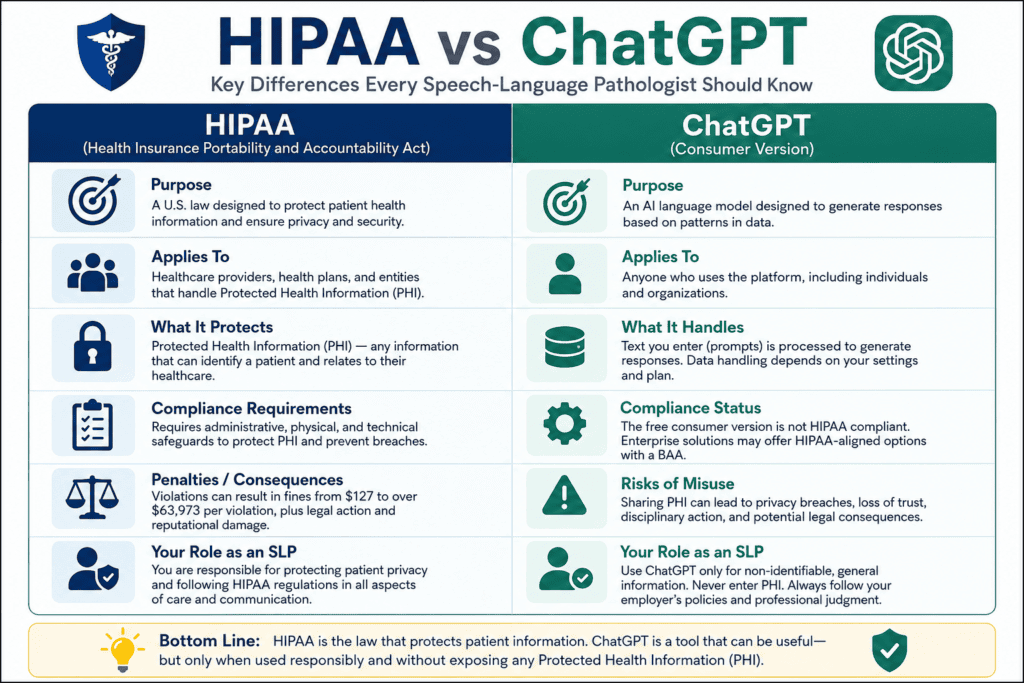
One of the biggest misconceptions among healthcare professionals is that HIPAA prohibits the use of artificial intelligence. In reality, HIPAA does not ban AI tools. Instead, it regulates how protected health information (PHI) is collected, stored, transmitted, and shared.
For Speech-Language Pathologists, understanding this distinction is critical because the risk isn’t AI itself—it’s exposing identifiable patient information inappropriately.
What Is HIPAA?
The Health Insurance Portability and Accountability Act (HIPAA) is a U.S. federal law enacted in 1996 to safeguard the privacy and security of patients’ health information.
Its primary objectives include:
- Protecting patient confidentiality.
- Establishing standards for electronic health information.
- Giving patients greater control over their medical records.
- Reducing healthcare fraud and abuse.
- Requiring organizations to implement appropriate security measures.
For Speech-Language Pathologists working in hospitals, schools (depending on applicable regulations), rehabilitation centers, private practices, and multidisciplinary clinics, HIPAA often plays an important role in daily clinical operations.
However, HIPAA compliance is not simply about technology—it is about how professionals handle patient information throughout its lifecycle.
What Is Protected Health Information (PHI)?
Protected Health Information (PHI) refers to individually identifiable health information that relates to a person’s health, healthcare services, or payment for healthcare.
PHI can exist in many forms, including:
- Written records
- Electronic files
- Audio recordings
- Images
- Emails
- Billing documents
- Clinical notes
- Evaluation reports
If information can reasonably identify a patient while relating to their healthcare, it should generally be treated as protected.
Common Examples of PHI in Speech-Language Pathology
Speech-Language Pathologists routinely work with information that falls under PHI protections.
Examples include:
Patient Identification
- Full name
- Home address
- Phone number
- Email address
- Date of birth
- Medical record number
- Insurance information
Clinical Documentation
- Speech-language evaluation reports
- Cognitive assessments
- Swallowing evaluations
- Therapy progress notes
- SOAP notes
- Treatment plans
- Discharge summaries
Educational Records (When Applicable)
Depending on the setting and applicable privacy laws, documentation may include:
- Individualized Education Program (IEP) information
- Therapy goals
- School reports
- Parent communication
- Student progress tracking
Always understand which privacy regulations apply in your specific work environment.
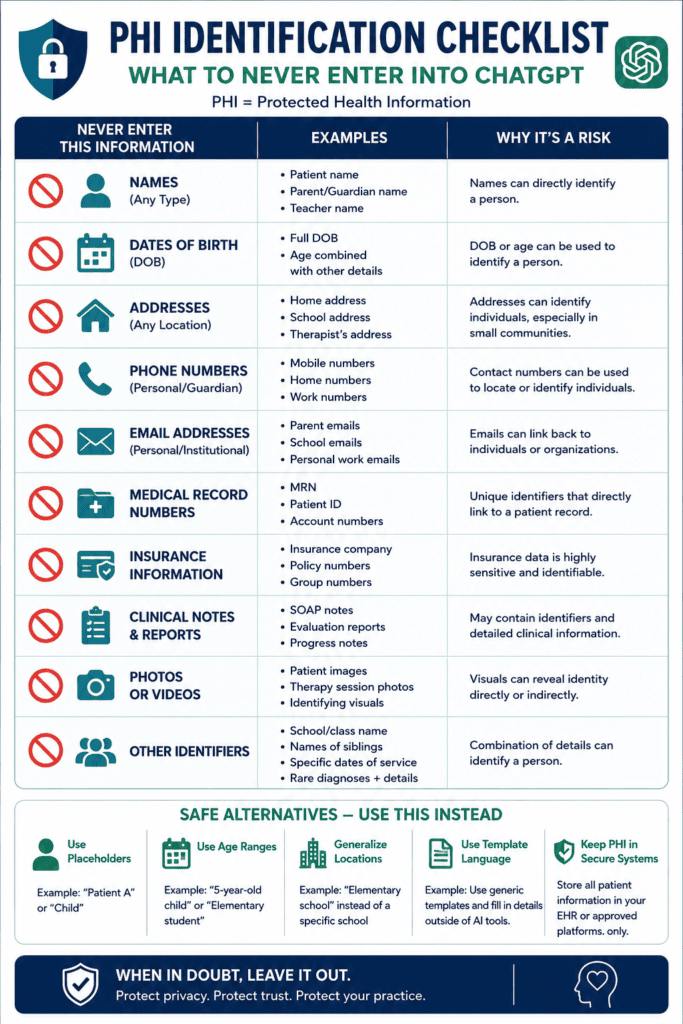
The 18 HIPAA Identifiers Every Clinician Should Recognize
Many clinicians assume that removing a patient’s name makes documentation safe to share.
Unfortunately, that’s not always true.
HIPAA’s de-identification guidance includes numerous identifiers that may need to be removed before information can be considered de-identified under applicable standards.
Examples include:
Direct Identifiers
- Patient names
- Addresses
- Telephone numbers
- Email addresses
- Social Security numbers
- Medical record numbers
- Insurance policy numbers
- Account numbers
Indirect Identifiers
These may also contribute to identifying an individual when combined with other information.
Examples include:
- Full dates related to an individual (such as birth date or admission date)
- Geographic information smaller than a state (with limited exceptions under HIPAA guidance)
- Device identifiers
- Biometric identifiers
- Photographs showing a patient’s face
- Unique identifying codes linked to an individual
Removing only the patient’s name does not necessarily eliminate privacy risks.
Why This Matters When Using ChatGPT
Every prompt entered into an AI system is a piece of information being shared with that system.
Consider the following example.
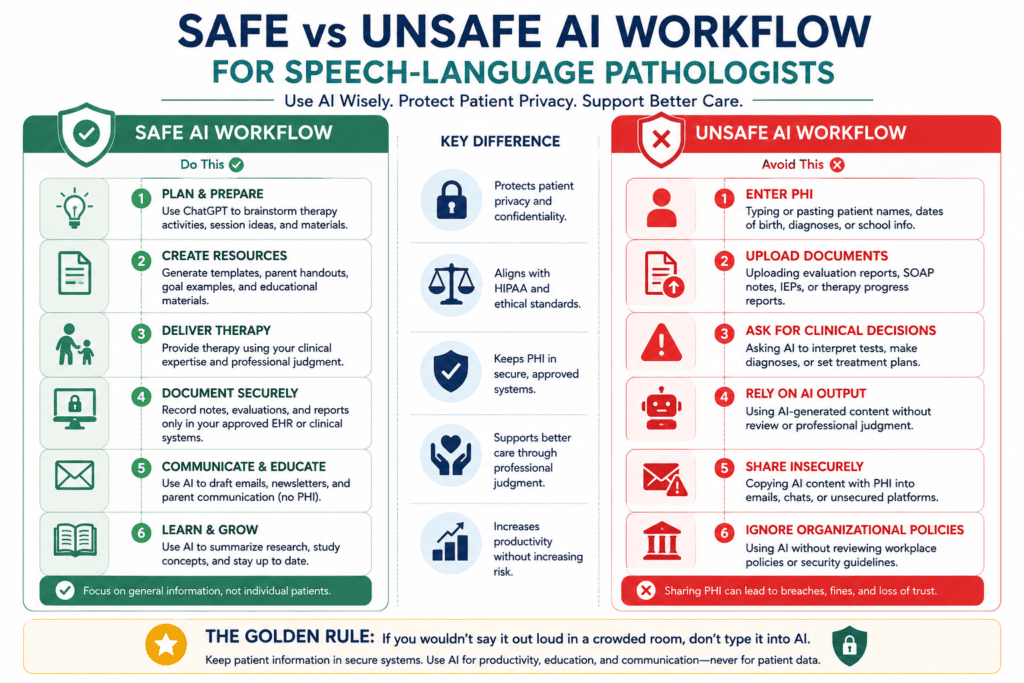
❌ Unsafe Prompt
Write a professional SOAP note for my patient John Smith, born on March 8, 2016.

He attends Lincoln Elementary School.

He has Childhood Apraxia of Speech and receives therapy twice a week.
This prompt includes multiple identifiers that could reveal a patient’s identity.
✅ Safer Alternative
Generate a SOAP note template for a pediatric speech therapy session involving a young child with Childhood Apraxia of Speech.

Use placeholder text instead of patient-specific information.
Notice the difference.
The second prompt requests the same type of assistance without exposing identifiable patient information.
This simple change dramatically reduces privacy risks while still allowing AI to provide useful support.
Why “Removing the Name” Isn’t Always Enough
Many Speech-Language Pathologists believe that deleting the patient’s name automatically makes documentation anonymous.
In practice, combinations of seemingly harmless details can sometimes identify an individual.
For example:
- Rare diagnoses
- Small communities
- Specific schools
- Exact therapy schedules
- Unusual demographic details
- Dates associated with care
Even if each detail seems insignificant on its own, together they may reveal who the patient is.
When in doubt, the safest approach is to avoid entering patient-specific details into consumer AI tools.
HIPAA Compliance Is About More Than Technology
Many discussions online ask:
“Is ChatGPT HIPAA compliant?”
A more useful question is:
“Am I using ChatGPT in a way that protects patient privacy?”
Compliance depends on the overall workflow, including:
- What information is entered.
- Whether identifiers are removed appropriately.
- Organizational policies.
- Security controls.
- Contracts and technical safeguards where required.
- Professional judgment.
Technology alone cannot guarantee compliance.
Common HIPAA Myths About AI
Let’s address several misconceptions that frequently appear in discussions among healthcare professionals.
Myth #1: AI Is Illegal in Healthcare
Reality:
Healthcare organizations increasingly explore AI for administrative tasks, documentation assistance, research support, scheduling, and education.
The focus is on using AI responsibly while protecting patient information.
Myth #2: Removing the Patient’s Name Makes Everything Safe
Reality:
Removing only a name may not sufficiently de-identify information.
Other identifiers and combinations of details can still reveal someone’s identity.
Myth #3: AI Can Replace Clinical Judgment
Reality:
ChatGPT can assist with drafting, brainstorming, summarizing general information, and generating templates.
It cannot replace:
- Clinical reasoning
- Professional assessment
- Diagnosis
- Ethical decision-making
- Individualized treatment planning
Speech-Language Pathologists remain responsible for every clinical decision they make.
Myth #4: Every AI Tool Handles Data the Same Way
Reality:
AI platforms differ significantly in:
- Privacy policies
- Data handling practices
- Security features
- Administrative controls
- Enterprise options
- Compliance capabilities
Understanding the specific platform and your organization’s policies is essential before incorporating AI into clinical workflows.
Key Takeaways
Before using ChatGPT in speech-language pathology, clinicians should have a clear understanding of HIPAA fundamentals.
The most important principle is that patient privacy—not AI itself—is at the center of compliance.
Protected Health Information includes far more than names, and even seemingly harmless details can sometimes identify an individual.
By understanding what PHI is, recognizing common misconceptions, and thinking carefully about the information entered into AI tools, Speech-Language Pathologists can make more informed decisions about when AI can support their work and when it should not.
Is ChatGPT HIPAA Compliant? The Answer Most Articles Oversimplify
This is the question almost every Speech-Language Pathologist asks before experimenting with AI:
“Is ChatGPT HIPAA compliant?”
If you’ve searched online, you’ve probably seen conflicting answers.
Some websites simply say “No.”
Others confidently claim “Yes.”
The truth is more nuanced.
The correct answer is:
ChatGPT is not automatically HIPAA compliant simply because it exists as an AI tool. Whether it can be used in a HIPAA-regulated environment depends on the specific deployment, the information entered, organizational policies, and the technical and contractual safeguards in place.
For most Speech-Language Pathologists using the standard consumer version of ChatGPT, the safest assumption is:
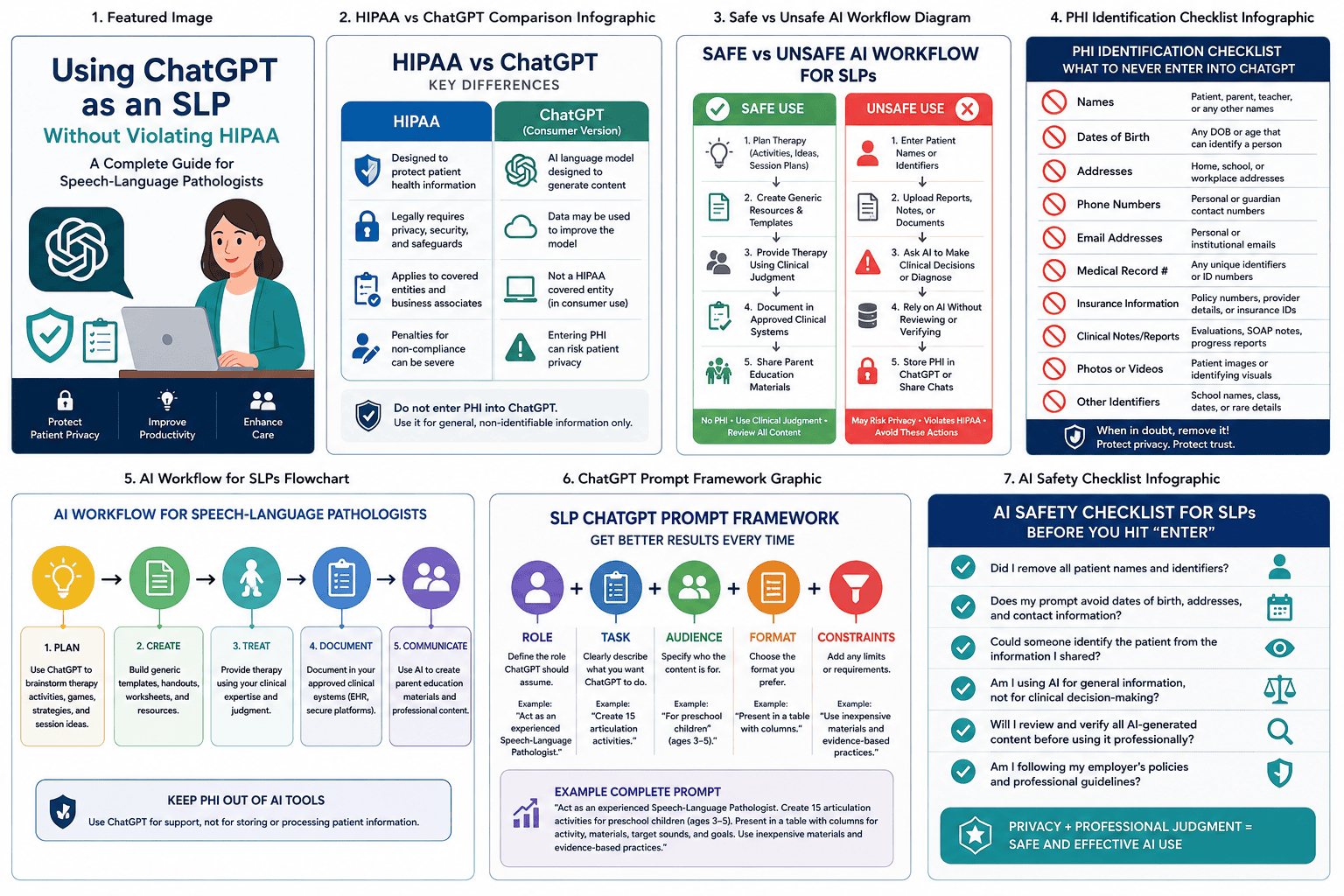
Do not enter Protected Health Information (PHI) into ChatGPT.
This simple rule eliminates the vast majority of privacy risks.
Why There Isn’t a Simple Yes or No Answer
Many articles reduce this discussion to a single sentence:
“ChatGPT isn’t HIPAA compliant.”
While that statement is often used as practical advice for everyday users, it doesn’t explain why.
HIPAA compliance is not a label attached to software.
Instead, compliance depends on how healthcare organizations use technology within a broader privacy and security framework.
Several factors influence whether an AI system can be used in regulated healthcare environments, including:
- Administrative safeguards
- Technical safeguards
- Organizational security policies
- Access controls
- Audit logging
- Data retention practices
- Contractual agreements
- Workforce training
Because these factors vary from one implementation to another, there is no universal answer that applies to every AI deployment.
Consumer ChatGPT vs Enterprise AI Solutions
This distinction is one of the biggest sources of confusion.
Consumer ChatGPT
Most clinicians experimenting with AI are using the publicly available version of ChatGPT.
This version is designed as a general-purpose AI assistant rather than a healthcare documentation platform.
For that reason, clinicians should avoid entering:
- Patient names
- Evaluation reports
- Clinical notes
- Medical record numbers
- Insurance details
- Therapy documentation containing identifiable information
Instead, use ChatGPT for tasks that do not require patient-specific data.
Enterprise AI Environments
Some healthcare organizations implement AI solutions with additional privacy, security, and contractual protections.
These environments may include:
- Organizational access controls
- Centralized administration
- Security monitoring
- Configurable data handling policies
- Contractual arrangements designed for healthcare environments
Whether such an implementation is appropriate depends on the organization, its legal obligations, and its compliance processes.
Individual clinicians should always follow their employer’s policies rather than making assumptions about a platform’s suitability.
What Does This Mean for Speech-Language Pathologists?
For most practicing SLPs, the practical takeaway is straightforward.
Think of ChatGPT as an assistant for:
✔ Writing
✔ Brainstorming
✔ Education
✔ Planning
✔ General templates
Not as a storage location for patient records.
If a prompt contains information that would normally be protected inside your Electronic Health Record (EHR) system, it probably doesn’t belong in a general-purpose AI chat.
A Simple Decision Framework
Before entering anything into ChatGPT, ask yourself these questions.
Question 1
Does this prompt contain any patient identifiers?
If Yes
➡ Stop.
Remove the information.
Question 2
Could someone identify the patient from the remaining details?
If Yes
➡ Rewrite the prompt.
Generalize the information further.
Question 3
Am I asking ChatGPT to create a generic resource rather than analyze an individual patient?
If Yes
You’re moving toward a much safer workflow.
Safe Examples of ChatGPT Use
These examples generally avoid patient-specific information and focus on educational or administrative support.
Therapy Activity Ideas
Suggest five articulation activities for children working on the /r/ sound.

Use play-based approaches suitable for ages 6–8.
Parent Education
Create a parent handout explaining language stimulation strategies for preschool-aged children.

Use simple language.
Goal Inspiration
Provide example SMART goals for expressive language development.

Do not reference any individual patient.
Clinical Education
Explain current evidence-based approaches for treating aphasia.

Summarize the information for clinicians.
Documentation Templates
Create a generic SOAP note template for pediatric speech therapy.

Use placeholders instead of patient information.
These prompts leverage AI’s strengths without exposing confidential information.
Examples That Should Be Avoided
Now compare those with prompts that introduce privacy concerns.
❌ Example 1
Rewrite my patient's evaluation report.

Here is the full document...
❌ Example 2
Summarize today's therapy session for Emily Johnson.

DOB:

Diagnosis:

Insurance:
❌ Example 3
Improve this progress report.

(Paste full report)
❌ Example 4
Analyze this swallowing evaluation from today's patient.Even if your intention is simply to improve wording, sharing identifiable clinical documentation with a consumer AI service can create privacy risks.
Think Like This Instead
Instead of asking ChatGPT to work with real patient information…
Ask it to teach you how to write better documentation.
For example:
Instead of:
Rewrite my patient's SOAP note.Ask:
Show me what an excellent pediatric speech therapy SOAP note should include.

Use fictional placeholder information only.
This approach turns ChatGPT into a learning and productivity assistant rather than a processor of sensitive patient data.
The “Coffee Shop Test”
Here’s a simple rule many clinicians find helpful.
Before pressing Enter, ask yourself:
“Would I feel comfortable reading this prompt aloud in a crowded coffee shop?”
If the answer is No, it probably contains information that shouldn’t be entered into a general AI chatbot.
While this isn’t a legal test, it’s an easy mental check that encourages privacy-conscious thinking.
Why Responsible AI Use Builds Patient Trust
Patients trust Speech-Language Pathologists with highly personal information.
Protecting that information is part of professional ethics—not just regulatory compliance.
Responsible AI use demonstrates that technology is being used to improve efficiency while maintaining respect for patient confidentiality.
The goal should never be to replace clinical judgment or compromise privacy in exchange for convenience.
Instead, AI should reduce administrative burden while preserving the standards patients expect from healthcare professionals.
Key Takeaways
The question “Is ChatGPT HIPAA compliant?” doesn’t have a universal yes-or-no answer.
For most Speech-Language Pathologists using the standard version of ChatGPT, the safest and simplest approach is to avoid entering Protected Health Information altogether.
ChatGPT can still provide tremendous value by helping with:
- Therapy planning
- Educational materials
- Documentation templates
- Clinical learning
- Parent resources
- Professional writing
without ever needing access to identifiable patient data.
Understanding this distinction allows clinicians to benefit from AI while maintaining privacy, professionalism, and patient trust.
15 Safe Ways Speech-Language Pathologists Can Use ChatGPT Every Day (Without Sharing PHI)
Artificial intelligence doesn’t need access to patient records to be useful.
In fact, some of the most valuable ways Speech-Language Pathologists use ChatGPT involve education, planning, communication, organization, and professional development—areas where no patient-identifying information is required.
The key principle is simple:
Ask ChatGPT to help you create resources, not process patient records.
Below are practical examples that demonstrate how AI can improve productivity while helping clinicians maintain patient privacy.
1. Generate Therapy Activity Ideas
Creating engaging therapy sessions week after week can be challenging.
ChatGPT can quickly generate fresh activity ideas tailored to a specific speech or language target without referencing any individual patient.
Example Prompt
Suggest 20 play-based activities for practicing the /s/ sound with elementary-aged children.

Include indoor and outdoor options.
Benefits
- Reduces lesson planning time
- Introduces new therapy ideas
- Encourages creative activities
- Helps prevent therapist burnout
2. Create Parent Education Handouts
Parents often need simple explanations they can understand and apply at home.
ChatGPT can draft educational materials using plain language.
Example Prompt
Write a one-page parent guide explaining language expansion techniques for toddlers.

Use simple language and practical examples.
Benefits
- Improves parent communication
- Saves writing time
- Creates reusable educational resources
3. Brainstorm Therapy Goals
Instead of writing goals from scratch every time, use ChatGPT to generate general examples.
Remember:
Generate examples—not individualized goals for a specific patient.
Example Prompt
Provide 15 SMART goal examples for expressive language development in preschool-aged children.

Do not reference any individual case.
Benefits
- Faster documentation
- Fresh wording ideas
- Professional inspiration
4. Develop Home Practice Activities
Families often ask:
“What should we practice at home?”
ChatGPT can help create generic home practice suggestions that you later personalize as appropriate.
Example Prompt
Create ten home activities that encourage vocabulary development during everyday family routines.Benefits
- Better family engagement
- Consistent home practice
- Printable resources
5. Simplify Research Articles
Keeping up with new clinical evidence takes time.
ChatGPT can explain complex research in more accessible language.
Example Prompt
Explain the key findings of recent research on childhood apraxia of speech in language suitable for busy clinicians.

Highlight practical takeaways.
Benefits
- Faster literature reviews
- Easier continuing education
- Improved evidence-based practice
6. Draft Professional Emails
Administrative communication consumes a surprising amount of time.
ChatGPT can draft professional emails for situations such as:
- Scheduling meetings
- Parent newsletters
- Staff communication
- Referral responses
- Workshop invitations
Example Prompt
Write a friendly email reminding parents about the importance of consistent home speech practice.

Keep the tone supportive and encouraging.
Benefits
- Saves administrative time
- Improves communication quality
- Creates reusable templates
7. Create Therapy Material Lists
Instead of spending time searching online, ChatGPT can suggest resources for different therapy objectives.
Example Prompt
List inexpensive therapy materials for articulation therapy that can be purchased locally or created at home.Benefits
- Faster preparation
- Budget-friendly ideas
- Increased therapy variety
8. Prepare Presentation Slides
Many SLPs provide staff training, community education, or conference presentations.
ChatGPT can assist with:
- Presentation outlines
- Speaker notes
- Key discussion points
- Audience questions
Example Prompt
Create an outline for a 30-minute presentation on language development milestones for preschool teachers.Benefits
- Faster presentation planning
- Better organization
- Reduced preparation time
9. Generate Patient-Friendly Explanations
Complex clinical concepts often need to be explained in simple language.
Example Prompt
Explain phonological processes in language that parents with no medical background can easily understand.Benefits
- Better family understanding
- Stronger clinician-parent communication
- More effective education
10. Build Professional Checklists
Checklists improve consistency in clinical workflows.
Examples include:
- Evaluation preparation
- Therapy room setup
- Equipment maintenance
- Session planning
- Continuing education tracking
Example Prompt
Create a pre-session checklist for pediatric speech therapy appointments.Benefits
- Improved organization
- Fewer missed steps
- Better workflow consistency
11. Create Continuing Education Study Notes
Preparing for certifications or professional development becomes easier with AI-assisted summaries.
Example Prompt
Summarize evidence-based intervention strategies for aphasia.

Organize them into bullet points for study purposes.
Benefits
- Faster revision
- Better retention
- Efficient study sessions
12. Generate Clinic Policy Drafts
Private practices often need documentation for internal use.
ChatGPT can help draft:
- Appointment policies
- Cancellation policies
- Consent form language
- Staff onboarding materials
- Office procedures
Example Prompt
Draft a cancellation policy for a pediatric speech therapy clinic.

Use professional but family-friendly language.
Benefits
- Saves administrative effort
- Improves documentation consistency
- Professional communication
13. Brainstorm Social Media Content for Your Clinic
Many clinics struggle to maintain an educational online presence.
ChatGPT can suggest:
- Weekly speech tips
- Awareness campaign ideas
- Myth vs. fact posts
- Parent education content
- Seasonal communication activities
Example Prompt
Generate 30 Instagram post ideas for a pediatric speech therapy clinic focused on educating parents.Benefits
- Consistent marketing
- Better community engagement
- Increased educational outreach
14. Organize Professional Workflows
ChatGPT can help organize recurring administrative tasks without referencing individual patients.
Examples include:
- Weekly planning
- Documentation schedules
- Meeting agendas
- Equipment inventories
- Continuing education calendars
Example Prompt
Create a weekly workflow for a full-time Speech-Language Pathologist balancing therapy, documentation, and professional development.Benefits
- Better time management
- Reduced stress
- Increased productivity
15. Learn New Clinical Topics
One of ChatGPT’s greatest strengths is personalized learning.
You can ask questions about:
- New treatment approaches
- Clinical terminology
- Therapy techniques
- Research methodology
- Professional guidelines
Example Prompt
Explain the differences between articulation disorders and phonological disorders using simple examples suitable for graduate students.Benefits
- Continuous learning
- Easier concept review
- Professional confidence
Safe AI Tasks at a Glance
| ✅ Generally Appropriate Uses | ⚠️ Avoid if Patient Information Is Included |
|---|---|
| Therapy activity brainstorming | Uploading evaluation reports |
| Parent education handouts | Pasting SOAP notes containing PHI |
| Generic SMART goal examples | Asking AI to analyze identifiable patient records |
| Research summaries | Uploading assessment results |
| Professional emails | Sharing medical record numbers |
| Presentation preparation | Including names, dates of birth, or addresses |
| Clinic policies | Uploading insurance information |
| Checklists and templates | Sharing photos or documents that identify a patient |
| Study notes | Requesting AI to make clinical decisions for an individual patient |
Key Takeaways
Speech-Language Pathologists do not need to avoid AI altogether to respect patient privacy.
The safest and most productive approach is to use ChatGPT for general knowledge, educational content, planning, communication, and reusable templates while keeping identifiable patient information out of consumer AI conversations.
When used thoughtfully, ChatGPT becomes a productivity assistant—not a repository for confidential clinical records.
15 Common Mistakes That Could Put Patient Privacy at Risk When Using ChatGPT
While ChatGPT can be an incredibly valuable productivity tool for Speech-Language Pathologists, many privacy risks arise not because of the AI itself, but because of how it’s used. Even well-intentioned clinicians can unknowingly expose Protected Health Information (PHI) through everyday prompts.
Understanding these common mistakes can help you build safer AI habits and reduce the likelihood of accidental privacy breaches.
Mistake #1: Copying and Pasting Entire Evaluation Reports
One of the most common mistakes is pasting a complete evaluation report into ChatGPT and asking it to improve the wording or summarize the findings.
A typical prompt might look like this:
❌ Unsafe
“Please rewrite this speech-language evaluation report to sound more professional.”
Although the goal is simply to improve writing, the report may contain patient names, dates of birth, diagnoses, addresses, school information, insurance details, and other identifiers.
Safer Alternative
Instead, ask ChatGPT to create a generic evaluation report template or improve a fictional example that contains placeholder information.
Mistake #2: Uploading SOAP Notes
SOAP notes often contain detailed clinical observations along with identifiable patient information.
Many clinicians ask AI to:
- Rewrite SOAP notes
- Improve grammar
- Shorten documentation
- Make notes more professional
If those notes contain PHI, they should not be pasted into a consumer AI chatbot.
Better Approach
Ask ChatGPT:
“Show me an example of a high-quality pediatric speech therapy SOAP note using fictional information.”
You still learn better documentation practices without exposing confidential information.
Mistake #3: Mentioning Patient Names
Even mentioning something as simple as:
“My patient Emma…”
can become problematic when combined with additional clinical details.
Names should never be included in prompts submitted to consumer AI tools when they relate to real patients.
Instead, replace names with neutral placeholders such as:
- Patient A
- Child
- Adult client
- Preschool student
- Fictional patient
Mistake #4: Including Dates of Birth
Dates of birth are considered identifying information under HIPAA.
Many prompts unintentionally include them because clinicians copy documentation directly from patient records.
For example:
❌
“Rewrite this report for a child born on January 12, 2020.”
Instead:
✅
“Rewrite this fictional pediatric speech evaluation using placeholder demographic information.”
Mistake #5: Sharing School or Workplace Information
Speech-Language Pathologists working in educational settings often mention:
- School names
- Classroom information
- Teachers
- Grade level
- Educational programs
Although these details may appear harmless, they can contribute to identifying an individual, especially in smaller communities.
Generalize the information whenever possible.
Instead of:
“Student at Lincoln Elementary.”
Write:
“Elementary school student.”
Mistake #6: Uploading Photos or Scanned Documents
Some AI platforms allow users to upload documents and images.
Avoid uploading:
- Evaluation reports
- Therapy worksheets with patient names
- Consent forms
- Medical documentation
- Insurance paperwork
- Progress reports
- Patient photographs
Even if you’re only asking AI to summarize the content, the document itself may contain confidential information.
Mistake #7: Assuming AI Automatically Deletes Everything
Many people assume every AI conversation disappears immediately after they close the browser.
In reality, different AI platforms have different data handling practices, retention policies, and privacy settings.
Before using any AI service professionally, review:
- Organization policies
- Vendor documentation
- Privacy settings
- Account configuration
Never rely on assumptions about how your data is handled.
Mistake #8: Asking AI to Make Clinical Decisions
ChatGPT should never replace professional clinical judgment.
Avoid prompts such as:
“Based on this patient’s assessment, what diagnosis should I give?”
or
“Should this child receive speech therapy twice or three times a week?”
Clinical reasoning requires individualized assessment, professional expertise, and evidence-based decision-making that cannot be delegated to a general AI chatbot.
Use AI as a writing assistant—not as a clinician.
Mistake #9: Forgetting to Review AI-Generated Content
Even when prompts are safe, AI-generated responses should always be reviewed before use.
ChatGPT may occasionally:
- Misinterpret clinical terminology
- Cite outdated practices
- Produce overly generic recommendations
- Generate inaccurate information
- Omit important clinical considerations
Every output should be treated as a draft that requires professional review and editing.
Mistake #10: Relying on AI Without Workplace Policies
Many clinics and healthcare organizations now have internal AI policies.
Before integrating ChatGPT into your workflow, ask:
- Does my employer allow AI tools?
- Are there approved platforms?
- Is additional staff training required?
- What documentation standards apply?
Following workplace policies helps reduce legal, ethical, and operational risks.
Logging into AI platforms from shared computers, public Wi-Fi networks, or unsecured devices can introduce additional security risks.
Best practices include:
- Using password-protected devices
- Enabling multi-factor authentication
- Logging out after each session
- Avoiding public computers for professional work
- Keeping software updated
Strong digital security complements responsible AI use.
Mistake #12: Treating AI as a Permanent Knowledge Source
AI models generate responses based on patterns in data—they are not substitutes for clinical guidelines, peer-reviewed research, or professional standards.
Before applying AI-generated recommendations:
- Verify clinical accuracy
- Consult current evidence-based resources
- Review applicable professional guidelines
- Exercise independent clinical judgment
Quick Privacy Checklist Before Using ChatGPT
Before submitting any prompt, ask yourself these questions:
✅ Does my prompt contain a patient’s name?
✅ Have I removed dates of birth and contact information?
✅ Could someone identify the patient from the remaining details?
✅ Am I asking for a generic resource instead of patient-specific advice?
✅ Will I review the AI-generated output before using it professionally?
If you answered “No” to any of these questions, revise your prompt before submitting it.
Key Takeaways
Most privacy concerns surrounding ChatGPT arise from human error rather than the technology itself.
By avoiding common mistakes—such as uploading evaluation reports, sharing identifiers, or relying on AI for clinical decision-making—Speech-Language Pathologists can use AI more responsibly while maintaining patient confidentiality and professional standards.
Developing good AI habits today will help clinicians confidently integrate emerging technologies into their workflows without compromising trust or privacy.
HIPAA-Safe ChatGPT Prompt Library for Speech-Language Pathologists (50 Ready-to-Use Prompts)
One of the easiest ways to use ChatGPT responsibly is to ask it to generate generic educational content, templates, checklists, and professional resources instead of processing real patient information.
Important Reminder
Every prompt below assumes no Protected Health Information (PHI) is included.
If you need patient-specific documentation, replace identifying information with fictional placeholders or create a generic template that you later personalize outside of ChatGPT.
Therapy Planning Prompts
These prompts help reduce lesson planning time while keeping patient privacy protected.
Prompt 1 – Therapy Activity Ideas
Generate 20 engaging articulation therapy activities for children practicing the /r/ sound.

Include games, movement activities, and printable worksheet ideas.
Prompt 2 – Language Intervention Activities
Suggest 25 expressive language activities for preschool children.

Organize them by difficulty level.
Prompt 3 – Group Therapy Planning
Create a 45-minute group speech therapy session plan for elementary students focusing on social communication skills.

Include warm-up, main activity, and closing activity.
Prompt 4 – Vocabulary Development
List fun vocabulary-building games suitable for kindergarten students.

Use inexpensive classroom materials.
Prompt 5 – Seasonal Therapy Ideas
Generate speech therapy activities for Halloween, Christmas, summer, and spring themes.

Organize them by age group.
Documentation & Template Prompts
These prompts help create reusable templates without referencing actual patients.
Prompt 6 – SOAP Note Template
Create a professional pediatric speech therapy SOAP note template.

Use placeholder text instead of patient information.
Prompt 7 – Progress Report Template
Write a generic six-month speech therapy progress report template.

Leave spaces for individualized observations.
Prompt 8 – Evaluation Report Structure
Generate a speech-language evaluation report outline following best clinical practices.

Do not include any patient information.
Prompt 9 – Goal Template
Provide 20 SMART goal templates for expressive language intervention.

Use placeholders instead of real patient data.
Prompt 10 – Session Planning Worksheet
Design a reusable speech therapy session planning worksheet for clinicians.Parent Communication Prompts
Communicating with families clearly is an essential part of speech-language pathology.
Prompt 11 – Parent Handout
Write a one-page guide explaining how parents can encourage language development during daily routines.Prompt 12 – Home Practice Guide
Create a printable home speech practice guide for preschool-aged children.

Use simple language.
Prompt 13 – Parent Newsletter
Draft a monthly speech therapy newsletter for parents.

Include seasonal language activities.
Prompt 14 – Explaining Speech Delays
Explain speech and language delays in simple language suitable for families with no clinical background.Prompt 15 – Frequently Asked Questions
Generate 20 common questions parents ask Speech-Language Pathologists with easy-to-understand answers.Professional Development Prompts
These prompts help clinicians continue learning and stay current with evidence-based practice.
Prompt 16 – Research Summary
Summarize current evidence-based approaches for treating childhood apraxia of speech.

Highlight practical clinical applications.
Prompt 17 – Compare Therapy Approaches
Compare articulation therapy and phonological intervention using a simple comparison table.Prompt 18 – Clinical Quiz
Create a 20-question multiple-choice quiz on aphasia assessment for graduate students.Prompt 19 – Continuing Education Notes
Summarize key concepts in dysphagia management for quick revision before a continuing education course.Prompt 20 – Explain Clinical Concepts
Explain neuroplasticity and its importance in speech-language rehabilitation using simple language.Clinic Management Prompts
AI can also help streamline the administrative side of speech-language pathology.
Prompt 21 – Appointment Policy
Draft a speech therapy appointment and cancellation policy that is professional, friendly, and easy for families to understand.Prompt 22 – New Patient Welcome Packet
Create a checklist outlining what should be included in a speech therapy clinic's new patient welcome packet.Prompt 23 – Staff Training Checklist
Generate an onboarding checklist for newly hired Speech-Language Pathologists joining a pediatric clinic.Prompt 24 – Equipment Checklist
Create a weekly therapy room equipment inspection checklist.Prompt 25 – Weekly Workflow Planner
Design a productivity schedule for a full-time Speech-Language Pathologist balancing therapy, documentation, meetings, and professional development.Educational Content Prompts
Prompt 26
Create a glossary of 100 speech-language pathology terms explained in simple language.
Prompt 27
Generate ten classroom language activities for preschool teachers.
Prompt 28
Write an educational article explaining phonological awareness for parents.
Prompt 29
Suggest ten books that support speech and language development in young children.
Prompt 30
Generate twenty conversation starters that encourage expressive language.
Marketing & Community Outreach Prompts
Prompt 31
Generate 30 Instagram post ideas for a pediatric speech therapy clinic.
Prompt 32
Write LinkedIn content promoting Speech-Language Pathology Awareness Month.
Prompt 33
Create Facebook post ideas educating parents about speech milestones.
Prompt 34
Suggest webinar topics that would interest parents of children receiving speech therapy.
Prompt 35
Write a community workshop outline titled:
“Supporting Early Language Development at Home.”
Productivity Prompts
Prompt 36
Create a daily productivity checklist for busy Speech-Language Pathologists.
Prompt 37
Suggest time-blocking strategies for clinicians managing high caseloads.
Prompt 38
Design a documentation workflow that reduces administrative workload.
Prompt 39
Generate ideas for organizing digital therapy resources efficiently.
Prompt 40
Recommend methods for preventing clinician burnout while maintaining documentation quality.
AI Learning Prompts
Prompt 41
Explain how generative AI works using language suitable for healthcare professionals with no technical background.
Prompt 42
Compare ChatGPT, Claude, Gemini, and Microsoft Copilot for administrative healthcare tasks.
Prompt 43
List the advantages and limitations of AI in Speech-Language Pathology.
Prompt 44
Explain the ethical considerations of AI in pediatric healthcare.
Prompt 45
Describe future trends in AI-assisted rehabilitation.
Bonus Productivity Prompts
Prompt 46
Create a checklist for preparing a conference presentation.
Prompt 47
Generate ideas for low-cost speech therapy materials that can be made at home.
Prompt 48
Suggest team-building activities for multidisciplinary rehabilitation clinics.
Prompt 49
Write a template for referring a patient to another healthcare professional.
Prompt 50
Create a one-year professional development roadmap for a newly qualified Speech-Language Pathologist.
Pro Tips for Writing Better ChatGPT Prompts
To get more useful responses, include details about the task, audience, format, and tone without including any patient-identifying information.
For example, instead of writing:
“Create therapy activities.”
Write:
“Generate 15 evidence-informed speech therapy activities for preschool children targeting expressive vocabulary. Present the ideas in a table with required materials, estimated duration, and learning objectives.”
The more context you provide about the task, the more relevant and structured the response is likely to be.
Prompt Writing Formula for SLPs
You can use this simple framework whenever you work with ChatGPT:
Role + Task + Audience + Format + Constraints
Example:
Role: Experienced Speech-Language Pathologist
Task: Create therapy activities
Audience: Preschool children
Format: Markdown table
Constraints: Use inexpensive materials, avoid patient-specific information, and include measurable objectives.
This framework consistently produces clearer, more actionable responses while helping you stay focused on privacy-safe use cases.
Building a HIPAA-Conscious AI Workflow for Your Speech Therapy Practice
One of the biggest misconceptions about using ChatGPT in healthcare is that clinicians must either use AI for everything or avoid it entirely. In reality, the safest and most effective approach is to integrate AI into specific administrative and educational tasks while keeping Protected Health Information (PHI) within your approved clinical systems.
Think of ChatGPT as a productivity assistant, not as your electronic health record (EHR), documentation system, or clinical decision-maker.
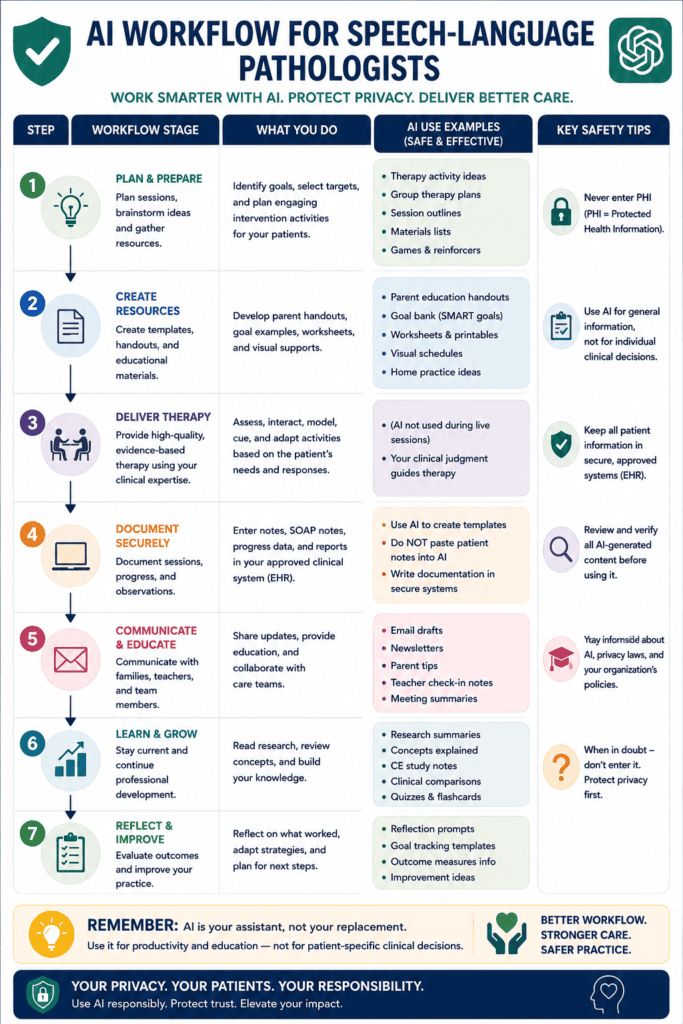
The workflow below demonstrates how a Speech-Language Pathologist can responsibly incorporate AI into a typical workday.
Step 1: Plan Your Therapy Sessions
Start your day by using ChatGPT to brainstorm ideas—not patient-specific treatment plans.
Ask AI to generate:
- Therapy activities
- Games
- Reinforcement ideas
- Home practice suggestions
- Session structures
- Group therapy exercises
Safe Example
Generate a 45-minute therapy session for preschool children targeting expressive vocabulary using play-based activities.
Why it’s safe:
- No patient names
- No diagnoses linked to an identifiable individual
- Educational content only
Step 2: Create Generic Clinical Resources
Instead of writing the same documents repeatedly, use ChatGPT to build reusable templates.
Examples include:
- SOAP note templates
- Evaluation report structures
- Progress report formats
- Parent handouts
- Therapy planning sheets
- Goal-writing frameworks
These resources become part of your personal toolkit and can be customized later without involving AI.
Step 3: Conduct Therapy Using Your Clinical Judgment
During the therapy session, rely on your professional expertise—not AI.
Observe:
- Patient responses
- Progress toward goals
- Behavioral observations
- Clinical decisions
- Adjustments made during therapy
These activities require individualized assessment and cannot be delegated to ChatGPT.
Step 4: Document Within Your Approved Clinical System
After the session, complete your documentation using your organization’s approved systems.
If you need help improving your writing:
- Draft a generic template in ChatGPT beforehand.
- Write the actual patient documentation directly in your secure EHR or documentation platform.
- Review and finalize it using your clinical judgment.
Never copy patient-specific notes into a consumer AI chatbot simply for editing or grammar corrections.
Step 5: Create Parent Education Materials
Families often benefit from simple, easy-to-understand educational resources.
Instead of writing every handout from scratch, ask ChatGPT to generate general information.
Safe Example
Write a one-page guide explaining language stimulation techniques parents can use during mealtime.
The content remains generic and can later be tailored to each family’s needs without exposing confidential information.
Step 6: Continue Professional Learning
ChatGPT is an excellent tool for professional development.
You can ask it to:
- Explain new therapy approaches
- Summarize research papers
- Compare intervention techniques
- Generate study guides
- Create certification quizzes
- Explain difficult terminology
Because these tasks involve learning rather than patient care, they pose far fewer privacy concerns.
A Typical AI-Assisted Workday for an SLP
The table below illustrates where ChatGPT can and should not be used during a typical clinical day.
| Time | Task | ChatGPT Appropriate? | Notes |
|---|---|---|---|
| Morning | Therapy planning | ✅ Yes | Generate activities, games, and lesson ideas |
| Morning | Create parent resources | ✅ Yes | Educational content only |
| During sessions | Direct patient care | ❌ No | Clinical judgment required |
| After sessions | Complete patient documentation | ⚠️ Use caution | Keep patient information in approved systems |
| Afternoon | Research review | ✅ Yes | Summaries of published research |
| End of day | Professional emails | ✅ Yes | Administrative communication only |
| Weekly | Clinic policy updates | ✅ Yes | Generic templates and documents |
| Monthly | Staff training materials | ✅ Yes | Educational and operational resources |
Separating AI Tasks from Clinical Tasks
One of the easiest ways to maintain compliance is to mentally separate your work into two categories.
AI-Friendly Tasks
These involve general knowledge, education, and administrative support.
Examples include:
- Lesson planning
- Therapy ideas
- Parent education
- Presentation creation
- Research summaries
- Marketing content
- Email drafting
- Professional development
- Generic documentation templates
- Checklists and workflows
Clinician-Only Tasks
These require individualized clinical expertise and should remain outside of consumer AI conversations.
Examples include:
- Diagnosing communication disorders
- Interpreting assessment results
- Writing patient-specific reports
- Developing individualized treatment plans
- Clinical decision-making
- Sharing identifiable patient information
- Determining therapy frequency
- Medical recommendations
The “Three-Layer Safety Rule”
Whenever you use ChatGPT professionally, pause and evaluate your prompt using these three questions.
Layer 1: Privacy
Does this prompt contain any information that could identify a patient?
If yes, stop and remove the identifying information.
Layer 2: Clinical Judgment
Am I asking AI to replace my professional expertise?
If yes, reconsider the task.
AI can assist with writing and organization, but it should not make clinical decisions.
Layer 3: Verification
Will I personally review everything before using it?
Always verify:
- Accuracy
- Clinical relevance
- Current evidence
- Grammar
- Professional tone
The clinician remains responsible for the final content.
Building an AI Policy for Your Clinic
As AI adoption grows, many speech therapy practices are developing internal guidelines to ensure consistent and responsible use.
A simple AI policy might include principles such as:
- Do not enter Protected Health Information into consumer AI tools.
- Use AI only for educational and administrative support unless approved secure systems are available.
- Review all AI-generated content before using it.
- Follow organizational privacy and security policies.
- Participate in ongoing AI and privacy training.
Having a written policy promotes consistency across teams and helps staff understand appropriate boundaries.
Signs You’re Using ChatGPT Responsibly
You’re likely using AI appropriately if you can answer yes to the following questions:
- I never upload patient-identifying information.
- I use AI primarily for templates, education, and planning.
- I review every AI-generated response before using it.
- I understand the limits of AI.
- I rely on my own clinical judgment for patient care.
- I follow my employer’s policies regarding AI use.
- I prioritize patient privacy over convenience.
Responsible AI use isn’t about avoiding technology—it’s about using it thoughtfully and ethically.
Key Takeaways
A well-designed AI workflow allows Speech-Language Pathologists to save time on repetitive administrative tasks while preserving the confidentiality and trust that are central to clinical practice.
By keeping AI focused on education, planning, communication, and reusable resources, clinicians can benefit from increased productivity without exposing Protected Health Information or compromising professional responsibilities.
The goal isn’t to replace the Speech-Language Pathologist. The goal is to reduce administrative burden so clinicians can spend more time delivering high-quality care.
Frequently Asked Questions About ChatGPT, HIPAA, and Speech-Language Pathology
Is ChatGPT HIPAA compliant?
The answer depends on how ChatGPT is used and the environment in which it is deployed. For most Speech-Language Pathologists using the standard consumer version of ChatGPT, the safest approach is not to enter Protected Health Information (PHI) into conversations. AI can still be valuable for creating templates, brainstorming therapy activities, summarizing public research, and drafting educational materials without accessing patient-specific information.
Can Speech-Language Pathologists legally use ChatGPT?
Yes. There is no law that prohibits Speech-Language Pathologists from using ChatGPT. However, clinicians must continue to comply with applicable privacy laws, workplace policies, ethical standards, and professional responsibilities. The safest approach is to use AI for general productivity rather than processing identifiable patient information.
Can I paste SOAP notes into ChatGPT?
As a general rule, you should avoid pasting SOAP notes that contain Protected Health Information into a consumer AI chatbot. Instead, ask ChatGPT to generate a generic SOAP note template or demonstrate best documentation practices using fictional examples and placeholder text.
Can ChatGPT write SOAP notes?
ChatGPT can help generate generic SOAP note templates, improve writing style, and explain documentation structures. However, the Speech-Language Pathologist remains responsible for creating accurate patient-specific documentation, verifying the content, and ensuring privacy requirements are met.
Can ChatGPT write IEP goals?
ChatGPT can generate sample SMART goals and provide examples of measurable objectives for educational purposes. These examples should be adapted by the clinician to reflect the individual student’s needs and should never replace professional judgment or individualized planning.
Is it safe to upload evaluation reports into ChatGPT?
No. Evaluation reports often contain multiple forms of Protected Health Information, including names, dates of birth, assessment results, and clinical observations. These reports should remain within approved clinical documentation systems rather than being uploaded to consumer AI platforms.
Can ChatGPT replace a Speech-Language Pathologist?
No. ChatGPT cannot perform comprehensive assessments, establish diagnoses, interpret clinical findings, or replace the expertise of a licensed Speech-Language Pathologist. AI should be viewed as a productivity tool that supports administrative and educational tasks rather than clinical decision-making.
Can AI diagnose speech or language disorders?
No. While AI technologies may assist with research or screening in certain contexts, diagnosis requires professional clinical evaluation, standardized assessments, patient history, observation, and evidence-based decision-making by qualified healthcare professionals.
What are the safest ways for SLPs to use ChatGPT?
Some of the safest applications include:
- Brainstorming therapy activities
- Creating parent education materials
- Drafting clinic policies
- Developing generic documentation templates
- Preparing presentations
- Summarizing published research
- Creating study guides
- Organizing professional workflows
These tasks do not require sharing identifiable patient information.
What information should never be entered into ChatGPT?
Avoid entering information that could identify a patient, such as:
- Full names
- Dates of birth
- Home addresses
- Phone numbers
- Email addresses
- Medical record numbers
- Insurance information
- Clinical reports
- Therapy session notes
- Evaluation results
- Patient photographs
When in doubt, leave it out.
Can private practice Speech-Language Pathologists use AI?
Yes, provided they use AI responsibly, follow applicable privacy regulations, and comply with any professional or organizational policies. AI can help with administrative work, marketing, educational resources, and practice management without exposing confidential client information.
Is ChatGPT useful for creating therapy activities?
Absolutely. Many clinicians use ChatGPT to generate therapy games, language activities, articulation exercises, vocabulary ideas, conversation prompts, and home practice suggestions. Because these activities are general educational resources, they can usually be created without referencing individual patients.
Can ChatGPT help with parent communication?
Yes. ChatGPT can draft newsletters, home practice guides, appointment reminders, educational emails, frequently asked questions, and informational handouts. Clinicians should review and personalize all content before sharing it with families.
Should every AI-generated response be reviewed?
Yes. AI-generated content should always be reviewed by the clinician before use. ChatGPT may occasionally produce inaccurate, outdated, or overly generic information. The Speech-Language Pathologist remains responsible for ensuring accuracy, professionalism, and clinical appropriateness.
Can ChatGPT summarize research papers?
Yes. ChatGPT can help explain published research, simplify technical language, and highlight key findings. However, clinicians should consult the original research when making clinical decisions or interpreting evidence.
Can ChatGPT help graduate SLP students?
Yes. Students can use ChatGPT to:
- Review terminology
- Create study guides
- Practice examination questions
- Understand clinical concepts
- Compare intervention approaches
- Learn evidence-based practices
It should supplement—not replace—formal education and supervision.
Is AI the future of Speech-Language Pathology?
Artificial intelligence is likely to become an increasingly valuable tool for administrative support, documentation assistance, education, workflow optimization, and research. However, empathy, clinical reasoning, interpersonal communication, and individualized patient care remain responsibilities that require qualified Speech-Language Pathologists.
Can AI improve productivity in speech therapy?
Yes. Many clinicians report that AI helps reduce time spent on repetitive administrative tasks, allowing more time for direct patient care, continuing education, and therapy preparation. The greatest productivity gains typically come from planning, writing, organization, and educational content creation rather than patient-specific documentation.
Will using AI affect patient trust?
When used responsibly and transparently within applicable privacy and ethical standards, AI can improve efficiency without compromising patient trust. Protecting confidentiality, reviewing AI-generated content, and maintaining professional judgment remain essential.
What’s the biggest mistake SLPs make when using ChatGPT?
The most significant mistake is treating ChatGPT like a secure clinical documentation system and entering identifiable patient information. The safest approach is to keep AI focused on general knowledge, templates, and educational resources while storing all patient records within approved healthcare systems.
Final Thoughts
Artificial intelligence is transforming the way healthcare professionals work, and Speech-Language Pathologists have an opportunity to benefit from these advances without compromising the trust placed in them by patients and families.
The key isn’t deciding whether to use AI—it’s learning how to use it responsibly.
When integrated thoughtfully, ChatGPT can help clinicians:
- Spend less time on repetitive administrative work.
- Generate fresh therapy ideas.
- Create educational materials.
- Improve professional communication.
- Stay current with emerging research.
- Organize workflows more efficiently.
At the same time, protecting patient privacy must remain the highest priority. By avoiding the use of identifiable patient information in consumer AI tools, reviewing all AI-generated content, and relying on professional judgment for clinical decisions, Speech-Language Pathologists can confidently embrace AI as a productivity partner rather than a replacement for clinical expertise.
As AI technologies continue to evolve, the clinicians who understand both their potential and their limitations will be best positioned to deliver efficient, ethical, and patient-centered care.
Conclusion
ChatGPT and other AI tools are becoming part of the modern healthcare landscape, but successful adoption requires more than learning new technology. It requires understanding privacy obligations, recognizing the boundaries of AI, and developing workflows that keep patient information secure.
For Speech-Language Pathologists, the safest path forward is clear:
- Use AI for planning, education, communication, and administrative support.
- Keep Protected Health Information inside approved clinical systems.
- Review every AI-generated output before using it professionally.
- Continue relying on your own clinical expertise for assessment, diagnosis, treatment planning, and patient care.
By following these principles, SLPs can enjoy the benefits of AI while maintaining the ethical and professional standards that define high-quality speech-language pathology practice.