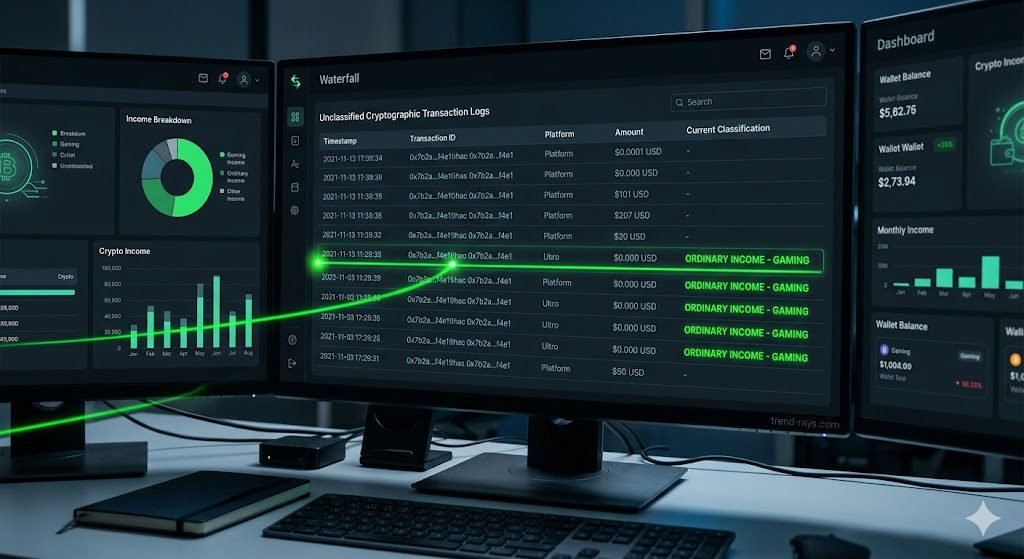
If you use legitimate apps that pay you to play games and regularly cash out your rewards via cryptocurrency, you have unlocked one of the most efficient ways to bypass PayPal fees and build a digital asset portfolio.
However, you have also triggered a massive, hidden administrative burden.
Every time a gaming app or GPT (Get-Paid-To) site deposits 0.05 Litecoin into your wallet, a taxable event occurs. If you are a high-frequency earner cashing out small amounts multiple times a week, tracking the exact Fair Market Value (FMV) of every single micro-transaction on a manual Excel spreadsheet becomes mathematically impossible.
With global tax authorities aggressively targeting digital assets in 2026, relying on guesswork is a guaranteed path to an audit. To survive, digital earners are abandoning manual tracking and adopting AI-powered Crypto Tax SaaS (Software as a Service). Here is how these enterprise tools automate your compliance and protect your earnings.
The Micro-Transaction Nightmare: The “Netting” Myth vs. The Law
If you browse forums like r/CryptoTax, you will see thousands of gamers asking how to report hundreds of tiny crypto payouts from sites like Freecash or Swagbucks. The most common—and most dangerous—advice given is to simply “net” the total. Users claim you should just add up your total withdrawals at the end of the year, subtract any fees, and report a single number.
This is technically non-compliant and a massive audit trigger.
According to global tax frameworks (including IRS Notice 2014-21 in the US and the OECD’s CARF directive), cryptocurrency is treated as property. This means you do not have one tax event at the end of the year; you have a distinct tax event every single time a coin hits your wallet.
The “Two-Tax” Trap of Gaming Rewards
The Web3 gaming economy forces you to act as your own accountant because every micro-transaction triggers a two-step tax process:
- Event 1: Ordinary Income (The Payout): If you withdraw $5 from Freecash in Litecoin on Monday, you must recognize $5 of Ordinary Income immediately.
- Event 2: Capital Gains (The Swap/Sale): If you hold that Litecoin for three months and sell it for $7, you must now report a $2 Short-Term Capital Gain.
The Compliance Data Requirements
To legally prove your Cost Basis for Event 2, you are legally required to record three specific data points for every single micro-payout:
- The Exact Timestamp: Down to the minute the block was validated.
- The Fair Market Value (FMV): The fiat value (USD/EUR/INR) of the specific coin at that exact second.
- The Network Gas Fee: To deduct from your final capital gains calculations.
The Reddit Way vs. The Legal Way
Here is why manual spreadsheets ultimately fail digital earners, and why tax authorities flag netted accounts:
| Reporting Strategy | How it Works | Audit Risk | Tax Authority View |
| The “Netting” Myth | Reporting one lump sum of $500 at the end of the year. | CRITICAL | Views it as tax evasion or hidden asset sheltering. |
| Manual Spreadsheets | Typing out the FMV and timestamp for 300+ tiny transactions. | HIGH | Prone to human math errors and FIFO miscalculations. |
| API Compliance (SaaS) | Connecting read-only exchange data to an automated tax engine. | LOW | Mathematically flawless; matches Form 1099-DA/DAC8 exactly. |
When you eventually sell or swap that crypto for fiat cash, calculating the Capital Gains using the First-In-First-Out (FIFO) accounting method across multiple coins and volatile price fluctuations is prone to human error. A single miscalculation destroys the accuracy of your entire ledger.
The 2026 Regulatory Trap: How Automated Discrepancy Matching Works
Tax authorities are no longer turning a blind eye to micro-earners, and they are no longer relying on human auditors to catch them. The global implementation of Automated Information Exchange Directives means your gaming payouts are mapped, tracked, and reported to the government before you even file your tax return.
Whether you are in the US, Europe, or India, regulatory bodies have forced centralized exchanges (like Binance, Coinbase, and Kraken) to build direct API pipelines into government databases. Here is the exact legislative and technical reality of the 2026 tax landscape.
The European Reality: DAC8 and The End of Anonymity
As of January 1, 2026, the European Union’s DAC8 directive (Directive on Administrative Cooperation) is fully operational.
Previously, offshore gaming apps and decentralized platforms operated in a gray area. DAC8 legally mandates that all digital asset service providers serving EU citizens must implement an Automatic Exchange of Information (AEOI) pipeline.
- The Mechanism: The exchange’s backend automatically logs your KYC (Know Your Customer) data, your total transaction volume, and your account balances, and transmits this data directly to the tax authority of your Member State.
- The Verdict: There is no minimum threshold. Even if you only earned €50 playing games, the European tax authorities have a digital receipt of that transaction. Attempting to hide it will trigger automatic tax evasion flags.
The US Reality: IRS Form 1099-DA & The AUR Algorithm
For US earners, the IRS has activated the Automated Underreporter (AUR) system specifically tuned for the new Form 1099-DA.
Under the expanded definition of a “broker,” any KYC-verified platform you use to cash out your rewards must report your digital asset proceeds directly to the IRS. Here is an example of the simplified JSON API payload your exchange transmits to the IRS the moment you sell your gaming rewards:
- The Trap: Notice that the
cost_basis_reported_by_brokeris oftennullwhen you transfer crypto into an exchange from a gaming app. The IRS AUR algorithm expects you to perfectly calculate and report that missing Cost Basis on your Form 8949. If the gross proceeds reported by the exchange do not perfectly match the math on your personal return, the AUR system automatically triggers a discrepancy audit.
The Indian Reality: Section 115BBH & The 1% TDS Hook
India enforces one of the most unforgiving regulatory frameworks in the world regarding Virtual Digital Assets (VDAs) under Section 115BBH.
- The 30% Flat Tax: All crypto gaming earnings are taxed at a flat 30%, plus applicable surcharges and cess. Crucially, India does not allow you to offset losses against gains.
- The 1% TDS Tracking Mechanism: Under Section 194S, the government mandates a 1% Tax Deducted at Source (TDS) on every sell or swap transaction on local exchanges (like CoinDCX or WazirX). This 1% is not just a tax; it is a cryptographic tracking hook. The exchange automatically remits that 1% to the government attached to your PAN card. If your PAN card shows TDS deductions for crypto sales, but your Income Tax Return (ITR) does not declare the corresponding 30% VDA income, you will face immediate scrutiny from the Income Tax Department.
Interactive Tool: 2026 Audit Risk & Compliance Checker
Not sure if your current tracking method is putting you at risk? Use our interactive risk assessment tool below. Input your jurisdiction and earning volume to see how the new 2026 tracking algorithms view your account.
Global Audit Risk & Compliance Checker
Calculate your vulnerability to automated tax discrepancy flags under the new 2026 DAC8, 1099-DA, and VDA frameworks.
Inside the Code: How AI Crypto Tax SaaS Executes the API Bridge
To bypass the multi-thousand-dollar fees of a specialized blockchain CPA, digital earners are shifting toward automated Tax Automation SaaS. However, to understand how these platforms maintain absolute audit-proof compliance, you must look beneath the surface-level marketing definitions.
The software does not simply “look at your wallet.” It runs a highly secure, multi-layered data ingestion pipeline that transforms raw, cryptographic blockchain data into traditional financial ledgers. This four-stage technical framework explains how the enterprise-level infrastructure operates.
Stage 1: The Cryptographic Read-Only Handshake
When linking your crypto exchange or decentralized Web3 wallet to a tax SaaS (like CoinTracker or Koinly), you never expose your private keys or seed phrases. Instead, the connection relies on two distinct protocols:
- Centralized Exchanges (C2C): You generate a scoped, read-only API subkey. In your exchange settings, you explicitly restrict permissions, enabling only
View ActivityorRead Historycheckboxes while permanently disablingEnable WithdrawalsorEnable Trading. - Decentralized Wallets (Non-Custodial): You provide your public wallet address (e.g., an Ethereum or Polygon
0x...address). Because public ledgers are entirely transparent, the software only needs this public cryptographic string to read the immutable history of that specific node.
Stage 2: JSON-RPC Ingestion and Historical Oracle Mapping
Once authorized, the software’s backend does not manually scroll through your history. It utilizes JSON-RPC endpoints to execute high-speed calls to blockchain nodes, downloading your raw transactional metadata.
When a raw transaction is pulled from the blockchain ledger, it contains zero fiat information. It only contains variables like timestamps, gas used, and token quantities.
To convert this into legally required accounting data, the SaaS pipeline pushes the transaction through a Pricing Oracle Engine (cross-referencing institutional historical data feeds from platforms like CoinGecko, CoinMarketCap, or Chainlink oracles). The system matches the exact second of the block validation timestamp with the historical global spot price of the token to calculate the precise Fair Market Value (FMV).
Here is a look at the exact computational transformation that occurs during this process. This is what the raw data looks like when harvested from the blockchain versus how the AI tax engine structures it for tax authority compliance:
Stage 3: Heuristic Vector Classification (Session vs. Individual)
The core differentiator of a true AI-powered tax engine is Heuristic Vector Classification.
The blockchain ledger does not natively label a transaction as “income,” “gift,” “trade,” or “internal transfer.” To an unoptimized software program, a $2 payout from a gaming app looks exactly the same as a $2 transfer from a friend. If left unclassified, the software will default to treating the asset as a zero-cost-basis asset, which completely skews your capital gains brackets.
The SaaS platform solves this by running an automated machine learning classification model over the data:
- Wallet Co-Reconciliation: If you move 1.45 LTC from your gaming wallet to your Coinbase account, the AI analyzes the timestamps. If the exit timestamp from Wallet A perfectly mirrors the entry timestamp of Wallet B (minus network lag), the AI automatically flags the transaction as an
Internal Transfer (Non-Taxable). This prevents you from being taxed twice on the exact same asset movement. - Source Pattern Matching: The machine learning model identifies known smart contract addresses belonging to corporate payout pools (e.g., offerwalls, play-to-earn protocols, micro-task operators). The system automatically tags these inflows as
Ordinary Income (Gaming Payout). - Session Roll-Ups: For extreme high-frequency earners executing dozens of micro-transactions daily, reporting each $0.50 line item creates a bloated tax return that risks triggering processing delays. The AI uses advanced aggregation algorithms to securely compress a single day’s multi-transactions into automated “Session Reports” that establish a uniform daily cost basis while maintaining absolute forensic audit compliance.
Stage 4: Localized Form Generation and 1099-DA Matching
In the final stage, the normalized, classified database passes through a country-specific localized legislative engine.
The software translates your transaction ledger directly into compliant tax schedules. If you are in the United States, it maps data points straight to IRS Form 8949 and Schedule D. If you are filing in India, it populates the specific lines required for Schedule VDA under the 30% tax rules.
Crucially, the software performs a predictive matching check against the automated Form 1099-DA records sent by centralized exchanges to national tax networks. By scanning for potential mismatch discrepancies before you officially file, the AI SaaS acts as a digital shield against automated algorithmic audit triggers.
Interactive Tool: Real-Time Blockchain Tax Ledger Reconciler
See how the AI tax engine works in real time. Click ‘Ingest Raw Blockchain Logs’ below to simulate a live data pipe. Watch how raw, unclassified cryptographic token logs are ingested, matched with historical oracle spot prices, securely categorized into compliant income streams, and compiled into an audit-ready tax line item.
AI Tax Ingestion Pipeline
Step through the SaaS backend process to see how raw blockchain data is transformed into a compliant tax ledger.