⚡ Quick Verdict: Are AI Voice Agents HIPAA Compliant?
Yes, AI voice agents (like Retell AI, Vapi, or custom Twilio builds) can be HIPAA compliant for patient intake and scheduling—but only if your entire technical stack is secured.
Because an AI voice agent relies on multiple vendors, you must execute a Business Associate Agreement (BAA) with your Telephony provider (Twilio), your Speech-to-Text provider (ASR), your Large Language Model (LLM), and your Text-to-Speech provider (TTS).
If even one vendor in this chain lacks a BAA or retains electronic Protected Health Information (ePHI) for model training, deploying the voice agent is a direct violation of the HIPAA Privacy and Security Rules, carrying penalties of up to $2 million per violation.
The Top Voice AI Vendors: HIPAA & BAA Status (2026)
If you are building a healthcare AI agent, you do not need to build the infrastructure from scratch. Several major Voice AI platforms now offer native HIPAA compliance—but their default settings are often dangerous.
Here is how the top three Voice AI platforms handle Business Associate Agreements (BAAs) and ePHI in 2026:
| Voice AI Platform | BAA Included? | Architecture / LLM Routing | Critical Setup Requirement |
| Bland AI | Yes (Out of the box) | Self-Hosted: Bland runs the ASR, LLM, and TTS on their own infrastructure. No third-party routing. | None. One BAA covers the entire call pipeline natively. |
| Vapi | Yes (Enterprise/Custom) | Cloud Routing: Vapi routes data to compliant providers (e.g., Azure OpenAI, Deepgram). | You must set "hipaaEnabled": true in the API config. If false, Vapi logs call transcripts. |
| Retell AI | Yes (Enterprise) | Cloud Routing: Routes through HIPAA-eligible LLMs and TTS engines. | Must sign a custom BAA before transmitting any PHI through the API. |
⚠️ The Developer Warning: If you use Vapi or Retell, do not pass your standard OpenAI API key into their system. You must provision a specifically secured Azure OpenAI endpoint that is covered under Microsoft’s BAA.
The “Voice AI Supply Chain” Trap
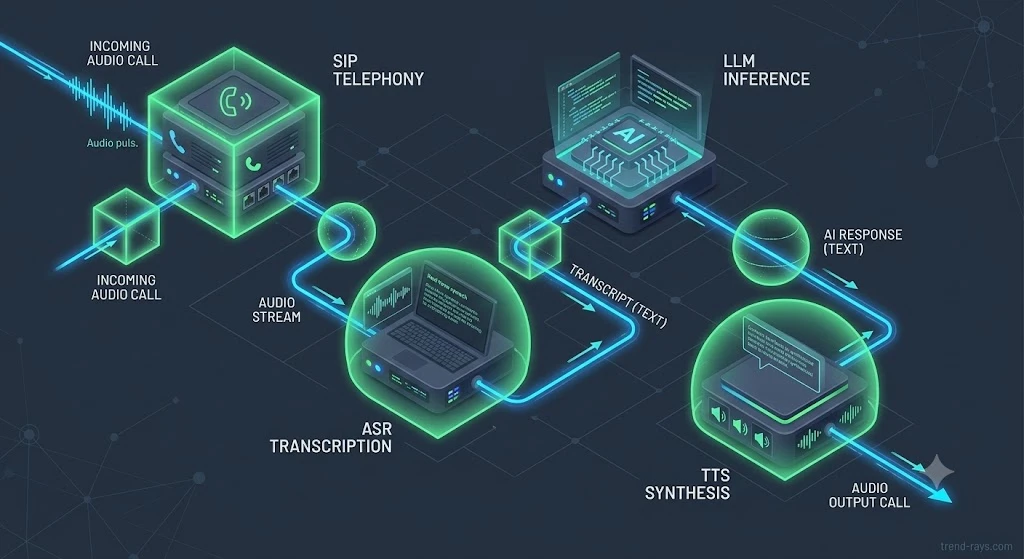
In 2026, medical clinics and dental offices are rapidly deploying AI phone receptionists to handle after-hours booking and patient triage. However, most developers and agency owners fail to realize that an AI voice agent is not a single piece of software; it is a complex, four-part “Supply Chain.” Just as corporate law firms must demand SOC 2 Type II compliance for AI contract review, healthcare administrators must secure a BAA for every single API endpoint in their voice stack.
When a patient calls your clinic and says, “My name is John Doe, and I need a refill for my Adderall,” that audio stream travels through multiple distinct microservices in less than 500 milliseconds:
- Telephony Gateway (SIP Trunk): Twilio or Vonage handles the actual phone call.
- Automatic Speech Recognition (ASR): Deepgram or AssemblyAI transcribes the spoken audio into text.
- The LLM “Brain”: OpenAI or Anthropic reads the text, understands the intent, and generates a text response.
- Text-to-Speech (TTS): ElevenLabs or PlayHT converts the LLM’s text response back into a human-sounding voice.
The Compliance Trap: HIPAA’s Shared Responsibility Model dictates that every single vendor that touches ePHI must sign a Business Associate Agreement (BAA). If you use a HIPAA-compliant LLM (like OpenAI Enterprise) but route the audio through a standard, non-compliant ElevenLabs TTS tier, you have broken the chain of compliance and are liable for a massive data breach.
The 3 Architecture Patterns for Healthcare Voice AI
To securely route patient data through this supply chain, IT architects currently rely on three distinct deployment patterns.
Pattern A: On-Premise / Self-Hosted (Absolute Security)
You host the ASR, LLM (e.g., Llama 3), and TTS entirely on your own local GPU cluster or a dedicated Virtual Private Cloud (VPC).
- Pros: PHI never leaves your physical security boundary. No external BAAs are required for inference.
- Cons: Massively expensive to maintain, and open-source voice models cannot currently match the sub-500ms latency of commercial cloud APIs, leading to unnatural, lagging phone conversations.
Pattern B: The PHI Redaction Proxy (The Gold Standard)
This is the most common and secure architecture for production systems in 2026. Data originates from your Twilio SIP trunk and passes through your own custom Redaction API before it hits the LLM.
- How it works: Your middleware uses a Named Entity Recognition (NER) model to strip the 18 HIPAA identifiers (names, DOB, SSN, conditions) from the transcript. “John Doe needs Adderall” becomes
[PATIENT_NAME] needs [MEDICATION]. The de-identified text is sent to the cloud LLM. When the LLM replies, your proxy re-identifies the tokens before sending the text to the TTS engine. - Why it wins: Even if your LLM provider suffers a catastrophic data breach, the data they hold is mathematically de-identified.
Pattern C: Full Cloud AI with Strict BAAs (Direct PHI)
You send the raw, unredacted transcript directly to the cloud AI providers (OpenAI, Deepgram) under the strict legal protection of signed BAAs.
- How it works: You must purchase the “Enterprise” or “Dedicated” tiers of these tools, ensuring they utilize a Zero Data Retention (ZDR) policy. The API processes the ePHI, returns the result, and instantly drops the payload from its servers.
Interactive Tool: The HIPAA Voice Stack Auditor
Use this interactive matrix to audit your current (or planned) Voice AI stack. Select your providers to see if you have achieved end-to-end HIPAA compliance.
HIPAA Voice Stack Auditor
🏥 HIPAA Voice AI Stack Auditor
Select your vendors to instantly audit the end-to-end HIPAA compliance of your Voice AI supply chain. Under the Shared Responsibility Model, one missing BAA breaks the entire stack.
Agentic AI vs. Generative Guardrails in Healthcare
Standard Generative AI is probabilistic—it predicts the next word in a sentence. This open-ended nature creates severe risks of “Hallucinations” (fabricating medical advice) and unauthorized scope creep.
To meet the HIPAA Security Rule’s requirement for “Access Control,” your voice agent must be Agentic, not merely Generative.
- Separation of Action: The LLM is only used to understand the user’s intent. Once the intent is classified (e.g., “Schedule an Appointment”), the LLM hands off the task to a deterministic, hard-coded Python script that queries your EHR (Electronic Health Record) system via an API.
- Medical Triage Blocking: You must implement pre-prompt guardrails that strictly forbid the AI from offering medical advice. If a caller says, “I’m having chest pain,” the agent must immediately execute an emergency call-forwarding protocol to a human triage nurse, bypassing the LLM entirely.
The “Call Recording” Trap: HIPAA vs. State Wiretapping Laws
Many healthcare clinics want their Voice AI to record and transcribe calls so the data can be pushed directly into their EHR (Electronic Health Record) system.
Under HIPAA, recording a patient call is not a violation. If the recording is used for treatment or operations, HHS (Health and Human Services) does not even require written patient authorization.
However, your AI agent is bound by a second, equally dangerous set of laws: State Wiretapping and Consent Laws. If your clinic is located in, or receives calls from, one of the 12 “All-Party Consent” states (including California, Florida, and Illinois), recording a patient without explicit warning is a felony.
The Required AI Scripting Fix: To legally capture audio for your LLM to process, your AI Voice Agent’s prompt must be hard-coded to begin every single interaction with a consent disclosure before any PHI is collected.
Example Safe Greeting:
“Thank you for calling [Clinic Name]. Please be aware that this call is being recorded and transcribed by our AI assistant for quality and medical documentation purposes. How can I help you today?”
If a patient proceeds after hearing this, they have provided implied consent, satisfying both state wiretapping laws and establishing a legal basis for the AI to process their ePHI.
Conclusion: The BAA is Your Shield
Building a Voice AI agent for a medical clinic is not a coding challenge; it is a regulatory architecture challenge.
If you are a developer or agency building these tools using platforms like Vapi or Retell AI, you must ensure you are on their Enterprise tiers, that you have signed their BAAs, and that you have executed your own BAA with your healthcare client.
By enforcing Zero Data Retention across your entire supply chain and implementing strict conversational guardrails, you can safely deploy Voice AI to reduce administrative burnout without risking the devastating financial penalties of a HIPAA breach.
Review our definitive guide on Applying the Essential Eight Cybersecurity Framework to AI Systems.
Frequently Asked Questions
Is Twilio HIPAA compliant for AI voice agents? Twilio can be HIPAA compliant, but it is not compliant by default. You must upgrade to Twilio’s Security or Enterprise Edition, sign a Business Associate Addendum (BAA), and ensure you are only using HIPAA-eligible API endpoints (like Programmable Voice and SIP Trunking) for your voice agent.
Does Retell AI or Vapi sign a BAA for healthcare clients?
Yes. Both Retell AI and Vapi offer HIPAA compliance and will sign Business Associate Agreements (BAAs), but only on specific Enterprise or custom tiers. For example, Vapi requires you to explicitly toggle hipaaEnabled: true in your API settings, which automatically disables default call recording and data logging.
Can I use ChatGPT’s voice mode for patient intake?
No. Using the consumer version of ChatGPT (or its native voice mode) for patient intake is a direct HIPAA violation. OpenAI does not sign BAAs for free or standard Plus accounts, and consumer inputs may be used to train their models, which illegally exposes Protected Health Information (PHI).
What happens if my Text-to-Speech (TTS) provider doesn’t have a BAA?
Under HIPAA’s Shared Responsibility Model, your entire tech stack must be compliant. If your LLM is secure but your TTS provider (e.g., ElevenLabs or PlayHT) does not have a signed BAA, you are committing a compliance violation by transmitting ePHI to an unsecured third party.
What are the HHS OCR penalty tiers for an AI data breach?
If your AI voice agent leaks patient data (e.g., via a non-BAA covered LLM), the Office for Civil Rights (OCR) issues fines based on four tiers of culpability. Tier 1 (Lack of Knowledge) starts around $135 per violation. However, Tier 4 (Willful Neglect without Correction)—such as knowingly using consumer ChatGPT to process patient calls—carries maximum fines of over $68,900 per individual record leaked, capped at roughly $2 million annually.
What are the HHS OCR penalty tiers for an AI data breach?
If your AI voice agent leaks patient data (e.g., via a non-BAA covered LLM), the Office for Civil Rights (OCR) issues fines based on four tiers of culpability. Tier 1 (Lack of Knowledge) starts around $135 per violation. However, Tier 4 (Willful Neglect without Correction)—such as knowingly using consumer ChatGPT to process patient calls—carries maximum fines of over $68,900 per individual record leaked, capped at roughly $2 million annually.