If you use legitimate apps that pay you to play games like Freecash or Pawns.app, you have likely noticed a frustrating reality: cashing out to PayPal often comes with a hefty 5% platform fee.
To avoid this, platforms heavily promote their cryptocurrency withdrawal options, promising “zero conversion fees” and minimum thresholds as low as $0.25 to $0.50. However, if you search the web for how these payouts work, you are instantly bombarded with guides for offshore crypto casinos.
Withdrawing earnings from a legitimate GPT (Get-Paid-To) site is completely different from a casino payout. If you don’t understand the difference between platform fees and network gas fees, your gaming profits will vanish before they ever hit your wallet. Here is the technical reality of Web3 off-ramps in 2026.
The Strategic Benefit of Crypto Withdrawals: Why Gamers are Ditching Fiat
If legitimate gaming platforms offer direct-to-bank or PayPal deposits, why would a player choose to receive their rewards in a highly volatile digital asset?
The answer goes far beyond the “crypto hype.” For digital earners, freelancers, and mobile gamers, cashing out in cryptocurrency—specifically stablecoins or major layer-1 assets—provides distinct financial leverage that traditional banking rails simply cannot match. Here is a technical breakdown of the strategic benefits of Web3 off-ramps.
Bypassing Cross-Border Friction and Forex Spreads
The most immediate benefit of a crypto withdrawal is the complete evasion of the correspondent banking system. If you are an international gamer using US-based or European-based GPT platforms, cashing out via fiat currency is shockingly expensive.
Traditional payment processors like PayPal levy severe cross-border conversion fees. For example, if an Indian user receives USD from an international gaming app, PayPal India applies a 3.0% to 4.0% fee on top of the base exchange rate to convert those funds into INR. If you use a credit or debit card to fund international transactions, a fixed fee (like $0.30 USD) plus a percentage is often applied.
By requesting a payout in Litecoin (LTC) or Dogecoin (DOGE), you completely bypass fiat conversion spreads. The digital asset is transmitted across a borderless global ledger in minutes for fractions of a cent, allowing you to convert it locally at a much more favorable peer-to-peer (P2P) exchange rate.
Asset Appreciation (The Micro-DCA Strategy)
When you withdraw $20 to your bank account, inflation immediately begins eroding its purchasing power. By withdrawing your gaming rewards in Bitcoin (BTC) or Ethereum (ETH), you transform a casual side hustle into a zero-risk entry point for Dollar Cost Averaging (DCA).
Instead of treating play-to-earn apps as mere “pocket money,” forward-thinking strategists use them to slowly build a digital asset portfolio. You are exchanging your raw time—not your primary income—for an asset class with massive historical upside. If the market dips, you only lost time spent playing mobile games; if the market rallies, your $50 gaming payout could appreciate significantly over a multi-year hold.
Hedging Against Local Inflation (The Stablecoin Advantage)
Not all crypto withdrawals are volatile. The most critical strategic tool for global gamers is the stablecoin.
As of early 2026, the total stablecoin market capitalization exceeds $300 billion. Over 95% of this market is dominated by USD-pegged tokens, with Tether (USDT) standing as the absolute largest by market cap at roughly 189.8 billion circulating supply.
If you live in a region suffering from hyperinflation or aggressive currency devaluation, storing your gaming rewards in a local bank account guarantees a loss of wealth. By withdrawing rewards in USDT or USDC to a non-custodial wallet, you are effectively earning and holding an asset pegged to the US dollar. This provides a powerful shield against local currency instability, allowing users to retain their exact purchasing power without needing a foreign bank account.
Financial Sovereignty and Unbanked Accessibility
Finally, crypto payouts democratize earning potential. To open a traditional bank account or a verified PayPal account, you need a government-issued ID, a physical address, and often a minimum deposit. This completely excludes millions of underbanked individuals worldwide.
Non-custodial crypto wallets (like MetaMask or Trust Wallet) require no credit check, no KYC (Know Your Customer) documents, and no minimum balance to open. Anyone with an internet connection can generate a wallet address in seconds. By withdrawing gaming rewards to a non-custodial Web3 wallet, users retain absolute, sovereign control over their money—immune to arbitrary bank freezes, geopolitical sanctions, or platform account terminations.
The Trap: Platform Fees vs. Network Gas Fees
The biggest misconception in the play-to-earn gaming economy is the marketing promise of “free” or “instant” crypto withdrawals. When platforms like Freecash or Pawns.app advertise a 0% fee on cryptocurrency cash-outs, they are technically telling the truth. However, they are only referring to their side of the transaction.
If you do not understand the fundamental difference between a Platform Fee and a Network Gas Fee, your digital earnings will vanish in transit. Here is the technical anatomy of a GPT (Get-Paid-To) crypto withdrawal.
Platform Fees: The Marketing Hook
A platform fee is the internal surcharge a gaming app levies to process your payout.
- The PayPal Benchmark: If you request a fiat withdrawal to PayPal, the GPT platform is forced to use traditional financial rails. To cover their corporate processing costs, apps often pass a 5% platform fee directly to the user. If you cash out $100, the app takes $5 before it even reaches PayPal (which may then charge you additional cross-border conversion fees).
- The Crypto Hook: To avoid these legacy banking costs, platforms incentivize Web3 withdrawals. Freecash, for example, charges an absolute 0% platform fee when you convert your in-app coins to Bitcoin, Ethereum, or Litecoin. The app deducts exactly $0.00 from your balance to initiate the transfer.
This zero-fee marketing hook is what drives millions of casual gamers to select the crypto option. But the moment the funds leave the platform’s internal database and hit the decentralized blockchain, a new, unavoidable cost structure takes over.
Network Gas Fees: The Blockchain’s Toll
A network gas fee is the mandatory toll charged by the blockchain’s miners (or validators) to secure your transaction, process the cryptographic data, and permanently record it in a block.
- The App Has No Control: The reward app does not set this fee, nor do they profit from it. It is paid entirely to the decentralized network validators.
- Size Does Not Matter: Unlike PayPal, which charges a percentage of your total transfer, blockchain gas fees are calculated based on network congestion and data weight, not the dollar amount being sent. Sending $5 costs the exact same amount of gas as sending $5,000.
This creates a massive structural trap for micro-earners. If the network gas fee is $2.00, a user withdrawing $100 loses only 2% of their total. But a casual gamer withdrawing a $5 app reward loses 40% of their earnings to validators instantly.
The 2026 Network Reality: Do Not Get Complacent
Historically, withdrawing Ethereum (ERC-20) tokens from GPT sites was a financial disaster for casual earners. During the NFT and DeFi booms of 2021 through 2024, base gas fees frequently spiked above $50. Cashing out a $10 gaming reward was mathematically impossible.
In 2026, the blockchain landscape has fundamentally shifted, but a hidden trap remains for the uneducated user. Thanks to recent Ethereum structural upgrades—specifically the implementation of Fusaka, PeerDAS, and the expansion of “blob” transactions (which moved heavy Layer-2 data off the main chain)—Ethereum’s mainnet congestion has been drastically reduced. As of mid-2026, the base average transaction fee on Ethereum has dropped to roughly $0.21.
However, do not let these low averages lull you into complacency. If you withdraw your gaming rewards without checking network conditions, you can still lose a massive percentage of your earnings to two major invisible costs:
Trap 1: Mempool Priority Spikes and Bot Wars
The $0.21 transaction fee is just an average; it is not a fixed price. When you request a crypto withdrawal, your transaction enters the “Mempool” (the blockchain’s waiting room).
Validators prioritize transactions based on who is willing to pay the highest “priority fee.” During high-demand windows—such as a major token airdrop or sudden market volatility—automated trading bots (MEV bots) and institutional algorithms flood the mempool. They artificially bid up the priority fees to ensure their trades are processed first.
If your gaming platform processes your $10 withdrawal during one of these 15-minute volatile spikes, the network cost can surge from $0.21 to $5.00 instantly. Because the platform automatically deducts this network fee from your payout, your expected reward is cut in half before it ever reaches your wallet.
- The Fix: Never withdraw on a weekday afternoon (EST). Always check a live Ethereum Gas Tracker. If the base fee is above 15 Gwei, leave your earnings in the gaming app and wait for off-peak hours (typically weekend mornings).
Trap 2: Smart Contract Execution Costs (The Multiplier Effect)
This is the most misunderstood mechanic in crypto payouts. A standard, peer-to-peer crypto transfer (sending Ethereum from your personal wallet to a friend’s wallet) requires exactly 21,000 units of gas.
However, major GPT platforms do not manually send peer-to-peer transactions. To handle thousands of daily payouts, they utilize automated Smart Contracts to batch and distribute user rewards.
Executing a smart contract requires significantly more computational power from the blockchain than a simple transfer. The network must verify the contract logic, check internal ledgers, and execute the batch payout. This complex interaction typically requires 65,000 to 150,000+ units of gas.
The Math: The network fee you pay is calculated by multiplying the Current Gas Price by the Gas Units Required. Because the gaming app uses a smart contract to send your money, the transaction requires 3x to 7x more gas units than a normal transfer.
Even if the network is relatively quiet, the sheer computational weight of the app’s automated payout system means your final deduction will always be significantly higher than the standard $0.20 base fee you see on public gas trackers.
- The Verdict: This hidden multiplier is exactly why you must avoid withdrawing micro-earnings ($5 – $20) via the Ethereum Mainnet. Always route your payouts through networks that are structurally designed to process smart contracts for pennies, such as Polygon (MATIC) or the Binance Smart Chain (BSC).
The Network Reality: Ethereum Mainnet vs. Altcoins vs. Layer 2
When you request a crypto withdrawal, the network you choose dictates whether you keep your profits or lose them to validators.
When you request a cryptocurrency withdrawal from a gaming app, you are essentially asking the platform to broadcast a mathematical command to a decentralized network. The specific network you select from the app’s dropdown menu dictates the underlying infrastructure your money travels on.
Choosing the wrong network is the single most common reason casual gamers lose their profits. Here is the B2B-level technical breakdown of the three primary network categories and how they impact your final payout.
Ethereum Mainnet (ERC-20): The Wealth Destroyer
Ethereum is the undisputed king of decentralized finance (DeFi) and the most secure smart-contract platform in the world. Because of its universal popularity, almost every GPT platform offers Ethereum (ETH) as a payout option.
- The Architecture: Ethereum operates as a global, decentralized settlement layer. It prioritizes absolute security and data availability over cheap transactions.
- The Reality for Gamers: The Ethereum Mainnet is fundamentally not designed for micro-transactions. It functions more like a high-security wire transfer than a casual payment rail. As discussed, when the gaming app executes its automated payout smart contract, the Ethereum validators charge a premium for the computational effort.
- The Verdict: Never use the Ethereum Mainnet for GPT payouts. Withdrawing $15 or even $50 of ETH directly on the Layer-1 mainnet is financial suicide for a side-hustle. The gas fees will completely consume your profit margin. Reserve Mainnet transactions strictly for moving thousands of dollars at a time.
The Utility Altcoins: Litecoin (LTC) & Dogecoin (DOGE)
If you analyze the withdrawal leaderboards on platforms like Freecash or Swagbucks, you will notice a massive volume of users cashing out via Litecoin (LTC) and Dogecoin (DOGE). This is not a coincidence; it is a calculated mathematical strategy.
- The Architecture: Unlike Ethereum, which processes complex, heavy smart contracts, Litecoin and Dogecoin were engineered specifically to act as simple, lightweight digital cash. They utilize simpler transaction ledgers (often based on the UTXO model) with faster block generation times (Litecoin creates a new block every 2.5 minutes, compared to Bitcoin’s 10 minutes).
- The Reality for Gamers: Because these networks do not have to process complex decentralized apps (dApps) or NFT mints, their block space is abundant and cheap. A standard Litecoin withdrawal from a gaming app costs fractions of a cent (typically $0.01 to $0.05) and settles in your wallet almost immediately.
- The Verdict: The undisputed champions for micro-earners. If your goal is to frequently cash out small increments ($5 to $20) to pay for real-world expenses, LTC and DOGE provide the most efficient, frictionless off-ramp.
Layer 2 Scaling: Polygon (MATIC), Arbitrum & Base
This is the modern frontier of crypto payouts, and the optimal choice for users who want the cheap fees of an altcoin but want to keep their money inside the Ethereum ecosystem.
- The Architecture: Layer 2 (L2) networks are secondary protocols built on top of the Ethereum Mainnet. They utilize a technology called “Rollups.” Instead of processing every $5 gaming payout individually on Ethereum (and paying $5 in gas each time), a Layer 2 network like Polygon batches tens of thousands of transactions together off-chain. It then rolls them up into a single, highly compressed cryptographic proof and submits that to the Ethereum Mainnet.
- The Reality for Gamers: By splitting the mainnet gas fee across thousands of users, your individual transaction cost drops to essentially zero (often $0.001 to $0.02). You receive a bridged version of the asset (like Polygon-wrapped ETH or native MATIC) that lives in a high-speed, low-cost environment.
- The Catch: You must ensure the exchange you are sending the money to supports the specific Layer 2 network. If you withdraw MATIC on the Polygon network, but send it to an exchange deposit address that only accepts Ethereum Mainnet deposits, your funds will be permanently lost.
- The Verdict: The future-proof choice for strategic accumulators. If the GPT platform offers a Polygon (MATIC) or Arbitrum payout option, and your receiving exchange supports it, this is mathematically the most superior network choice. It allows you to build an Ethereum-based portfolio without paying Ethereum-based fees.
Custodial vs. Non-Custodial Storage: Who Actually Owns Your Gaming Payouts?
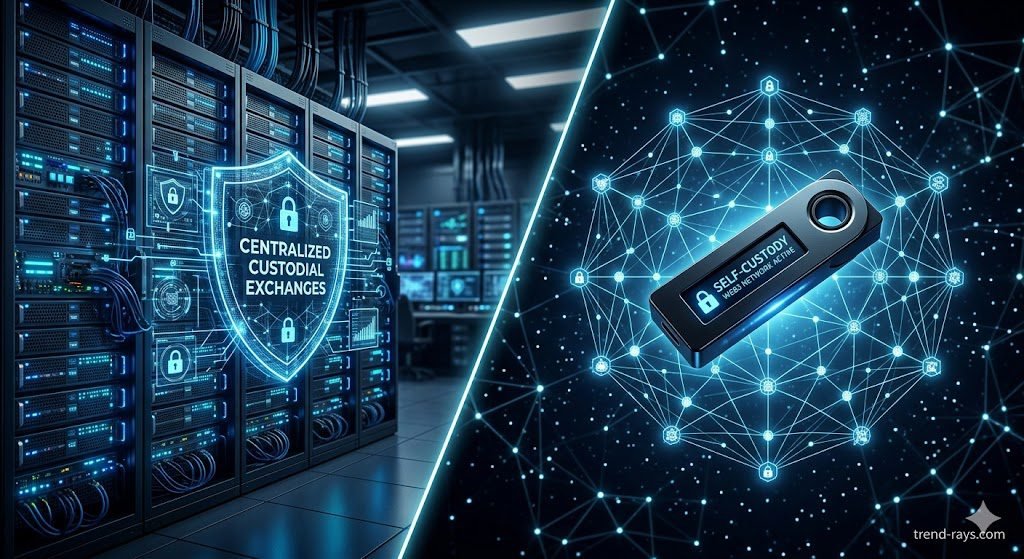
When you initiate a cryptocurrency withdrawal from a GPT platform, the app will prompt you for a “Deposit Address.” Where you generate this address fundamentally alters your legal ownership of the digital asset, your exposure to regulatory tracking, and the hidden fees you will pay later.
In the Web3 ecosystem, storage architecture is divided into two strict categories: Custodial and Non-Custodial. Understanding this cryptographic divide is critical to protecting your gaming profits.
Custodial Storage: The Exchange Route (Coinbase, Binance, CoinDCX)
When you generate a deposit address from a centralized exchange (CEX), you are utilizing a custodial wallet.
- The Technical Reality (The IOU Model): When the gaming app sends Ethereum to your Binance or Coinbase address, you do not actually possess the cryptographic private keys to that Ethereum. The exchange’s corporate treasury holds the master keys. What you see in your exchange dashboard is simply a database entry—an IOU from the exchange stating that they owe you that specific amount of crypto.
- The Advantages (Frictionless Fiat Off-Ramping): This is the path of least resistance. When you want to convert your gaming rewards into usable cash, custodial exchanges provide an immediate, zero-gas internal swap to fiat currency (USD, EUR, INR). You can then initiate an ACH transfer or wire directly to your linked bank account. If you lose your password, customer support can reset it.
- The Disadvantages (Counterparty Risk & Regulatory Freezes): Not your keys, not your crypto. Because you do not hold the private keys, you are subject to complete counterparty risk. If the exchange goes bankrupt, your gaming earnings are liquidated. Furthermore, you are at the mercy of localized regulatory crackdowns. For example, if an offshore exchange fails to comply with local financial intelligence units (like the FIU-IND mandates requiring strict AML tracking), your local ISP can block the domain, and the exchange can freeze your assets without warning.
Non-Custodial Storage: The Self-Custody Route (MetaMask, Trust Wallet, Ledger)
When you generate an address using a decentralized software wallet (like MetaMask) or a physical hardware wallet (like a Ledger Nano), you are utilizing non-custodial storage.
- The Technical Reality (BIP-39 Seed Phrases): In this architecture, the wallet software mathematically generates a public/private key pair directly on your device, usually represented by a 12- or 24-word recovery phrase (the BIP-39 standard). The cryptocurrency does not live “inside” the app or the USB drive; it lives on the decentralized blockchain. Your non-custodial wallet simply acts as the master cryptographic key that grants you the authority to move it.
- The Advantages (Absolute Sovereignty): No centralized entity can freeze your account, block your transaction, or seize your funds. It requires zero KYC verification—no ID, no facial scans, and no physical address are needed to generate a non-custodial wallet. It is the ultimate censorship-resistant vault for long-term accumulation.
- The Disadvantages (The “Double Gas” Trap & User Error): If you lose your 12-word seed phrase, your money is gone forever; there is no customer support to recover it. More importantly for gamers, non-custodial wallets create a Double Gas Trap. If you withdraw a $15 gaming reward to MetaMask, you pay the network gas fee once. But you cannot buy groceries with MetaMask. To turn that crypto into fiat cash, you must eventually send it from MetaMask to a centralized exchange, forcing you to pay a second network gas fee out of your own pocket.
Strategic Verdict: Which Wallet Architecture Should You Use?
Your wallet choice should be dictated entirely by your end goal for the gaming payouts.
The Digital Accumulator Strategy (Use Non-Custodial): If you are treating reward apps as a passive method to slowly Dollar-Cost Average (DCA) into digital assets over several years, withdraw directly to a non-custodial wallet. By holding the keys yourself, you protect your growing portfolio from exchange insolvencies and centralized regulatory freezes while you wait for macro market appreciation.
The Casual Earner Strategy (Use Custodial): If your goal is to play games for a few weeks, earn $50, and immediately use that cash to pay a phone bill or buy a Steam gift card, always withdraw directly to a KYC-verified custodial exchange. You will avoid the “Double Gas Trap” and have immediate access to fiat off-ramps.
KYC Protocols: The Global Fiat Off-Ramp

The final hurdle in play-to-earn gaming is converting your digital assets into usable cash. In 2026, global Anti-Money Laundering (AML) regulations require all centralized exchanges to enforce strict Know Your Customer (KYC) protocols. The friction you face—and the taxes you pay—depend entirely on your geopolitical jurisdiction.
The Western World (US & EU Compliance)
Western regulators heavily focus on tracking transaction thresholds, establishing cost basis, and eliminating anonymous fiat off-ramping.
- US Compliance (FinCEN & IRS 1099-DA): To withdraw fiat to a US bank account, centralized exchanges operate under strict mandates from the Financial Crimes Enforcement Network (FinCEN), requiring a government-issued ID, Social Security Number, and live facial verification. More importantly, 2026 marks the enforcement of the new Form 1099-DA. According to the Internal Revenue Service (IRS), digital asset brokers must now comprehensively track and report your gross proceeds and acquisition cost basis directly to the government.
- EU Compliance (MiCA & DAC8): The European banking sector has been entirely restructured by the Markets in Crypto-Assets (MiCA) regulation. MiCA enforces the stringent “Travel Rule” on all digital transfers and explicitly prohibits anonymous accounts and privacy-centric tokens. Combined with the DAC8 directive active in 2026, crypto-asset service providers (CASPs) must automatically share cross-border transaction data with EU tax authorities, making anonymous fiat off-ramping legally impossible.
The Indian Reality: FIU-IND & The Heavyweight Tax Burden
If you are cashing out gaming rewards in India, the regulatory landscape is arguably the most aggressive in the world. India views crypto payouts not as a currency, but as a heavily regulated, heavily taxed asset class.
- FIU-IND Registration Mandate: Under the Prevention of Money Laundering Act (PMLA, 2002), the Indian government mandates that all crypto exchanges—both domestic and offshore—must register as reporting entities with the Financial Intelligence Unit – India (FIU-IND). If you attempt to use a non-compliant offshore exchange to bypass KYC and withdraw cash, your funds will likely be trapped, as Indian ISPs actively block non-compliant domains. You must route your gaming rewards through an FIU-registered exchange to successfully link an Indian bank account.
- The 30% VDA Tax (Section 115BBH): The Indian government does not distinguish between crypto bought as a Wall Street investment and crypto earned by grinding Offerwalls on a mobile app. According to the Income Tax Department of India, all crypto payouts are classified as Virtual Digital Assets (VDAs). Under Section 115BBH of the Income Tax Act, any profit generated from transferring a VDA is subject to a blunt, flat 30% tax (plus a 4% health and education cess and applicable surcharges).
- No Deductions or Loss Offsets: The 30% tax law is notoriously rigid. You cannot claim network gas fees, exchange withdrawal fees, or internet expenses as deductions; only the initial purchase cost (which is zero for gaming rewards) is recognized. Furthermore, you cannot offset crypto losses. If you lose ₹5,000 trading one token but cash out ₹10,000 from a gaming app, you are taxed on the full ₹10,000.
- 1% Tax Deducted at Source (TDS): To ensure every digital transaction is tracked on the blockchain, Section 194S imposes a 1% TDS on the transfer of crypto assets. When you finally sell your gaming rewards for INR on an Indian exchange, the platform acts as a tax collector. It will automatically deduct 1% of the total transaction value and deposit it directly with the government via Form 26QE before releasing the remaining 99% to your wallet. You must reconcile this TDS when filing your ITR under Schedule VDA.
The Optimal 4-Step Crypto Withdrawal Framework for Digital Earners
If you want to protect your gaming profits from network validators and regulatory tax audits, you cannot treat crypto cash-outs like a casual PayPal transfer. You must execute your withdrawals using a calculated, four-step financial framework.
Whether you are using Freecash, Swagbucks, or a Web3 Offerwall, follow this exact protocol to maximize your fiat off-ramp.
Step 1: Accumulate (The Threshold Rule)
The most common mistake casual gamers make is treating gaming apps like an ATM, withdrawing their rewards in tiny $5 or $10 increments the moment they hit the minimum payout threshold.
Because blockchain gas fees are a flat rate rather than a percentage, micro-withdrawals mathematically destroy your profit margin. This is known as the Fee-to-Earnings Ratio.
- If you withdraw $5 and the network fee is $0.50, you have lost 10% of your earnings instantly.
- If you leave your funds in the app’s internal ledger until you reach $50, that same $0.50 network fee represents only a 1% loss.
The Actionable Strategy: Treat the reward app’s internal vault as a holding account. Set a strict personal threshold—we recommend a minimum of $50 to $100—before you trigger a smart contract payout to the blockchain.
Step 2: Select the Right Network (The Routing Protocol)
Never rely on the default payout option selected by the gaming app. You must manually route your funds through a micro-transaction optimized network.
- Avoid the Ethereum Mainnet (ERC-20): Unless you are withdrawing over $500, never select the Ethereum network. The smart-contract execution costs are too volatile for side-hustle earnings.
- Select the Micro-Champions: Always open the payout dropdown menu and look for Litecoin (LTC) or Dogecoin (DOGE). These legacy utility coins boast average transaction fees of less than $0.05 and settle within minutes.
- Leverage Layer 2: If you prefer to hold Ethereum-ecosystem assets, only withdraw if the platform supports Polygon (MATIC) or Arbitrum routing. Crucial Warning: Before initiating a Layer 2 withdrawal, verify that your receiving exchange explicitly supports deposits on that specific L2 network, otherwise your funds will be permanently lost in transit.
Step 3: Route to a Compliant Exchange (The KYC Off-Ramp)
Do not attempt to bypass local regulations by sending your payouts to shady, offshore exchanges or using a VPN. Global Anti-Money Laundering (AML) algorithms will flag the digital transfer, and your funds will be frozen. Send the funds directly to an exchange that is fully KYC-verified and legally registered with your country’s financial authorities.
- For US Earners: Route your payouts directly to FinCEN-compliant platforms like Coinbase or Kraken. These platforms provide frictionless, insured bridges to ACH bank transfers.
- For Indian Earners: India’s regulatory environment is unforgiving. You must route your gaming rewards to an exchange registered with the Financial Intelligence Unit (FIU-IND), such as CoinDCX or WazirX. Using non-compliant offshore apps risks triggering PMLA (Prevention of Money Laundering Act) violations and domain blocks by Indian ISPs.
Step 4: Prepare for Taxes (Establish Your Cost Basis)
The moment the cryptocurrency hits your wallet, a taxable event has occurred. You cannot wait until tax season to figure out what your gaming points were worth. You must document the Fair Market Value (FMV) immediately.
- Income Recognition: If an app pays you 0.05 ETH, and the exact market price of Ethereum on that day is $3,000, you have just earned $150 in taxable gross income.
- Establishing Cost Basis: That $150 fiat value becomes your “Cost Basis.” When you eventually sell that 0.05 ETH for actual cash weeks or months later, you will use that $150 baseline to calculate your Capital Gains or Capital Losses.
- The Actionable Strategy: Maintain a dedicated spreadsheet. Every time a withdrawal hits your exchange, log four things: The Date, the App Name, the Exact Token Amount (e.g., 1.5 LTC), and the Fiat Value (USD/INR) at that exact timestamp. This will save you from devastating audit penalties under the new IRS 1099-DA rules or the Indian Section 115BBH (30% VDA tax) mandates.
Calculate Your Crypto Payout Strategy: The Mathematics of Withdrawals
Don’t guess how much money you will actually receive. The most dangerous mistake a digital earner can make is assuming that crypto withdrawal fees function like traditional bank fees. They do not.
Because network gas fees are static—based entirely on network congestion and computational weight, regardless of whether you are sending $5 or $50,000—withdrawing small amounts on expensive networks results in massive, disproportionate percentage losses.
The “Test Withdrawal” Trap
Many cautious gamers attempt a small “test withdrawal” of $2 or $3 just to verify that a new GPT platform is legitimate.
If you route a $3 test withdrawal through the Ethereum Mainnet, and the current smart-contract execution gas fee is $4.50, the transaction will not simply fail; the network will consume your $3, attempt to process the transaction, run out of gas, and return an “Out of Gas” error. You lose your earnings, and you do not get the gas fee refunded.
Understanding the Fee-to-Earnings Ratio (FER)
To maximize your payout, you must calculate your Fee-to-Earnings Ratio before clicking withdraw.
- The High-Loss Scenario: If you have earned $10 on Freecash and choose to withdraw via Bitcoin (where average network fees might hover around $2.50), your FER is 25%. You are sacrificing a quarter of your total time and effort just to move the money.
- The Optimized Scenario: If you wait until you have accumulated $50 and withdraw via Litecoin (where average fees are $0.02), your FER is 0.04%. You retain practically 100% of your earnings.
The Interactive Payout Calculator
Because gas fees fluctuate constantly based on global blockchain demand, static math is not enough. You need real-time strategy.
Use this interactive calculator to determine the most profitable coin for your current app earnings. Adjust the slider to match your in-app balance, select your desired cryptocurrency, and the tool will calculate your exact Fee-to-Earnings Ratio. If the percentage lost to fees enters the “Danger Zone” (above 5%), leave your funds in the app’s vault and continue accumulating.
Use this interactive calculator to determine the most profitable coin for your current app earnings. Adjust the slider to match your in-app balance, select your desired cryptocurrency, and the tool will calculate your exact Fee-to-Earnings Ratio. If the percentage lost to fees enters the “Danger Zone” (above 5%), leave your funds in the app’s vault and continue accumulating.
Use this interactive calculator to determine the most profitable coin for your current app earnings. Adjust the slider to match your in-app balance, select your desired cryptocurrency, and the tool will calculate your exact Fee-to-Earnings Ratio. If the percentage lost to fees enters the “Danger Zone” (above 5%), leave your funds in the app’s vault and continue accumulating.
Payout Strategy Calculator
See how network gas fees impact your actual gaming earnings.