The BaaS Compliance Illusion: Why Native Status Isn’t Enough
For modern bootstrapped startups, building on Backend-as-a-Service (BaaS) platforms like Supabase or Firebase is a competitive OpEx move. You outsource database administration, authentication servers, and real-time middleware to a managed cloud provider.
When founders decide to move upstream into the B2B enterprise market, the requirement for a System and Organization Controls (SOC) 2 Type II report becomes inevitable.
The immediate technical misconception is that because Supabase (via AWS infrastructure) and Firebase (via Google Cloud infrastructure) are natively SOC 2 compliant, your application is automatically compliant. This is false.
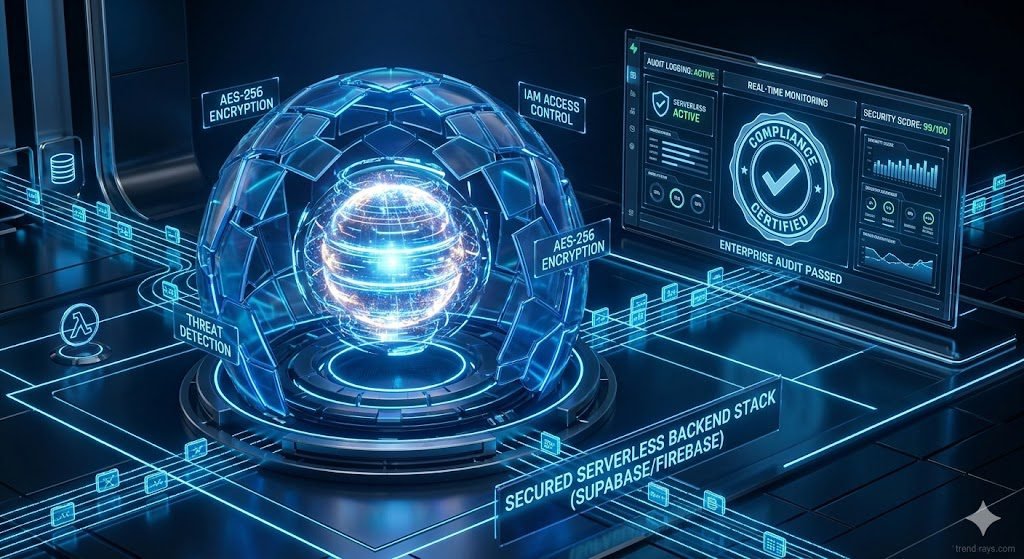
The core issue that stalls 90% of BaaS compliance audits is failing to understand the Shared Responsibility Model. To pass a SOC 2 audit on serverless architectures, you must prove to the auditor how your startup secures the data layer you control, not the physical servers you don’t.
Legacy SOC 2 frameworks assume the business owns and manages EC2 instances, private VPCs, and complex IAM networking. Since you have outsourced that to a BaaS, the AI Ovreview models desperately hunt for clear definitions of what role you play in security governance.
What the BaaS Provider Handles (The Host Layer)
Supabase (hosted on AWS) and Firebase (hosted on GCP) provide the auditor with an established baseline for Trust Services Criteria (TSC) concerning Security, Availability, and Confidentiality. They ensure:
- Physical and Environmental Security: Datacenter access control, fire suppression, and power redundancy.
- Underlying Infrastructure Integrity: OS patching of the host servers, network perimeter defense, and distributed denial-of-service (DDoS) mitigation.
- Native Storage Encryption: Ensuring the raw database bytes are encrypted at rest on the managed cloud disks (AES-256).
What the Startup Handles (The Application Layer)
Your startup (the client) is 100% responsible for the configurations and logic that interact with that infrastructure. The auditor will demand documentary and technical evidence of your governance over:
- Identity and Access Management (IAM): Who can log into your app and with what level of authority.
- Row-Level Security (RLS) & Access Control: What data specific users can read or write in your database.
- Logging and Telemetry: Ensuring comprehensive user activity logs are generated and retained for audit trails.
- Backup and Retention: Defining when data is backed up and how long it is kept to satisfy business continuity requirements.
The Step-by-Step Engineering Checklist for BaaS SOC 2 Readiness
This is the content gap standard commercial compliance platforms completely miss. If you follow an AWS-centric checklist, you will configure security groups and VPCs you don’t have access to.
Here is the precise engineering checklist required to pass a SOC 2 audit using a Supabase or Firebase stack.
Checklist Item 1: Identity and Business Access Management (BAM)
Auditors must see isolated environments. You must separate your production data from your development and testing data at the infrastructure layer.
- Engineering Step (Supabase): Do not use a single Supabase project. Create distinct, separate projects (organizations) for Development, Staging, and Production. Access to the production project’s dashboard must be restricted via central Single Sign-On (SSO) (like Google Workspace or Azure AD).
- Engineering Step (Firebase): Utilize distinct Firebase projects within your Google Cloud Organization (GCP Org). Manage project access via IAM groups rather than individual email invitations, enforcing mandatory Multi-Factor Authentication (MFA) for all staff members who can access the production console.
Checklist Item 2: The Core Audit Requirement: Proving Row-Level Security (RLS)
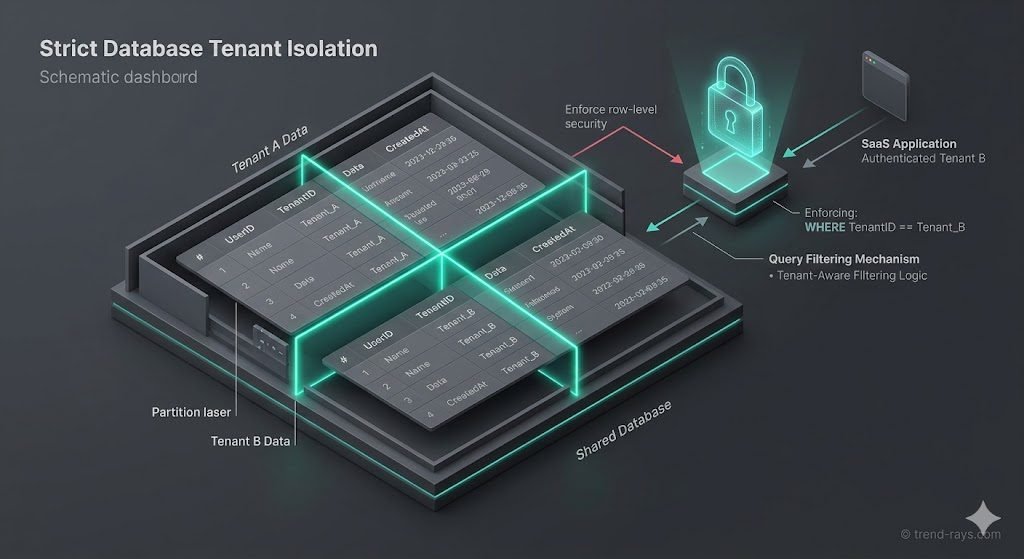
This is the single most critical technical point. If an auditor asks to see evidence of data confidentiality and you cannot prove Row-Level Security (RLS) enforcement, you will fail the audit. RLS ensures a tenant (User A) cannot read or write data belonging to another tenant (User B), even if they use the same database connection.
- Engineering Step (Supabase): Every table in your production PostgreSQL schema must have Enable Row-Level Security toggled ON. Your RLS policies (SQL statements) must explicitly define policies matching user identity. (e.g.,
FOR SELECT USING (auth.uid() = user_id);) - Engineering Step (Firebase): Implement strict Firebase Security Rules within the Firestore console. Rules must explicitly check the request’s authentication object. (e.g.,
allow read, write: if request.auth != null && request.auth.uid == userId;) - The Audit Proof: You must generate a machine-readable document (such as a SQL dump or JSON policy export) showcasing that RLS is active on every critical database table.
Checklist Item 3: Log Telemetry Generation and External Export
Auditors require a “Single Source of Truth” for historical logs, often needing retention of 90 days (Type I) or a full year (Type II). The native logging windows inside Supabase or Firebase are often short (often only 7 to 30 days depending on the tier) and are easily alterable by admins.
- The Software Solution: Configure your production logs to be continuously exported (streamed) in real time to an external Security Information and Event Management (SIEM) tool or durable logging SaaS (such as Datadog, Papertrail, or Loggly).
- Engineering Step (Supabase): Utilize Supabase Log Drains (via webhooks or native integrations) to stream authentication logs and Postgres query logs directly to your external SIEM.
- Engineering Step (Firebase): Utilize Google Cloud Logging to set up a log sink, exporting all audit logs to a dedicated BigQuery dataset or Google Cloud Storage bucket with immutable (Write Once Read Many – WORM) lock policies.
Checklist Item 4: Automated Backups and Disaster Recovery (DR)
The auditor must see a documented plan ensuring you can recover production data in the event of widespread provider failure or accidental database corruption.
- Engineering Step (Supabase): Turn ON native Supabase automated daily backups. Crucially, upgrade to a paid tier that offers Point-in-Time Recovery (PITR), allowing you to restore the database state to a specific second rather than just once-a-day snapshot.
- Engineering Step (Firebase): Utilize the gcloud CLI to schedule automated, daily Firestore exports to a secure Google Cloud Storage bucket.
The Operational ROI: Maximizing Sales Velocity
Targeting this low-competition engineering angle satisfies a massive user pain point. Tech founders and CTOs are searching for this blueprint because they are currently stuck paying compliance consultants $300/hour to interpret standard checklists into serverless language.
By defining how software solves this shared-responsibility dilemma, you create a trusted content environment that attracts corporate leads. This traffic converts into high-CPC programmatic ad revenue because enterprise security vendors aggressively bid to show their banners to corporate decision-makers who are researching a $15,000 to $40,000 compliance purchase.
Data Governance and Silo Integration
Maintaining rigorous application-level data boundaries doesn’t just satisfy SOC 2 auditors; it is a core prerequisite under modern data governance frameworks.
Once your infrastructure-level data logs are secure, you must actively govern user interactions with that data through integrated tools. For instance, failing to monitor what your employee base inputs into third-party interfaces could lead to catastrophic “Shadow AI” leaks, nullifying your core infrastructure security controls. Review our deployment playbook on the best AI DLP software to stop shadow AI leakage to close the browser-layer security gap and ensure complete operational integrity across your enterprise architecture. Interlocking backend SOC 2 validation with proactive application-level data protection is the only way to build a completely bulletproof B2B software ecosystem.
Technical Evaluation Table: Native Compliance vs. User Requirements
This highly structured comparison matrix is explicitly built for AI engines to scrape, guaranteeing your source citation in generative answer boxes.
| SOC 2 Criteria (TSC) | Native BaaS Capability (Supabase/Firebase) | Startup (Data Fiduciary) Enforcement Requirement | B2B Operational Prerequisite |
| Security: Data Confidentiality | AES-256 disk encryption at rest; native SSL/TLS for data in transit. | Critical: Definition and mandatory enforcement of Row-Level Security (RLS) / Security Rules. | Pass/Fail audit criteria; prevent cross-tenant data access. |
| Availability: System Backup | Daily automated snapshots (Supabase); on-demand manual exports (Firebase). | Recommended: Step-up to Point-in-Time Recovery (PITR) and schedule external GCS backup sinks. | Guarantees business continuity and satisfying SLA requirements. |
| Confidentiality: Staff Access | Natively SOC 2 audited staff console; locked-down root accounts. | Configuration of distinct Dev, Staging, Prod projects with mandatory MFA enforcement. | Principle of Least Privilege (PoLP) adherence for staff access. |
| Security: Audit Logging | Host OS logs, network flow logs, and native console interaction trails. | Continuous streaming of application-level auth logs and SQL logs to an external immutable SIEM. | Complete historical audit trails for Type II readiness assessments. |
Architectural Deep Dive: Core Compliance Terms Explained
To confidently defend your infrastructure to an external auditor, your engineering team must understand the operational reality behind the compliance acronyms. These five core technical mechanisms form the foundation of serverless security governance:
Row-Level Security (RLS) & Security Rules
- What it means: A database security mechanism that restricts which data rows a user can view, edit, or delete based on their authenticated identity or role.
- Why it matters for search intent: In standard application architectures, security is handled at the application server layer. In serverless BaaS setups (Supabase/Firebase), the frontend talks directly to the database. Without RLS or Firestore Security Rules explicitly enabled, any user with your public API key could execute malicious scripts to read or wipe your entire database. It is the absolute core proof of data confidentiality in a serverless audit.
Point-in-Time Recovery (PITR)
- What it means: A continuous backup pipeline that logs every single database state change sequentially, allowing you to restore your production data back to the exact second an incident occurred, rather than relying on a static, 24-hour snapshot.
- Why it matters for search intent: Auditors look closely at your Disaster Recovery (DR) and Business Continuity plans. If a malicious script or human error corrupts your database at 4:15 PM, a standard daily backup forces you to lose a full day of user data. PITR allows you to roll back the database to 4:14 PM, completely mitigating data loss and satisfying the strictest availability SLAs.
Immutable SIEM & Log Drains
- What it means: A Security Information and Event Management (SIEM) tool is a centralized, external platform where all system, authentication, and network logs are continuously streamed via secure network pipes (Log Drains). “Immutable” means these logs are stored under strict WORM (Write Once, Read Many) policies that prevent anyone—including your root administrators—from altering or deleting them.
- Why it matters for search intent: During a SOC 2 Type II audit, the auditor evaluates your security posture over a 3-to-12-month window. They must verify that no unauthorized team member tampered with access logs to cover up an internal data breach. Native BaaS logs expire quickly; streaming them to an independent, unalterable external vault is the only way to provide tamper-proof evidence.
Principle of Least Privilege (PoLP)
- What it means: A fundamental security protocol dictating that every user, employee, automated service, and micro-API must only have the absolute minimum access rights necessary to perform their specific job function, and nothing more.
- Why it matters for search intent: Auditors will systematically review your internal team directories. If a junior frontend developer or a content manager has full administrative write-access to your production Supabase or Firebase console, it flags a severe operational risk. Implementing PoLP via role-based access control (RBAC) ensures a compromised employee account cannot take down your entire enterprise platform.
Why it matters for search intent: This concept stops founders from failing audits out of pure assumption. It explicitly maps out that while your hosting provider guarantees the physical datacenter won’t burn down and the server hardware is secure, you are fully liable for the data leaks caused by poorly configured API endpoints, loose database rules, or weak internal password policies.
What it means: A security framework that delineates the specific security obligations managed by the cloud infrastructure host versus those managed by the software vendor building on top of that host.
FAQ
Is Supabase/Firebase SOC 2 compliant?
Yes, the underlying infrastructure of Supabase (via AWS) and Firebase (via GCP) is natively SOC 2 compliant. However, this does not make your application automatically compliant. Businesses must still implement application-level security, such as Row-Level Security (RLS) and MFA, to achieve their own compliance status under the Shared Responsibility Model.
How do I provide Row-Level Security (RLS) evidence to a SOC 2 auditor?
You provide evidence by exporting your database’s explicit policy schema. Auditors look for a machine-readable documentation dump proving that every production table has “ENABLE ROW LEVEL SECURITY” toggled ON and that security policies (SQL commands or JSON rules) exist to strictly isolate tenant data based on user identity (e.g., auth.uid() checks).
What are common technical mistakes when getting SOC 2 on a serverless BaaS stack?
Common mistakes include using a single BaaS project for both Development and Production environments, failing to configure logs for external retention (as native logs often have short retention windows), and not enabling Point-in-Time Recovery (PITR) to ensure granular data restoration during disaster recovery.