
Document storage is a solved problem. The critical bottleneck for enterprise legal operations in 2026 is Time-to-Closure.
As organizations scale, manual review of third-party paper, Non-Disclosure Agreements (NDAs), and Master Service Agreements (MSAs) throttles revenue realization. While generic LLMs can summarize text, deploying public AI models in an enterprise legal environment is a catastrophic security risk. Modern legal operations require specialized, single-tenant AI architecture that actively mitigates risk without exposing proprietary data.
When evaluating AI tools for contracts, the market fractures into three distinct tiers:
- Standalone AI (The Bicycle): Lightweight tools (like Acrobat AI or ChatGPT Enterprise) that are fast and cheap but lack native workflow routing and present severe data governance risks for complex portfolios.
- AI-Enhanced CLMs (The Hybrid Car): Mid-market Contract Lifecycle Management systems (like Ironclad or LinkSquares) where AI is woven directly into the repository for search, tagging, and routing. This is the sweet spot for most growing organizations.
- AI-Everything Platforms (The Race Car): Enterprise-scale systems (like Sirion or Harvey) powered by heavy LLMs designed to reason over thousands of documents for M&A diligence and global procurement. Powerful, but demanding strict IT governance to deploy.
The Baseline: LLM Architecture & Enterprise Data Security
Before evaluating feature sets, IT Directors and Chief Information Security Officers (CISOs) must audit the underlying architecture. Running a vendor contract through a public model violates almost every modern compliance framework.
Data Governance:
The foundational requirement for any legal AI is a private, zero-retention API deployment. This means the vendor’s LLM processes the contract for extraction but immediately purges the payload from its cache. The data must never be utilized to train the provider’s baseline models.
Compliance Baselines:
Any tool seriously considered for enterprise deployment must, at minimum, hold SOC 2 Type II and ISO 27001 certifications. If a tool cannot provide a recent SOC 2 audit report detailing its data encryption standards (AES-256 at rest, TLS 1.2+ in transit), it fails the procurement phase.
Explainable AI & The “Black Box” Problem:
Modern AI review software must move beyond binary risk scoring. A tool cannot simply assign a “High Risk” flag to an indemnity clause; it must provide Explainable AI. The system needs to explicitly map the deviation against the company’s approved playbook.
Example: Instead of simply highlighting text, the AI must output: “This clause expands liability beyond the standard 30-day cure period outlined in Playbook V.4, presenting a critical financial exposure.”
Comprehensive 2026 Comparison Matrix
Note to buyers: Implementation time and learning curves are the hidden costs of AI procurement. Factor these heavily into your total cost of ownership (TCO).
| Tool | Ideal Target Persona | Standout Technical Feature | Learning Curve | Implementation Time |
| LegalOn | Solo Counsel & Small Teams | MS Word Native Pre-built Playbooks | Very Low | Immediate (Day 1) |
| LinkSquares | Mid-Market & Agencies | Bulk M&A Risk Scoring Agent | Moderate | 2 to 4 Weeks |
| Ironclad AI | Growing Enterprises | Conditional Workflow Routing | High | 1 to 3 Months |
| Sirion | Global Corporations | Post-Signature SLA Tracking | Very High | 3 to 6+ Months |
Detailed Tool Breakdown & Operational Workflows
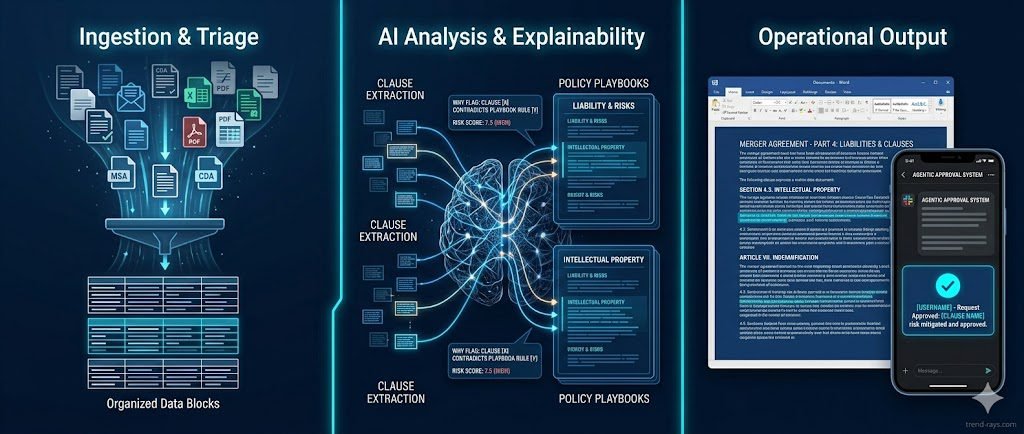
To understand the true ROI of these platforms, you must look at how they alter the daily operational workflow of a legal or procurement team.
1. LinkSquares: The Speed & Volume Play
LinkSquares recently consolidated its capabilities under the LinkAI banner. A major differentiator is their new Assist Tab, a natural language chat interface docked directly next to the document. A user can highlight a complex indemnification clause and ask, “Explain the implications of this clause in plain English,” or “Redraft this to cap our liability at the contract value.” This contextual awareness is why LinkSquares maintained a massive 98% user satisfaction rating in the latest G2 CLM Grid Reports. LinkSquares utilizes an agentic architecture designed to ingest and categorize massive amounts of unstructured legacy data rapidly.
How to Use It (The Workflow):
- Bulk Ingestion: Users upload thousands of legacy PDFs via the Smart Import tool.
- AI Triage: The predictive AI reads the documents and assigns an immediate A-through-F risk score based on deviation from standard company terms.
- Automated Routing: “A-grade” contracts are automatically pushed to execution, while “D-grade” contracts are isolated into a specialized dashboard for senior counsel review.
Advantages:
- Unmatched speed for M&A due diligence and legacy data auditing.
- Excellent centralized repository (Analyze) that connects amendments and exhibits to the master agreement.
Disadvantages:
- Search functionality relies heavily on initial data tagging accuracy.
- Customization options for highly bespoke contracts are less flexible than enterprise counterparts.
2. Ironclad AI: The Compliance Heavyweight
Ironclad shifted from basic text extraction to a fully “agentic” architecture. Their Intake Agent automatically reads incoming agreements from emails or slack and populates the workflow without human data entry. Furthermore, their AI Assist™ module is directly powered by OpenAI’s GPT-4, allowing users to highlight a highly unfavorable clause and simply type, “Redraft this to be more vendor-friendly based on our standard playbook.” Paired with Ironclad Insights for visual pipeline analytics, it’s easy to see why they recently surpassed $200 million in Annual Recurring Revenue.
Ironclad transforms static contracts into active operational workflows. It is designed for companies where policy enforcement across multiple departments (Sales, Legal, Finance) is non-negotiable.
How to Use It (The Workflow):
- Intake: A sales rep submits a vendor contract via an internal Ironclad portal.
- Metadata Extraction: Ironclad’s GPT-4 powered AI Assist extracts the core data (liability caps, governing law, payment terms).
- Conditional Routing: If the AI detects a liability cap under $1M, it automatically pauses the workflow and routes an approval ping to the CFO via Slack or email.
- Analytics: The operations team monitors the Insights dashboard to see exactly where bottlenecks occur (e.g., “Contracts are stalling at the CFO approval stage”).
Advantages:
- Exceptional risk mitigation through strict, automated process controls.
- Deep integration ecosystems (Salesforce, Workday, Slack).
Disadvantages:
- High total cost of ownership and per-seat licensing.
- Lengthy onboarding process to map out complex organizational routing logic.
3. LegalOn: The “Out-of-the-Box” Attorney Engine
LegalOn doesn’t just use standard ChatGPT prompts; it operates on a highly specialized 5-Layer RAG (Retrieval-Augmented Generation) Architecture specifically chunked for legal clauses. Following their “Best Overall in Contract Review” win at the 2026 Spring LegalTech Awards, they introduced LegalOn Translate—a feature allowing teams to review contracts in English but return markups in the original foreign language. Furthermore, their Vault smart repository turns executed contracts into structured business intelligence, allowing users to query their entire database via plain-language search.
LegalOn bypasses complex software deployments by living entirely where lawyers already work: Microsoft Word. It is backed by a 5-layer RAG architecture built specifically for legal phrasing.
How to Use It (The Workflow):
- Select Playbook: The user opens a third-party contract in MS Word and selects a predefined playbook (e.g., “Standard Vendor NDA”) from the LegalOn add-in.
- AI Review: The AI scans the document and flags deviations directly inline, explaining why a clause is risky.
- One-Click Redline: The user clicks to accept the AI’s suggested fallback language, which automatically replaces the text while maintaining document formatting.
Advantages:
- Delivers immediate Day-1 ROI with over 100 attorney-vetted playbooks natively installed.
- Explains its reasoning in plain English rather than just highlighting text in red.
Disadvantages:
- Solely focused on pre-signature review; lacks post-signature tracking.
- Not designed for massive, multi-department approval routing.
4. Sirion: The AI-Native Enterprise Behemoth
Sirion has restructured its AI framework into three distinct pillars: STORE, CREATE, and MANAGE. Using their proprietary Extraction Agent, Sirion goes beyond simple text detection to understand nested conditions and cross-references that basic keyword-scanners miss. By dynamically linking contract deliverables to ERPs and invoice validation engines, enterprise clients utilizing Sirion’s MANAGE pillar report an astonishing 80% faster contract redlining and negotiation alongside complete automation of post-signature SLA tracking.
Sirion does not just read contracts; it monitors their execution. It is designed for massive procurement teams that need to track millions of dollars in post-signature vendor deliverables.
How to Use It (The Workflow):
- Obligation Mapping: Sirion ingests an executed contract and maps all deliverables, SLAs, and payment milestones.
- ERP Integration: The platform connects bidirectionally with the enterprise ERP (like SAP or Oracle).
- Active Monitoring: If a vendor misses a delivery SLA, Sirion automatically triggers an alert to the procurement team to collect the contractual penalty.
Advantages:
- Massive financial ROI through revenue protection and SLA enforcement.
- Unifies pre-signature review and post-signature analytics in one platform.
Disadvantages:
- The highest learning curve and implementation timeline on the market.
- Requires massive document volume to justify the enterprise pricing.
Enterprise buyers must evaluate the Total Cost of Ownership (TCO), not just the SaaS subscription.
Pricing Transparency & Deployment TCO
- Implementation Timelines: Expect rapid deployments (2–4 weeks) for targeted tools like LegalOn. Comprehensive CLM overhauls (Ironclad, Sirion) generally require 3 to 6 months of dedicated IT collaboration.
- The Migration Tax: The largest hidden cost in AI contract management is legacy data migration. Do not underestimate the human hours required to map existing unstructured data into the new AI’s structured framework.
- License Structures: LinkSquares and Sirion operate on opaque, quote-based enterprise models heavily dependent on document volume. Ironclad utilizes a modular, per-seat structure, meaning procurement must accurately forecast the ratio of “view-only” business users to “power-user” legal admins to avoid license bloat.
Conclusion: Which AI Contract Tool is Right for You?
Choosing the right AI contract software depends entirely on your organizational scale and primary bottleneck.
For Global Corporations: Choose Sirion. If you manage global procurement and are losing millions annually to uncollected vendor penalties and missed SLAs, Sirion is the only platform that actively monitors your financial obligations post-signature.
For Freelancers & Solo Practitioners: Choose LegalOn. If you are a solo attorney or an independent consultant reviewing NDAs and MSAs, you don’t need a complex repository. LegalOn lives inside MS Word, requires zero IT setup, and gives you instant, attorney-grade redlining from day one.
For Agencies & Mid-Market Businesses: Choose LinkSquares. If your business is scaling rapidly and you are drowning in standard vendor agreements or facing an M&A audit, LinkSquares’ ability to ingest thousands of documents and assign instant risk scores will clear your backlog in days, not months.
For Growing Enterprises: Choose Ironclad AI. When your organization reaches the size where sales, finance, and legal are stepping on each other’s toes, Ironclad is the answer. It enforces compliance by ensuring no contract gets signed without the proper departmental approvals based on the AI’s data extraction.