The first impression your business makes is rarely visual anymore; it is often auditory. When a potential high-value client or a stressed customer calls your business, what do they hear? If they are greeted by a robotic, disjointed, 1990s-era auto-attendant, your brand equity immediately drops.
For years, creating a seamless, professional Interactive Voice Response (IVR) system required hiring professional voice actors, booking studio time, and paying premium fees every time your holiday hours changed. Today, that barrier has vanished. Integrating AI voice cloning into your phone system is one of the highest-leverage upgrades you can make when building the ultimate AI tech stack for your small business.
Here is how you can use advanced AI to make your boutique agency or local shop sound like a Fortune 500 enterprise—for a fraction of the cost.
What is AI Voice Cloning in the Context of IVR?
Historically, text-to-speech (TTS) in phone systems sounded flat, mechanical, and frustratingly artificial. Think of the classic “Press… ONE… for… SALES” prompt.
Modern AI voice cloning has moved beyond basic TTS. Platforms now use deep learning models and natural language processing to understand not just what is being said, but how it should be performed. The AI comprehends punctuation, emotional inflection, and pacing, delivering hyper-realistic human voices that breathe and pause naturally.
Why Small Businesses Are Ditching Voice Actors for AI
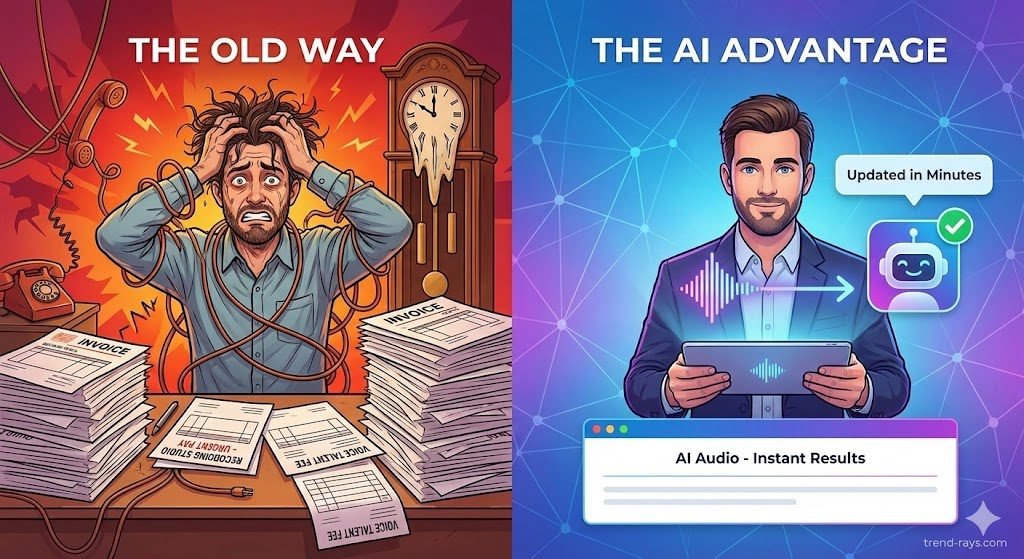
While professional voice actors are incredible artists, the traditional voiceover model doesn’t align with the agile needs of a small business. Here is why the shift to AI is accelerating:
1. Speed and Agility
Imagine a sudden snowstorm forces your local retail shop to close early, or your SaaS platform experiences an unexpected outage. You need to update your phone menu immediately to inform callers. With AI, you can type a new greeting, generate the audio, and upload it to your VoIP provider in under three minutes. No waiting for a freelancer on Upwork to wake up in a different time zone.
2. Cost Consistency
Hiring a professional voice actor for a phone tree typically incurs a per-project fee or a per-word rate, easily costing $100 to $500 per update. High-end AI voice generators operate on a subscription model (often between $11 to $30 a month), allowing for unlimited tweaks and regenerations until the tone is absolutely perfect.
3. Unbreakable Brand Consistency
If your original voiceover artist retires, raises their rates, or goes on vacation, your phone menu suddenly becomes a patchwork of different voices as you update extensions. By establishing a specific AI “voice persona,” your brand sounds consistent across your phone systems, website explainer videos, and social media ads.
How AI Voice Menus Directly Impact Your Bottom Line
It is easy to view phone systems as an administrative expense, but your IVR is often the first touchpoint in your sales funnel. Upgrading to a natural-sounding AI voice has direct implications for your revenue:
- Reducing the “Abandoned Call” Rate: Studies show that overly complex or robotic phone menus lead to high drop-off rates. If a caller hangs up before reaching your sales team because they are frustrated by a metallic, 1990s robot voice, that is lost revenue. A warm, human-like AI greeting keeps callers engaged and on the line.
- The “Enterprise Illusion” Premium: In B2B sales and boutique services, perceived authority dictates pricing power. A seamless, high-fidelity phone system makes a two-person agency sound like a 50-person firm. This elevated brand perception directly impacts trust, making it easier to close high-ticket clients.
- Recovering Lost Labor Hours: Every time an employee has to answer a basic question (like “What are your hours today?” or “Where are you located?”), your business leaks money. A clear, easily updatable AI phone tree handles Level 1 support automatically, freeing your team to focus strictly on revenue-generating conversations.
Built for Scale: Growing Your Phone Tree Without Growing Costs
The fatal flaw of hiring human voice actors for your business phone is the lack of scalability.
Imagine your boutique agency lands a few big contracts and suddenly needs to add a dedicated “Billing Department” and a “Client Success” extension. If you used a human voice actor six months ago, you now have to track them down, hope they are available, pay their minimum studio fee, and wait days for a five-second audio clip just to keep your menu sounding uniform.
With an AI voice subscription, your phone system scales infinitely. Adding three new extensions, launching a bilingual support line, or opening a new branch in a different time zone takes 60 seconds of typing. You simply select your saved, custom AI voice clone, type the new routing instructions, and export. Total additional cost: $0.
Step-by-Step: Implementing AI Voice in Your Phone System
Getting an AI-generated menu live on your business line is a straightforward process that requires zero coding.
Step 1: Choose the Right Generator
Not all AI voices are created equal. For IVR, you want maximum realism.
- ElevenLabs: Currently the gold standard for hyper-realistic, emotive voices. Ideal for businesses that want a warm, conversational tone.
- Murf.ai: Excellent for clean, corporate, and highly professional enterprise-style voices.
Step 2: Draft the Script for the Spoken Word
People read differently than they listen. Keep your IVR script brief and conversational.
- Bad: “Please select from the following numerical options to be routed to the appropriate departmental representative.”
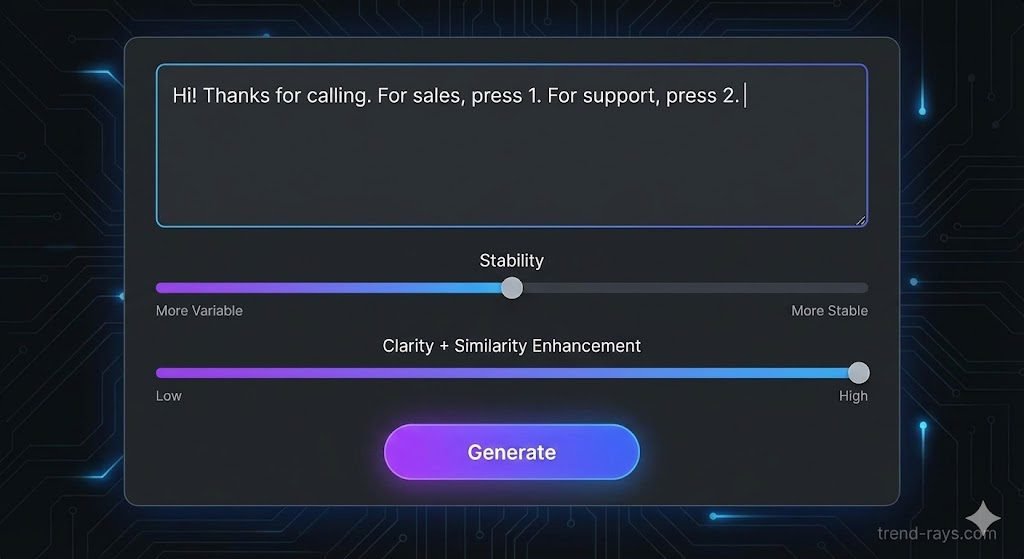
- Good: “Hi, thanks for calling us! Press 1 for sales, 2 for support, or stay on the line and we’ll be right with you.”
Step 3: Generate and Refine
Input your text and adjust the AI’s settings. Dialing back the “stability” slider slightly in tools like ElevenLabs often introduces natural human variations, making the voice sound less rigid.
Step 4: Export and Integrate
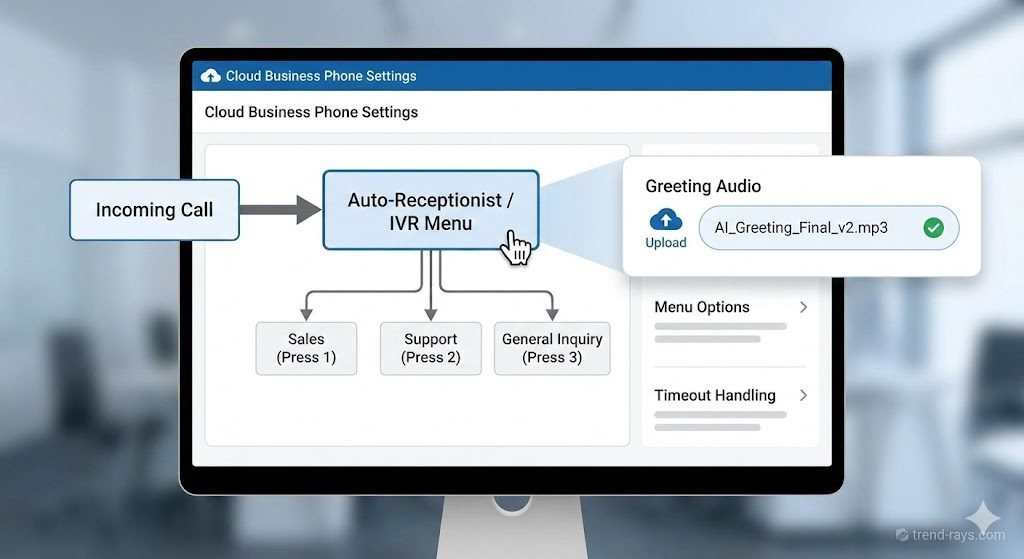
Download the finalized audio file (usually an MP3 or WAV). Log into your VoIP provider’s dashboard—such as RingCentral, Zoom Phone, Dialpad, or Twilio—navigate to your Auto-Receptionist or IVR settings, and replace the default greeting with your new file.
Addressing the Risks: Quality and Legality
As with any emerging tech, business owners often have two immediate concerns:
“Does it actually sound real?” In 2026, the best AI voice models are virtually indistinguishable from humans over a standard phone line (which naturally compresses audio anyway). Your customers will likely not know they are listening to an AI unless you tell them.
“Is it legal to use these voices commercially?” Yes, provided you are using the tools correctly. Free tiers of AI voice generators often restrict audio to non-commercial use. To legally use the generated voice for your business phone lines, you must have an active paid subscription to the platform, which grants you full commercial rights to the output.
The Hidden Opportunity: Offering “IVR Modernization” as a Freelance Service
If you are a freelancer or a solo agency owner, this technology isn’t just a way to save money on your own business—it is a highly lucrative service you can sell.
Right now, thousands of local businesses (dentists, plumbers, law firms, and real estate agencies) are losing customers because their phone systems sound terrible. They don’t have the time to learn about AI voice cloning or navigate VoIP dashboards.
This creates a massive arbitrage opportunity:
- The Pitch: You call local businesses, listen to their terrible phone menus, and pitch an “Enterprise Phone Modernization” package for $300 to $500.
- The Execution: You use a $22/month ElevenLabs subscription to generate a hyper-realistic, warm, professional script for them.
- The Delivery: You deliver the MP3s and offer a simple PDF guide on how they can upload it to their RingCentral or generic VoIP provider.
You can fulfill a $500 service in less than 20 minutes, with practically zero overhead, simply by leveraging the AI tools most local businesses don’t even know exist yet.
The Bottom Line
A professional, warm, and highly functional phone greeting is low-hanging fruit for improving your perceived brand value. By leveraging AI voice cloning, solo founders and small teams can command the auditory presence of a massive enterprise, while maintaining the agility and budget of a startup.