
If you have ever tried to use a Virtual Private Network (VPN) to access higher-paying US or UK surveys on apps that pay you to play games, you already know the outcome: an instant, permanent account ban.
For years, casual users have wondered how a simple mobile puzzle game or GPT (Get-Paid-To) site can instantly detect and block military-grade VPNs like NordVPN or ExpressVPN. The answer lies in the backend infrastructure.
Modern reward apps do not rely on basic IP blacklists. To protect their multi-million-dollar advertising budgets from proxy farms, platforms like Freecash, Swagbucks, and Mistplay integrate enterprise-level, AI-driven Fraud Detection SaaS (Software as a Service).
If you want to understand why your account was terminated, here is the technical reality of the AI security infrastructure operating quietly behind your favorite reward apps.
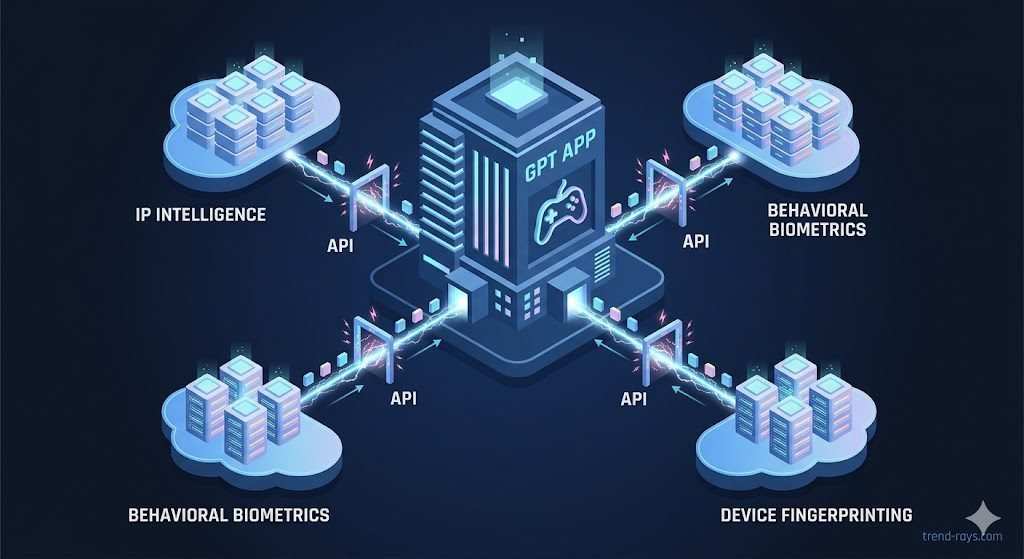
What Actually Is “AI SaaS Infrastructure”?
Before understanding how you were caught, you must understand what caught you. When a casual gamer hears “AI,” they usually think of generative chatbots like ChatGPT. But in the world of B2B enterprise security, AI means something entirely different.
AI SaaS Infrastructure is the invisible, cloud-based nervous system that protects digital platforms. Let’s break down the three components:
- SaaS (Software as a Service): Game developers are good at making games; they are not cybersecurity experts. Instead of spending $10 million to build their own fraud-detection system from scratch, platforms like Freecash or Swagbucks “rent” this technology from enterprise security companies (like MaxMind, BioCatch, or SEON). They pay a monthly subscription fee to access this software via the cloud.
- Infrastructure (The Plumbing): The security software doesn’t live on your phone. It lives on massive external servers. The “infrastructure” refers to the APIs (Application Programming Interfaces) and SDKs (Software Development Kits) that act as a bridge. When you click “Login” on a reward app, the infrastructure instantly sends your device data across the internet to the security company’s servers for analysis.
- The AI (Machine Learning & Pattern Recognition): This is not a human reviewing your account. The enterprise SaaS uses predictive machine learning models. These models have been trained on billions of data points from known hackers, proxy farms, and legitimate users. The AI can analyze your IP address, your device hardware, and your typing speed in less than 200 milliseconds, calculate a “Risk Score” from 0 to 100, and return a verdict before the app’s loading screen even finishes.
In short: Reward apps do not manually catch VPN users. They plug their apps into a global, AI-powered hive mind that specializes in detecting digital deception in real-time. Here are the three specific layers of that infrastructure that trigger your ban.
IP Intelligence APIs: The Frontline Defense (And The JSON Payload)
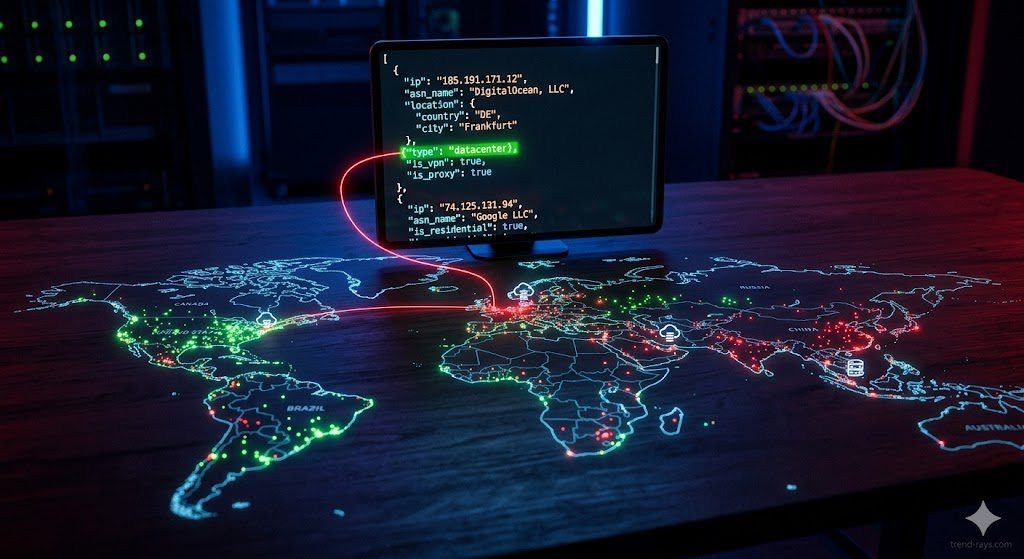
The moment you open a GPT app, click a survey, or attempt a withdrawal, the platform does not manually check your IP address. Instead, it fires a server-to-server API call to a specialized B2B IP Intelligence SaaS provider, such as AbstractAPI, MaxMind (GeoIP2), or IPQualityScore (IPQS).
Within 50 milliseconds, these enterprise databases cross-reference your IP address against billions of known proxy nodes and return a highly detailed JSON payload to the gaming app. The app’s logic engine parses this data to look for four specific technical red flags.
Red Flag A: ASN (Autonomous System Number) Mismatches
Every IP address on the internet belongs to an ASN, which identifies the organization that owns it.
- Residential ASNs: If you are at home, your IP resolves to a consumer ISP (e.g., ASN 7922 – Comcast Cable or ASN 9498 – Airtel).
- Datacenter ASNs: Commercial VPN providers (like NordVPN or ExpressVPN) do not own residential networks. They rent massive server racks from cloud providers. Therefore, a VPN IP will always resolve to a commercial host (e.g., ASN 14061 – DigitalOcean or ASN 16509 – Amazon.com).
The reward app is programmed with a strict boolean rule: If connection_type == "Hosting", execute an instant account ban. It does not matter how expensive or “stealthy” your commercial VPN claims to be; the underlying ASN is immutable and publicly verifiable.
Red Flag B: The Fraud Risk Score & The is_vpn Boolean
Advanced APIs do not just return network locations; they utilize predictive machine learning to assign your connection a Fraud Risk Score from 0 to 100.
Here is an example of the actual JSON data payload a reward app receives when you connect with a VPN:
If the SaaS provider’s web-scrapers have previously identified your specific VPN server, the is_vpn flag returns as true. However, even if the VPN server is brand new, the AI will calculate the fraud_score. Most legitimate gaming platforms are configured to instantly shadowban or terminate any account that registers a fraud score above 75.
Red Flag C: IP Velocity and Subnet Abuse
What if you buy a private, dedicated proxy IP that has never been flagged before? The AI will catch you using Velocity Checks.
The security SaaS monitors how many unique device fingerprints or accounts are authenticating from the same IP subnet within a specific timeframe. If a VPN provider spins up a new server block, and 50 different users suddenly log into Freecash from that exact IP range within an hour, the velocity algorithm instantly flags the entire subnet as a “Proxy Farm,” retroactively banning everyone who connected through it.
Red Flag D: The WebRTC Leak Trap
Many users attempt to bypass VPN detection by using browser extensions rather than system-wide VPNs, or by buying “Residential Proxies” that route traffic through infected consumer PCs.
This fails because of WebRTC (Web Real-Time Communication). WebRTC is a browser protocol used for video streaming and audio calls. Crucially, it bypasses standard proxy settings. When a reward platform’s security script runs in your browser, it can execute a WebRTC request that forces your browser to leak your true, underlying local IP address, completely ignoring your expensive residential proxy. If the WebRTC local IP does not match the proxy’s public IP, the system instantly logs a mismatch and terminates your account.
Behavioral Biometrics: The AI Silent Killer (And The Telemetry Payload)
What happens if you spend $50 a month on a premium “Residential Proxy” that successfully bypasses the ASN and IP Intelligence checks? In 2026, reward apps have escalated their defenses by integrating Behavioral Biometric SaaS platforms (like BioCatch, HUMAN Security, or Forter).
These tools do not care where your IP address is located; they care how you physically interact with your device. They operate on a simple mathematical premise: Humans are biologically incapable of perfection.
When you interact with a GPT app, an invisible background SDK (Software Development Kit) records your micro-movements at 60 frames per second. It streams this telemetry data to the AI fraud engine, which analyzes three specific vectors to calculate your “Bot vs. Human” confidence score.
Vector A: Touchscreen Dynamics & Device Physics
If you are playing a mobile game or scrolling through an Offerwall, the biometric SDK doesn’t just register that you tapped the screen. It records the physics of the tap.
- Scroll Curvature: When a human thumb scrolls down a smartphone screen, it naturally arcs in a slight curve due to the biomechanics of the hand. Bots and automated scripts scroll in a perfectly straight, vertical line.
- Pressure and Surface Area: Modern smartphone screens measure capacitive pressure. The AI analyzes how hard you press and the exact millimeter surface area of your fingertip.
- Gyroscope & Accelerometer Integration: Humans do not hold their phones perfectly still. Your breathing and micro-tremors register on the phone’s internal gyroscope. If the biometric payload shows a device sitting at a mathematically perfect 0.00-degree tilt with zero accelerometer variance, the AI instantly flags the session as a “Server-Racked Device” or emulator.
Vector B: Keystroke Dynamics (The Typing Signature)
When you type your email address to log in, you are leaving a digital biometric signature that is as unique as your fingerprint. The AI measures two critical micro-metrics:
- Flight Time: The exact millisecond delay between releasing one key and pressing the next.
- Dwell Time: How long your finger rests on a single key before releasing it.
If a script automatically injects an email address into a login field, or if a user copies and pastes data with zero flight time, the AI flags the input as “Synthetic.”
Vector C: Emulator Detection (The BlueStacks Ban)
This is exactly why your account gets terminated when you try to use an Android emulator like BlueStacks on your PC to complete mobile game offers.
If you map a PC mouse to simulate a touchscreen swipe, your mouse movements are perfectly linear and mathematically precise. A macro script moves the cursor from Point A to Point B at a constant velocity.
The AI behavioral engine instantly recognizes the lack of “human jitter” (the micro-corrections your hand makes as it moves). It classifies the session as Automation_Emulator_Detected, bypasses the IP check entirely, and issues a permanent hardware ban for violating the Terms of Service.
The Raw Telemetry Payload
Here is a simplified example of the telemetry data payload that a biometric SDK silently transmits to the fraud detection server when you interact with the app:
Because the accelerometer_variance is zero and the velocity_curve is perfectly linear, the human_confidence_score drops to 2%, triggering an immediate termination.
Interactive: Test Your Biometric Signature
Don’t believe that an AI can tell the difference between you and a bot? Use the widget below. Move your mouse or drag your finger from the Start target to the End target. The AI will analyze your movement telemetry—jitter, speed variations, and curve—to determine if you are human or an automated script.
Device Fingerprinting: The Immutable Hardware Ban (And The Entropy Hash)
The most common mistake banned users make is assuming they can simply delete the app, turn off their VPN, create a new email address, and start over. They try this, and the new account is banned within seconds.
This happens because you were not just IP-banned; you were hit with a Hardware Ban via Device Fingerprinting.
When you install a reward app, you also install the integrated marketing and security SDKs (Software Development Kits) embedded in its code, such as AppsFlyer, Adjust, or Branch.io. These SDKs bypass your network connection entirely and harvest raw data directly from your device's motherboard to create a deterministic, unique cryptographic hash.
The Anatomy of an Entropy Hash
To generate this unique fingerprint, the AI SaaS relies on "Entropy"—the measure of uniqueness in your device's hardware and software configuration. The SDK scrapes dozens of micro-parameters that, when combined, create a profile so unique that no two phones on earth share the exact same hash.
- Vector A: Hardware & OS Level Data: The system pulls your exact OS kernel version, baseband version, CPU architecture (e.g., ARMv8), total RAM down to the byte, and your precise internal storage capacity. Resetting your phone to factory settings does not change physical RAM or CPU architecture.
- Vector B: WebGL & Canvas Fingerprinting: This is where the tracking becomes aggressively advanced. The SDK forces your device's GPU to secretly render a hidden, invisible 3D graphic using WebGL. Because every GPU chip has microscopic manufacturing variances, and every graphics driver renders pixels slightly differently, the resulting image is entirely unique to your specific processor. The system hashes this invisible image into a text string.
- Vector C: The Sensor & Media Stack: The AI checks your exact battery health percentage and discharge rate, your device's native AudioContext (how your specific sound card processes frequency rates), and your exact screen resolution and color depth.
The Fingerprint Payload
When all this entropy is collected, the SDK runs it through a hashing algorithm (like SHA-256) to create your device_fingerprint_id. Here is an example of the JSON payload transmitted to the fraud server:
Why "Resetting Your Ad ID" Fails
In the past, users could evade bans by resetting their Google Advertising ID (GAID) or Apple IDFA. In 2026, AI SaaS platforms do not care about your mutable Ad ID.
If the Fraud SaaS detects you using a VPN during an Offerwall survey, it takes your hash_id and permanently burns it into their global blacklist database. Because this hash is tied to your physical motherboard, GPU, and RAM, any future attempt to register a new account from that exact piece of hardware—even on a clean, residential Wi-Fi network—will be automatically blocked at the server level.
The only way to bypass a modern device fingerprint ban is to literally throw the phone in the trash and buy a new one.
Entropy SDK Simulator
Click 'Scan device' to simulate an anti-fraud SDK harvesting raw hardware and browser entropy points to generate your deterministic fingerprint hash.
NOTE: Due to browser privacy constraints, this web-based simulation pulls fewer "entropy" points than an installed mobile SDK (Adjust/AppsFlyer), which harvests native OS kernel data for absolute hash determination.