When corporate counsel issues a sudden litigation hold, IT departments must instantly freeze millions of cross-platform messages to prevent the illegal spoliation of evidence. The Solution: To execute a legally defensible preservation protocol without alerting the employees under investigation, Enterprise IT must deploy Microsoft Purview eDiscovery (Premium). By utilizing authorized third-party data connectors to ingest Slack Enterprise Grid data into Exchange Online mailboxes, administrators can apply silent, in-place holds across both Microsoft Teams and Slack simultaneously. This satisfies strict EDRM (Electronic Discovery Reference Model) preservation requirements while drastically reducing third-party data ingestion fees.
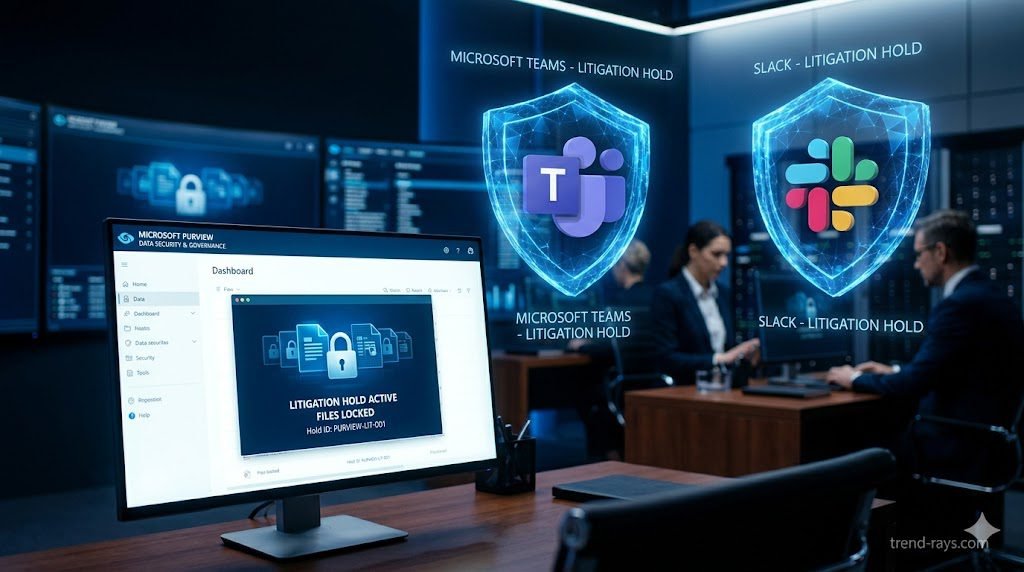
The Compliance Crisis: Spoliation and the “Export Trap”
When a corporation faces an SEC audit, an HR lawsuit, or intellectual property litigation, the legal department issues a preservation memo. Historically, IT responded to this by telling employees to “stop deleting emails” or by forcefully exporting terabytes of raw inbox data to PST files and shipping them to external law firms.
In 2026, this legacy approach is a massive legal and financial liability.
- Spoliation of Evidence: If an employee deletes a highly relevant Slack message or Teams chat after a hold is issued, the opposing counsel will accuse your company of “Spoliation of Evidence.” Judges routinely issue devastating financial sanctions—and sometimes default judgments—against corporations that fail to take “reasonable steps” to freeze data.
- The CFO’s “Export Trap”: External eDiscovery processing platforms (like Relativity, Logikcull, or Everlaw) charge exorbitant ingestion and hosting fees based on data volume (often hundreds of dollars per gigabyte). If IT blindly exports the entire company’s Slack and Teams history to outside counsel, the legal bill will bankrupt the quarter’s operating budget.
Advanced Preservation Architecture (Deep Dive)
Microsoft retired its “classic” eDiscovery portals in late 2025. Today, Microsoft Purview eDiscovery (Premium) is the undisputed command center for legal data governance, but mapping modern chat applications into its architecture requires strict technical precision.
Deciphering Microsoft 365 E5 Compliance Licensing Requirements
Before configuring a single hold, IT must address the licensing hurdle. Standard Office 365 E3 licenses only provide basic eDiscovery (Standard), which cannot intelligently thread Teams conversations or utilize advanced AI analytics. To deploy these advanced features, the specific custodians (the employees placed on hold) must be licensed with either a full Microsoft 365 E5 license or the Microsoft 365 E5 Compliance Add-on.
Transitioning to EDRM-Aligned Purview
Purview eDiscovery (Premium) maps directly to the Electronic Discovery Reference Model (EDRM). It provides an end-to-end workflow to identify, preserve, collect, process, and review data without it ever leaving the Microsoft 365 security boundary, massively reducing the risk of a data breach during transit to outside counsel.
Mapping Teams Litigation Holds: Standard vs. Private Channels
Placing Microsoft Teams on hold is notoriously complex because “Teams” is not a single database; it is a UI that pulls data from multiple backend locations. To successfully freeze Teams data, administrators must target the correct underlying storage:
- 1:1 and Group Chats: These are stored in hidden folders within the individual users’ Exchange Online mailboxes. The hold must be placed on the specific custodians’ mailboxes.
- Standard Channel Messages: These are stored in the group mailbox associated with the Microsoft 365 Group. The hold must be placed on the Group.
- Shared and Private Channel Messages: Private channel chats are stored in the mailboxes of the specific channel members, while files are stored in a dedicated, hidden SharePoint site.
Preserving Cross-Tenant Collaboration Chats
In modern business, employees frequently chat with external vendors via Teams Shared Channels (B2B Direct Connect). When a cross-tenant collaboration hold is required, Purview can only preserve the data that physically resides within your tenant’s boundaries. If your employee is chatting in a channel hosted by a partner company, you must legally request the partner’s IT department to place a hold on their side.
Ingesting Slack via Third-Party Data Connectors
If your engineering department uses Slack while the rest of the business uses Teams, you cannot execute two separate, disjointed legal holds. You must consolidate the preservation layer.
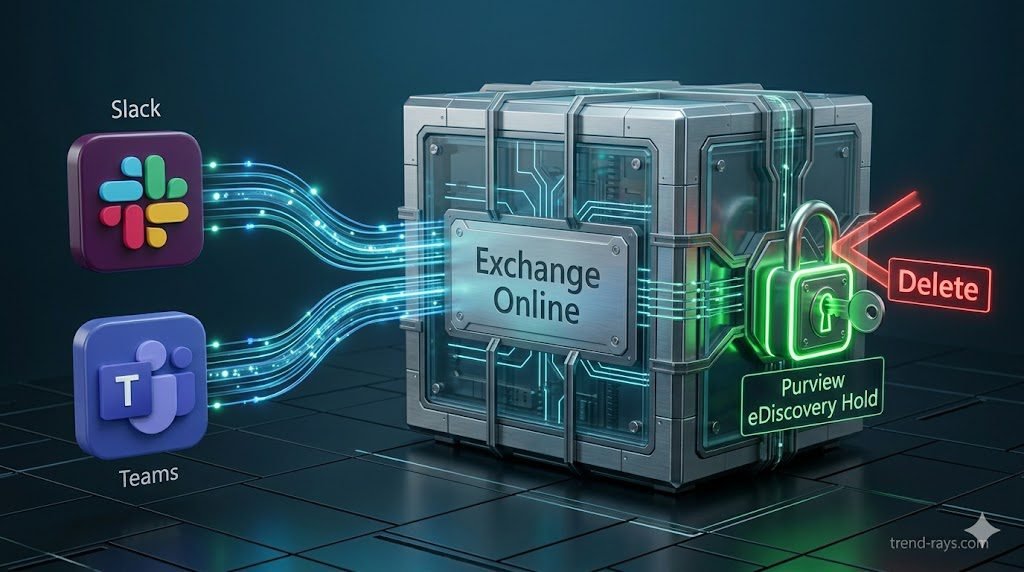
- The Architecture: Microsoft 365 allows administrators to deploy authorized third-party data connectors (provided by vendors like Veritas or TeleMessage) to build an API bridge to Slack Enterprise Grid.
- The Execution: The connector continuously pulls Slack direct messages, channel chats, and attachments, formatting them into standard email items (using the
kind:externaldataproperty), and seamlessly injects them into the respective users’ Exchange Online mailboxes. Once the Slack data is inside Exchange, Purview can place a single, unified Litigation Hold over both Teams and Slack simultaneously.
Step-by-Step: Executing a Silent In-Place Litigation Hold
The most critical requirement of an internal investigation (such as an embezzlement or insider trading probe) is that the employee must not know they are being investigated. Purview handles this elegantly via Silent In-Place Holds.
- Create the eDiscovery (Premium) Case: Navigate to the Microsoft Purview compliance portal and establish a new case with strict access controls (restricting access to authorized eDiscovery managers and corporate counsel only).
- Add Custodians: Identify the specific users under investigation. Purview will automatically map their primary Exchange mailbox and OneDrive account.
- Map Additional Locations: Manually attach the Microsoft 365 Groups (for Teams channels) and the Slack-ingested mailboxes relevant to those custodians.
- Apply the Hold: Execute the hold policy.
The UX Result: The hold is entirely invisible to the employee. If the user attempts to delete a highly incriminating Teams message or empty their recycle bin, the item disappears from their screen as expected. However, on the backend, Purview silently intercepts the deletion and moves the item into a hidden, immutable Recoverable Items partition that the user cannot access, preserving it flawlessly for the legal team.
The Architect’s Dilemma: Purview Native vs. Third-Party eDiscovery
Once the data is frozen, the enterprise must decide where to actually read and review the evidence. Do you process the data entirely within Purview, or do you export it to a dedicated eDiscovery platform?
Early Case Assessment (ECA) Data Culling Workflows
The Financial Verdict: Smart enterprises use Purview eDiscovery (Premium) to freeze 100% of the data and use Purview’s Early Case Assessment (ECA) search queries to cull the data set by 90% (removing system notifications, personal chatter, and spam). They only export the remaining 10% of highly responsive documents to platforms like Relativity, saving millions of dollars in external hosting fees while maintaining perfect compliance.
Frequently Asked Questions (eDiscovery & Purview)
Does a Purview Litigation Hold notify the employee?
No. By default, applying a hold in Microsoft Purview is a silent, backend operation. The user receives no alerts, and their daily experience in Outlook, Teams, or Slack remains completely unchanged, making it ideal for sensitive internal investigations.
Can Purview capture edited Teams and Slack messages?
Yes. When a hold is active, Purview does not just save the final state of the message. If an employee sends a message, edits it to hide incriminating details, and then deletes it, Purview retains the original message, the edited version, and the deletion event, providing a complete forensic audit trail.
What happens to the legal hold if a user account is deleted?
If a user leaves the company and their Entra ID account is deleted, their mailbox and OneDrive data will typically be purged after 30 days. However, if a Purview hold is active on that account, it converts the data into an “Inactive Mailbox.” The data is retained indefinitely and remains fully searchable for the duration of the legal case, without requiring an active M365 license.
![One of the most dangerous blind spots in modern enterprise security does not come from sophisticated nation-state hackers—it comes from your own employees trying to bypass IT restrictions. Whether it is a remote worker downloading a cracked version of Adobe Premiere, or an employee installing a pirated "repack" of a video game (like a FitGirl or Dodi repack) onto their corporate laptop, the threat vector is the same. Threat actors are now heavily relying on repackaged "flat-pack" malware—inexpensive, off-the-shelf malicious components bundled inside seemingly legitimate software installers. These "piggyback" attacks are designed to silently execute InfoStealers, ransomware, or Remote Access Trojans (RATs) while the user is distracted by the installation of the main program. Because the malware is heavily compressed and obfuscated, traditional signature-based Antivirus (AV) completely fails to detect it. In this guide, we break down exactly how modern Security Operations Center (SOC) teams use Endpoint Detection and Response (EDR) platforms to hunt, isolate, and neutralize repackaged malware before it can compromise the corporate network. The Corporate Threat of "Repacks" (Why Antivirus Fails) To understand how to defeat flat-pack malware, you must understand why legacy security tools fail to see it. Traditional Antivirus relies on Static Properties Analysis. It scans a file's code on the hard drive and checks if its digital "signature" matches a known database of bad files. Malware authors easily bypass this by "packing" or compressing the malicious payload inside a custom wrapper. Because the wrapper's code is mathematically unique, the AV scans it, finds no matching signature, and allows the file to execute. Furthermore, attackers are utilizing "vibe-hacking" and social engineering to distribute these files. They buy sponsored search engine ads for "Microsoft Teams Installer" or "Free PDF Editor," which redirect employees to cloned websites serving the repackaged malware. The legitimate application actually installs and functions perfectly, but a secondary, invisible child process unpacks the malicious payload directly into the computer's volatile memory (RAM), bypassing the hard drive entirely. (Image Prompt 1 - Featured Hero) Prompt: A highly photorealistic, 16:9 cinematic image of a modern Security Operations Center (SOC). In the foreground, a dark-mode glowing computer monitor displays a complex cybersecurity threat-hunting dashboard. A red warning alert reads "Obfuscated Payload Detected." In the background, out-of-focus IT analysts monitor large digital wall screens. Cool blue and aggressive red cyber lighting. A clear, semi-transparent watermark reading "trend-rays.com" sits neatly in the bottom right corner. Step 1: Hunting for Indicators of Compromise (IoCs) If your organization does not yet have an enterprise EDR solution deployed, your IT administrators must actively hunt for the behavioral footprints—known as Indicators of Compromise (IoCs)—left behind by repackaged software. When analyzing an endpoint suspected of a shadow IT infection, look for these specific anomalies: Suspicious Child Processes: Legitimate software installers rarely need to invoke command-line tools. If a setup file (e.g., setup_v2.exe) suddenly spawns cmd.exe, PowerShell.exe, or WMI Provider Host in the background, it is a massive red flag that a flat-pack script is attempting to alter registry keys or disable local Windows Defender settings. Abnormal Memory Allocation: Packed malware must eventually unpack itself in memory to execute. Look for processes that allocate highly unusual amounts of memory relative to their size on the disk. Unrecognized Outbound Beacons: InfoStealers bundled in repacks will immediately attempt to exfiltrate browser passwords and session cookies. Monitor your network firewall logs for endpoints making sudden, persistent outbound connections to unknown IP addresses or unregistered domains (often using Telegram bots or Discord webhooks as Command and Control servers). Step 2: Deploying EDR to Catch "Unpacking" in Memory While manual threat hunting is possible, it does not scale. To protect a fleet of 5,000 corporate laptops, you need Endpoint Detection and Response (EDR). Unlike legacy AV, EDR focuses on Behavioral Analysis and continuous telemetry. It does not care what a file looks like; it cares what the file does. When an employee runs a repackaged installer, the EDR agent monitors the execution in real-time. The moment the hidden malware attempts to unpack itself and inject code into a legitimate process (like explorer.exe), the EDR’s machine learning algorithms flag the behavior as hostile. Top 3 Enterprise EDR Solutions for Repack Detection If you are upgrading your endpoint security stack in 2026, these three platforms provide the most robust defense against obfuscated, flat-pack payloads: CrowdStrike Falcon (Best for Memory Scanning): CrowdStrike’s lightweight agent is peerless at detecting fileless malware and in-memory unpacking. Its AI models instantly recognize the behavioral signatures of InfoStealers attempting to scrape credential vaults, killing the process in milliseconds before data exfiltration can occur. SentinelOne Singularity (Best for Automated Rollback): SentinelOne operates entirely autonomously on the endpoint, meaning it does not need a cloud connection to stop a threat. If a repackaged ransomware payload manages to execute, SentinelOne's "Storyline" technology can track every single file the malware altered and execute a 1-click automated rollback, restoring the PC to its pre-infected state instantly. Microsoft Defender XDR (Best for Windows-Native Environments): For organizations heavily invested in the Microsoft 365 ecosystem, Defender XDR provides incredible native telemetry. It correlates data not just from the endpoint, but from Office 365 emails and Azure Active Directory, allowing SOC analysts to see if the repackaged malware was initially delivered via a phishing link. (Image Prompt 2 - Threat Isolation) Prompt: A photorealistic 16:9 close-up of a cybersecurity professional's dual-monitor workstation. The screen displays an Enterprise EDR dashboard (like SentinelOne or CrowdStrike) showing a visual node-graph of a malware attack. One specific malicious file node is highlighted in bright red and marked "Isolated / Quarantined." Clean, bright corporate IT office lighting. A clear, semi-transparent watermark reading "trend-rays.com" sits neatly in the bottom right corner. The CISO Playbook: Blocking Shadow IT at the Perimeter Detecting malware is good; preventing the execution entirely is better. Chief Information Security Officers (CISOs) must implement strict "Zero Trust" policies to prevent employees from running unverified repacks in the first place. Enforce Application Allowlisting: Use tools like Windows AppLocker to create a strict Allowlist. Block the execution of any .exe, .msi, or script that does not reside in a protected directory (like Program Files) or isn't signed by a trusted corporate publisher. Revoke Local Admin Rights: 90% of repackaged malware requires administrative privileges to install its rootkits or disable security telemetry. By implementing a Privilege Access Management (PAM) solution, employees cannot install unauthorized software without an IT helpdesk ticket. Deploy DNS Filtering: Block access to known software piracy forums, torrent trackers, and "free software" directories at the network level using tools like Cisco Umbrella or Cloudflare Gateway. The True Cost of a Repack Breach (ROI & Business Impact) When an executive pushes back on the budget required for premium EDR software, it is vital to contextualize the financial devastation of a single successful flat-pack malware breach. An employee downloading a cracked PDF editor to "save the company $15 a month" can easily result in the deployment of an InfoStealer. That malware scrapes the employee's browser cookies, capturing their active session token for the company's AWS environment or Salesforce CRM. The attacker bypasses Multi-Factor Authentication (MFA) entirely using the stolen token, accesses your customer database, and deploys network-wide ransomware. The resulting downtime, ransom demands, regulatory fines (GDPR, HIPAA, or CCPA), and class-action lawsuits frequently exceed millions of dollars. Investing in an EDR platform that costs $50 per endpoint annually is the cheapest insurance policy a modern enterprise can buy. Frequently Asked Questions (Endpoint Malware Defense) What is flat-pack malware? Flat-pack malware refers to malicious payloads that are heavily compressed, obfuscated, and bundled together with legitimate software components using off-the-shelf hacker tools. This "repackaging" technique allows attackers to rapidly generate new malware variants that bypass traditional, signature-based antivirus scanners. Why is downloading FitGirl or Dodi repacks a corporate security risk? While often used by gamers to pirate software, "repacks" are a massive vector for shadow IT. Because these installers are inherently modified to bypass digital rights management (DRM), employees who download them onto corporate hardware often accidentally execute hidden InfoStealers or Remote Access Trojans (RATs) embedded by third-party distributors. What is the difference between EDR and Antivirus? Traditional Antivirus uses static signatures to block known bad files on the hard drive. Endpoint Detection and Response (EDR) uses behavioral analysis, AI telemetry, and memory scanning to monitor what a program is actively doing. EDR can detect and kill unknown, "zero-day" malware that legacy AV cannot see. How do InfoStealers bypass MFA? When an InfoStealer (often hidden in repackaged software) infects an endpoint, it targets the web browser's local storage to steal active session cookies. Attackers can import these stolen cookies into their own browsers, allowing them to log into corporate systems (like Microsoft 365 or Slack) without needing a password or triggering an MFA prompt. Conclusion & Next Steps The perimeter of your corporate network is no longer defined by your office firewall; it is defined by the security of your employees' endpoints. Relying on legacy antivirus to stop modern, repackaged malware is a guaranteed path to a data breach. By deploying behavioral-based EDR solutions and strictly policing shadow IT, you can isolate threats in memory before they execute their payloads. Securing your endpoints against rogue software is critical, but it is only half the battle. Threat actors are also using advanced AI to bypass human verification. Ensure your organization is prepared for the next wave of social engineering by reading our definitive guide on [Best Enterprise AI Voice Cloning SaaS for Corporate Training] to learn how to deploy deepfake guardrails and secure corporate communications.](https://trend-rays.com/wp-content/uploads/2026/03/unnamed-54-1.jpg "How to Detect Repackaged \"Flat-Pack\" Malware on Endpoints (2026) 4")