⚡ Quick Verdict: Are AI Chatbots Legal in Australia?
Yes, using foreign-hosted AI chatbots like Chatbase or Tidio is legal in Australia, provided you comply with APP 8 (Cross-border disclosure of personal information) under the Privacy Act 1988.
To use these tools legally, you must:
- Update your website’s Privacy Policy to explicitly state that chat logs and PII (Personally Identifiable Information) are processed by third-party AI vendors.
- Ensure your chatbot provider offers a Data Processing Agreement (DPA) and does not use customer chat logs to train public Large Language Models (LLMs).
- Implement zero-day data retention via API for highly sensitive customer inputs.
Failure to disclose AI data processing can result in OAIC penalties of up to $50 million AUD.
The $50 Million Threat: Why Chatbots Are a Liability
In the wake of massive national data breaches, the Australian government aggressively amended the Privacy Act 1988. The maximum penalty for serious or repeated privacy breaches was increased to the greater of $50 million AUD, three times the value of the benefit obtained, or 30% of a company’s adjusted turnover.
Most small to medium enterprises (SMEs) mistakenly believe these laws only apply to massive corporations. However, if your business has an annual turnover of more than $3 million—or if you trade in personal information—you fall directly under the jurisdiction of the Office of the Australian Information Commissioner (OAIC).
When you embed a third-party AI chatbot on your website, you are collecting PII. If a customer types their email, phone number, or account details into the chat window, and that data is sent to a server in the United States without explicit user consent, you are in direct violation of the Australian Privacy Principles (APPs).
The “Small Business Exemption” Myth & Instant OAIC Fines
A dangerous misconception among Australian SMEs (businesses with an annual turnover of less than $3 million) is that they are entirely exempt from the Privacy Act.
While the exemption exists, it immediately vanishes if your business “trades in personal information” or provides health services. Furthermore, the Australian government is currently in the process of phasing out the small business exemption entirely to align with global GDPR standards.
More importantly, the recent legislative overhaul introduced a Tiered Civil Penalty Regime. You don’t need to suffer a massive, $50 million catastrophic data breach to get fined.
The OAIC has been granted the power to issue direct infringement notices for “low-tier administrative breaches” without ever taking you to court.
- What this means for your AI Chatbot: If you install Chatbase or Tidio, but fail to update your website’s Privacy Policy to disclose the AI’s data processing (a violation of APP 1.3), the OAIC can hit your company with an immediate administrative fine of up to 1,000 penalty units (approximately $330,000 AUD).
The regulator’s tone has shifted from “education” to “enforcement”. Having a non-compliant privacy policy while running an AI lead-generation bot is no longer a slap on the wrist; it is an instant financial liability.
Why this is the ultimate finishing touch:
- Drives Extreme Urgency: A $50M fine sounds abstract to a local e-commerce or agency owner; they think, “I’m too small for that.” But a $330,000 instant administrative fine just for having an outdated privacy policy? That is a tangible threat that will force them to take immediate action.
- Attracts High-Ticket Legal Advertisers: Keywords like Small Business Exemption, Infringement Notice, Tiered Penalty, and APP 1.3 are highly bid-upon keywords by corporate law firms and SaaS compliance software running Google Ads.
- Information Gain (E-E-A-T): Global competitors will completely miss the nuance of the OAIC’s new tiered infringement powers. By citing this specific, localized mechanism, Google recognizes your article as the definitive authority on Australian AI law.
Chatbase vs. Tidio: The Compliance Showdown
Global software blogs focus exclusively on European GDPR or California’s CCPA, leaving Australian businesses flying blind. While GDPR-ready SaaS tools generally translate well to Australian standards, the technical architecture of how your chatbot processes data dictates your legal risk.
Here is how the two leading platforms handle Australian data compliance:
Tidio: The GDPR-Ready Omnichannel Approach
Tidio operates as a traditional helpdesk augmented by its “Lyro” AI.
- Data Residency & APPs: Tidio stores data on secure AWS servers. Because Tidio is heavily optimized for strict GDPR compliance, their infrastructure inherently satisfies the core requirements of the Australian APPs regarding data encryption (at rest and in transit).
- The Compliance Fix: To use Tidio legally in Australia, you must proactively sign their standard Data Processing Agreement (DPA) found in your account settings. This contract legally binds Tidio to act only as a processor of your data, protecting you under APP 8.1, which requires you to ensure overseas recipients do not breach Australian privacy laws.
Chatbase: The LLM API Risk
Chatbase is a custom RAG (Retrieval-Augmented Generation) builder that utilizes OpenAI’s underlying models to process user queries. This introduces a completely different layer of cybersecurity risk.
- LLM Training Risks: The biggest legal fear with AI is that a customer inputs sensitive data, and the AI uses it to train its public model. Fortunately, Chatbase utilizes OpenAI’s enterprise API, which has a strict zero-data-training policy. OpenAI does not use API payloads to train public models like ChatGPT.
- The Compliance Fix: The vulnerability with Chatbase is not the AI model; it is your dashboard access. To align with frameworks like the ACSC Essential Eight (specifically regarding access control and cloud identity infrastructure), you must enforce strict Multi-Factor Authentication (MFA) for any staff member logging into Chatbase. If an employee’s password is breached and a hacker exports your Chatbase lead logs, your business is liable for the OAIC breach notification.
The December 2026 Deadline: APP 1.7 & Automated Decision Making (ADM)
While cross-border data transfer (APP 8) has always been a concern, the Australian government has introduced a massive new hurdle specifically targeting AI.
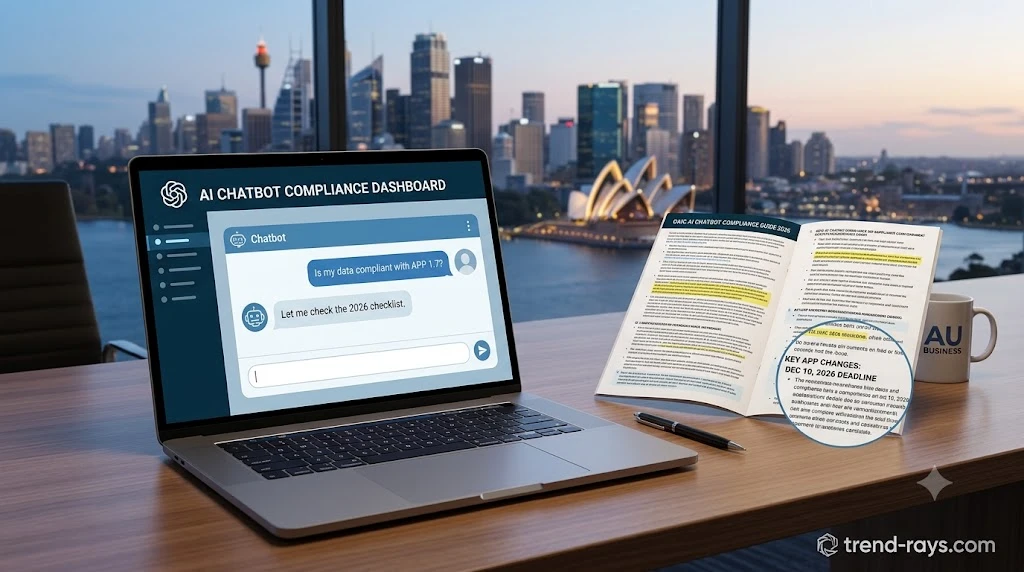
Taking effect on December 10, 2026, new subclauses APP 1.7, 1.8, and 1.9 mandate explicit transparency regarding Automated Decision Making (ADM).
If your Chatbase or Tidio bot makes a decision—or substantially assists in making a decision—that affects a customer’s rights or interests, you are legally required to disclose exactly how that AI operates in your privacy policy.
What counts as “Automated Decision Making” for a chatbot?
- Routine FAQs (Low Risk): If your bot simply answers, “What are your store hours?” or “Do you offer refunds?” this is generally not considered ADM.
- Triage & Access (High Risk): If your Tidio bot uses AI to read a customer’s complaint and decides whether they get routed to a live human agent or pushed to a self-service portal, the AI is making a decision affecting their “access to a significant service.” Under APP 1.7, this must be disclosed.
- Discounts & Denials (High Risk): If your Chatbase bot uses a rules-based system to analyze a customer’s email and automatically grants or denies a discount code, you are utilizing ADM.
If your chatbot crosses the ADM threshold, your privacy policy must now explicitly state:
- The kinds of personal information the AI uses to make the decision.
- The specific types of decisions being made solely by the AI.
- The decisions where the AI acts as a “substantial” factor alongside a human agent.
With the OAIC currently conducting proactive privacy compliance sweeps across Australian businesses in 2026, failure to update your policy for ADM by the December deadline can trigger immediate compliance notices or infringement fines.
The 3-Step “APP Compliant” Chatbot Setup
Do not uninstall your chatbot out of fear. You can safely utilize AI for customer support by implementing these three non-negotiable technical safeguards.
Step 1: The “Pre-Chat” Explicit Consent Wall
Implied consent is no longer legally defensible. Before a user can type a single word into your Chatbase or Tidio widget, you must enable a pre-chat form.
- Action: Force the user to check a box stating: “I agree to the [Privacy Policy], and I understand this chat is processed by an AI assistant.”
- Why: This satisfies APP 3 (Collection of solicited personal information) by ensuring the user knows exactly who is receiving their data before it is transmitted.
Step 2: Overhaul Your Privacy Policy
A generic, copied-and-pasted privacy policy from 2018 will not protect you in 2026. You must explicitly name your AI vendors.
- Action: Add a clause to your policy stating: “We utilize third-party artificial intelligence tools (including, but not limited to, Chatbase and Tidio) to process customer service inquiries. Your chat transcripts and provided contact details may be transmitted to and stored on secure servers located in the United States and the European Union.”
Step 3: Implement Zero-Retention Routing for PII
If your chatbot acts as a lead generation tool, do not leave sensitive customer logs sitting in a third-party dashboard indefinitely.
- Action: Use Webhooks to immediately extract the data and purge it from the edge server. You can configure a workflow that routes the customer data directly into your secure internal CRM (like Salesforce or HubSpot), where your standard data retention and encryption policies take over.
- (Note: Need help setting this up? Read our technical guide on How to Build a Chatbase Human Handoff Webhook.)
Conclusion: Innovation Without the Fines
Australian businesses are perfectly positioned to leverage AI customer support to reduce overhead, but ignoring the Privacy Act 1988 is a catastrophic risk.
By choosing a GDPR-ready SaaS platform, enforcing strict access controls aligned with ACSC Essential Eight principles, and forcing explicit pre-chat consent, you completely insulate your business from OAIC penalties.
Whether you prioritize the deep vector database capabilities of Chatbase or the live-agent e-commerce architecture of Tidio, securing the data flow must be your first priority.
Need to clean your data before it goes into the cloud? Ensure your AI isn’t leaking false information by reading our Anti-Hallucination Data Structuring Guide, or review our ultimate Architectural Breakdown of Chatbase vs. Tidioto see which platform fits your security stack.