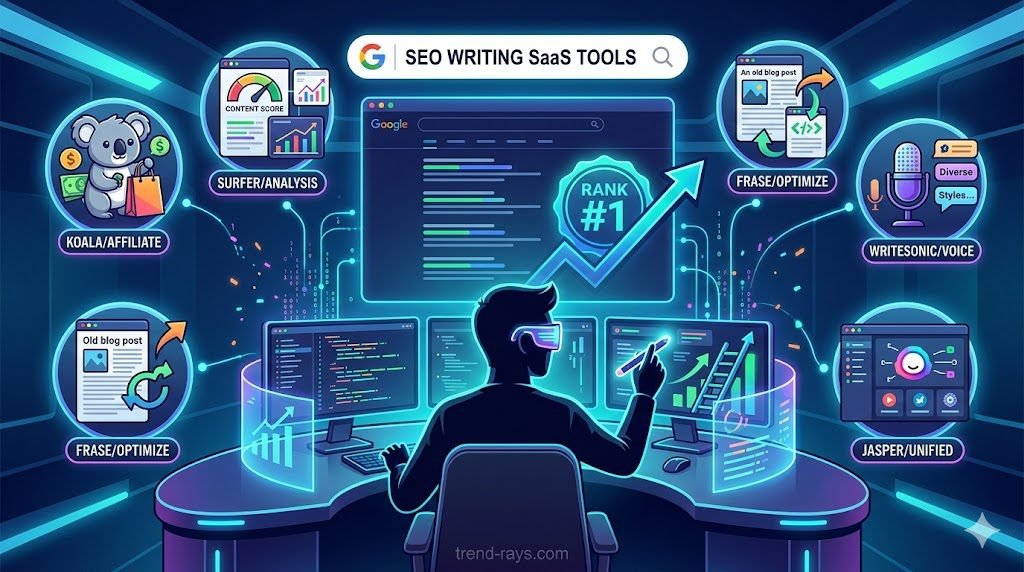
Let’s address the elephant in the room immediately: if you are just pasting generic, raw ChatGPT outputs into your WordPress blog, Google’s 2026 spam algorithms will flat-out ignore your website. The days of ranking “thin” AI content are completely over. The famous legendary line in SEOs is write for humans, not for search engines keep this thing always in your mind.
Today, to capture organic search traffic, you need content that is deeply researched, perfectly optimized for LSI (Latent Semantic Indexing) keywords, and structured exactly how search engines prefer. Doing this manually takes hours. Using a standard chatbot results in robotic, penalized text.
The solution? Dedicated AI SEO Writing SaaS.
These are not just chatbots. They are sophisticated software platforms that scrape the top 10 Google results, analyze your competitors’ headings and word counts, and automatically generate highly optimized drafts ready for human editing. But only quality content will not help you to rank backlinks and many other SEO practices will help you combined with the quality content.
Here is our completely unbiased breakdown of the 5 best AI SEO writing tools on the market today, categorized by exactly who should use them—plus the truth about whether Google actually penalizes AI content.
The ROI: Freelance Writer vs. AI SEO SaaS
For a startup founder or niche website owner, content is a numbers game. How much does it actually cost to scale a blog? Let’s break down the maths and the cost of a freelance writer vs AI SEO Saas.
- The Traditional Route: A native English-speaking freelance SEO writer typically charges between $0.08 to $0.15 per word. A comprehensive 1,500-word pillar post will cost you roughly $150 to $225 per article.
- The AI SaaS Route: Premium AI SEO tools cost between $30 to $130 per month and can generate dozens of heavily researched, 2,000-word articles for pennies on the dollar.
While the AI will never replace the unique insights of a true industry expert, an SEO SaaS handles 80% of the heavy lifting—the outlining, the keyword density, and the first draft—allowing you to act as the editor rather than the blank-page writer. But after generating the content, human editing and cross-check is a must because we can’t rely on AI totally.
1. KoalaWriter (Best for 1-Click Affiliate & Programmatic SEO)
KoalaWriter has taken the niche blogging community by storm. It is arguably the best “one-click” AI writer available because it directly integrates live Google Search data and Amazon product API data into its generation process.
- Best For: Amazon affiliate bloggers, programmatic SEO site owners, and niche site builders.
- The Standout Feature: Real-time web scraping. Koala reads current news and live Amazon reviews before it writes, ensuring the content is factually accurate and up-to-date.
- The Reality Check: Because it is so automated, the writing style can become slightly repetitive if you generate 100 articles with the exact same prompt.
- Pricing: Starts at $9/month for 15,000 words.
How to Generate an Amazon Affiliate Post with KoalaWriter:
- Select the Article Type: Choose “Amazon Product Review” from the dashboard dropdown.
- Input the Keyword: Type your target keyword (e.g., “Best DJI Mini 3 Pro Accessories”).
- Set the Tone & Point of View: Select a “First Person (I, we)” point of view to sound like a real reviewer, and choose a conversational tone.
- Enable Real-Time Data: Check the box to allow Koala to scrape live Amazon reviews so it mentions actual pros and cons from real buyers.
- Generate & Edit: Click create. In 2 minutes, you will have a fully formatted article with H2s, H3s, and product tables ready for your affiliate links.

2. Surfer AI (Best for Hardcore Competitor Analysis)
Surfer SEO was already the industry standard for grading content. Now, with Surfer AI, it actually writes the content to perfectly match its own scoring algorithm. It is the ultimate “done-for-you” SEO tool for highly competitive niches.
- Best For: SEO agencies, high-budget startups, and sites fighting for massive search volume keywords.
- The Standout Feature: The proprietary “Content Score.” Surfer analyzes the top-ranking pages and tells you exactly how many times to use specific keywords to beat them. Surfer AI writes the draft to hit a perfect score of 80+ automatically.
- The Reality Check: It is incredibly expensive. You are paying a premium for the algorithm data, not just the word generation.
- Pricing: The base Surfer plan starts at $89/month, plus $29 per AI-generated article.
How to Dominate a Keyword with Surfer AI:
- Create a Content Editor: Type in your primary keyword (e.g., “SaaS Marketing Strategies”).
- Review Competitors: Surfer will pull the top 10 ranking pages. Manually deselect any sites that don’t match your search intent (like Wikipedia or Pinterest).
- Customize the Outline: Click the “AI” button to generate a proposed outline. Review the H2s and H3s and add your own custom talking points.
- Select Tone & Generate: Choose your brand’s tone of voice and hit generate.
- The Final Polish: The AI will produce an article with a near-perfect SEO score. Spend 15 minutes injecting your own personal stories before publishing.
3. Frase (Best for Content Briefs & Updating Old Posts)
Frase excels at the research phase of SEO. Instead of just blindly generating text, Frase helps you build incredibly detailed content briefs based on the exact questions people are asking on Google, Reddit, and Quora.
- Best For: Freelance writers, content managers, and website owners looking to refresh decaying, old content.
- The Standout Feature: The “Outline Builder.” It scrapes the H2s and H3s of all your competitors and lets you drag and drop them to build a comprehensive “super-outline.”
- The Reality Check: Its actual AI writing engine is slightly less robust than Koala or Jasper. Frase is better used as an SEO research assistant than a pure 1-click generator.
- Pricing: Starts at $14.99/month.
How to Update an Old Article Using Frase:
- Import Your URL: Create a new document in Frase and paste the URL of an old blog post that is losing traffic.
- Analyze the Gap: Frase will compare your old post to the current top 20 Google results and highlight the exact keywords and topics you are currently missing.
- Build a Brief: Use the “Questions” tab to find new “People Also Ask” questions that have emerged since you originally published the post.
- Use AI to Expand: Highlight a missing keyword, click “Write with AI,” and let Frase generate a new paragraph seamlessly blending into your old text.
- Export & Update: Paste the updated, comprehensive post back into your CMS.
4. Writesonic (Best for Startups & Budget All-in-One)
Writesonic is a massive, all-in-one suite. It isn’t just for SEO blogs; it can write your Facebook ads, product descriptions, and landing pages. Its “Article Writer 6.0” is specifically designed to pull factual, up-to-date information.
- Best For: Bootstrapped startups, solopreneurs, and local businesses needing a bit of everything.
- The Standout Feature: Brand Voice. You can upload previous blog posts or PDFs of your company’s guidelines, and Writesonic will mimic your exact writing style.
- The Reality Check: Because it tries to do everything, the UI can feel cluttered, and the pure SEO capabilities aren’t as deep as Surfer’s.
- Pricing: Free tier available. Paid plans start at $16/month.
How to Write an SEO Blog with Writesonic:
- Open Article Writer 6.0: Select the flagship long-form writer from the dashboard.
- Input Core Topic: Type in your main idea and target keyword.
- Provide Reference Links: (Crucial Step) Paste links to 3 or 4 competitor articles you want Writesonic to use as factual references. This prevents AI hallucinations.
- Apply Brand Voice: Select your pre-trained Brand Voice profile from the dropdown menu.
- Generate: The AI will synthesize the competitor facts into a brand-new, unique article written in your company’s tone.
5. Jasper AI (Best for Enterprise Teams & Unified Brand Voice)
Jasper is the heavyweight champion of AI marketing tools. While it can write SEO blogs, its true power lies in campaign management. It is designed for marketing teams who need to generate a blog post, a Twitter thread, a LinkedIn carousel, and an email newsletter all from the same core idea.
- Best For: Large marketing teams, established agencies, and enterprise companies.
- The Standout Feature: The “Campaigns” tool.
- The Reality Check: Jasper is overkill if you just want to run a simple niche blog. It is a premium tool with a premium price tag.
- Pricing: Starts at $39/month (Creator Plan).
Trend Rays Resource: Once you use a tool like Jasper to write your blog post, how do you distribute it? Read our guide on the best AI social media management SaaS tools to automatically schedule your new articles across every platform!
The Big Question: Will Google Penalize AI-Generated Content?
This is the most critical question in SEO right now.
The answer is NO, Google does not penalize AI content just because an AI wrote it. However, Google heavily penalizes SPAM and unhelpful content.
Google’s official guidelines state they reward high-quality content however it is produced. But to rank in 2026, your content must demonstrate E-E-A-T (Experience, Expertise, Authoritativeness, and Trustworthiness).
How to Safely Publish AI Content (The EEAT Defense):
- Inject First-Hand Experience: An AI cannot test a camera or fly a drone. You must manually add a paragraph detailing your personal experience with the product or strategy.
- Fact-Check Everything: AI tools still hallucinate. If you publish false data, users will bounce, and Google will drop your rankings.
- Format for Humans, Not Bots: Break up massive walls of text. Use bullet points, custom graphics, and embed relevant videos. (Tip: Need visual assets? Learn how to generate free AI B-roll videos for your blog posts to keep readers on the page longer).
The Golden Rule: Write for Humans, Not Search Engines
It is easy to get addicted to SEO SaaS tools. When you see your Surfer AI score hit 95/100, your brain gets a dopamine hit. But you must never forget the golden rule of modern SEO: Search engines do not buy products; humans do.
If you focus purely on satisfying the algorithm—stuffing every LSI keyword into your text and writing robotic, 300-word introductions just to hit a word count—your readers will immediately click the “back” button. In the SEO world, this is called “Pogo-Sticking,” and it is the fastest way to signal to Google that your content is unhelpful, which will tank your rankings. So write for humans who are the actual readers of your content, not the search engines or chat bots, they are the only platform between your content and the readers thats it.
How to balance AI optimization with human connection:
- Use AI for the Skeleton: Let tools like KoalaWriter or Frase build the outline, gather the facts, and ensure you have the right keyword density.
- Use Your Brain for the Soul: Once the AI draft is done, go through and inject your own personality. Add humor, share a brief story about how you personally struggled with the topic, and use formatting (like bolding and blockquotes) to make the text scannable for tired eyes.
- The “Read Aloud” Test: Before you hit publish on an AI-generated post, read the first two paragraphs out loud. If it sounds like a college textbook instead of a conversation with a friend, rewrite it.
Conclusion: The Unbiased Final Verdict
There is no magic button in SEO. The SaaS tools listed above are incredibly powerful assistants, but they are not your replacements.
If you want the absolute highest quality, data-driven drafts and have the budget for it, Surfer AI is unmatched in its competitive analysis. If you are building an empire of niche affiliate websites and need bulk, real-time generation, KoalaWriter is the most cost-effective powerhouse on the market. If you are a startup that needs to manage an entire marketing campaign—from SEO blogs to ad copy—invest in Jasper AI.
Start with a free trial of KoalaWriter or Writesonic. Generate one article, spend 30 minutes heavily editing it to add your unique human perspective, and watch how much faster your publishing schedule becomes.