
If you are running a one-person business, your most constrained resource isn’t capital—it’s time. Whether you are managing multiple niche websites, running a local travel agency, or balancing client work with marketing, maintaining a consistent social media presence often falls to the bottom of the to-do list.
Building out the ultimate AI tech stack for your small business is critical, but when it comes to social media specifically, many solo founders hesitate. Is an AI social media management tool just another monthly subscription, or is it a measurable driver of ROI?
In this cost-benefit analysis, we break down exactly what solo entrepreneurs gain—and what they risk—by handing their social channels over to artificial intelligence.
The True Cost of Manual Social Media Management
To understand the benefit of AI tools, we first have to quantify the cost of the alternative: doing it all manually.
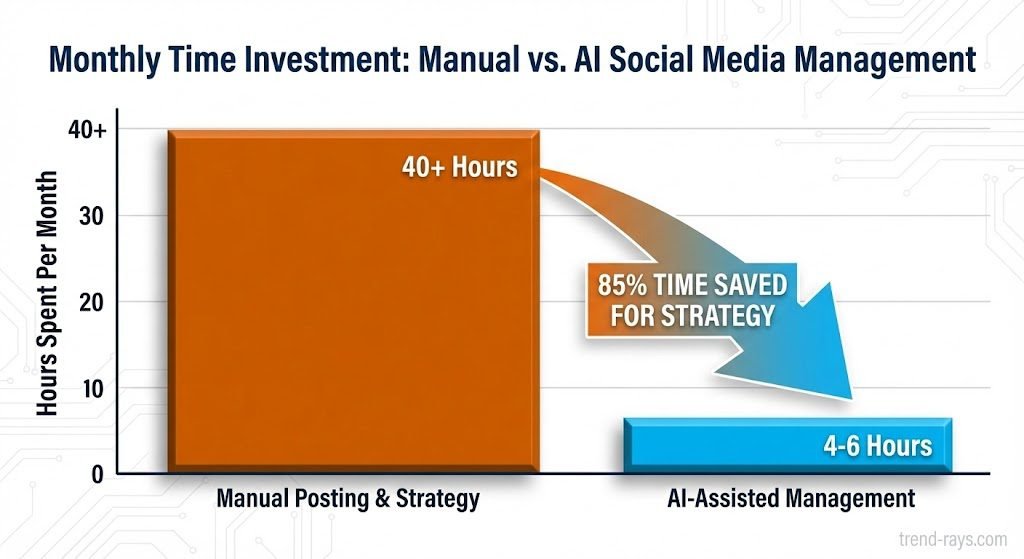
Drafting captions, researching trending hashtags, resizing images for different platforms, and manually hitting “publish” across LinkedIn, X, and Instagram can easily consume 10 hours a week. If you value your time at a conservative $50 per hour, manual social media management is silently costing your business $2,000 a month in opportunity cost. That is time you aren’t spending closing sales, improving your product, or optimizing your websites.
The Financial Breakdown: AI Tools vs. Alternatives
When solopreneurs decide to offload social media, they generally have three options. Here is how the hard costs compare:
| Approach | Estimated Financial Cost | Estimated Time Cost | Scalability |
| Manual Posting (Native Apps) | $0 / month | 40+ hours / month | Very Low |
| Freelance Virtual Assistant | $300 – $800 / month | 2 – 5 hours / month (management) | Medium |
| AI Social Media Management Tool | $15 – $30 / month | 4 – 6 hours / month (strategy) | High |
For under $30 a month, tools like Metricool, SocialBee, or Buffer offer enterprise-tier capabilities without the enterprise price tag (which often exceed $100/mo for tools like Sprout Social or Hootsuite).
When Should a Solopreneur Actually Invest? (The Scale Tipping Point)
It is easy to fall into the trap of buying software before you have a business. If you are at $0 in revenue and just starting, stick to native, manual posting. You need to learn what resonates with your audience first.
However, there is a clear tipping point where manual social media management becomes a liability to your growth. You should integrate an AI social media tool if you hit any of the following triggers:
- The $3,000 – $5,000 MRR Mark: At this Monthly Recurring Revenue, your primary focus must shift from basic client acquisition to client retention and scaling operations. A $20/month tool is a micro-expense compared to the revenue you protect by staying focused on fulfillment.
- The 30-Hour Client Week: If you are spending 30 hours a week on direct client work or product development, the remaining 10 hours of a standard workweek must be spent on high-level strategy, not resizing images for Instagram.
- Managing 3+ Traffic Channels: If your strategy requires maintaining an active presence on a blog (like your website), an email newsletter, and two social platforms (e.g., X and LinkedIn), manual cross-posting is no longer mathematically viable for one person.
Top Affordable AI Social Media Tools for the One-Person Business
Enterprise tools like Sprout Social ($99+/month) are overkill for solo founders. You need platforms that combine scheduling with AI-driven content generation at a price point under $30. Here are the top three choices for budget-conscious solopreneurs:
- Metricool (Best Free Tier & Analytics): Starting at $0 (or $18/mo for premium), Metricool is an absolute powerhouse. It includes an AI text generator to write captions, but its true strength is its competitor analysis and unified inbox.
- SocialBee (Best for Evergreen Recycling): Starting around $29/mo, SocialBee is the king of setting up “content categories.” Its AI assistant can take a single blog post URL and generate 10 different social posts, automatically queuing them to recycle over the next six months.
- Buffer (Best for Simplicity): Starting at $6/month per channel, Buffer’s AI Assistant is built directly into the composer. It is the most intuitive, clutter-free option if you just want to quickly rewrite a caption in different tones (e.g., casual for X, professional for LinkedIn) without a steep learning curve.
Quick-Start Guide: Automating Your First Week with AI
Buying the tool is only 10% of the battle. Here is a rapid 3-step framework to get your system running and actually reclaim your time:
Step 1: Train the AI on Your Brand Voice
Do not skip this. In your chosen tool (like Buffer or SocialBee), paste in 3 to 5 of your past top-performing posts. Instruct the AI system: “Analyze the tone, formatting, and emoji usage of these posts. Use this exact style for all future generation.”
Step 2: The ‘One-to-Many’ Repurposing Method
Take your highest-value asset for the week—like a new blog post or a YouTube video. Feed the URL or transcript into the tool’s AI composer and ask it to generate:
- One long-form educational thread for X (Twitter).
- One professional summary for LinkedIn.
- Three short, punchy promotional posts for Facebook or Instagram.
Step 3: Leverage the Predictive Queue
Instead of manually picking dates and times, drop all five generated posts into the platform’s predictive queue. The AI will analyze when your specific followers are online and automatically slot the posts into the highest-engagement windows throughout the week. You just turned one piece of content into a week’s worth of optimized visibility in under 15 minutes.
Quantifying the Benefits: Where AI Drives Real ROI

1. Content Recycling and Evergreen Automation
One of the highest-value features of AI social media managers is automated content recycling. Instead of writing a post once and letting it die in the feed, AI tools can identify your top-performing content and automatically rewrite and reschedule it months later. This maximizes the lifespan of your best ideas without requiring additional creative energy.
2. Predictive Analytics for Engagement
Guessing the best time to post is a massive waste of energy. AI tools analyze your specific audience’s historical activity and automatically queue your posts for the exact minute your followers are most active. This predictive scheduling directly increases organic reach, lowering your overall customer acquisition cost.
3. Beating the “Robotic” Stigma
A common question in the search space is: Do AI-generated posts sound robotic? In 2026, the answer is no—if configured correctly. Modern AI social tools allow you to upload your brand guidelines, past successful posts, and specific tone constraints. The AI acts as a creative partner that understands your unique voice, eliminating the blank-page syndrome that stalls so many creators.
The Hidden Costs: What Solopreneurs Must Watch Out For
While the benefits are heavy, the costs aren’t strictly monetary.
- The “Set It and Forget It” Trap: AI is not autopilot. If you fail to review the AI’s output, you risk publishing tone-deaf content during sensitive news cycles or industry shifts.
- Engagement is Still Human: An AI tool can publish your post, but it cannot authentically build relationships in the comment section. You still need to dedicate 15 minutes a day to answering DMs and engaging with your community.
- Feature Bloat: Many platforms upcharge for advanced social listening or complex team collaboration features that a solo entrepreneur simply doesn’t need. Stick to the plans designed for solo operators.
The Verdict: Is the Investment Worth It?
For the solo entrepreneur, an AI social media management tool is one of the most asymmetric investments you can make. The $20 to $30 monthly cost is negligible compared to the 30+ hours of reclaimed time each month.
If your goal is to stay visible, drive consistent traffic, and free up your calendar to focus on high-impact revenue generation, integrating an AI social manager into your broader tech stack is not just a luxury—it is a necessity.