The remote work revolution has completely transformed how professionals present themselves across European IT hubs like Bucharest, Cluj, and Warsaw. Whether you are a freelance developer, a startup founder, or a corporate executive, your digital first impression is often your only first impression. You need a high-quality, professional headshot.
But if you search online for the best way to get one, you are likely met with heavily skewed advice.
Right now, the conversation is dominated by two extremes. On one side, AI software companies publish highly biased “reviews” that conveniently ignore the technology’s flaws to sell you a subscription. On the other side, traditional photography blogs defensively claim that AI is a fad, ignoring the very real budget constraints of modern remote workers. Furthermore, almost all the major tech review sites focus exclusively on US pricing and ignore strict European data privacy laws.
We are cutting through the noise. We tested the top AI tools against the traditional photography standard to see if the technology is actually ready for the European corporate world, without the sales pitch.
As traditional studios pivot to offer digital-first packages, many are also upgrading their backend operations, deploying custom AI chatbots for small businesses to handle pricing inquiries and calendar bookings automatically.
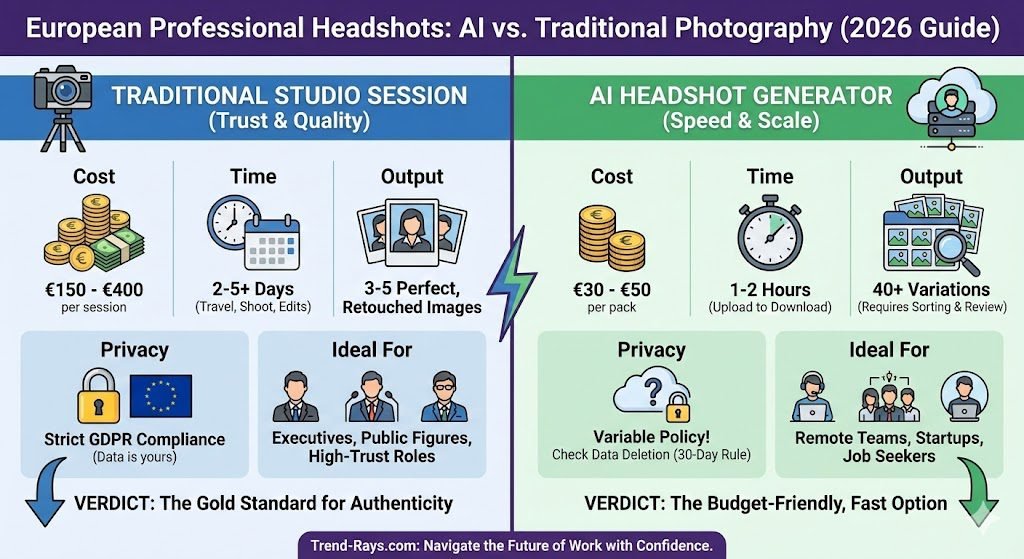
Short Answer: For European professionals, a traditional studio headshot costs between €150–€350 and takes days, while AI headshot generators cost €30–€50 and take 2 hours. AI is the most cost-effective solution for remote teams and startups, provided the platform complies with GDPR data privacy laws.
The Financial Breakdown: European Market Realities
Let’s look at the actual math. For a junior developer in Romania or a newly funded startup in Poland, the ROI of a professional image has to make sense.
Here is the objective breakdown of what you actually pay for, comparing a standard European photography studio against premium AI headshot generators (like Aragon AI or HeadshotPro).
| Feature | Traditional EU Studio | Premium AI App | The Verdict |
| Average Cost | €150 – €350 | €30 – €50 | AI is up to 90% cheaper. |
| Time Investment | 2–4 hours (Travel + Shoot) | 15 minutes (Uploading selfies) | AI eliminates commute and scheduling. |
| Turnaround Time | 3 to 7 days for edits | 1 to 2 hours | AI wins for urgent needs. |
| Deliverables | 3–5 highly retouched photos | 40+ variations (mixed quality) | Studios guarantee perfection; AI requires sorting. |
| Location Variety | 1–2 studio backdrops | Infinite (Offices, cafes, outdoors) | AI offers more versatility for remote teams. |
The Startup Multiplier
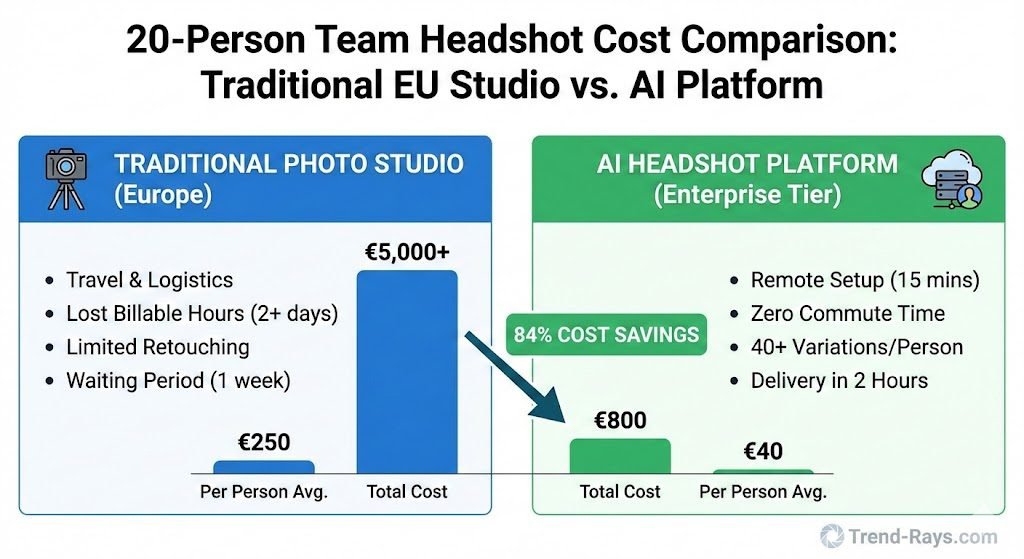
The price gap becomes undeniable when you scale it for a team. If a Bucharest-based tech agency wants to standardize the LinkedIn profiles of its 20 employees, sending everyone to a local studio will cost upwards of €4,000, not to mention the lost billable hours.
Using an enterprise tier on an AI headshot platform brings that cost down to roughly €800. The team gets matching corporate backgrounds without ever leaving their home offices.
The Hidden Costs: Where AI Still Demands Your Time
However, the AI SaaS companies won’t tell you about the “sorting tax.” While you receive 40 to 100 images for your €40, you will likely discard 80% of them. AI still struggles with complex patterns, glasses blending into cheeks, or generating the dreaded “six-fingered hand” if your original selfies included limbs. You are saving money, but you must be prepared to spend 30 minutes acting as your own photo editor to find the one image that doesn’t fall into the uncanny valley.
The Real-World Visual Test: Spotting the “Uncanny Valley”
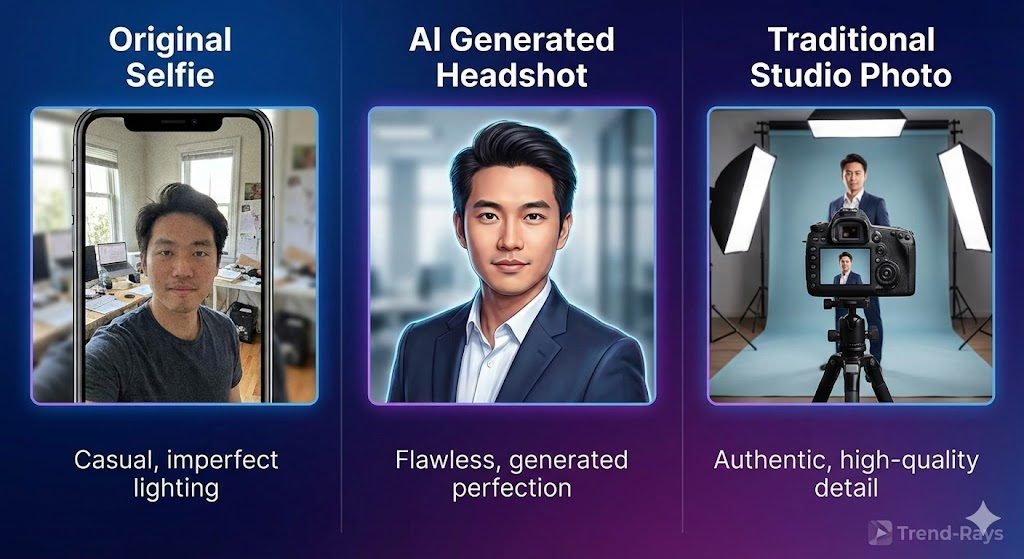
The financial argument for AI is bulletproof. But what happens when you actually look at the photos? To find out, we took standard smartphone selfies—the kind you snap in your home office—and ran them through top-tier AI generators to compare them against a €200 studio portrait.
The results are highly impressive at first glance, but a closer inspection reveals where the technology still struggles.
Where AI Excels: Lighting and Wardrobe
If you upload a selfie in a t-shirt, the AI can seamlessly generate a tailored navy suit or a crisp white blouse. It understands studio lighting perfectly, casting realistic shadows that mimic a professional ring light or a softbox setup. For a tiny LinkedIn thumbnail on a mobile screen, the illusion is flawless.
The Technical Flaws: The Devil is in the Details
However, AI does not take a picture of you; it synthesizes a new image based on you. This process often falls into the “Uncanny Valley”—an unsettling feeling when an image looks almost human, but slightly off. Here is what to look out for before updating your profile:
- The “Glassy Eye” Effect: AI struggles to replicate the complex reflection of light in the human pupil. Eyes can sometimes look slightly dead or misaligned, lacking the natural spark captured by a real camera lens.
- Teeth and Smiles: If your training selfies feature closed-mouth smiles, the AI will guess what your teeth look like. The result can be overly perfectly straight, aggressively white teeth that look artificial to anyone who knows you.
- Accessories and Hair: Glasses are notoriously difficult for AI to render without blending the frames into the cheekbones. Similarly, complex hairstyles, stray curls, or distinct facial hair can look painted on or over-smoothed.
- Background Context: While a studio photographer blurs a real background (bokeh), AI sometimes generates nonsensical background elements—like a floating window frame or a blurred plant that merges into your shoulder.
The Authenticity Tax
This is the core argument of traditional European photographers. When you hire a human in a studio in Warsaw or Bucharest, you are paying for absolute authenticity. If a potential client or investor realizes your photo is AI-generated, does it subcommunicate that you cut corners?
For a junior developer applying for remote roles, probably not. But for a CEO pitching a €500,000 contract, that slight loss of trust could be far more expensive than a €300 photoshoot.
The European Elephant in the Room: GDPR & Data Privacy
While American tech blogs focus entirely on the price and speed of these tools, European professionals have a much bigger hurdle: Data Privacy.
When you use an AI headshot generator, you aren’t just uploading a picture of a landscape; you are uploading 15 to 20 highly detailed images of your face. Under the General Data Protection Regulation (GDPR), biometric data is heavily protected. Uploading your face to a server that trains public AI models without your explicit, ongoing consent is a massive red flag—especially if a company mandates the software for its employees.
How to Protect Your Digital Identity
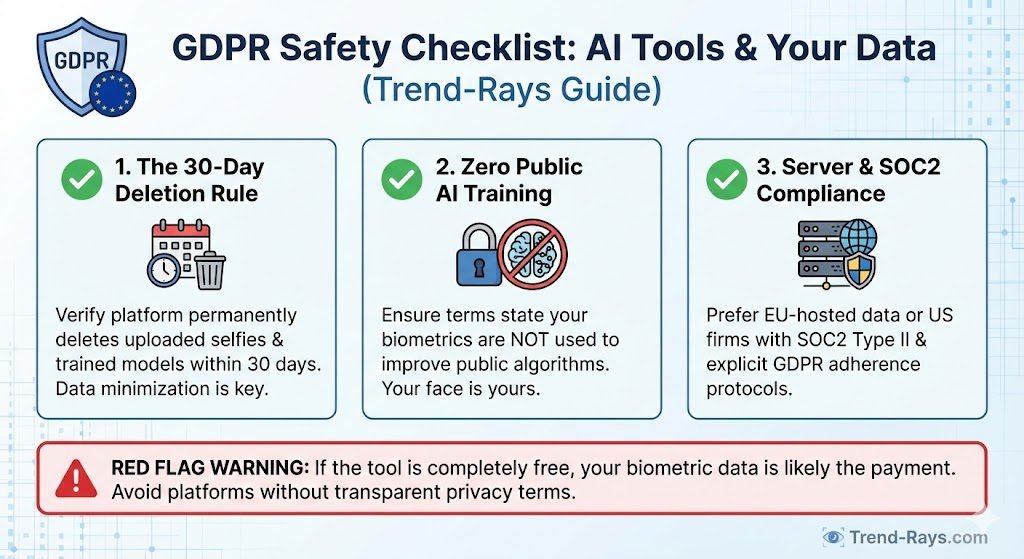
Before you or your IT department buys an enterprise pack of AI headshots, you must check the platform’s privacy policy for these three non-negotiable terms:
- The 30-Day Deletion Rule: The best platforms (like HeadshotPro) explicitly state that they delete your uploaded selfies and the trained AI model of your face from their servers within 30 days.
- Zero Public Training: Ensure the terms of service guarantee your photos will not be used to train the company’s overarching, public AI algorithms. Your face should only be used to generate your specific photos.
- Server Location and SOC2: While finding a purely EU-hosted AI headshot tool is still rare, look for US-based companies that hold SOC2 compliance and explicitly state their adherence to European GDPR frameworks for data processing.
If a tool is entirely free, or costs only €5, you are the product. Do not trade your biometric data to save €30.
The Final Verdict: When to Use Which?
The €300 traditional studio session is not dead, but its monopoly on the corporate world is officially over. AI headshot technology has matured past the “gimmick” phase and is now a legitimate, highly disruptive business tool. However, it is not a one-size-fits-all replacement.
Here is how to make the right call for your specific career stage:
🟢 Go With AI Headshots If:
- You are a Remote Team: If your startup has employees spread across Bucharest, Cluj, and London, AI is the only cost-effective way to achieve matching, branded LinkedIn profiles and website “Team” pages.
- You are a Job Seeker: If you need a clean, professional photo immediately to apply for remote IT roles and want to keep your budget under €50.
- You Hate the Camera: If posing in a studio makes you incredibly uncomfortable, spending 15 minutes taking selfies in your living room will likely yield a more relaxed-looking final product.
🔵 Hire a Traditional Photographer If:
- You are a C-Suite Executive: If you are pitching million-euro contracts or speaking at major industry events, absolute authenticity is your currency. The slight risk of the “uncanny valley” effect is not worth the €250 savings.
- You Need Diverse Media Assets: A studio photographer doesn’t just give you a headshot; they give you a portfolio. You get wide shots for website banners, candid-looking office shots, and creative lighting setups that AI cannot reliably match yet.
- You Work in High-Trust Sectors: If you are in legal, medical, or high-level wealth management, clients need to know the person they see online is exactly the person they will meet in the boardroom.
The Bottom Line for 2026: AI has successfully commoditized the standard corporate headshot. Use it to scale your team’s digital presence, but reserve the traditional photographer for when your personal brand demands undeniable, premium authenticity.