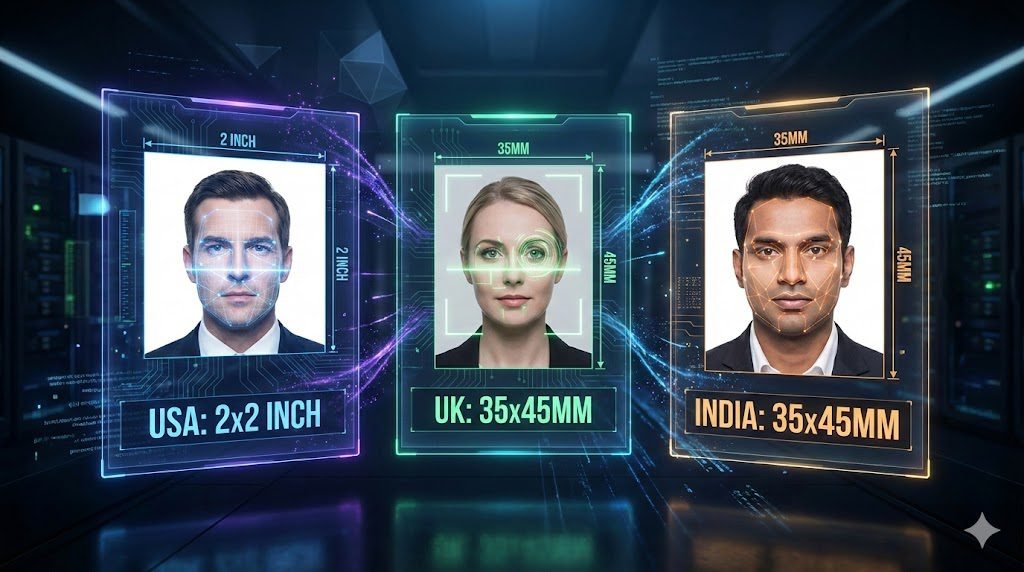
In 2026, passport photos are no longer just for human eyes; they are primarily for AI-driven facial recognition algorithms. A photo that looks “good” to you may be rejected by the ICAO (International Civil Aviation Organization) compliance software used by the USA, UK, and India.
This guide breaks down the technical “Nodal Point” requirements and physical specifications you need to guarantee acceptance. Check out these passport photo apps to create your own photo at home and save some money and get it printend at any Walmart store instantly.
1. Technical Specification Comparison
| Technical Metric | United States (USA) | United Kingdom (UK) | India (New 2026 Standard) |
| Physical Size | 2 x 2 inches (51 x 51 mm) | 35 x 45 mm | 35 x 45 mm (Digital) / 2×2 (Paper)* |
| Digital Resolution | Min 600 x 600 px | Min 600 x 750 px | 630 x 810 px (E-Passport) |
| Background | Plain White / Off-white | Light Grey or Cream | Plain White |
| Print Quality | 300 DPI (Continuous Tone) | 600 DPI (Professional) | 300 DPI (No visible dots) |
| Head Height | 25mm – 35mm (50-69%) | 29mm – 34mm (65-75%) | 31mm – 36mm (70-80%) |
| Recency | 6 Months | 30 Days | 6 Months |
*Note: India is currently in a “hybrid” phase. The online Passport Seva portal now mandates the 35x45mm digital crop for chip-based e-passports.
Struggling to meet these technical requirements? Check out our hands-on review of the best US passport photo validation apps to see which AI tools actually pass the biometric test.
2. Country-Specific Technical Deep-Dives
USA: The “No-Glasses” Square
The U.S. Department of State uses a specific “Photo Tool” that checks for “headroom” (the space between the top of your hair and the edge of the photo).
- The Eyeglass Ban: Since 2016, glasses are strictly prohibited. Even “anti-reflective” lenses cause micro-reflections that interfere with the biometric mapping of the iris.
- Lighting Geometry: The US prefers “Three-Point Lighting”—one key light, one fill light to remove shadows under the chin, and a back-light to separate the subject from the white background.
UK: The “Photo Code” System
The UK is unique in its move toward the “Digital Photo Code.”
- Background Contrast: Avoid a pure white background. The UK uses Light Grey (Pantone Cool Gray 1C or similar). This is because high-contrast white backgrounds often cause “blooming” around the hair, which makes it difficult for AI to define the exact crown of the head.
- Expression Neutrality: Unlike the US, where a “natural” closed-mouth smile is sometimes tolerated, the UK HMPO software checks for Nasal-Labial symmetry. Any muscle tension (smiling or frowning) can lead to a “Biometric Failure.”
India: The E-Passport Transition (New for 2026)
With the 2026 rollout of chip-embedded passports, India has moved closer to European (UK/Schengen) standards.
- The 80% Rule: The face must occupy significantly more of the frame (80%) than in the US standard. This is to ensure the RFID chip can store a high-resolution map of facial “Nodal Points” (distance between eyes, nose to chin, etc.).
- Attire Warning: Do not wear white or light blue. The Passport Seva portal’s AI often fails to distinguish the shoulders of a light-clothed applicant from the white background, leading to an “Invalid Outline” error.
3. Top 5 “Hidden” Rejection Reasons in 2026
- AI “Beautification” Filters: Modern smartphones often apply a subtle “skin smoothing” filter by default. Turn this off. If the software detects a lack of skin texture (pores), it flags the photo as “Digitally Altered.”
- The “Selfie” Distortion: Taking a photo at arm’s length causes Wide-Angle Distortion, making the nose look larger and the ears disappear. This changes your biometric profile. Always stand 1.5 meters (5 feet) away and use a 2x zoom (50mm equivalent).
- Shadows on the Pinna: Shadows inside or behind the ears are a major cause of rejection in the UK and India. Use a secondary light source to ensure the background is evenly illuminated.
- Visible Teeth: Even a “micro-smile” that shows a sliver of teeth will be rejected by the automated scanners in 2026.
- Ink-Jet “Dot” Patterns: If printing at home, you must use a high-resolution printer (min 300-600 DPI). If the “dots” of the ink are visible under a magnifying glass, the biometric scanner will fail to read the facial details.
4. Professional “DIY” Checklist
- Lighting: Stand facing a window during mid-day. Avoid direct sunlight (too harsh) or overhead room lights (causes “raccoon eyes”).
- Camera Height: The lens must be exactly at eye level. Looking up or down at the camera alters the jawline geometry.
- Hair: Ensure hair does not cover the “edges” of the face or the eyebrows. Biometric systems need to see the full oval of the face.
Would you like me to create an “Image Layout” template or a table specifically for infant/child passport photo requirements?
Frequently Asked Questions (FAQ) – 2026 Edition
1. Can I wear a Hijab, Turban, or other religious headgear?
- USA, UK, & India: Yes, religious headgear is permitted in all three countries. However, the headgear must not cover any part of the face (from the bottom of the chin to the top of the forehead) or cast shadows on the face. You may need to provide a signed statement or affidavit for the USA and UK confirming the attire is for religious purposes.
2. Can I wear a digital watch or heavy jewelry?
- Technical Rule: While not strictly banned, large jewelry can cause specular reflection (light bounce) which triggers AI rejection. It is highly recommended to remove large earrings or necklaces. Digital watches/trackers are fine as long as they aren’t visible in the frame (which only covers the head and shoulders).
3. What should I do if my child/infant won’t keep their eyes open?
- USA: For infants, it is acceptable if the eyes are not completely open.
- UK & India: The eyes must be open. Tip: Lay the baby on a plain white sheet and take the photo from above to ensure a flat, shadow-free background. No hands or toys can be visible in the frame.
4. Are “Selfies” acceptable for digital passport uploads?
- No. Selfies cause “Barrel Distortion” because the lens is too close to your face, making your nose look larger and ears smaller. This alters your biometric profile. Always have someone else take the photo from at least 5 feet away.
5. Can I smile in my 2026 passport photo?
- USA: A “natural,” closed-mouth smile is allowed.
- UK & India: Strictly neutral expression only. No smiling. AI software measures the distance between your mouth corners; smiling changes these coordinates.
6. Can I wear a uniform or camouflage clothing?
- USA: Uniforms, clothing that looks like a uniform, and camouflage attire are prohibited.
- UK & India: Generally discouraged. Stick to smart-casual “civilian” clothing in dark colors to contrast with the background.
7. Can I use AI tools to remove the background of my photo?
- Caution: While background removal is common, many AI tools leave “artifacts” or jagged edges around the hair. If the software detects a “halo” effect or unnaturally smooth edges, the photo will be rejected for digital manipulation.
8. What happens if I have a temporary injury (like a black eye)?
- Rule: If the injury is temporary, you should wait until it heals. If you have a permanent facial scar or tattoo, it must be visible in the photo as it is part of your permanent biometric record.
9. Why was my “White Background” photo rejected for the UK?
- The UK Exception: The UK HMPO specifically requests a light grey or cream background. A pure white background often causes “flare” around the hair, making it impossible for the scanner to determine the exact head height.
10. Can I wear tinted lenses or transition glasses?
- Strict No: Even if your glasses are for medical reasons, they are generally prohibited in the USA. In the UK and India, any tint or glare that obscures the eyes will lead to an immediate rejection.