
⚡ Quick Verdict: The Danger of “Deferred Billing” in AI SaaS
If you are running an AI SaaS (like a Chatbase wrapper or an AI image generator) and using Stripe’s default “Metered Billing,” you are exposed to catastrophic financial risk.
Stripe’s architecture relies on Deferred Billing—meaning usage happens now, but the customer is billed at the end of the month. Because you must pay your cloud providers (OpenAI, Anthropic, AWS) in real-time for GPU compute, a single user racking up $5,000 in token usage whose credit card bounces on the 31st of the month will force your startup to absorb the entire compute cost.
To survive, AI founders must abandon default metered subscriptions and implement Pre-Funded Wallets and real-time balance-gating webhooks.
The Architectural Flaw: Real-Time Compute vs. Deferred Billing
The standard SaaS playbook for the last decade was simple: charge a $29/month flat fee. If a user’s credit card declined, you simply revoked their access. Your only loss was a canceled account.
Generative AI destroyed this model.
In 2026, most AI applications utilize Usage-Based Pricing (charging per 1,000 tokens or per image). Developers naturally turn to Stripe’s Metered Billing API to handle this. You create a Billing Meter, report the user’s events via the API, and Stripe aggregates the invoice.
Here is where startups are dying: Stripe does not gate usage. Stripe simply records it. When a user generates a 4K video using your app, your server instantly pays the API provider (e.g., Runaway or OpenAI) for the GPU compute. Stripe logs the event. Thirty days later, Stripe attempts to charge the user’s card.
If that user used a virtual burner card, a prepaid debit card with insufficient funds, or simply initiated a chargeback, you have already paid the API provider. You cannot “un-generate” the AI request. You eat the loss. Hackers are currently exploiting this via automated botnets to steal thousands of dollars of free AI compute from early-stage startups.
Before layering complex metering APIs over your SaaS, you must ensure your foundational support system is structurally sound. If you are still evaluating platforms, review our deep-dive architectural breakdown of Chatbase vs. Tidio to choose the right base infrastructure.
The 2026 Threat Vector: “Token Arbitrage” Botnets
Why is deferred billing so dangerous right now? Because hackers have fully weaponized it.
In 2026, malicious actors deploy automated botnets to sign up for thousands of AI SaaS accounts using virtual burner cards (like Privacy.com) or stolen, low-limit credit cards. They then funnel massive amounts of prompts through your API interface.
They aren’t doing this for fun. They are engaging in Token Arbitrage—reselling access to your underlying LLM on the dark web or via Telegram bots at a discount. By the time Stripe attempts to bill their burner cards at the end of the month, the cards decline. The hackers have stolen $50,000 of OpenAI compute, and your startup is left holding the bill. If your system does not gate usage in real-time, you are an open ATM for botnets.
The Gross Margin Lie (Failing VC Due Diligence)
If you are raising a Seed or Series A round in 2026, venture capitalists are actively auditing a new metric: Gross Margins Post-Compute Loss.
Many AI founders pitch a 70% gross margin based on their Stripe dashboard. However, VCs will immediately request your “Stripe Failed Invoice” rate. If 15% of your metered usage invoices bounce at the end of the month, your actual gross margin plummets. Investors view deferred billing in AI as a catastrophic liability. To pass due diligence in 2026, you must prove to investors that you have a “Zero-Exposure” prepaid architecture in place.
Building the Redis Circuit Breaker (Technical Implementation):
Do not rely on Stripe webhooks for real-time gating; they can experience latency during peak hours. You must use an in-memory datastore like Redis to check user balances in milliseconds before firing the LLM request.
The Logic Flow:
- User submits a prompt.
- App estimates token cost (e.g., using
tiktoken). redis.get(user_id_balance)- If
balance < estimated_cost→ Return402 Payment Required. - If sufficient → Fire LLM → Deduct actual tokens used via
redis.decrby().
Only sync this Redis ledger back to your main database (or Stripe’s new Metronome acquisition backend) asynchronously. Never block the user experience on a database write.
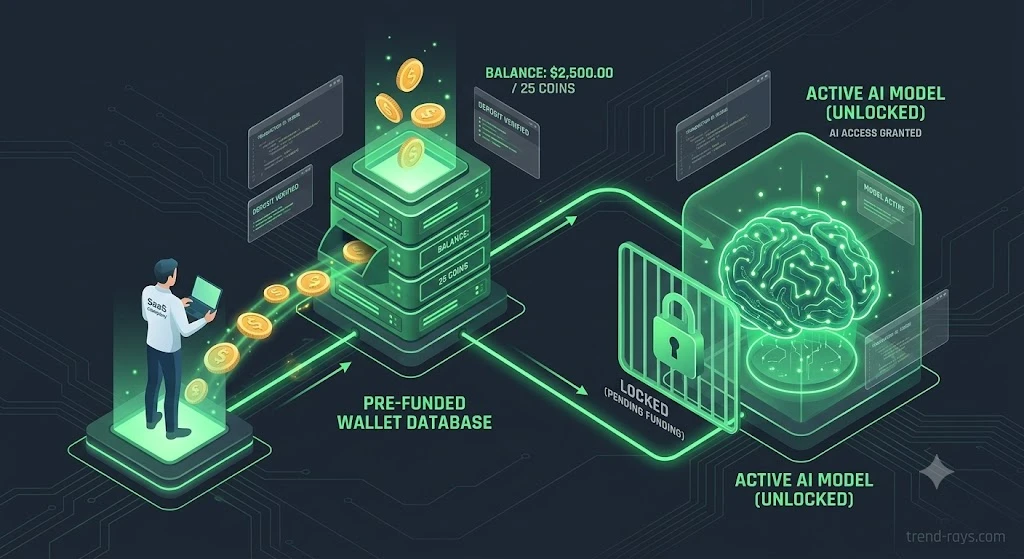
The Solution: Pre-Funded Wallets & Circuit Breakers
To protect your startup, you must decouple usage from deferred billing. You must treat AI compute like a prepaid mobile phone plan.
Step 1: The Pre-Funded Wallet Architecture
Do not use Subscription objects for metered AI usage. Instead, force users to buy “Credit Packs” upfront using Stripe Checkout. Store their credit balance in your own database (e.g., PostgreSQL or Redis).
Step 2: The Real-Time “Circuit Breaker”
Before your server makes a call to the OpenAI or Anthropic API, your backend must query your local database:
- Does User A have enough credits for this prompt?
- If yes -> deduct the estimated token cost -> execute the LLM call.
- If no -> block the LLM call -> redirect to the Stripe top-up page.
Step 3: Handling the new Stripe “LLM Token Billing” API (2026 Preview)
If you must use post-paid billing, Stripe recently released a private preview of their Billing for LLM Tokens API. This system automatically tracks OpenAI/Anthropic model prices and aggregates usage. However, you must implement Circuit Breakers via Stripe Webhooks. You must configure a webhook that triggers when a user’s unbilled usage crosses a specific threshold (e.g., $50). Once triggered, your app must temporarily freeze their account and force an immediate mid-cycle invoice payment before allowing further GPU generation.
Interactive Tool: The AI SaaS Financial Exposure Calculator
Use this calculator to determine exactly how much money your startup will lose this month if you rely on standard end-of-month metered billing.
AI Financial Exposure Calculator
📉 AI SaaS Financial Exposure Calculator
Calculate the catastrophic risk of using Stripe’s deferred “Metered Billing.” If user credit cards decline at the end of the month, your startup absorbs the raw GPU compute costs.
The 2026 AIaaS Tax Nightmare (Stripe Tax PTCs)
Financial exposure isn’t your only risk; international tax audits are destroying SaaS margins.
Because Generative AI is a new digital frontier, tax jurisdictions view it differently than traditional SaaS. If you are selling an AI product globally, you can no longer use the standard txcd_10103000 (Software as a Service) Product Tax Code in Stripe.
The New Stripe AIaaS Codes: To avoid severe audit penalties from the EU (VAT) and US states, you must update your Stripe Tax settings to use the brand-new Artificial Intelligence as a Service (AIaaS) codes:
txcd_10105001: Cloud-Based AIaaS for Personal Use (e.g., B2C AI companions).txcd_10105002: Cloud-Based AIaaS for Business Use (e.g., B2B contract reviewers).txcd_10105004: Cloud & Downloaded AIaaS (e.g., downloading a local model with a cloud sync).
Failing to categorize your AI usage accurately will result in under-collecting digital sales tax, a cost your startup will be forced to pay out of pocket during an audit.
Conclusion: Guard Your Compute
Building an AI SaaS is fundamentally different from building traditional software. Your infrastructure costs scale instantly, dynamically, and unforgivingly.
Relying on legacy subscription billing models is a recipe for disaster. By enforcing pre-funded wallets, building real-time database circuit breakers, and correctly classifying your AIaaS tax codes, you ensure your revenue scales safely alongside your compute.
Are you building a custom AI agent for your SaaS? If your AI handles sensitive user data, you must ensure your architecture complies with cybersecurity laws. Read our technical breakdown onBuilding a HIPAA Compliant AI Voice Stack.
Frequently Asked Questions
1. Will switching to pre-funded wallets destroy my SaaS conversion rate?
No, provided you reframe credits as “Instant Value” rather than a friction barrier. While traditional 1-click free trials have higher initial sign-up numbers, AI companies using deferred billing suffer up to 30% higher churn and massive chargeback rates. Offering a small batch of free starter credits upon sign-up (e.g., $1 worth of free generations) lets users test the product immediately, while requiring a prepaid top-up before high-compute features unlock. This filters out botnets while maintaining a high conversion rate for serious buyers.
2. What happens to unspent user credits under state “Escheatment” (Unclaimed Property) laws?
This is a critical legal trap for token-based SaaS. In many US states and EU jurisdictions, unspent prepaid credits that sit inactive for 1 to 3 years can legally be classified as “unclaimed property.” If your Terms of Service state that credits “never expire,” your startup may technically be obligated to report and remit unspent balances to state treasuries.
The Fix: Your Terms of Service must explicitly state that purchased credits are non-refundable, non-transferable “service units” tied to active account usage, with an explicit 12-month inactivity expiration policy.
3. Can Stripe’s default Radar fraud prevention stop automated token arbitrage botnets?
Not on its own. Stripe Radar is designed to detect stolen credit cards and high-risk IP addresses during the initial checkout phase. It cannot detect when a legally valid, low-balance virtual card (like Privacy.com or Revolut single-use cards) passes checkout, gets authorized for $1, and then proceeds to drain $2,000 worth of LLM API tokens before declining on the end-of-month invoice. You must enforce real-time database circuit breakers at the API gateway layer.
4. How do I handle sudden LLM price drops (e.g., OpenAI reducing GPT model costs) if users bought prepaid credits?
Decouple your credit system from flat dollar amounts by using internal “Compute Units.” Never sell credits as direct dollar equivalents (e.g., “$10 = 1,000 OpenAI tokens”). Instead, sell “Platform Credits” (e.g., $10 = 1,000 Credits).
When API providers drop their token costs, simply reduce the number of internal Credits required per generation in your application backend. This allows you to pass cost savings to your users instantly without altering their stored wallet balances or rewriting your billing ledger.