Have you ever wondered how an app can afford to pay someone real money just for playing a mobile game?
At first glance, it sounds too good to be true.
After all, if thousands—or even millions—of people are earning rewards every day, where does that money actually come from? Are these companies simply giving away cash? Is there a hidden catch? Or is there an entire business model working behind the scenes that most users never see?
These questions have become increasingly common as reward platforms like Freecash, Swagbucks, Mistplay, Testerup, Cash Giraffe, and other “get-paid-to” (GPT) apps have grown in popularity. Their advertisements often promise gift cards, PayPal cash, or other rewards in exchange for playing games, testing apps, completing surveys, or trying new services.
While the rewards are real on many legitimate platforms, the explanation behind them is often oversimplified.
Most articles stop after a single sentence:
“Reward apps make money from advertisers and share a portion of that revenue with users.”
Technically, that’s true.
But it leaves out almost everything that actually happens behind the scenes.
Who are these advertisers?
Why would a game developer willingly pay someone to install their game?
Why are some offers worth just a few dollars while others promise significantly higher rewards?
How does a reward platform know that you’ve completed a task?
Why do offers disappear overnight?
And if users are getting paid, how do all the companies involved still make a profit?
The answers lie within a massive global industry that most reward app users never realize they’re participating in.
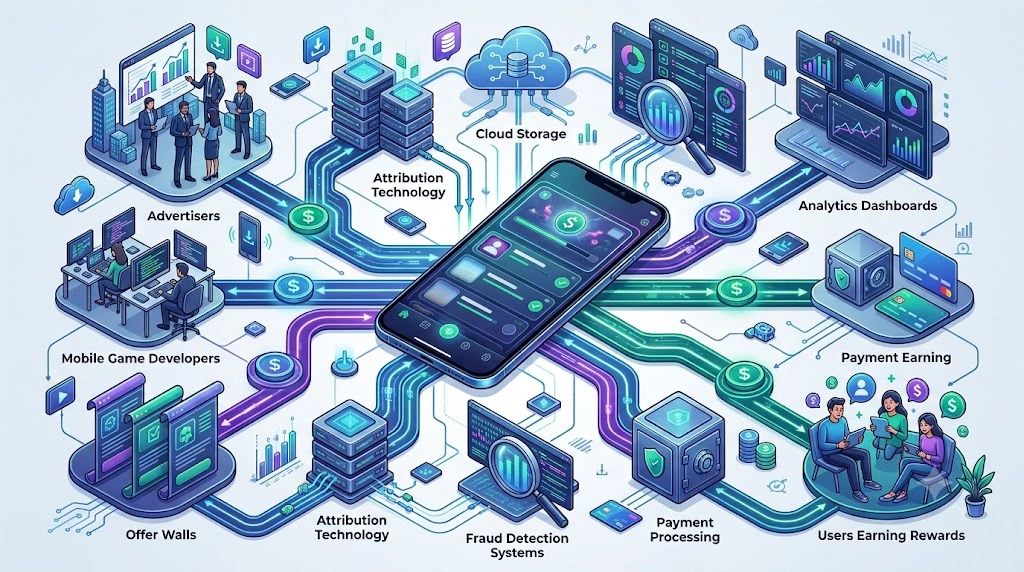
Behind every completed offer is a chain of businesses that includes mobile game studios, advertising agencies, user acquisition specialists, offer wall providers, attribution platforms, analytics companies, payment processors, and reward apps. Together, they form an ecosystem worth billions of dollars every year.
Understanding that ecosystem changes the way you look at reward apps.
Instead of seeing them as mysterious platforms that somehow “give away money,” you’ll see them for what they really are: marketing platforms designed to connect advertisers with potential customers while sharing part of the advertising budget with users who complete specific actions.
In this guide, we’ll follow the journey of a single reward—from the moment a game developer decides they need more players to the moment a user receives a payout.
Along the way, you’ll learn:
- Why mobile game companies spend billions acquiring new players.
- How reward apps fit into the mobile advertising ecosystem.
- What offer walls actually do.
- Why different users receive different rewards for the same game.
- How app install tracking works.
- Why some offers fail to track correctly.
- How advertisers measure success.
- Why legitimate reward apps can afford to pay users while still remaining profitable.
- And what the future of the reward app industry may look like.
Whether you’re simply curious about how these platforms work, trying to decide if they’re legitimate, or interested in the business of mobile advertising itself, this guide will take you far beyond the simplified explanations you’ll usually find online.
Let’s begin with the most important question of all:
Where does the money actually come from?

The Short Answer: Where Does the Money Come From?
If you only remember one thing from this entire article, remember this:
Reward apps don’t create money—they redistribute advertising budgets.
That single sentence explains the business model behind almost every legitimate reward platform.
Whether you’re using Freecash, Mistplay, Swagbucks, Testerup, Cash Giraffe, or another rewards app, the money you receive usually originates from companies trying to acquire new customers.
In most cases, those companies are:
- Mobile game developers
- App publishers
- E-commerce businesses
- Subscription services
- Financial technology (FinTech) companies
- Streaming platforms
- Online education providers
- VPN services
- Shopping apps
- And many other digital businesses
These companies aren’t paying you simply because they’re generous.
They’re paying because acquiring new users is one of the biggest challenges in the digital economy.
Think of It Like Hiring a Salesperson
Imagine you own a brand-new mobile game.
You’ve spent two years designing it.
You’ve invested hundreds of thousands—or perhaps millions—of dollars in development, artwork, music, servers, testing, and marketing.
Now your game is finally available on the App Store and Google Play.
But there’s one problem.
No one knows it exists.
Even though there are millions of potential players, your game is competing against hundreds of thousands of other apps for attention.
Waiting for people to discover it naturally could take months or even years.
Instead, you decide to actively promote it.
This is where reward apps enter the picture.
Rather than hoping users eventually find your game, you pay marketing partners to introduce your game directly to people who are willing to try it.
Reward platforms become one of those partners.
You’re Not the Customer—You’re Part of the Marketing Campaign
This is one of the biggest mindset shifts readers should understand.
When using a reward app, you’re not just earning money.
You’re also participating in a marketing campaign.
Here’s a simplified example.
Suppose a game studio decides:
“We’ll pay $12 for every genuinely interested new player who reaches Level 15.”
That doesn’t mean the player receives the entire $12.
Instead, that advertising budget is distributed across multiple companies involved in delivering and verifying the campaign.
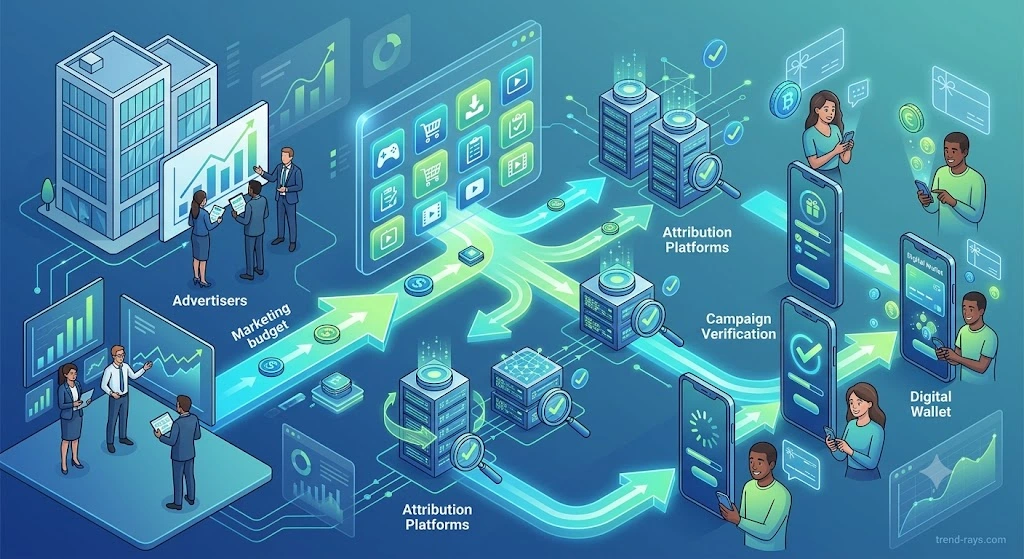
A simplified flow looks like this:
Game Studio
        ↓
Advertising Budget
        ↓
Marketing Partner
        ↓
Offer Wall
        ↓
Reward Platform
        ↓
You (the player)
Each participant performs a specific role, and each receives a portion of the advertising budget.
We’ll examine each of these companies in detail later in this guide.
Why Would a Game Company Spend Money Like This?
At first, paying people to play a game may sound like a bad business decision.
But from the developer’s perspective, it can be a highly profitable investment.
Consider this example.
A mobile strategy game earns revenue through:
- in-app purchases,
- battle passes,
- cosmetic items,
- advertising,
- premium subscriptions,
- and seasonal events.
If the average long-term player spends $80 over their lifetime, paying $15 to acquire that player may actually be an excellent investment.
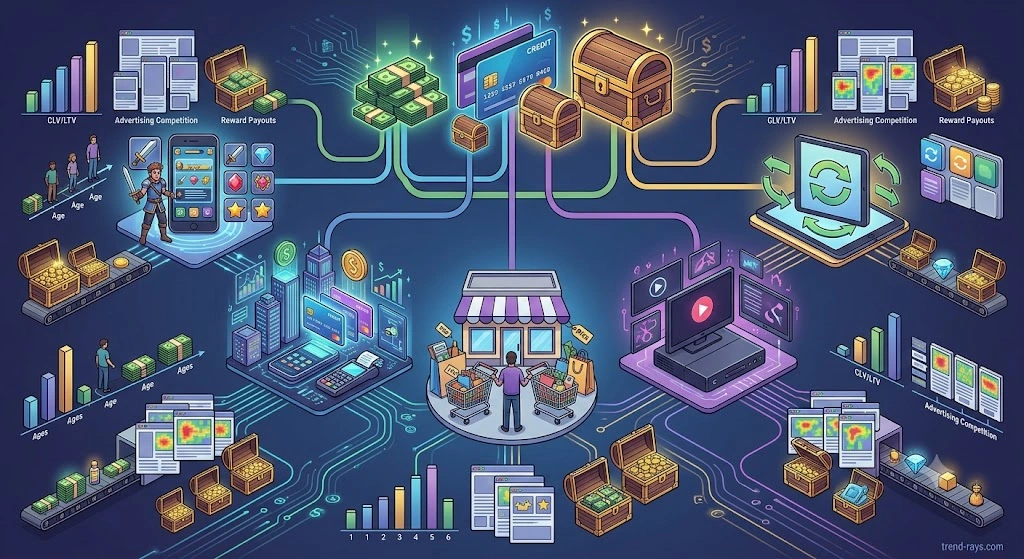
In marketing, this idea is often described by comparing two important numbers:
- Customer Acquisition Cost (CAC) – how much it costs to acquire a new user.
- Lifetime Value (LTV) – how much revenue that user is expected to generate over time.
As long as the expected lifetime value is higher than the acquisition cost, the campaign can still be profitable.
This is one of the fundamental economic principles behind reward apps.
Why Don’t Developers Just Use Traditional Advertising?
They do.
In fact, most successful mobile games advertise across many different channels at the same time.
These may include:
- YouTube advertisements
- TikTok campaigns
- Instagram ads
- Facebook advertising
- Google App Campaigns
- Influencer sponsorships
- Mobile ad networks
- Search advertising
- Reward platforms
- Offer walls
Reward apps are simply one customer acquisition channel among many.
Different channels reach different audiences, and developers typically invest in several of them simultaneously rather than relying on just one source of new users.
So, Are Reward Apps Losing Money?
This is another common misconception.
Many people assume that because users receive rewards, the platform itself must be operating at a loss.
In reality, a legitimate reward app is a business.
Its goal isn’t to give away money.
Its goal is to earn more from advertisers than it pays out to users.
For example, imagine an advertiser pays $20 when a user successfully completes a high-value offer.
That entire amount doesn’t go directly to the participant.
Instead, portions of that budget may cover:
- advertising partners,
- offer wall providers,
- fraud prevention,
- payment processing,
- platform operations,
- customer support,
- taxes,
- and finally, the user’s reward.
Although the exact distribution differs between companies and campaigns, the key principle remains the same:
Every participant in the ecosystem earns a share of the advertiser’s marketing budget.
That’s what allows the system to continue operating.
Why This Model Works
Reward apps solve a problem for everyone involved.
Advertisers gain:
- New users.
- Measurable marketing campaigns.
- Better control over acquisition costs.
- Performance-based advertising.
Reward platforms earn:
- Revenue from successful campaigns.
- Long-term advertiser relationships.
- Opportunities to grow their user base.
Users receive:
- Gift cards.
- PayPal rewards.
- Cashback.
- Cryptocurrency (on some platforms).
- Other incentives for completing eligible activities.
Instead of one company paying another with no measurable outcome, everyone benefits when a campaign successfully attracts engaged users.
The Hidden Industry Most Users Never See
When you install a game through a reward app, dozens of invisible technologies begin working behind the scenes.
Within seconds:
- your installation is tracked,
- attribution systems identify where you came from,
- fraud detection tools analyze the activity,
- campaign databases record milestones,
- advertisers monitor conversion data,
- and payment systems prepare future rewards if the required objectives are completed.
Most users never notice this invisible infrastructure.
Yet it’s one of the most sophisticated parts of the entire mobile advertising industry.
Understanding these hidden systems is the key to understanding why reward apps exist in the first place.
And that’s exactly where we’re heading next.
The Billion-Dollar Mobile Gaming Industry: Why Companies Spend So Much to Acquire Players
To understand why reward apps exist, you first need to understand the industry that funds them.
The rewards you receive for playing games, testing apps, or completing offers don’t appear out of thin air. They originate from marketing budgets allocated by companies competing in one of the most competitive digital markets in the world: mobile gaming.
Every year, developers launch thousands of new games on the Apple App Store and Google Play. Some are created by independent developers with small budgets, while others are backed by multinational publishers investing millions of dollars into development and marketing.
Regardless of their size, they all face the same challenge:
Getting people to discover their game.
Creating a great game is only half the battle. Convincing players to install it is often even harder.
The App Stores Are Crowded
Imagine opening a new coffee shop in a city with thousands of existing cafés.
Even if your coffee is excellent, customers won’t magically find your business.
You need visibility.
The same principle applies to mobile games.
When players search the App Store or Google Play, they’re presented with thousands of options across every category imaginable. Popular games already dominate charts, receive editorial features, and benefit from years of brand recognition.
A newly released game starts with none of those advantages.
Without marketing, even a well-designed game may struggle to attract enough players to survive.
This is one of the main reasons publishers invest heavily in user acquisition instead of waiting for organic downloads.
Downloads Alone Don’t Build a Business
Many people assume success is measured by download numbers alone.
In reality, developers care far more about active, engaged players.
For example:
- A game with 100,000 engaged users who regularly play and make occasional purchases can be far more profitable than a game with 1 million installs where most users leave after a single day.
Because of this, advertisers don’t simply pay for downloads.
They often pay for meaningful actions such as:
- completing the tutorial,
- reaching Level 10,
- reaching Level 25,
- remaining active after seven days,
- making an in-app purchase,
- subscribing,
- or completing another valuable milestone.
This explains why many reward offers require players to achieve specific goals instead of simply installing an app.
Advertisers want users who are genuinely interested—not just people collecting rewards.
Why User Acquisition Has Become a Billion-Dollar Industry
The process of attracting new users is known as User Acquisition (UA).
Every major mobile publisher has one objective:
Acquire high-quality players at a cost lower than the revenue those players are expected to generate.
This is why companies dedicate enormous budgets to marketing.
Instead of hoping players eventually discover their games, they actively compete for attention through:
- Search advertising
- Social media campaigns
- YouTube advertisements
- Influencer partnerships
- App Store optimization (ASO)
- Reward platforms
- Offer walls
- Referral programs
- Affiliate marketing
- Cross-promotion between games
Each channel reaches different audiences and serves a different purpose.
Reward apps are simply one piece of this much larger acquisition strategy.
Every New Player Has a Potential Value
To understand why advertisers are willing to spend money acquiring users, imagine two different mobile games.
Game A
A casual puzzle game generates revenue almost entirely through advertisements.
Most players never spend money.
The average player generates only a small amount of advertising revenue over time.
Because each user has relatively low lifetime value, the developer cannot afford to spend much acquiring new players.
Reward offers for this type of game are usually modest.
Game B
Now imagine a strategy game where many players purchase:
- premium currency,
- expansion packs,
- battle passes,
- exclusive characters,
- and seasonal subscriptions.
Although only a percentage of players spend money, those who do may remain active for months or even years.
Each long-term player could be worth significantly more to the publisher.
Because of that higher potential value, the developer can justify investing much more to acquire qualified players.
This is one reason why you’ll occasionally encounter reward offers worth substantially more than others.
The reward often reflects the advertiser’s expectations—not the amount of time required.
Marketing Is an Investment—Not an Expense
One of the biggest misconceptions is that advertising is simply money being spent.
Successful companies treat marketing differently.
They view it as an investment.
Suppose a publisher spends $20 acquiring a new player.
If historical data shows that similar players typically generate $75 in revenue over the following year, the campaign may produce a healthy return.
This is why companies continuously analyze metrics such as:
- Customer Acquisition Cost (CAC)
- Lifetime Value (LTV)
- Retention Rate
- Return on Ad Spend (ROAS)
- Conversion Rate
These measurements help advertisers determine whether a campaign is profitable.
We’ll explain each of these concepts later in the article using simple, real-world examples.
Why Some Companies Spend Millions Every Month
Large mobile publishers rarely run a single advertising campaign.
Instead, they operate dozens—or even hundreds—simultaneously across multiple countries.
Campaigns may target:
- new Android users,
- iPhone users,
- strategy gamers,
- puzzle enthusiasts,
- sports fans,
- users in specific age groups,
- or people in particular regions.
Budgets are constantly adjusted based on campaign performance.
If one marketing channel delivers better long-term players than another, advertisers may shift more spending toward that channel.
Reward platforms compete for a share of these budgets alongside many other forms of digital advertising.
Competition Drives Innovation
The intense competition within the mobile gaming industry has led companies to develop increasingly sophisticated marketing techniques.
Instead of asking:
“How do we get more downloads?”
Modern publishers ask much deeper questions:
- Which advertising channel delivers the highest-quality users?
- Which players stay active for 30 days?
- Which users are most likely to make purchases?
- Which campaigns generate the best long-term return?
- Which countries produce the highest-value players?
Answering these questions requires enormous amounts of data—and that’s where tracking, analytics, attribution platforms, and reward apps begin working together.
As you’ll soon discover, the reward app you use is only one small part of a much larger marketing ecosystem.
The Bigger Picture
By now, one thing should be clear:
Reward apps don’t exist because companies enjoy giving away money.
They exist because acquiring loyal players is incredibly valuable.
Every reward you earn is funded by a marketing budget designed to attract users who may eventually become long-term customers.
Understanding this changes the way you look at every offer.
You’re not simply installing a game.
You’re participating in a carefully measured marketing campaign backed by data, advertising technology, and billions of dollars in annual spending.
The next question is:
If acquiring players is so important, why don’t developers just rely on the App Store or Google Play to attract them naturally?
To answer that, we need to explore the concept of organic growth versus paid user acquisition—and why most successful apps invest heavily in both.
Why Game Developers Buy Players Instead of Waiting for Organic Downloads
If you’ve ever published a mobile app, launched a website, uploaded a YouTube video, or started an online business, you’ve probably discovered an uncomfortable truth:
Building something great doesn’t automatically mean people will find it.
The same challenge exists in the mobile gaming industry.
A game may have outstanding graphics, addictive gameplay, positive reviews, and years of development behind it. But if nobody knows the game exists, none of those qualities matter.
This is why user acquisition has become one of the largest expenses for mobile game publishers.
They’re not paying for downloads because they enjoy spending money.
They’re paying because visibility has become one of the most valuable resources in the digital economy.
The “Build It and They Will Come” Myth
Many first-time developers believe that once their game is published on the App Store or Google Play, downloads will naturally begin to increase.
Unfortunately, that’s rarely how today’s app marketplaces work.
Every day, thousands of new apps and games compete for the same users.
Meanwhile, players are overwhelmed with choice.
When someone searches for terms like:
- racing games
- puzzle games
- strategy games
- survival games
they’re presented with hundreds—or even thousands—of options.
Most people download only one or two.
That means thousands of perfectly good games receive very little attention simply because they never become visible enough.
Organic Downloads vs. Paid User Acquisition
There are two primary ways a game can attract new players.
Organic Growth
Organic users discover the game naturally.
This may happen through:
- App Store searches
- Google Search
- YouTube videos
- Social media
- Friends and family
- Press coverage
- Word of mouth
- Content creators
- Community recommendations
Organic growth is valuable because developers don’t pay directly for each install.
However, it can also be slow, unpredictable, and highly competitive.
Paid User Acquisition
Paid acquisition is different.
Instead of waiting for players to discover the game, publishers actively promote it.
Examples include:
- Google App Campaigns
- Apple Search Ads
- TikTok advertising
- Meta advertising
- Influencer sponsorships
- Reward apps
- Offer walls
- Affiliate campaigns
- Mobile advertising networks
In this model, every advertising dollar is treated as an investment designed to attract potential long-term players.
Most successful mobile games combine both strategies rather than relying on only one.
Why Organic Growth Isn’t Enough
Imagine launching a new online store.
You could wait for customers to discover your website through search engines.
Eventually, some people might.
But what if your competitors are actively advertising every day?
They’re reaching customers immediately while you’re waiting for traffic to arrive naturally.
The same situation exists in mobile gaming.
Developers who rely entirely on organic discovery often struggle to compete against companies investing millions of dollars in user acquisition.
Paid marketing accelerates growth.
Instead of waiting months to build an audience, publishers can begin attracting players almost immediately.
The Network Effect
Many modern games become more valuable as more people join them.
Think about:
- multiplayer shooters,
- battle royale games,
- sports games,
- MMORPGs,
- social casino games,
- cooperative adventures.
A large player base creates:
- faster matchmaking,
- healthier communities,
- more active guilds,
- better competition,
- increased social sharing,
- stronger recommendations.
This creates what’s known as a network effect.
More players attract even more players.
Because of this, publishers often prioritize rapid growth during the early stages of a game’s life cycle.
Early Momentum Matters
Imagine two identical mobile games launched on the same day.
Game A
The developer spends almost nothing on marketing.
After six months:
- 8,000 installs
- Few online reviews
- Limited community
- Minimal social discussion
Game B
The developer invests heavily in user acquisition.
After six months:
- 500,000 installs
- Thousands of reviews
- Active Discord community
- YouTube creators producing guides
- Social media discussions
- Better App Store rankings
Even if both games were equally well designed, Game B now has significantly more momentum.
That momentum often leads to even more organic growth because successful apps become easier to discover.
This creates a positive feedback loop.
Paid Marketing Can Create Organic Growth
This is one of the most misunderstood aspects of app marketing.
Developers don’t always spend money solely to buy users.
Sometimes they spend money to improve visibility.
More installs can lead to:
- more ratings,
- more reviews,
- more gameplay videos,
- more Reddit discussions,
- more YouTube tutorials,
- better App Store rankings,
- stronger word-of-mouth recommendations.
Eventually, those organic channels begin attracting users without additional advertising.
In other words:
Paid growth can help create future organic growth.
Why Reward Apps Fit Into This Strategy
Reward apps provide publishers with another way to introduce their games to potential players.
Instead of showing a traditional advertisement, reward platforms encourage users to actively install and experience the game.
If players genuinely enjoy it, they may continue playing long after earning their reward.
From the developer’s perspective, this creates an opportunity to acquire engaged users rather than simply generating advertisement impressions.
That’s why many campaigns require players to:
- complete tutorials,
- reach certain levels,
- remain active for several days,
- or achieve specific milestones.
These requirements help advertisers identify users who are more likely to become long-term players.
Why Some Campaigns End Suddenly
Readers often notice that attractive reward offers disappear without warning.
This usually isn’t because something went wrong.
Instead, campaigns often end because:
- the advertiser reached its acquisition goal,
- the marketing budget was fully spent,
- performance targets changed,
- another campaign delivered better results,
- or the publisher shifted its strategy.
Marketing campaigns are constantly being adjusted based on real-time data.
Reward platforms simply reflect those changes.
Marketing Is Constantly Being Optimized
Modern mobile publishers rarely launch one campaign and leave it unchanged.
Instead, they continuously test questions such as:
- Which countries deliver the highest-quality users?
- Which reward platform performs best?
- Which advertising creative generates more installs?
- Which campaign brings players who remain active after 30 days?
- Which acquisition channel produces the highest lifetime value?
The answers determine where millions of advertising dollars are invested next.
Reward apps compete alongside many other acquisition channels to prove that they can deliver valuable players.
The Missing Piece
By now, it’s clear that reward apps don’t operate independently.
They’re part of a much larger advertising ecosystem designed to help publishers acquire new users in measurable, cost-effective ways.
But one important question still remains:
How does a reward app actually connect with game developers?
After all, game studios don’t negotiate individually with every rewards platform around the world.
Instead, a specialized group of companies sits between advertisers and reward apps, making the entire system work behind the scenes.
These companies are called offer walls, and without them, much of today’s reward app industry wouldn’t function.
In the next section, we’ll explore what offer walls are, how they operate, and why they’re one of the most important—but least understood—parts of the reward app ecosystem.
Meet the Hidden Middleman: What Are Offer Walls and Why Do They Exist?

By now, we’ve answered two important questions:
- Why do game developers spend money acquiring new players?
- Why do reward apps exist?
But there’s still one missing piece.
If thousands of advertisers want new users, and thousands of reward platforms want campaigns to show their users, how do these two groups actually find each other?
Does every game studio negotiate individual contracts with every reward app?
Not usually.
Instead, most campaigns flow through a specialized type of advertising platform known as an offer wall.
Although millions of people interact with offer walls every day, very few users know they even exist.
In many ways, they’re the invisible marketplace that keeps much of the reward app ecosystem running.
Think of an Offer Wall Like a Marketplace
Imagine a large shopping mall.
Instead of every customer visiting dozens of individual factories to buy products, they visit one location where hundreds of stores operate under the same roof.
Offer walls work in a similar way.
Instead of advertisers partnering separately with hundreds of reward apps, they can place campaigns on an offer wall.
Reward apps then integrate that offer wall into their platform, giving users access to hundreds—or even thousands—of available offers through a single connection.
Rather than building thousands of separate partnerships, everyone benefits from one shared marketplace.
The Four Main Participants
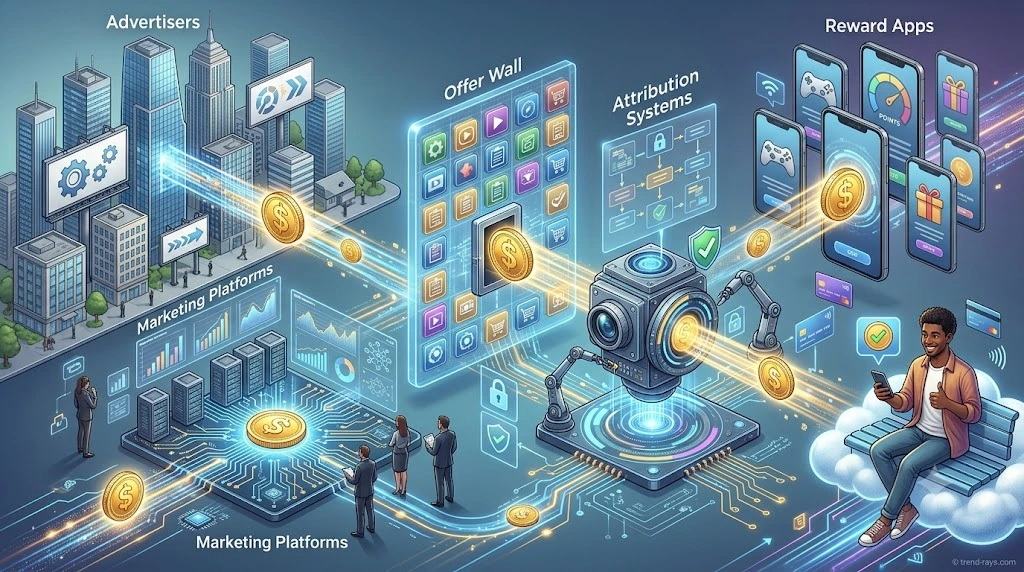
A simplified reward ecosystem usually looks something like this:
Game Studio / Advertiser
            │
            ▼
      Offer Wall Provider
            │
            ▼
     Reward App or GPT Platform
            │
            ▼
             User
Each participant has a different responsibility.
1. The Advertiser
This is the company trying to achieve a business goal.
Depending on the campaign, they may want users to:
- install a mobile game,
- register for an app,
- subscribe to a service,
- complete a purchase,
- test a new feature,
- or remain active for several days.
Instead of marketing directly to every potential customer, they create advertising campaigns with specific objectives.
2. The Offer Wall
The offer wall acts as the marketplace connecting advertisers with publishers.
Its responsibilities include:
- collecting campaigns from advertisers,
- organizing available offers,
- tracking user progress,
- verifying completed actions,
- detecting fraudulent activity,
- reporting campaign performance,
- and distributing revenue to participating partners.
Without offer walls, every reward platform would need to negotiate and manage thousands of individual advertising relationships—a task that would be extremely difficult to scale.
3. The Reward Platform
Apps such as gaming reward platforms, survey sites, or GPT websites integrate one or more offer walls into their products.
When you browse available offers inside one of these apps, there’s a good chance many of those campaigns are actually being supplied by an external offer wall rather than the reward platform itself.
The reward platform focuses on:
- attracting users,
- providing the interface,
- handling user accounts,
- processing withdrawals,
- offering customer support,
- and building the overall experience.
4. You
Finally, there’s the user.
You complete eligible tasks, such as:
- installing a game,
- reaching a required level,
- finishing a survey,
- testing an application,
- or signing up for a service.
Once the required action has been verified, rewards begin moving back through the same ecosystem until they eventually appear in your account.
A Single Offer Travels Through Multiple Companies
Let’s follow one simplified example.
Suppose a strategy game publisher launches a campaign.
Their goal is:
Acquire 50,000 new Android users who reach Level 20.
The process might look something like this:
Game Studio creates campaign
            │
            ▼
Campaign is uploaded to an Offer Wall
            │
            ▼
Offer becomes available inside Reward Apps
            │
            ▼
A user installs the game
            │
            ▼
Tracking confirms the install
            │
            ▼
User reaches Level 20
            │
            ▼
Advertiser verifies completion
            │
            ▼
Payment flows back through the ecosystem
            │
            ▼
User receives a reward
Although this diagram is simplified, it illustrates an important point:
Your reward isn’t triggered simply because you downloaded an app.
Several systems work together to verify that the campaign requirements were actually completed.
Why Don’t Reward Apps Build Their Own Offers?
This is a question many people never think to ask.
In theory, every reward platform could negotiate directly with advertisers.
In practice, that approach would be incredibly inefficient.
Imagine trying to maintain separate contracts with:
- thousands of game studios,
- shopping apps,
- VPN providers,
- finance companies,
- survey providers,
- subscription services,
- streaming platforms,
- and software companies.
Now multiply that across dozens of countries.
Offer walls solve this problem by acting as a centralized marketplace where campaigns can be managed, updated, tracked, and optimized at scale.
One Reward App Can Use Multiple Offer Walls
Here’s something many users don’t realize.
The reward platform you use probably isn’t connected to just one offer wall.
Many platforms integrate several offer providers simultaneously.
Why?
Because each offer wall has different:
- advertisers,
- campaign inventories,
- countries,
- reward rates,
- verticals,
- and promotional offers.
Combining multiple offer walls gives users a wider variety of opportunities while helping the platform remain competitive.
This is one reason why the available offers inside your favorite reward app may change from week to week.
The Companies Behind the Scenes
Although most users never notice them, several companies specialize in operating offer walls and performance marketing campaigns.
Examples include providers that focus on:
- mobile game installs,
- surveys,
- shopping offers,
- financial products,
- app testing,
- subscription campaigns,
- and other performance-based advertising opportunities.
Each provider works with different advertisers, supports different countries, and offers its own campaign inventory.
Rather than thinking of them as “reward apps,” it’s more accurate to view them as advertising marketplaces connecting businesses with potential customers.
Why Offer Walls Matter
Offer walls make the reward app ecosystem scalable.
Without them:
- advertisers would struggle to reach large audiences efficiently,
- reward apps would need thousands of direct business relationships,
- campaigns would be harder to manage,
- and users would have far fewer opportunities to earn rewards.
They quietly coordinate much of the work happening behind the scenes while allowing advertisers, publishers, and users to interact through a single, streamlined system.
The Next Piece of the Puzzle
Now that you know how advertisers connect with reward platforms, another important question naturally follows:
If multiple companies share the same advertising budget, how does each one actually make money?
After all:
- the advertiser pays,
- the offer wall earns,
- the reward platform earns,
- and the user also receives a reward.
So where does the profit come from?
The answer lies in performance marketing economics, where every participant earns value by helping advertisers acquire customers efficiently.
In the next section, we’ll break down exactly how the money flows through the ecosystem and explain why every company involved has a financial incentive to participate.
Following the Money: How Every Company in the Reward App Ecosystem Makes a Profit
By now, we’ve met all of the major players:
- The advertiser
- The offer wall
- The reward platform
- The user
At first glance, the business model seems confusing.
If advertisers pay money…
…and reward platforms pay users…
…and offer walls also earn money…
How can everyone involved remain profitable?
The answer lies in one of the most important principles of modern digital marketing:
Every participant creates value for the advertiser.
Instead of thinking of reward apps as companies that “give away money,” it’s more accurate to think of them as businesses that help advertisers achieve measurable marketing goals.
Let’s follow a single campaign from beginning to end.
Step 1: The Advertiser Sets a Marketing Goal
Imagine a mobile game studio launching a new strategy game.
The marketing team has one objective:
Acquire 100,000 new players who reach Level 20 within seven days.
Notice something important.
They’re not paying for downloads alone.
They’re paying for qualified players.
A player who reaches Level 20 has already invested time in learning the game and is much more likely to remain active than someone who installs the app and immediately deletes it.
From the advertiser’s perspective, those users are far more valuable.
Step 2: The Marketing Budget Is Approved
Before launching the campaign, the publisher decides how much acquiring those players is worth.
For example, suppose the marketing department allocates:
$2 million
to acquire 100,000 qualified users.
That doesn’t mean every user receives $20.
Instead, that budget funds an entire acquisition ecosystem.
It covers:
- campaign management,
- advertising technology,
- attribution,
- fraud prevention,
- payment processing,
- publisher commissions,
- and user rewards.
The budget is designed to generate profitable long-term customers—not simply distribute cash.
Step 3: The Campaign Reaches an Offer Wall
Instead of contacting hundreds of reward platforms individually, the advertiser works with an offer wall or performance marketing partner.
The offer wall becomes responsible for:
- distributing the campaign,
- making it available to participating platforms,
- tracking installations,
- measuring progress,
- validating completed objectives,
- detecting fraudulent activity,
- and reporting campaign performance back to the advertiser.
Think of the offer wall as the logistics company that delivers campaigns efficiently across hundreds of publishers.
Step 4: Reward Platforms Bring the Audience
This is where companies like reward apps and GPT platforms add value.
They already have communities of users actively looking for:
- new games,
- paid offers,
- surveys,
- cashback opportunities,
- and app testing campaigns.
Instead of the advertiser having to find every potential customer individually, reward platforms bring interested users together in one place.
That audience has real value.
Building and maintaining it requires:
- app development,
- customer support,
- fraud monitoring,
- payment infrastructure,
- marketing,
- compliance,
- and ongoing platform improvements.
The reward platform earns a share of the campaign because it delivers users to the advertiser.
Step 5: The User Completes the Campaign
Now it’s your turn.
Suppose you:
- install the advertised game,
- finish the tutorial,
- reach Level 20,
- and satisfy every campaign requirement.
At this point, multiple systems begin working simultaneously.
Tracking platforms verify:
- the installation,
- the source of the traffic,
- campaign eligibility,
- milestone completion,
- and fraud checks.
Only after these validations are complete does the advertiser approve payment.
Step 6: Revenue Flows Back Through the Ecosystem
Once the campaign is verified, the advertiser releases payment.
Rather than moving directly to the player, the revenue passes back through several participants.
A simplified example looks like this:
Advertiser Marketing Budget
            │
            ▼
 Offer Wall / Performance Partner
            │
            ▼
 Reward Platform
            │
            ▼
           User
Each participant receives compensation for the role they performed in delivering a successful customer.
The exact commercial arrangements vary between companies and campaigns, so there is no universal revenue split.
However, the principle remains consistent:
Every company earns by helping the advertiser acquire valuable users—not by taking money away from users.
Why Advertisers Are Happy to Pay
Some readers may still wonder:
“Why spend so much money acquiring players?”
The answer depends on the economics of the game.
Imagine two scenarios.
Scenario A
A casual puzzle game earns only a small amount of advertising revenue per player.
The publisher may be willing to spend only a modest amount acquiring each new user.
Reward offers for these games are usually lower.
Scenario B
A strategy game includes:
- premium subscriptions,
- cosmetic purchases,
- battle passes,
- expansion packs,
- limited-time events,
- and long player retention.
One loyal player may generate significantly more revenue over time.
That allows the publisher to invest much more in acquiring similar users.
Higher-value users justify higher acquisition budgets.
Why Reward Amounts Are Never Fixed
If you’ve ever noticed that the same game pays different amounts on different platforms—or even different amounts over time—this is why.
Reward values are influenced by factors such as:
- advertiser budgets,
- campaign demand,
- competition between acquisition channels,
- geographic targeting,
- seasonal promotions,
- campaign performance,
- user quality,
- and remaining marketing budget.
In other words:
Reward values behave more like advertising prices than fixed product prices.
Just as airline tickets and hotel rooms fluctuate based on demand, reward offers can change as marketing campaigns evolve.
Profit Doesn’t Come From “Keeping Your Reward”
Another common misconception is that reward platforms become profitable by refusing to pay users.
In reality, reputable reward platforms succeed when campaigns perform well.
Their long-term business depends on:
- attracting quality users,
- maintaining advertiser trust,
- processing rewards reliably,
- reducing fraud,
- and encouraging repeat participation.
Consistently failing to reward legitimate users would damage their reputation and make it harder to attract both advertisers and participants.
Their incentives are generally aligned with keeping the ecosystem functioning effectively.
Every Dollar Has a Purpose
One of the biggest insights from understanding this industry is realizing that every advertising dollar is carefully measured.
Advertisers don’t simply distribute money at random.
Each campaign is analyzed using metrics such as:
- acquisition cost,
- conversion rate,
- player retention,
- return on ad spend,
- lifetime value,
- and campaign profitability.
If the numbers make sense, the campaign continues.
If they don’t, budgets are adjusted, paused, or redirected elsewhere.
That’s why reward app offers are constantly changing.
Behind every offer is a business decision driven by performance data—not guesswork.
The Missing Technology
So far, we’ve explained:
- where the money comes from,
- why advertisers spend it,
- how offer walls connect everyone,
- and how every participant earns a profit.
But one important mystery still remains.
How does an advertiser actually know that you completed the offer?
How can they distinguish your installation from millions of others?
How do they prevent the same reward from being claimed multiple times?
The answer lies in a sophisticated technology known as mobile attribution—the invisible tracking system that powers nearly every reward app campaign.
Without attribution, advertisers wouldn’t know where their customers came from, reward platforms couldn’t verify completed offers, and users wouldn’t receive rewards.
In the next section, we’ll explore how mobile attribution works, why it’s essential to the industry, and why tracking sometimes fails even when users believe they’ve completed every requirement.
The Invisible Technology That Makes Reward Apps Possible: Understanding Mobile Attribution

Imagine this situation.
You open your favorite reward app and find an offer that says:
Install this game and reach Level 20 to earn $25.
You tap the offer.
The game downloads.
You spend several days playing.
Eventually, you reach Level 20.
A few minutes later, your reward appears in your account.
Simple, right?
From your perspective, yes.
But behind the scenes, dozens of automated systems have been working together from the moment you clicked Install.
Without those systems, advertisers would have no way of knowing:
- who installed the game,
- where that user came from,
- whether the required objectives were completed,
- or whether the reward should actually be paid.
The technology responsible for answering those questions is called mobile attribution.
Although most users never hear this term, it is one of the most important technologies in the mobile advertising industry.
What Is Mobile Attribution?
In simple terms, mobile attribution is the process of identifying which marketing campaign deserves credit for bringing in a new user.
Think of it like a delivery tracking system.
When you order a package online, every step of the journey is recorded.
- The order is confirmed.
- The warehouse ships it.
- The courier transports it.
- The package arrives.
- Delivery is verified.
At any moment, the company knows where your package is.
Mobile attribution works in a similar way.
Instead of tracking packages, it tracks advertising campaigns and user journeys.
It helps answer questions like:
- Which advertisement did the user click?
- Which reward platform referred them?
- Which campaign generated the install?
- Did the player complete the required milestone?
- Should the advertiser pay for this conversion?
Without attribution, those questions would be impossible to answer reliably at scale.
Following Your Journey
Let’s imagine you’re using a reward platform.
Here’s what happens after you click an offer.
You Click an Offer
          │
          ▼
Reward Platform records the click
          │
          ▼
Offer Wall generates tracking information
          │
          ▼
App Store opens
          │
          ▼
Game is installed
          │
          ▼
Game launches
          │
          ▼
Attribution platform verifies the install
          │
          ▼
Campaign progress is monitored
          │
          ▼
Required milestone completed
          │
          ▼
Reward approved
This process usually happens automatically and often within seconds of important milestones being completed.
Why Attribution Matters So Much
Imagine an advertiser spending $5 million on marketing across different channels.
Some users arrive from:
- Google Ads
- TikTok
- YouTube
- Reward platforms
- Influencers
- App Store search
- Affiliate websites
Without attribution, every install would look identical.
The advertiser wouldn’t know:
- which campaigns worked,
- which advertising channel generated the highest-quality players,
- where to invest future marketing budgets,
- or which campaigns should be stopped.
Attribution transforms marketing from guesswork into measurable business decisions.
Attribution Isn’t Just About Installs
Many people assume tracking ends once the game is downloaded.
In reality, advertisers often care much more about what happens after the install.
Depending on the campaign, attribution systems may measure whether a player:
- completes the tutorial,
- reaches Level 5,
- reaches Level 20,
- remains active for seven days,
- makes an in-app purchase,
- subscribes,
- or achieves another predefined milestone.
These milestones help advertisers distinguish between users who simply downloaded a game and users who genuinely engaged with it.
Why Reward Apps Don’t Verify Everything Themselves
Another common misconception is that reward platforms personally verify every completed task.
In reality, verification is usually shared across multiple systems.
The reward platform receives campaign information.
The offer wall monitors campaign progress.
The advertiser confirms qualifying events.
The attribution platform connects the entire journey.
Each participant contributes part of the verification process, helping reduce errors and improve confidence that rewards are being issued correctly.
The Companies Behind Attribution
Several specialized technology companies provide attribution services for the mobile app industry.
Their software helps advertisers understand:
- where users came from,
- which campaigns generated installs,
- how users behave after installation,
- and whether marketing budgets are producing profitable results.
These platforms process enormous amounts of campaign data every day, making them an essential part of the modern mobile advertising ecosystem.
Although most reward app users never interact with these companies directly, they quietly power much of the infrastructure behind successful campaigns.
Why Tracking Sometimes Fails
If you’ve ever completed an offer and wondered why your reward didn’t appear immediately, attribution is often part of the explanation.
Tracking may occasionally fail because of factors such as:
- interrupted installations,
- device privacy settings,
- network interruptions,
- campaign eligibility rules,
- app permission restrictions,
- delayed event reporting,
- or technical synchronization between different systems.
In many cases, the reward platform isn’t intentionally withholding payment.
Instead, one or more tracking events may not have been recorded successfully.
We’ll explore these situations in much greater detail later in this guide when discussing common tracking issues and how users can reduce the chances of them occurring.
Why Advertisers Invest Millions in Attribution
Building a great marketing campaign isn’t enough.
Advertisers also need confidence that every marketing dollar is producing measurable results.
Imagine spending millions on advertising without knowing:
- where customers came from,
- which campaigns succeeded,
- or whether users actually completed valuable actions.
No serious business could operate efficiently under those conditions.
Attribution provides the data needed to answer those questions.
It allows companies to improve campaigns, eliminate ineffective spending, reward successful partners, and make smarter investment decisions.
Without attribution, the performance marketing industry as we know it simply couldn’t function.
The Bigger Picture
By now, the reward app ecosystem should look very different from when you started reading this guide.
It’s no longer just:
Download a game → Get paid.
Instead, it’s a sophisticated network involving advertisers, offer walls, attribution platforms, analytics systems, fraud detection technologies, payment processors, and reward platforms—all working together to acquire, measure, verify, and reward valuable users.
But there’s still one major challenge.
What happens when someone tries to cheat the system?
With millions of dollars flowing through advertising campaigns every day, fraud has become one of the biggest threats facing the reward app industry.
In the next section, we’ll explore how fraudulent activity affects advertisers, why reward platforms invest heavily in fraud prevention, and how legitimate users can avoid being mistakenly flagged during reward campaigns.
Why Fraud Is One of the Biggest Challenges Facing Reward Apps

By now, you’ve seen how much work goes into a single reward campaign.
Advertisers invest millions of dollars.
Offer walls distribute campaigns.
Attribution platforms verify installs.
Reward apps attract users.
Players complete objectives and receive rewards.
When everything works correctly, everyone benefits.
But there’s one problem that threatens this entire ecosystem:
Fraud.
Every year, companies involved in mobile advertising lose enormous amounts of money to fraudulent activity.
Some fraud is simple.
Some is highly sophisticated.
And because advertisers are paying for measurable results rather than just app downloads, every fake conversion represents real financial loss.
That’s why legitimate reward platforms invest heavily in detecting suspicious behavior before rewards are approved.
Why Would Anyone Commit Fraud?
Imagine an advertiser launches a campaign offering rewards for reaching Level 20 in a mobile game.
The advertiser expects to pay only for genuine new players.
Now imagine someone discovers a way to claim the reward without actually becoming a real customer.
From the advertiser’s perspective:
- they spent money,
- but gained no valuable user,
- no future customer,
- and no return on investment.
Multiply that by thousands of fake conversions, and the financial impact quickly becomes enormous.
Protecting against those losses is one of the primary reasons verification systems have become increasingly sophisticated.
Common Types of Reward App Fraud
Fraud doesn’t always look the way people imagine.
Instead of dramatic hacking attempts, it often involves users trying to bypass campaign rules.
Some examples include:
Creating Multiple Accounts
A user creates several accounts to repeatedly complete the same offer.
Most campaigns are intended for first-time users only.
Reinstalling the Same Game
Someone deletes a game they’ve already played, creates a new reward account, and attempts to earn the reward again.
Because advertisers are paying for new customer acquisition, repeat installs usually don’t qualify.
Using Automated Software
Some fraudsters attempt to automate installs or gameplay using software instead of completing offers themselves.
Modern fraud detection systems are designed to identify many forms of automated behavior.
Device Manipulation
Changing device information, resetting advertising identifiers, or using virtual devices in an attempt to appear as a new user may violate campaign rules and can result in offers being rejected.
Location Manipulation
Some campaigns are available only in certain countries.
Attempting to access region-restricted offers by disguising your location can interfere with campaign tracking and may lead to disqualification.
Why Fraud Hurts Honest Users
One common misconception is that fraud only affects advertisers.
In reality, it affects everyone in the ecosystem.
When fraudulent activity increases:
- advertisers become more cautious,
- verification becomes stricter,
- rewards may take longer to approve,
- campaigns may be paused,
- and some offers may disappear entirely.
Honest users often experience these changes even though they followed every rule.
This is why reward platforms continuously balance two competing priorities:
- preventing fraud,
- while ensuring legitimate users receive their rewards as quickly as possible.
Why Some Rewards Stay Pending
Many users become concerned when an offer enters a “pending” status.
It’s easy to assume something has gone wrong.
In many cases, however, pending rewards are simply part of the normal verification process.
Depending on the campaign, advertisers may need time to confirm that:
- required milestones were completed,
- campaign conditions were satisfied,
- the user is genuinely new,
- suspicious activity wasn’t detected,
- and all tracking data matches correctly.
Only after those checks are completed is the campaign approved for payment.
Different advertisers use different verification timelines, which is why pending periods can vary from one offer to another.
Why Legitimate Users Sometimes Experience Tracking Problems
One of the most frustrating situations is completing an offer correctly but not receiving immediate credit.
While technical issues can occur, many apparent tracking failures are actually caused by campaign requirements that weren’t fully met.
Examples include:
- installing the app after clicking a different advertisement,
- previously downloading the same app,
- switching devices during the campaign,
- uninstalling before completing the required objective,
- disabling important tracking permissions,
- or not meeting the advertiser’s eligibility requirements.
This doesn’t necessarily mean the reward platform made a mistake.
It often means one of the required verification events couldn’t be confirmed.
How Reward Platforms Reduce Fraud
Modern reward platforms use multiple layers of protection rather than relying on a single security check.
These protections may include:
- account verification,
- device analysis,
- behavioral monitoring,
- campaign eligibility checks,
- attribution verification,
- duplicate account detection,
- automated fraud detection systems,
- and manual review for unusual activity.
Most of these systems operate quietly in the background, allowing legitimate users to complete offers without noticing the security processes taking place.
What Honest Users Can Do
Although users can’t control every aspect of campaign tracking, they can reduce the likelihood of problems by following a few simple practices:
- Read the offer requirements carefully before starting.
- Install the app only after clicking through the reward platform.
- Complete the required milestones on the same device.
- Avoid creating multiple accounts.
- Don’t attempt to manipulate device settings to qualify for offers.
- Keep screenshots of important milestones if the platform recommends doing so.
- Contact customer support with relevant details if a genuine tracking issue occurs.
Following these practices helps both the user and the advertiser maintain accurate campaign data.
Why Trust Is the Foundation of the Industry
Every successful reward campaign depends on trust.
Advertisers trust that reward platforms will deliver genuine users.
Reward platforms trust that advertisers will pay for verified conversions.
Users trust that legitimate campaigns will honor their promised rewards.
When any part of that trust breaks down, the entire ecosystem suffers.
That’s why fraud prevention isn’t simply about stopping dishonest behavior.
It’s about protecting a business model that allows millions of users to earn rewards while giving advertisers confidence that their marketing budgets are being spent effectively.
The Next Question
Now that we’ve explored how the industry protects itself from fraud, another important question naturally arises:
Why do some offers pay just a few dollars while others can be worth $100—or even more?
The answer isn’t random.
Reward amounts are influenced by advertising economics, competition, campaign goals, geographic targeting, and the expected value of each new customer.
In the next section, we’ll uncover the factors that determine reward values—and explain why two people can sometimes receive completely different offers for the same app.
Why Some Reward App Offers Pay $2 While Others Pay $200
If you’ve used reward apps for any length of time, you’ve probably noticed something surprising.
Two offers can appear side by side.
One pays:
$1.50
while another promises:
$150 or even more.
At first glance, it seems random.
Many users assume:
- the higher-paying offer must be easier,
- the lower-paying offer must be a scam,
- or the reward platform simply decides how much to pay.
In reality, none of those assumptions are usually correct.
Reward amounts are determined by advertising economics, and every campaign is priced differently depending on what the advertiser is trying to achieve.
You’re Not Being Paid for Your Time
This is probably the biggest misconception surrounding reward apps.
People often think:
“The longer a game takes, the more it should pay.”
That’s not how advertisers calculate rewards.
Instead, advertisers ask a different question:
“How valuable is this customer likely to be?”
Your reward reflects the estimated value of acquiring a qualified new user—not the number of hours required to complete the task.
This is why some relatively simple offers can pay more than games that require days of gameplay.
Customer Value Determines Advertising Budgets
Imagine two different companies.
Company A
A casual mobile game earns small amounts of advertising revenue whenever someone plays.
Most users never spend money inside the game.
Because each player generates relatively little revenue, the company has a limited budget for acquiring new users.
As a result, reward offers are usually modest.
Company B
Now imagine a financial app where customers may:
- open an account,
- invest money,
- subscribe to premium features,
- or remain active for several years.
Each successful customer could generate substantially more long-term revenue.
That allows the company to spend much more acquiring qualified users.
The same principle applies to many subscription services, shopping platforms, and high-value mobile games.
The greater the potential customer value, the more advertisers can justify spending to acquire that customer.
Campaign Difficulty Isn’t the Main Factor
Many users compare offers by asking:
“Which one takes less time?”
Advertisers think differently.
They’re asking:
“Which campaign delivers the highest-quality users?”
A campaign requiring someone to reach Level 30 may seem demanding.
However, from the advertiser’s perspective, reaching Level 30 demonstrates genuine engagement.
Players who reach advanced milestones are generally more likely to:
- remain active,
- make purchases,
- recommend the game,
- and continue using the app.
Those users are significantly more valuable than someone who installs the app and never opens it again.
Geography Plays a Huge Role
One of the biggest reasons reward amounts vary is location.
Advertisers don’t value every market equally.
Campaign budgets often differ depending on factors such as:
- local purchasing power,
- competition,
- advertising costs,
- smartphone usage,
- payment methods,
- and expected customer lifetime value.
For example, a campaign targeting one country may offer substantially higher rewards than the same campaign in another because the advertiser expects different long-term returns.
This is why users in different regions often see different offers—or different payouts for the same offer.
Supply and Demand Affect Reward Prices
Reward offers behave much like airline tickets or hotel rooms.
Prices change based on market conditions.
Suppose an advertiser urgently needs:
20,000 new players before the weekend.
To attract users quickly, the advertiser may temporarily increase the campaign budget.
Higher budgets often result in higher rewards.
Once enough users have been acquired, the campaign may:
- reduce payouts,
- pause temporarily,
- or disappear altogether.
The reward wasn’t arbitrary.
It reflected changes in marketing demand.
Competition Between Advertising Channels
Reward platforms aren’t the only way advertisers acquire users.
They also compete with:
- Google App Campaigns
- Apple Search Ads
- TikTok Ads
- Meta Ads
- YouTube advertising
- Influencer marketing
- Affiliate marketing
- Referral programs
- Mobile advertising networks
Advertisers constantly compare performance across these channels.
If reward platforms deliver better-quality users at a lower acquisition cost, more advertising budget may be allocated to them.
If another channel performs better, budgets may shift elsewhere.
This competition directly influences available campaigns and reward values.
Seasonal Marketing Budgets
Advertising isn’t constant throughout the year.
Many businesses increase spending during major shopping and holiday periods.
Examples include:
- Black Friday
- Cyber Monday
- Christmas
- New Year promotions
- Summer gaming events
- New product launches
During these periods, advertisers often compete more aggressively for users, which can increase campaign availability and reward values.
Conversely, quieter periods may see reduced budgets and fewer high-paying offers.
Why the Same Offer Can Pay Different Users
Another question users frequently ask is:
“Why is my friend getting paid more for the same game?”
Several factors can influence this:
- country or region,
- device type,
- advertiser targeting,
- campaign availability,
- user eligibility,
- previous app installations,
- promotional events,
- remaining campaign budget,
- and marketing experiments.
Advertisers regularly test different campaign strategies to understand which combinations deliver the best long-term results.
This means two users may legitimately receive different reward amounts without anything being wrong.
Why Extremely High-Paying Offers Have More Requirements
When you see an offer worth $100 or more, it’s rarely because the advertiser is feeling generous.
Higher-value offers usually require more valuable actions.
For example:
- opening a financial account,
- subscribing to a premium service,
- completing an extended game milestone,
- making a qualifying purchase,
- or remaining active over several weeks.
These requirements help advertisers identify users who are genuinely interested rather than people attempting to collect quick rewards.
Higher rewards generally correspond to higher business value for the advertiser.
Reward Prices Are Dynamic
Perhaps the most important takeaway is this:
Reward values are constantly changing.
They’re influenced by:
- advertiser budgets,
- customer lifetime value,
- campaign demand,
- competition,
- geography,
- seasonality,
- marketing performance,
- and business goals.
In other words, reward offers function much like an advertising marketplace rather than a fixed price list.
What pays $40 today could pay $25 next month—or $60 during a future promotional campaign.
Looking Ahead
By now, we’ve answered many of the biggest questions surrounding reward apps:
- Where the money comes from.
- Why developers buy players.
- How offer walls connect advertisers and users.
- How every company earns a profit.
- How attribution tracks campaigns.
- Why fraud prevention is necessary.
- Why reward amounts constantly change.
But one question remains:
Can this business model continue to work in the future?
As privacy regulations evolve, advertising technology changes, and artificial intelligence reshapes digital marketing, the reward app industry is also changing.
In the next section, we’ll explore the future of reward apps, the challenges the industry faces, and whether these platforms are likely to remain profitable over the coming years.
The Future of Reward Apps: Can This Business Model Survive?

If reward apps have been around for years, it’s reasonable to ask another question:
Will they still exist five or ten years from now?
The short answer is:
Probably yes—but they won’t look exactly the same as they do today.
The technology powering reward apps is changing rapidly.
Privacy regulations are evolving.
Mobile operating systems continue to limit certain forms of tracking.
Artificial intelligence is transforming digital advertising.
Fraud prevention systems are becoming more sophisticated.
And advertisers are demanding better measurement of every marketing dollar they spend.
All of these changes are influencing how reward platforms operate.
The core idea—rewarding users for completing valuable actions—is likely to remain.
However, the methods used to verify, measure, and optimize those campaigns will continue to evolve.
Privacy Is Changing Mobile Advertising
Over the last few years, both Apple and Google have introduced stronger privacy protections for mobile users.
These changes give people greater control over how their data is collected and used across apps.
For advertisers, however, this also creates new challenges.
When tracking becomes more limited, it becomes harder to answer questions such as:
- Which advertisement generated the install?
- Which campaign produced the customer?
- Which marketing channel deserves credit?
- Which users completed valuable actions?
As a result, the mobile advertising industry has invested heavily in developing new privacy-conscious measurement techniques.
Reward platforms must adapt alongside these changes.
Artificial Intelligence Is Transforming User Acquisition
Artificial intelligence isn’t only changing search engines.
It’s also changing advertising.
Today, many marketing platforms use AI to help:
- optimize advertising campaigns,
- predict user behavior,
- identify high-value audiences,
- detect fraudulent activity,
- improve campaign performance,
- allocate advertising budgets,
- and personalize recommendations.
Instead of manually adjusting thousands of campaigns, advertisers increasingly rely on machine learning systems to make faster, data-driven decisions.
Reward platforms will likely benefit from these improvements by delivering more relevant campaigns to users.
Fraud Detection Will Become Even Smarter
As technology improves, so do fraud prevention systems.
Future verification tools may become better at distinguishing between:
- genuine new users,
- automated activity,
- duplicate accounts,
- suspicious installations,
- and manipulated campaign behavior.
For honest users, stronger fraud detection can help protect advertiser confidence and encourage continued investment in reward campaigns.
The goal isn’t simply to reject suspicious activity.
It’s to ensure marketing budgets are spent on real customers who create value for advertisers.
Personalization May Increase
Not every user sees the same offers today.
That trend is likely to continue.
Future reward platforms may personalize available campaigns based on factors such as:
- device compatibility,
- regional availability,
- language,
- interests,
- previous activity,
- advertiser demand,
- and campaign performance.
Rather than displaying identical offer lists to everyone, platforms may increasingly tailor opportunities to individual users.
This could improve campaign performance for advertisers while making offers more relevant to participants.
New Industries Are Joining Reward Platforms
Although mobile games remain one of the largest categories, they’re no longer the only businesses using reward campaigns.
Today, advertisers from many industries participate in performance marketing.
These include:
- financial technology,
- online education,
- streaming services,
- e-commerce,
- food delivery,
- travel,
- productivity software,
- health and fitness,
- and subscription-based businesses.
As more industries adopt performance-based advertising, reward platforms may continue expanding beyond gaming.
This could create a wider variety of offers for users over time.
Reward Apps Will Need Greater Transparency
As users become more informed, expectations are changing.
People increasingly want to know:
- how rewards are calculated,
- why offers differ,
- how tracking works,
- why campaigns fail,
- and how their data is used.
Platforms that communicate these processes clearly are more likely to build long-term trust.
Transparency is becoming a competitive advantage—not just a legal requirement.
Will Rewards Become Higher?
Many users hope future campaigns will pay more.
The reality is more complicated.
Reward values will continue to depend on:
- advertiser demand,
- customer lifetime value,
- competition,
- campaign goals,
- and overall economic conditions.
Some industries may offer larger rewards as customer acquisition becomes more competitive.
Others may reduce payouts if advertising costs change or campaigns become less profitable.
Rather than expecting rewards to increase uniformly, it’s more realistic to expect ongoing fluctuations based on market conditions.
Could Reward Apps Disappear Completely?
It’s unlikely that the entire industry will disappear.
The reason is simple.
Businesses will always need new customers.
As long as companies compete for users, they will continue investing in marketing.
Reward platforms are simply one channel within that much larger advertising ecosystem.
Individual companies may enter or leave the market.
Specific campaign types may evolve.
Tracking technologies will change.
But the underlying need for measurable customer acquisition is unlikely to disappear.
The Bigger Opportunity
Interestingly, the future of reward platforms isn’t just about helping users earn gift cards or PayPal rewards.
It’s about helping advertisers spend their marketing budgets more efficiently.
Every improvement in:
- attribution,
- fraud detection,
- campaign optimization,
- personalization,
- analytics,
- and artificial intelligence
makes the entire ecosystem more valuable.
Reward apps are becoming part of a broader trend toward performance-based marketing, where businesses pay for measurable outcomes instead of simply paying for advertising exposure.
That trend extends far beyond gaming and is likely to remain an important part of digital marketing for years to come.
What This Means for Users
If you’re using reward apps today, the future is likely to bring:
- more sophisticated campaign verification,
- improved fraud protection,
- greater personalization,
- more diverse offer categories,
- better advertising measurement,
- and continued competition between platforms.
The specific apps may change.
The technologies behind them will certainly evolve.
But the opportunity to connect advertisers with motivated users through performance-based rewards is likely to remain.
The Final Question
We’ve now explored the entire ecosystem:
- where the money comes from,
- why advertisers spend it,
- how reward platforms operate,
- how attribution works,
- why fraud prevention matters,
- why reward values change,
- and how the industry is evolving.
Only one final question remains:
So… are reward apps actually worth using?
The answer isn’t simply “yes” or “no.”
Like any tool, their value depends on your expectations, your goals, and how you choose to use them.
In the final section of this guide, we’ll bring everything together with a balanced conclusion, practical advice for users, and realistic expectations about what reward apps can—and cannot—deliver.
Are Reward Apps Worth Using? The Final Verdict
After exploring the business model behind reward apps, one thing should be clear:
These platforms aren’t magical money generators, nor are they simply “apps that give away free cash.”
They’re part of a much larger performance marketing ecosystem where advertisers invest in acquiring new customers, technology companies measure campaign performance, offer walls distribute marketing opportunities, reward platforms connect users with advertisers, and participants receive a share of those advertising budgets for completing eligible actions.
Understanding this changes the conversation completely.
Instead of asking:
“Are reward apps real?”
A better question is:
“Can reward apps create value for everyone involved?”
When the system works as intended, the answer is yes.
Advertisers gain measurable customer acquisition.
Reward platforms generate revenue by connecting businesses with users.
Offer walls manage and optimize advertising campaigns.
And users earn rewards for completing activities that advertisers already consider valuable.
Set Realistic Expectations
One of the biggest reasons people become disappointed with reward apps is unrealistic expectations.
Social media is filled with exaggerated headlines promising:
- “Earn hundreds of dollars every day!”
- “Get rich by playing games!”
- “Quit your job using reward apps!”
These claims often ignore how the industry actually works.
Reward platforms were never designed to replace a full-time income.
They were designed to help advertisers acquire users while sharing part of their marketing budget with participants.
For many people, reward apps can be an enjoyable way to earn occasional gift cards, PayPal cash, or other incentives while trying new games and digital services.
That’s very different from treating them as a guaranteed source of substantial income.
The Best Way to Think About Reward Apps
Instead of viewing every offer as “free money,” think of reward apps as performance-based partnerships.
You’re helping advertisers achieve measurable goals.
In return, advertisers share a portion of their customer acquisition budget with you.
The better you understand how campaigns work, the easier it becomes to:
- choose legitimate opportunities,
- understand why offers differ,
- avoid common tracking mistakes,
- recognize unrealistic claims,
- and set reasonable expectations.
Knowledge becomes one of your greatest advantages.
What This Guide Should Help You Do
By reading this article, you should now understand:
✓ Where reward app money actually comes from.
✓ Why companies are willing to pay for new users.
✓ How offer walls connect advertisers and reward platforms.
✓ Why campaign requirements exist.
✓ Why rewards constantly change.
✓ How mobile attribution verifies installs.
✓ Why fraud prevention is essential.
✓ Why tracking sometimes fails.
✓ Why some offers pay significantly more than others.
✓ How the industry is likely to evolve in the coming years.
These concepts apply far beyond any single app.
Whether you’re using Freecash, Mistplay, Swagbucks, Testerup, Cash Giraffe, or a future platform that hasn’t even launched yet, the underlying business principles remain remarkably similar.
The Bigger Lesson
Perhaps the most important takeaway isn’t about reward apps at all.
It’s about digital marketing.
Every day, billions of dollars move through online advertising ecosystems that most internet users never see.
Whenever you:
- install a mobile app,
- click an advertisement,
- subscribe to a service,
- complete an online purchase,
- or sign up for a free trial,
there’s often an invisible network of advertisers, technology providers, analytics platforms, and marketing partners working behind the scenes.
Reward apps simply make part of that ecosystem visible by allowing users to participate directly in campaigns that would otherwise operate entirely in the background.
In that sense, they’re more than earning platforms.
They’re a window into how modern performance marketing works.
Our Advice Before You Start
If you’re considering using reward apps, keep these practical recommendations in mind:
- Choose established platforms with transparent policies and responsive customer support.
- Read offer requirements carefully before starting any campaign.
- Understand that higher rewards usually require more valuable actions.
- Be patient with verification and pending periods.
- Avoid shortcuts or attempts to manipulate campaigns.
- Protect your personal information and use strong account security practices.
- Remember that consistency and realistic expectations matter more than chasing unusually high payouts.
Approaching reward apps responsibly will almost always produce a better experience than chasing unrealistic promises.
Final Thoughts
The reward app industry is constantly evolving.
New advertisers enter the market.
Campaigns change.
Technology improves.
Privacy regulations develop.
Artificial intelligence reshapes marketing.
And new opportunities continue to emerge.
But one principle remains unchanged:
Businesses will always need customers.
As long as companies compete to acquire those customers, there will be marketing budgets looking for effective ways to reach them.
Reward apps are simply one part of that much larger story.
The next time you complete a game offer or earn a reward, you’ll know that the money didn’t appear by chance.
It traveled through an entire ecosystem of advertisers, offer walls, attribution platforms, analytics systems, and reward platforms—all working together to connect businesses with the right users.
Understanding that journey not only makes reward apps easier to understand—it makes you a more informed participant in today’s digital economy.
Continue Learning
If you enjoyed this guide, you may also find these in-depth resources helpful:
- The Complete Guide to Legit Money-Making Game Apps – Explore trusted platforms, compare features, and learn how different reward apps work in practice.
- Why Reward Apps Pay Different Users Different Amounts – Discover how geography, advertising budgets, customer value, and campaign targeting influence payouts.
- The Beginner’s Guide to Offer Walls – Learn how offer walls connect advertisers, publishers, and users behind the scenes.
- Why Reward Apps Sometimes Don’t Track – Understand the most common causes of tracking issues and how to reduce the chances of missing rewards.
Together, these guides provide a deeper understanding of the technology, economics, and marketing systems that power the modern reward app ecosystem.

Frequently Asked Questions (FAQ)
Are reward apps legitimate?
Many reward apps operate legitimate performance marketing businesses by partnering with advertisers that want to acquire new users. Instead of paying people simply to play games, advertisers pay for measurable actions such as installing an app, reaching a specific game level, or subscribing to a service. However, not every platform offers the same level of transparency or customer support, so it’s important to research any platform before investing significant time.
Why would a company pay me to play games?
The company isn’t paying you simply to play.
They’re investing part of their customer acquisition budget to attract potential long-term users. If a player continues using the game, makes purchases, watches advertisements, or subscribes to premium features, the company may earn significantly more than it spent acquiring that customer.
Where does the reward money actually come from?
In most cases, reward money originates from advertisers.
Game developers, app publishers, financial technology companies, subscription services, and many other businesses allocate marketing budgets to acquire new customers. Reward platforms distribute part of that advertising budget to users who complete eligible campaigns.
Why do some games pay much more than others?
Rewards are usually based on the estimated business value of acquiring a customer rather than the amount of time required to complete an offer.
Factors influencing payouts include:
- customer lifetime value,
- advertising competition,
- campaign demand,
- country,
- seasonality,
- marketing budgets,
- and advertiser objectives.
Why do rewards change so often?
Reward values are dynamic.
Advertisers regularly adjust campaign budgets based on:
- acquisition goals,
- remaining budget,
- marketing performance,
- competition,
- and seasonal demand.
Because of this, the same offer may pay different amounts over time.
Why does my friend receive different offers than I do?
Offer availability depends on many factors, including:
- country,
- device compatibility,
- operating system,
- advertiser targeting,
- campaign availability,
- previous app installations,
- and eligibility requirements.
Two users may legitimately see different campaigns even while using the same reward platform.
Why do some rewards stay pending?
Pending rewards are usually part of the advertiser’s verification process.
Before approving payment, advertisers often confirm that:
- campaign requirements were completed,
- the user qualifies as a new customer,
- tracking information is valid,
- and no fraudulent activity has been detected.
Verification times differ between campaigns.
Why didn’t my offer track correctly?
Tracking issues can occur for several reasons, including:
- previously installing the app,
- switching devices,
- interrupted installations,
- network problems,
- campaign eligibility restrictions,
- or technical synchronization delays between participating systems.
Most tracking problems are related to campaign verification rather than intentional withholding of rewards.
Do reward apps collect personal information?
Like many online platforms, reward apps typically collect information necessary to provide their services, verify accounts, prevent fraud, and process rewards.
The exact data collected varies between platforms. Before registering, it’s always a good idea to review the platform’s privacy policy and understand what information is required.
Can reward apps replace a full-time income?
For most users, no.
Reward apps are generally designed to provide supplementary earnings rather than a reliable full-time income.
Actual earnings depend on:
- available campaigns,
- geographic location,
- advertiser demand,
- eligibility,
- and the amount of time users choose to participate.
Approaching reward apps with realistic expectations usually leads to a better experience.
Are higher-paying offers always better?
Not necessarily.
Higher rewards often require more valuable actions from the advertiser’s perspective, such as reaching advanced game levels, opening financial accounts, or subscribing to premium services.
Before starting any campaign, consider the required effort, eligibility criteria, and whether the reward justifies the time involved.
What’s the biggest misconception about reward apps?
The biggest misconception is that reward apps simply “give away free money.”
In reality, they’re part of a sophisticated performance marketing ecosystem where advertisers invest in acquiring customers, technology companies measure campaign performance, and reward platforms share part of those marketing budgets with users who complete eligible actions.
Understanding this business model makes reward apps much easier to evaluate and use responsibly.
Glossary of Reward App and Mobile Marketing Terms
If you’re new to reward apps or mobile advertising, you’ll encounter technical terms that may seem confusing at first. This glossary explains the most important concepts in plain English.
Advertiser
An advertiser is the company paying to promote its product or service.
In the reward app industry, advertisers are often:
- Mobile game developers
- App publishers
- Financial technology companies
- Subscription services
- Shopping apps
- Streaming platforms
- Software companies
Their goal is to acquire new customers through measurable marketing campaigns.
Attribution
Attribution is the process of determining which marketing campaign deserves credit for bringing in a new user.
When you install an app through a reward platform, attribution technology helps advertisers verify:
- where you came from,
- which campaign generated the install,
- and whether the required milestones were completed.
Without attribution, reward campaigns couldn’t operate reliably.
Campaign
A campaign is a specific marketing objective created by an advertiser.
Examples include:
- Install a mobile game.
- Reach Level 20.
- Complete a survey.
- Subscribe to a streaming service.
- Open a financial account.
Every campaign has its own eligibility requirements, budget, and reward amount.
Conversion
A conversion is the successful completion of the action an advertiser wants.
Depending on the campaign, a conversion might be:
- an app install,
- reaching a game milestone,
- completing registration,
- making a purchase,
- or subscribing to a service.
Advertisers generally pay only after qualifying conversions occur.
Cost Per Action (CPA)
CPA is a pricing model where advertisers pay only when users complete a predefined action.
Examples include:
- creating an account,
- completing a purchase,
- subscribing,
- or reaching a game objective.
Many reward app offers operate using CPA-based campaigns.
Cost Per Install (CPI)
CPI refers to the amount an advertiser is willing to spend to acquire a new app installation.
Not every campaign pays solely for installs.
Many advertisers require additional milestones to ensure users genuinely engage with the app.
Customer Acquisition Cost (CAC)
Customer Acquisition Cost represents the average amount a business spends to acquire one new customer.
Companies compare CAC with the expected revenue generated by that customer to determine whether marketing campaigns remain profitable.
Fraud Detection
Fraud detection refers to the systems used to identify suspicious activity such as:
- duplicate accounts,
- automated installs,
- manipulated devices,
- invalid traffic,
- or fake conversions.
Strong fraud prevention protects advertisers while helping maintain trust throughout the ecosystem.
Lifetime Value (LTV)
Lifetime Value estimates how much revenue a customer is expected to generate during their relationship with a business.
Advertisers use LTV to decide how much they can afford to spend acquiring new users.
Higher LTV often supports larger marketing budgets.
Offer Wall
An offer wall is a marketplace that connects advertisers with reward platforms.
Instead of negotiating with hundreds of publishers individually, advertisers can publish campaigns through offer walls, which then distribute those offers across multiple reward apps.
Offer walls also help manage campaign tracking, reporting, and verification.
Performance Marketing
Performance marketing is an advertising model in which businesses pay for measurable outcomes instead of simply paying for exposure.
Examples of measurable outcomes include:
- app installs,
- purchases,
- subscriptions,
- registrations,
- or completed game milestones.
Reward apps are one example of performance marketing in action.
Publisher
Within the reward app ecosystem, a publisher is the platform that presents advertising campaigns to users.
Publishers attract audiences, display available offers, and help advertisers acquire new customers.
Reward apps, GPT websites, and cashback platforms are common examples.
Return on Ad Spend (ROAS)
Return on Ad Spend measures how much revenue a company earns for every dollar spent on advertising.
If campaigns consistently produce profitable customers, advertisers are more likely to increase future marketing budgets.
Retention
Retention measures how long users continue using an app after installing it.
Advertisers generally value long-term active users more than people who uninstall an app after only a few minutes.
High retention often indicates a successful acquisition campaign.
Reward Platform
A reward platform is the app or website users interact with to complete offers and earn rewards.
These platforms typically partner with one or more offer walls and handle user accounts, withdrawals, customer support, and reward distribution.
User Acquisition (UA)
User Acquisition is the process of attracting new users to an app or digital service.
Companies use multiple acquisition channels, including:
- search advertising,
- social media,
- influencer marketing,
- referral programs,
- offer walls,
- and reward platforms.
Acquiring high-quality users efficiently is one of the primary goals of modern digital marketing.
Verification
Verification is the process of confirming that a user completed every required campaign condition before rewards are approved.
Verification may involve attribution systems, advertiser data, fraud checks, and campaign-specific eligibility rules.
This helps ensure advertisers pay only for genuine, qualifying users.