Artificial intelligence is changing the way healthcare professionals document patient care. What once required hours of typing, editing, and formatting can now be completed much faster with the help of AI-powered writing assistants.
For Speech-Language Pathologists (SLPs), this raises an important question:
Can AI actually write speech therapy SOAP notes?
The short answer is yes—but with important limitations.
Modern AI tools can generate structured SOAP note drafts, improve documentation quality, suggest professional wording, and reduce administrative workload. However, they cannot replace the clinical reasoning, observations, and professional judgment of a licensed Speech-Language Pathologist.
Understanding this distinction is critical.
A well-written SOAP note is more than a summary of a therapy session. It is a legal document, a communication tool between healthcare providers, evidence for insurance reimbursement, and a record of clinical decision-making. While AI can assist with formatting and language, the responsibility for accuracy and patient care always remains with the clinician.
This guide explores what AI can and cannot do, where it fits into modern speech therapy documentation, and how clinicians can use it responsibly without compromising quality or patient privacy.
Whether you’re a school-based SLP, a hospital clinician, a private practice owner, or a graduate student learning documentation, this article will help you understand the practical role of AI in SOAP note writing.
Why More Speech-Language Pathologists Are Turning to AI for Documentation
Documentation has long been one of the most time-consuming aspects of speech-language pathology.
A typical workday may include:
- Conducting evaluations
- Delivering therapy sessions
- Collaborating with caregivers and other professionals
- Writing SOAP notes
- Updating progress reports
- Preparing treatment plans
- Completing insurance documentation
- Responding to emails
- Managing administrative tasks
For many clinicians, documentation continues well after the last therapy session has ended.
This administrative burden has fueled growing interest in AI-powered documentation tools.
Instead of spending 10–15 minutes drafting each SOAP note from scratch, clinicians are exploring ways to use AI to:
- Generate documentation templates
- Improve grammar and readability
- Standardize writing style
- Organize observations into structured formats
- Draft educational content
- Reduce repetitive typing
The goal isn’t to eliminate documentation—it is to reduce the amount of time spent formatting and rewriting so clinicians can focus more on patient care.
What Is a Speech Therapy SOAP Note?
Before discussing AI, it’s important to understand what a SOAP note is and why it plays such a critical role in speech-language pathology.
A SOAP note is a structured method of documenting clinical encounters. The acronym stands for:
| Section | Purpose |
|---|---|
| Subjective (S) | Information reported by the patient, caregiver, or teacher, including observations and concerns. |
| Objective (O) | Measurable findings from the therapy session, such as accuracy percentages, cues provided, and task performance. |
| Assessment (A) | The clinician’s interpretation of the patient’s progress, response to intervention, and clinical reasoning. |
| Plan (P) | Recommendations for future sessions, home practice, treatment modifications, and follow-up care. |
Each section serves a distinct purpose, helping create a complete and organized record of the therapy session.
Unlike simple progress notes, SOAP notes combine objective measurements with professional analysis, making them essential for continuity of care and communication with other healthcare providers.
Why High-Quality SOAP Notes Matter
Strong documentation is about far more than meeting administrative requirements.
High-quality SOAP notes help:
Support continuity of care
Clear documentation enables other clinicians to understand the patient’s history, progress, and current treatment approach.
Demonstrate medical necessity
Insurance providers and healthcare organizations often rely on documentation to determine whether services are justified and appropriately delivered.
Track measurable progress
Accurate SOAP notes allow clinicians to evaluate long-term outcomes, adjust treatment plans, and identify trends over time.
Protect the clinician
Well-documented clinical reasoning can provide important legal and professional protection if documentation is ever reviewed during an audit or investigation.
Improve communication
SOAP notes facilitate collaboration among Speech-Language Pathologists, physicians, occupational therapists, physical therapists, psychologists, educators, and caregivers.
Because of these responsibilities, documentation should never be treated as a simple administrative task. It is an essential part of evidence-based clinical practice.
Where AI Fits Into the Documentation Process
One of the biggest misconceptions about AI is that it can independently create complete, accurate clinical documentation.
In reality, AI is best viewed as a documentation assistant rather than a documentation replacement.
AI can help with:
- Organizing information into SOAP format
- Improving grammar and readability
- Creating reusable templates
- Suggesting professional wording
- Formatting documentation consistently
- Generating fictional examples for training and education
However, AI cannot independently:
- Observe therapy sessions
- Interpret patient behavior
- Exercise clinical judgment
- Make diagnoses
- Determine treatment effectiveness
- Replace professional decision-making
The most effective workflow combines human expertise with AI-assisted writing, allowing clinicians to maintain full control over the content while reducing repetitive administrative work.
Can AI Actually Write Every Part of a Speech Therapy SOAP Note?
The short answer is yes—but not equally well.
A SOAP note isn’t a single block of text. It’s a structured clinical document made up of four distinct sections, each requiring a different level of professional judgment.
Artificial intelligence excels at organizing information, improving writing quality, and generating structured templates. However, it struggles with clinical interpretation, nuanced observations, and decision-making that require the expertise of a licensed Speech-Language Pathologist.
Let’s examine each section individually.
Subjective (S): AI Can Help Organize Patient-Reported Information
The Subjective section documents information reported by the patient, caregivers, teachers, or family members. It often includes observations about how the patient has been doing since the previous session.
Typical examples include:
- Parent reports increased communication at home.
- Teacher noticed improved classroom participation.
- Patient reports swallowing feels easier.
- Caregiver observed fewer articulation errors during conversation.
Because this information comes directly from the patient or caregiver, AI can help organize it into clear, professional language.
Example
Clinician Notes
- Mom says child practiced speech homework every day.
- Teacher noticed fewer pronunciation mistakes during reading.
- Child enjoyed today’s therapy activities.
AI-Assisted Draft
The caregiver reported that the patient consistently completed assigned home practice throughout the week. The classroom teacher observed improved speech intelligibility during reading activities. The patient appeared engaged and expressed enjoyment during today’s therapy session.
Notice what AI is doing here.
It is improving readability, not creating clinical observations.
Objective (O): AI Can Format Data, But It Cannot Generate It
The Objective section contains measurable information collected during therapy.
Examples include:
- Accuracy percentages
- Number of prompts required
- Type of cues provided
- Standardized assessment scores
- Duration of activities
- Quantifiable performance
This section should always be based on actual observations made during the therapy session.
Example
Session Data
- Produced /r/ correctly in words 82% of opportunities.
- Required moderate verbal cues.
- Maintained attention for 30 minutes.
- Successfully completed naming task with 18 out of 20 correct responses.
AI-Assisted SOAP Note
The patient produced the /r/ phoneme accurately in structured word-level tasks with approximately 82% accuracy while requiring moderate verbal cueing. Sustained attention was maintained throughout the 30-minute therapy session. During expressive language tasks, the patient correctly named 18 of 20 target items.
AI simply transforms raw data into professional documentation.
It does not observe therapy sessions or calculate performance independently.
Assessment (A): This Is Where Clinical Expertise Matters Most
The Assessment section is the heart of every SOAP note.
This is where the Speech-Language Pathologist explains:
- Progress toward goals
- Response to intervention
- Clinical reasoning
- Factors affecting performance
- Need for treatment modifications
Unlike the Subjective and Objective sections, the Assessment requires interpretation—not just description.
Example
Clinician’s Observation
The patient demonstrated improved articulation accuracy during structured tasks but continued to experience reduced intelligibility during spontaneous conversation. Increased accuracy suggests that current intervention strategies are effective, although additional generalization activities are needed.
AI can improve grammar and sentence structure.
However, it cannot determine whether intervention is effective unless the clinician provides that interpretation.
This distinction is critical.
Clinical reasoning remains the responsibility of the treating Speech-Language Pathologist.
Plan (P): AI Can Suggest Structure, Not Clinical Decisions
The Plan outlines what will happen after the current session.
It may include:
- Therapy frequency
- Home exercises
- Goal modifications
- Family education
- Referral recommendations
- Future intervention strategies
AI can generate well-written plans when the clinician supplies the intended direction.
Example
Clinician Decision
Continue targeting vocalic /r/ at the sentence level. Introduce conversational practice next session. Provide parents with home practice activities.
AI-Assisted Version
Continue intervention targeting vocalic /r/ production at the sentence level while gradually increasing opportunities for spontaneous conversational practice. Provide caregivers with home exercises designed to reinforce accurate productions outside the therapy setting.
Again, AI improves wording—not treatment planning.
What AI Does Well in SOAP Note Writing
Artificial intelligence performs particularly well in repetitive writing tasks that follow predictable patterns.
These strengths include:
Improving Grammar and Readability
Many clinicians know exactly what they want to say but struggle with wording after a long day of seeing patients.
AI can:
- Correct grammar
- Improve sentence flow
- Reduce repetitive language
- Increase clarity
- Maintain a professional tone
Creating Consistent Documentation
One common challenge in busy clinics is maintaining consistency across documentation.
AI helps standardize:
- Sentence structure
- Formatting
- Terminology
- Writing style
- Organization
This consistency can make documentation easier to read for colleagues, supervisors, and auditors.
Reducing Documentation Time
Documentation fatigue is one of the leading contributors to clinician burnout.
Rather than staring at a blank page, clinicians can begin with:
- Templates
- Structured outlines
- Generic examples
- Reusable phrases
This allows more time to focus on patient care instead of repetitive writing tasks.
Generating Educational Templates
AI is especially effective at creating reusable resources such as:
- SOAP note templates
- Evaluation report outlines
- Goal-writing frameworks
- Parent education materials
- Home practice instructions
- Documentation checklists
Because these resources contain no patient-specific information, they present significantly fewer privacy concerns.
Where AI Falls Short
Despite its impressive capabilities, AI has important limitations that every Speech-Language Pathologist should understand.
AI Cannot Observe Therapy Sessions
Artificial intelligence has no firsthand knowledge of what occurred during a treatment session.
It cannot determine:
- Patient motivation
- Behavioral changes
- Emotional responses
- Therapist-child interaction
- Quality of cueing
- Environmental factors
Only the treating clinician can accurately document these observations.
AI Cannot Replace Clinical Judgment
Clinical reasoning is developed through education, supervised practice, and experience.
AI cannot independently determine:
- Whether therapy is effective
- Whether goals should change
- Appropriate treatment intensity
- Medical necessity
- Discharge readiness
- Differential diagnoses
These decisions require human expertise.
AI May Produce Convincing but Incorrect Information
One of the most important limitations of generative AI is that it can occasionally produce statements that sound accurate but are factually incorrect.
Examples include:
- Incorrect clinical terminology
- Unsupported treatment recommendations
- Invented references
- Misinterpreted assessment results
- Inaccurate percentages
- Generic recommendations that don’t match the clinical situation
For this reason, every AI-generated SOAP note draft should be reviewed carefully before being incorporated into professional documentation.
AI vs Human: Who Should Write What?
The most effective workflow combines AI’s efficiency with the clinician’s expertise.
| SOAP Note Component | AI Assistance | Clinician Responsibility |
|---|---|---|
| Subjective | Organize caregiver or patient-reported information into clear language | Confirm accuracy of reported information |
| Objective | Format measurable data into professional documentation | Collect and verify all session data |
| Assessment | Improve wording and structure after the clinician provides interpretation | Analyze progress, clinical reasoning, and treatment effectiveness |
| Plan | Rewrite clinician-directed plans in a clear and organized manner | Decide future goals, treatment strategies, referrals, and recommendations |
The takeaway is simple:
AI should assist with writing—not with thinking.
Speech-Language Pathologists remain responsible for the clinical content, while AI can help communicate that content more efficiently and consistently.
AI vs Human-Written Speech Therapy SOAP Notes: Which Is Better?
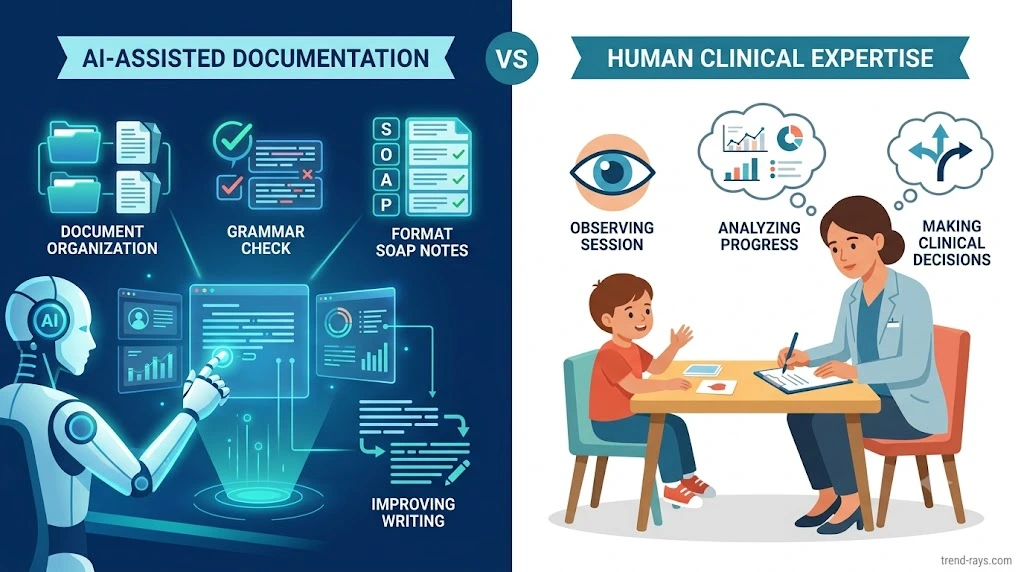
One of the biggest concerns clinicians have is whether AI-generated SOAP notes are as reliable as those written by experienced Speech-Language Pathologists.
The reality is that this isn’t a competition between AI and humans. The highest-quality documentation usually comes from AI-assisted clinicians, not AI working independently.
Think of AI as a highly efficient writing assistant rather than an autonomous documentation system.
AI Can Save Time
One of AI’s greatest advantages is speed.
Once a clinician has documented key observations, AI can quickly:
- Convert notes into SOAP format
- Improve grammar and readability
- Remove repetitive wording
- Standardize documentation style
- Organize information logically
This can significantly reduce the time spent on administrative writing, particularly for clinicians managing high caseloads.
Human Clinicians Provide Clinical Reasoning
AI cannot observe subtle patient behaviors, interpret assessment findings, or understand the clinical context behind a therapy session.
For example, AI cannot determine:
- Whether a child’s progress is clinically significant
- If reduced performance resulted from fatigue, illness, or distraction
- Whether therapy goals should be modified
- If current interventions remain appropriate
- Whether discharge criteria have been met
These decisions require professional judgment, experience, and evidence-based practice.
Comparison at a Glance
| Documentation Task | AI | Speech-Language Pathologist |
|---|---|---|
| Grammar correction | ✅ Excellent | ✅ Excellent |
| Formatting | ✅ Excellent | ✅ Excellent |
| Organizing notes | ✅ Excellent | ✅ Excellent |
| Clinical observation | ❌ Cannot perform | ✅ Essential |
| Patient assessment | ❌ Cannot perform | ✅ Essential |
| Treatment planning | ❌ Cannot perform | ✅ Essential |
| Clinical reasoning | ❌ Cannot perform | ✅ Essential |
| Ethical responsibility | ❌ No | ✅ Yes |
The takeaway is simple: AI can improve how documentation is written, but only clinicians can determine what should be documented.
Can AI Help Reduce Documentation Burnout?
Administrative work is consistently identified as one of the biggest contributors to clinician fatigue.
Speech-Language Pathologists often spend hours each week completing:
- SOAP notes
- Evaluation reports
- Progress reports
- Goal updates
- Parent communication
- Insurance documentation
- IEP documentation
- Administrative emails
For many clinicians, documentation extends well beyond working hours.
This is one reason AI has gained so much attention within healthcare.
Where AI Saves the Most Time
The greatest efficiency gains usually come from repetitive writing tasks rather than complex clinical work.
Examples include:
- Rewriting repetitive phrases
- Creating documentation templates
- Drafting parent handouts
- Improving sentence clarity
- Generating reusable report sections
- Organizing information into structured formats
Instead of replacing clinicians, AI helps reduce time spent on repetitive writing so more time can be dedicated to patient care.
Can AI-Generated SOAP Notes Be Used for Insurance Documentation?
This is one of the most frequently asked questions among clinicians.
The answer depends on several factors, including your workplace policies, payer requirements, documentation standards, and applicable regulations.
The important point is this:
Insurance companies evaluate the quality and accuracy of documentation—not whether AI assisted in writing it.
If documentation is inaccurate, incomplete, inconsistent, or unsupported by clinical findings, it may create problems regardless of whether AI was involved.
Likewise, a well-written note that accurately reflects the therapy session and is reviewed by the treating clinician remains the clinician’s professional responsibility.
Documentation Should Always Be
- Accurate
- Complete
- Individualized
- Supported by clinical evidence
- Reviewed before submission
- Consistent with payer requirements
AI should never be used to fabricate observations or generate documentation for sessions that did not occur.
Can AI Hallucinate in Clinical Documentation?
Yes.
One of the most important limitations of generative AI is its tendency to occasionally produce information that appears convincing but is inaccurate.
This phenomenon is commonly referred to as an AI hallucination.
In healthcare documentation, hallucinations can be especially problematic because they may introduce details that were never observed during the therapy session.
Example
Imagine a clinician enters the following prompt:
“Write a professional SOAP note for today’s articulation therapy session.”
If insufficient information is provided, AI may invent details such as:
- Accuracy percentages
- Types of verbal cues
- Therapy activities
- Patient behaviors
- Clinical interpretations
- Future treatment recommendations
Although the output may sound professional, these details could be entirely fictional.
Why This Matters
Clinical documentation should reflect what actually happened, not what AI predicts likely happened.
Every statement included in a SOAP note should be supported by direct observation or verified clinical information.
For this reason, clinicians should avoid vague prompts and instead provide only the factual information needed to organize documentation.
A Better Workflow: AI Assists, Clinician Verifies
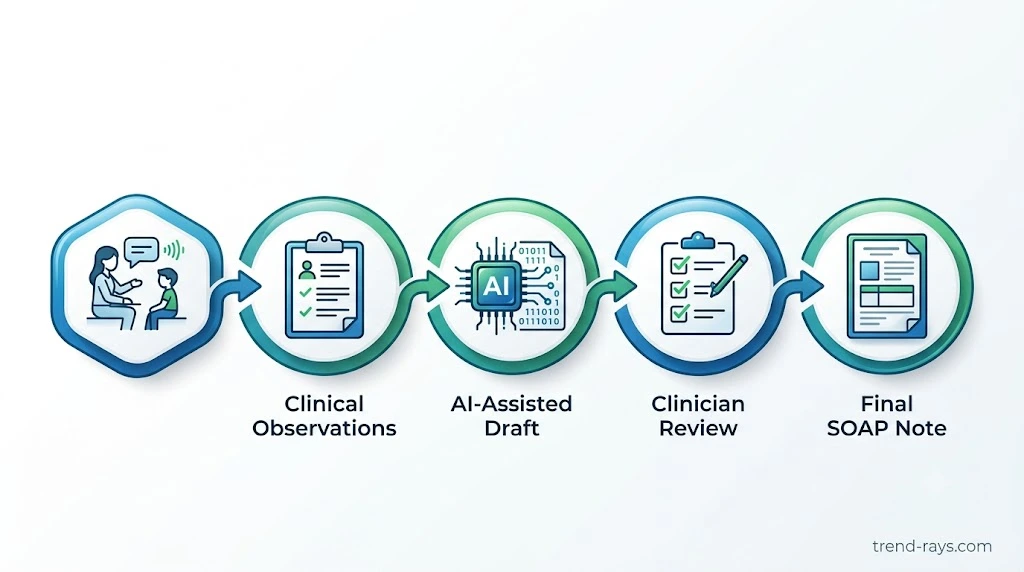
The safest approach is to let AI handle writing while the clinician remains responsible for all clinical content.
A simple workflow might look like this:
Step 1: Conduct the Therapy Session
Observe the patient, collect objective data, and make clinical decisions as you normally would.
↓
Step 2: Record Key Findings
Document measurable outcomes, caregiver comments, observations, and treatment decisions.
↓
Step 3: Use AI to Improve Structure
If appropriate and consistent with your organization’s policies, use AI to improve grammar, organization, or formatting of generic templates or de-identified content.
↓
Step 4: Review Every Line
Read the AI-generated draft carefully.
Verify that every sentence is:
- Accurate
- Complete
- Clinically appropriate
- Consistent with your observations
↓
Step 5: Finalize Documentation
Complete the final note within your approved documentation system and sign it as the treating clinician.
This workflow allows clinicians to benefit from AI without surrendering responsibility for patient care or documentation quality.
AI Documentation Tools Comparison ⭐⭐⭐⭐⭐ (Highest Priority)
This is the biggest missing piece.
Users searching “Can AI write speech therapy SOAP notes?” often end up wanting to know which tool to use.
Instead of creating a separate article immediately, include a comparison section like this:
| Tool | Best For | HIPAA-Friendly Features | Strengths | Limitations |
|---|---|---|---|---|
| ChatGPT | Templates, rewriting | Depends on deployment and organizational setup | Excellent writing quality | General-purpose AI |
| Claude | Long documents | Depends on deployment | Long context window | General-purpose AI |
| Gemini | Google Workspace users | Depends on deployment | Google ecosystem integration | General-purpose AI |
| Microsoft Copilot | Microsoft 365 users | Enterprise options available | Office integration | General-purpose AI |
| Dedicated healthcare AI platforms | Clinical documentation | Varies by vendor | Workflow-specific features | Usually subscription-based |
Red Flags That AI Should Not Be Used for a Task
Although AI is helpful in many situations, there are times when it is best left out of the documentation process.
Consider avoiding AI if the task involves:
- Highly sensitive patient information
- Complex differential diagnoses
- Legal documentation
- Disciplinary proceedings
- Incident reports
- Ethical investigations
- Expert witness documentation
- Situations requiring extensive individualized clinical interpretation
In these cases, direct clinician documentation is generally the most appropriate approach.
Best Practices for Using AI in Speech Therapy Documentation
If you’re planning to incorporate AI into your workflow, follow these practical guidelines:
- Never enter Protected Health Information into consumer AI tools.
- Remove patient identifiers before using AI for educational or template purposes.
- Treat AI-generated content as a draft—not a finished document.
- Review every sentence for accuracy.
- Use AI to improve writing quality rather than generate clinical observations.
- Stay informed about workplace AI policies and applicable privacy requirements.
- Continue developing your documentation skills rather than relying solely on automation.
- Remember that you—not the AI—are accountable for the final record.
Following these practices helps ensure that AI remains a productivity aid rather than a source of documentation risk.
Decision Tree: Should I Use AI for This SOAP Note?
Nobody is doing this.
Example:
Did today's note include PHI?

        ↓

Yes
↓

Use your approved documentation system.

--------------------

No
↓

Are you creating

• Template?
• Example?
• Parent handout?

↓

Yes

↓

AI can assist.

--------------------

Need diagnosis?

↓

No AI.

Use clinician judgment.
Key Takeaways
Artificial intelligence has the potential to significantly reduce the administrative burden associated with speech therapy documentation, but its role should be clearly understood.
AI excels at improving language, formatting, organization, and efficiency. It does not replace observation, clinical reasoning, ethical decision-making, or professional accountability.
The most effective documentation workflow combines the strengths of both:
- The clinician provides expertise, judgment, and patient-specific insights.
- AI enhances clarity, consistency, and writing efficiency.
When used responsibly, AI becomes a valuable assistant—not a substitute—for high-quality speech-language pathology documentation.
Is ChatGPT the Best AI for Writing Speech Therapy SOAP Notes?
Many Speech-Language Pathologists start their AI journey with ChatGPT because it’s widely available, easy to use, and excellent at improving writing quality.
However, once clinicians begin using AI more regularly, they often discover that ChatGPT is only one option in a rapidly growing ecosystem of AI documentation tools.
Today, there are AI platforms built specifically for healthcare documentation, clinical note generation, and rehabilitation workflows. Each serves a different purpose, and understanding their strengths and limitations can help clinicians choose the right tool for their needs.
The most important question isn’t:
“Which AI is the smartest?”
Instead, ask:
“Which AI fits my documentation workflow while maintaining patient privacy and professional standards?”
AI Prompt Library for Documentation
Instead of 10 prompts…
Include 30 documentation prompts.
Examples:
SOAP Notes
Progress Notes
Evaluation Reports
Goal Writing
Home Programs
Parent Emails
Insurance Letters
Discharge Summaries
Progress Reports
Documentation Improvement
This can rank independently.
ChatGPT vs Dedicated AI Documentation Tools
ChatGPT is a general-purpose AI assistant. It excels at generating text, brainstorming ideas, rewriting content, and creating templates.
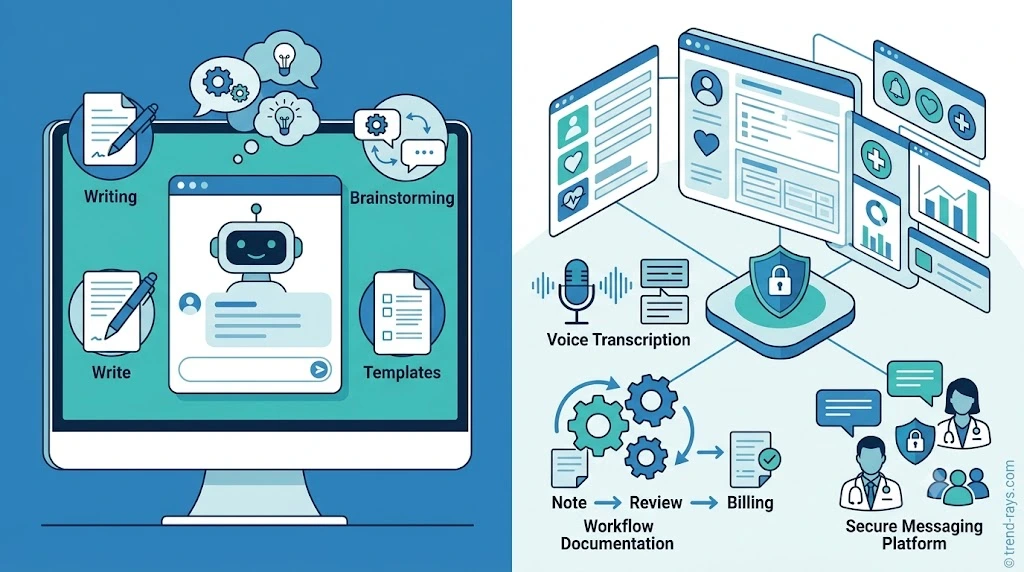
Dedicated healthcare AI platforms, on the other hand, are designed specifically for clinical workflows. Some integrate with electronic health records (EHRs), automate transcription, or provide documentation features tailored to healthcare professionals.
Here’s a comparison of how these tools differ.
| Feature | ChatGPT | Dedicated Healthcare AI Tools |
|---|---|---|
| General writing assistance | ✅ Excellent | ✅ Excellent |
| SOAP note templates | ✅ Yes | ✅ Yes |
| Therapy activity generation | ✅ Excellent | ⚠️ Limited |
| Parent handouts | ✅ Excellent | ⚠️ Limited |
| Clinical documentation workflow | ⚠️ General-purpose | ✅ Designed for healthcare |
| EHR integration | ❌ Usually unavailable | ✅ Often available |
| Voice transcription | ❌ Limited | ✅ Common feature |
| Team collaboration | ⚠️ Limited | ✅ Frequently included |
| Specialized healthcare workflows | ⚠️ General | ✅ Purpose-built |
For many clinicians, ChatGPT is an excellent starting point for administrative tasks and educational content. However, organizations with more complex documentation requirements may benefit from platforms specifically developed for healthcare environments.
When ChatGPT Is the Right Choice
ChatGPT performs exceptionally well when the goal is to improve productivity without processing patient-specific records.
Some ideal use cases include:
Creating Documentation Templates
Instead of writing SOAP note formats from scratch, clinicians can generate reusable templates that can later be completed within their approved documentation systems.
Improving Writing Style
After drafting documentation independently, clinicians can use AI to improve:
- Grammar
- Sentence flow
- Professional tone
- Readability
- Consistency
Brainstorming Therapy Activities
ChatGPT is particularly strong at generating:
- Articulation activities
- Language games
- Home practice ideas
- Parent education resources
- Therapy materials
Professional Development
Speech-Language Pathologists can also use ChatGPT to:
- Summarize research
- Create study guides
- Explain clinical concepts
- Compare intervention approaches
- Develop presentation content
These educational tasks involve little or no patient-specific information, making them well suited to AI assistance.
When Dedicated AI Documentation Software May Be Better
Organizations managing large caseloads or complex documentation workflows may prefer software specifically designed for healthcare.
Depending on the platform, dedicated documentation tools may offer features such as:
- Secure voice transcription
- Automated note generation
- EHR integration
- Team collaboration
- Workflow automation
- Appointment documentation
- Clinical documentation management
These tools are often intended to streamline documentation across entire healthcare organizations rather than simply assisting with writing.
Before adopting any platform, clinicians should evaluate:
- Privacy practices
- Security controls
- Organizational approval
- Integration with existing systems
- Documentation review process
- Compliance with applicable regulations
Technology alone does not guarantee appropriate or compliant use.
Common Mistakes Clinicians Make When Using ChatGPT for SOAP Notes
Many first-time users unknowingly make mistakes that reduce documentation quality or increase privacy risks.
Mistake 1: Asking AI to Create an Entire SOAP Note Without Providing Context
A prompt such as:
“Write a SOAP note for today’s speech therapy session.”
doesn’t give AI enough information.
As a result, it may invent observations, treatment activities, or clinical interpretations that never occurred.
Instead, provide structured, factual information and use AI only to improve organization and wording.
Mistake 2: Sharing Too Much Patient Information
Copying complete evaluation reports or therapy notes into consumer AI tools can expose confidential information.
Whenever possible:
- Remove identifying details.
- Use fictional examples.
- Generate templates instead of real documentation.
Mistake 3: Accepting AI Output Without Review
AI-generated documentation should never be copied directly into the patient’s record.
Every sentence should be checked for:
- Accuracy
- Clinical relevance
- Completeness
- Appropriate terminology
- Consistency with the actual therapy session
Mistake 4: Using Generic Prompts
The quality of AI-generated content depends heavily on the quality of the prompt.
Instead of writing:
“Write a SOAP note.”
Try:
“Using the following fictional therapy session details, organize the information into a professional SOAP note template. Improve readability without adding or inventing clinical information.”
Specific prompts consistently produce better results.
A Better Prompt Formula for SOAP Notes
One of the easiest ways to improve AI-generated documentation is to structure your prompts using a consistent framework.
A practical formula is:
Role + Task + Context + Format + Rules
For example:
Role
Experienced Speech-Language Pathologist.
Task
Organize documentation into SOAP format.
Context
Use only the fictional information provided below.
Format
Professional clinical documentation.
Rules
Do not invent observations, percentages, diagnoses, recommendations, or patient details. Improve grammar and readability only.
This type of prompt helps reduce the likelihood of AI introducing unsupported information.
Should You Trust AI With Your Documentation?
The better question is:
Should you trust yourself to review AI-generated documentation?
AI should never be viewed as an independent author of clinical records.
Instead, think of it as a drafting assistant.
The Speech-Language Pathologist remains responsible for:
- Observing the therapy session.
- Collecting objective data.
- Interpreting patient performance.
- Making clinical decisions.
- Verifying documentation accuracy.
- Signing the final record.
When these responsibilities remain with the clinician, AI can become a valuable tool for improving efficiency without compromising professional standards.
Key Takeaways
Choosing the right AI tool depends on how you plan to use it.
ChatGPT excels at writing assistance, educational content, brainstorming, and template creation. Dedicated healthcare AI platforms may offer additional workflow features for organizations with more advanced documentation needs.
Regardless of the technology you choose, the same principle applies:
AI can support documentation—but it should never replace clinical judgment, patient observation, or professional accountability.
Real AI-Assisted Speech Therapy SOAP Note Examples (Fictional)
One of the easiest ways to understand the role of AI in documentation is by looking at practical examples.
The examples below are entirely fictional and created for educational purposes. They do not represent real patients or actual clinical records.
Instead of showing how AI can replace clinicians, these examples demonstrate how AI can improve writing quality, organization, and readability while leaving clinical reasoning in the hands of the Speech-Language Pathologist.
Example 1: Pediatric Articulation Therapy
Scenario
A six-year-old child attended a 30-minute articulation therapy session targeting the /s/ sound at the word level.
The clinician recorded the following observations:
- Produced /s/ correctly in 24 out of 30 opportunities.
- Required moderate verbal cues.
- Participated throughout the session.
- Parent reported practicing at home four times this week.
- Continue targeting /s/ at the phrase level next session.
Raw Clinical Notes
Mom said they practiced speech homework four times this week.

Child participated well.

24/30 correct.

Needed moderate cues.

Move to phrase level next session.
AI-Assisted SOAP Note
Subjective
The caregiver reported that the patient completed assigned speech practice activities on four occasions during the past week and observed increased confidence during home practice.
Objective
The patient produced the target /s/ phoneme accurately in 24 out of 30 word-level opportunities while requiring moderate verbal cueing. The patient remained engaged throughout the 30-minute therapy session.
Assessment
The patient continues to demonstrate steady improvement in articulation accuracy at the word level. Performance suggests readiness to begin introducing phrase-level practice while maintaining cueing as needed to support accuracy.
Plan
Continue targeting /s/ production during phrase-level activities in the next therapy session. Encourage caregivers to continue structured home practice throughout the week.
What AI Improved
AI successfully:
- Organized information into SOAP format.
- Improved grammar and readability.
- Maintained a professional writing style.
- Eliminated repetitive wording.
The clinician still provided:
- Session observations.
- Accuracy data.
- Clinical interpretation.
- Future treatment decisions.
Example 2: Expressive Language Therapy
Scenario
An eight-year-old student participated in expressive language intervention focusing on vocabulary expansion and sentence formulation.
Raw Notes
Student named 18/20 pictures.

Needed visual prompts.

More complete sentences today.

Teacher says classroom participation improving.

Continue vocabulary goals.
AI-Assisted SOAP Note
Subjective
The classroom teacher reported noticeable improvements in the student’s participation during classroom discussions and increased confidence when responding to questions.
Objective
The student accurately named 18 of 20 vocabulary items and demonstrated improved sentence formulation during structured language tasks. Visual prompts were provided as needed to support task completion.
Assessment
The student’s expressive language skills continue to improve, particularly in vocabulary retrieval and sentence construction. Progress observed during therapy appears consistent with reports from the educational setting.
Plan
Continue targeting expressive vocabulary and sentence formulation while gradually reducing visual prompting as appropriate.
Why This Works
AI improved clarity without changing the clinician’s observations.
Every measurable outcome came directly from the therapist—not from AI.
Example 3: Adult Aphasia Therapy
Scenario
An adult receiving post-stroke rehabilitation attended a 45-minute language therapy session.
Raw Notes
Patient completed naming tasks 80%.

Self-corrected several errors.

Conversation improving.

Continue semantic cueing.
AI-Assisted SOAP Note
Subjective
The patient reported feeling more confident communicating with family members between therapy sessions.
Objective
The patient achieved approximately 80% accuracy during structured naming tasks and independently self-corrected multiple word retrieval errors. Functional conversational performance demonstrated continued improvement throughout the session.
Assessment
The patient’s increased use of self-monitoring strategies suggests continued progress toward improved expressive communication. Semantic cueing remains an effective intervention approach.
Plan
Continue incorporating semantic cueing techniques while increasing opportunities for functional conversational practice during future sessions.
Example 4: Fluency Therapy
Scenario
A teenager attended fluency intervention focused on speech rate control and easy onset techniques.
Raw Notes
Used easy onset 70%.

Speech rate slower.

Less tension.

Needs reminders during conversation.

Practice at home.
AI-Assisted SOAP Note
Subjective
The patient reported increased awareness of speech rate during conversations at school and expressed confidence using learned fluency strategies.
Objective
The patient successfully applied easy onset techniques during approximately 70% of structured speaking tasks. Speech rate was slower and physical tension appeared reduced compared with previous sessions. Occasional clinician reminders were required during conversational speech.
Assessment
Progress indicates growing independence in applying fluency techniques during structured activities. Continued practice is needed to improve carryover into spontaneous conversation.
Plan
Continue fluency intervention emphasizing conversational carryover and assign home practice focusing on speech rate awareness in everyday communication situations.
Before and After: How AI Improves Documentation
The following example illustrates the difference between quick handwritten notes and an AI-assisted draft.
Before
Good session.

80%.

Needed cues.

Mom practiced.

Continue.
After AI Editing
The caregiver reported consistent completion of assigned home practice throughout the week. During today’s session, the patient achieved approximately 80% accuracy on targeted articulation tasks while requiring occasional verbal cueing. Overall performance demonstrated continued progress toward treatment goals. Continue the current intervention plan while gradually increasing task complexity.
The clinical information has not changed.
The documentation has simply become:
- Easier to read
- More professional
- Better organized
- More consistent
Clinician Review Checklist Before Finalizing an AI-Assisted SOAP Note
Regardless of which AI tool you use, every draft should be reviewed carefully before becoming part of the patient’s record.
Use this checklist before signing your documentation.
Accuracy
☐ Every observation actually occurred during the session.
☐ All percentages match my recorded data.
☐ No information has been invented.
Clinical Judgment
☐ The assessment reflects my own professional interpretation.
☐ Treatment recommendations are my own.
☐ Clinical reasoning is accurate.
Privacy
☐ No Protected Health Information was entered into consumer AI tools.
☐ Documentation complies with workplace privacy requirements.
☐ Patient confidentiality has been maintained.
Professional Quality
☐ Grammar and spelling are correct.
☐ Medical terminology is accurate.
☐ Documentation is clear and concise.
☐ The note reflects evidence-based clinical practice.
Common AI Errors to Watch For
Even well-written AI-generated documentation should be checked for these common issues:
Invented Accuracy Scores
AI may create percentages that were never recorded.
Always verify objective measurements.
Incorrect Clinical Terminology
Occasionally AI substitutes similar—but clinically inaccurate—terms.
Review all terminology carefully.
Generic Assessments
AI often writes broad statements such as:
“The patient is making good progress.”
Ask yourself:
Does this statement accurately describe today’s session?
If not, revise it.
Unrealistic Treatment Plans
AI may recommend interventions that don’t match the patient’s goals or current level of functioning.
Future treatment plans should always be determined by the clinician.
Overly Repetitive Language
If every SOAP note sounds identical, documentation quality may suffer.
Edit repetitive phrases to ensure each note accurately reflects the individual therapy session.
The Bottom Line
These examples demonstrate an important principle:
AI is exceptionally good at improving how clinical documentation is written.
It is not capable of replacing the clinical expertise required to determine what should be written.
The most effective Speech-Language Pathologists use AI as an editing assistant—not as an autonomous documentation system.
By combining accurate clinical observations with AI-assisted writing, clinicians can produce documentation that is efficient, professional, and easier to read while maintaining full responsibility for the content.
The Future of AI in Speech Therapy Documentation
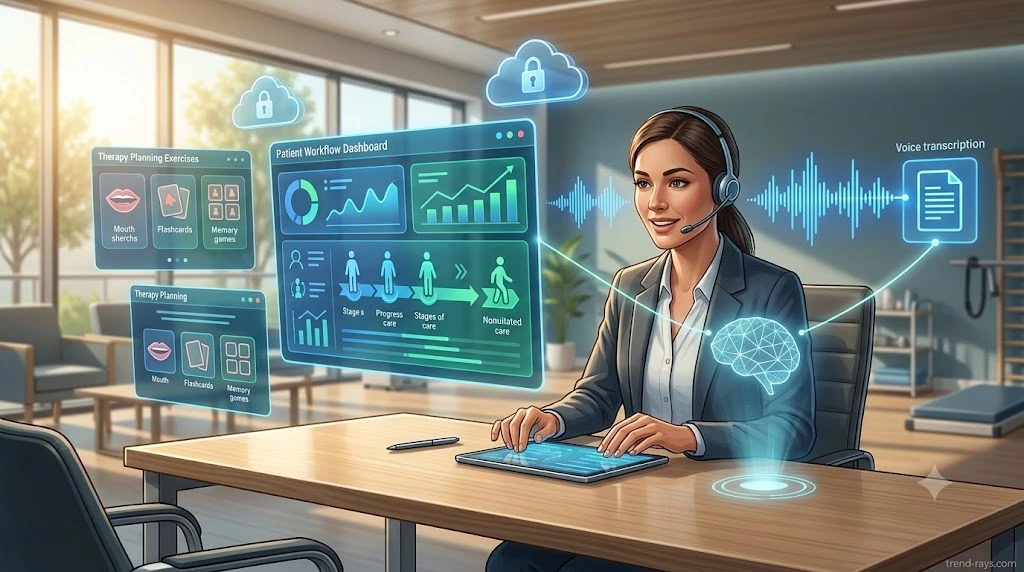
Artificial intelligence is evolving rapidly, and documentation is one of the first areas where Speech-Language Pathologists are seeing practical benefits.
Over the next few years, AI is likely to become more deeply integrated into clinical workflows, not as a replacement for clinicians, but as a productivity tool that reduces repetitive administrative work.
Future AI-assisted documentation may include:
- Voice-to-SOAP note transcription
- Automatic formatting into clinical templates
- Smart documentation suggestions
- Integration with Electronic Health Record (EHR) systems
- Real-time grammar and terminology assistance
- Automated documentation reminders
- Workflow optimization for multidisciplinary teams
These advancements have the potential to reduce documentation time significantly while allowing clinicians to spend more time delivering direct patient care.
However, regardless of how advanced AI becomes, professional oversight will remain essential. Clinical reasoning, ethical decision-making, patient relationships, and individualized treatment planning cannot be automated.
Time Savings Analysis
Very unique.
Example table:
| Documentation Task | Manual | AI Assisted |
|---|---|---|
| SOAP Note | 12 min | 5 min |
| Parent Email | 10 min | 2 min |
| Progress Report | 40 min | 20 min |
| Evaluation Template | 60 min | 20 min |
This directly addresses the “is it worth it?” question.
Myth vs Fact
People love these.
Example:
| Myth | Reality |
|---|---|
| AI writes perfect SOAP notes | AI still requires clinician review |
| AI replaces SLPs | AI supports clinicians |
| AI is always HIPAA compliant | Compliance depends on how the tool is deployed and used |
| AI never makes mistakes | AI can produce inaccurate or unsupported information |
These tables often get featured snippets.
Frequently Asked Questions
Can ChatGPT write a complete SOAP note by itself?
Technically, ChatGPT can generate a complete SOAP note if given enough information. However, clinicians should never rely on AI to independently create clinical documentation. Every note should be based on the clinician’s own observations and reviewed for accuracy before being finalized.
Is it safe to use ChatGPT for speech therapy documentation?
ChatGPT can be used safely for educational purposes, documentation templates, and writing assistance when no Protected Health Information (PHI) is shared. Patient-specific documentation should remain within approved clinical systems and follow applicable privacy and workplace policies.
Can AI replace Speech-Language Pathologists?
No. AI cannot perform assessments, observe therapy sessions, make diagnoses, interpret clinical findings, or exercise professional judgment. It is designed to support administrative and writing tasks rather than replace licensed clinicians.
Can AI reduce documentation time?
Many clinicians find that AI helps reduce time spent on repetitive writing tasks such as formatting notes, improving grammar, generating templates, and organizing information. The greatest efficiency gains occur when AI is used as a drafting assistant rather than an independent documentation tool.
What is the biggest risk of using AI for SOAP notes?
The primary risks include entering identifiable patient information into consumer AI tools, accepting AI-generated content without review, and relying on AI to make clinical decisions. These risks can be minimized by using AI responsibly, verifying every output, and maintaining clinician oversight.
Are AI-generated SOAP notes acceptable for insurance documentation?
Insurance providers evaluate the quality, accuracy, and completeness of documentation rather than whether AI assisted in writing it. Clinicians remain responsible for ensuring that every note accurately reflects the therapy session and meets applicable documentation requirements.
Should graduate SLP students learn AI?
Yes. Understanding how AI works, its strengths, limitations, and ethical considerations will become an increasingly valuable professional skill. Learning to use AI responsibly can help future clinicians improve productivity while maintaining high standards of patient care.
Which AI tool is best for Speech-Language Pathologists?
There is no single best solution for every clinician.
The right choice depends on factors such as:
- Type of practice
- Documentation workload
- Privacy requirements
- Workflow preferences
- Budget
- Integration needs
Many clinicians begin with general-purpose AI assistants for educational and administrative tasks before exploring specialized healthcare documentation platforms.
Final Thoughts
Artificial intelligence is reshaping healthcare documentation, and Speech-Language Pathologists are well positioned to benefit from these advances when AI is used responsibly.
Rather than replacing clinical expertise, AI has the potential to reduce repetitive administrative work, improve documentation quality, and support more efficient workflows.
The most successful clinicians will not be those who rely entirely on AI or avoid it completely. Instead, they will understand how to combine the efficiency of AI with the critical thinking, compassion, and professional judgment that only a licensed Speech-Language Pathologist can provide.
By using AI to enhance writing—not replace decision-making—SLPs can save valuable time while continuing to deliver high-quality, patient-centered care.
Conclusion
So, can AI write speech therapy SOAP notes?
Yes—but only as an assistant, not as the author.
AI can help organize information, improve grammar, standardize formatting, and generate reusable templates. These capabilities can reduce documentation fatigue and improve efficiency for busy Speech-Language Pathologists.
What AI cannot do is observe therapy sessions, interpret patient performance, make clinical judgments, or assume responsibility for healthcare documentation.
Every SOAP note should ultimately reflect the clinician’s own observations, expertise, and professional accountability.
As AI technology continues to evolve, the role of the Speech-Language Pathologist remains unchanged: to deliver individualized, evidence-based care while using technology thoughtfully to support—not replace—clinical practice.