The legislative death of the visual invoice is driven by a massive, continent-wide push to modernize tax collection and eliminate the VAT gap. Enterprise clients are no longer allowed to manually process your billing data; their systems must ingest it directly from machine-readable files.
The EU ViDA Directive and 2026 National Mandates
The overarching framework driving these changes is the European Commission’s VAT in the Digital Age (ViDA) directive, which establishes a baseline for Continuous Transaction Controls (CTC) across the continent. Under this framework, Member States are aggressively rolling out national e-invoicing mandates based on the European core standard EN 16931.
- Belgium’s 2026 Rollout: As of January 1, 2026, structured electronic invoicing became mandatory for almost all B2B transactions in Belgium. While foreign non-established entities are technically exempt from issuing them, Belgian clients increasingly demand compliant formats to streamline their own accounts payable.
- France’s Imminent Deadlines: By September 2026, France requires all businesses to be able to receive structured e-invoices, and mandates large and mid-sized companies to begin issuing them.
- The Compliance Reality: These mandates dictate that the structured data file itself—not a visual PDF representation—is the only legally valid invoice.
Understanding Peppol BIS Billing 3.0 and UBL XML
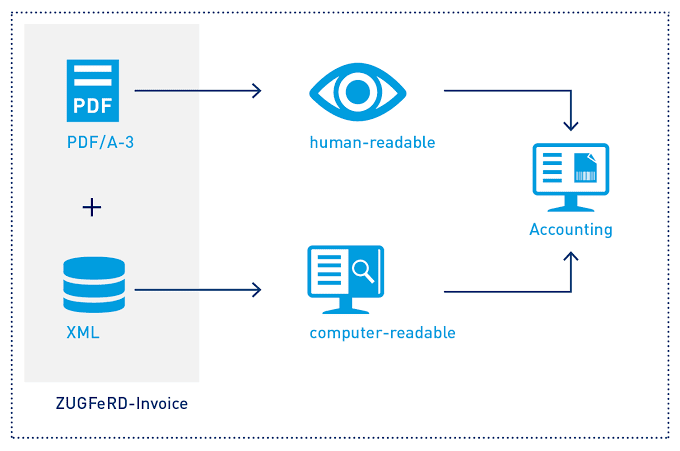
To comply with the EN 16931 standard, freelancers must abandon unstructured formats. A PDF, even one generated by a modern cloud accounting app or read by OCR software, is legally insufficient because it lacks standardized machine-to-machine readability.
- The Peppol Network: Instead of direct emails, invoices are increasingly routed through the Peppol network, a secure, standardized delivery infrastructure.
- UBL XML Structure: The standard format for this network is Peppol BIS Billing 3.0, which relies on Universal Business Language (UBL) XML. UBL is a highly detailed, structured XML format that includes precise tags for line items, taxes, delivery information, and payment details.
- Technical Validation: Because UBL XML is so strict, accurate field mapping and valid codes are essential; if a single tag is misconfigured, the network’s automated validation will instantly reject the invoice before it ever reaches your client.
Connecting to the Peppol Network: The 4-Corner Model
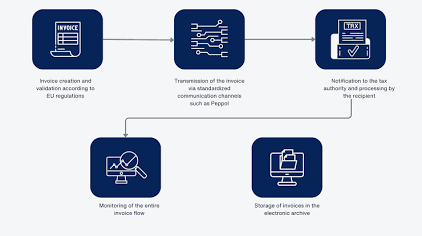
Freelancers cannot simply email an XML file; the Peppol network requires an encrypted, standardized delivery infrastructure known as the 4-Corner Model. This architecture ensures seamless interoperability between different Electronic Data Interchange (EDI) environments without requiring bilateral agreements with each client.
What is a Certified Peppol Access Point?
Every Peppol document flows through four distinct nodes, removing the need for a single, centralized exchange platform.
- Corner 1 (C1 – Originator): The business issuing the invoice. For a DevOps consultant or freelancer, this is your local billing SaaS, custom ERP plugin, or API integration.
- Corner 2 (C2 – Outbound Gateway): Your certified Peppol Access Point. This provider receives your raw data, validates it against Peppol BIS specifications, wraps it in an OASIS-standardized Standard Business Document Header (SBDH) envelope, signs it, and transmits it securely.
- Corner 3 (C3 – Inbound Gateway): The receiver’s Access Point. This gateway verifies the cryptographic signature, validates payload conformance, and routes the document to the final client.
- Corner 4 (C4 – End Recipient): The enterprise client consuming the invoice via their automated accounts payable system.
To bridge the gap between C2 and C3, the network utilizes a dynamic discovery process. When your Access Point (C2) initiates a transfer, it queries the Service Metadata Locator (SML)—a central DNS-based root managed by the European Commission—using the client’s unique Peppol Participant ID. The SML resolves this ID to a specific Service Metadata Publisher (SMP). The SMP acts as a decentralized registry, verifying if the client’s Access Point can accept a Peppol BIS Billing 3.0 document and providing the exact Applicability Statement 4 (AS4) endpoint URL for secure transmission.
Handling E-Invoice Rejections and Status Responses
Because Peppol replaces human visual checks with machine-to-machine validation, handling transmission states is a critical architectural requirement. Transport between C2 and C3 is governed by the AS4 web service protocol (based on ebMS 3.0 over SOAP), which enforces message-level encryption, non-repudiation, and reliable messaging.
If a structured invoice fails a schema validation check—such as a missing mandatory tax code or an invalid GLN format—it will be rejected in transit. When this happens, the C3 gateway issues a Message Delivery Notification (MDN) or a specialized Message Level Response (MLR) back to your C2 Access Point. For freelancers, this means your chosen billing software must be capable of translating these complex MLR failure codes into a readable dashboard alert, ensuring you aren’t left guessing why an enterprise payment hasn’t cleared.
Schrems II and GDPR: The Threat of US-Hosted Financial Data
Format compliance is only half the battle; where the actual databases holding your clients’ PII (Personally Identifiable Information) reside is equally critical. Invoicing data contains highly sensitive corporate information, banking details, and project descriptions. For enterprise procurement teams in 2026, relying on standard US-based accounting software is a massive red flag.
The Data Localization Mandate for B2B Billing
Following the Schrems II ruling, which invalidated the EU-US Privacy Shield, transatlantic data transfers have been on legally thin ice. While the European Commission approved a replacement—the EU-U.S. Data Privacy Framework (DPF) in 2023—this framework is currently experiencing severe structural instability in 2026.
Although the EU General Court dismissed an initial challenge (Latombe v. Commission) in September 2025, confirming the DPF’s validity at that specific time, the legal foundation is crumbling. The core vulnerability is that the DPF relies heavily on the independence of US enforcement bodies, primarily the Federal Trade Commission (FTC). A recent landmark 2026 US Supreme Court ruling (Trump v. Slaughter) expanded presidential authority to remove FTC commissioners, fundamentally undermining the agency’s status as an independent regulator under EU law.
Consequently, privacy advocates like Max Schrems and the NOYB organization are actively preparing a “Schrems III” legal challenge aiming to strike down the DPF entirely. For a freelancer, relying on an invoicing SaaS that hosts its databases in Virginia means that if the DPF is invalidated tomorrow, you instantly violate GDPR regulations regarding your European enterprise clients’ data. To bypass this legal volatility, European enterprises are aggressively enforcing Data Localization, demanding that suppliers utilize a “Sovereign Stack” where financial data never leaves European borders.
The Self-Hosted Sovereign Stack (Docker & VPS)
For DevSecOps engineers and technical consultants handling highly sensitive client environments, the safest route to compliance is bypassing proprietary SaaS black boxes altogether. You can achieve absolute data sovereignty by deploying a self-hosted invoicing stack.
- EU-Based Infrastructure: By spinning up a Virtual Private Server (VPS) with a European provider like Hetzner (Germany) or Scaleway (France), you guarantee that the physical disks storing your client data are subject solely to EU jurisdiction.
- Containerized Open-Source Billing: Utilizing Docker, you can deploy robust open-source invoicing platforms (like Invoice Ninja or Crater). This ensures you have full root access to your MariaDB or PostgreSQL databases, eliminating third-party vendor risk.
- Bridging to Peppol: Because self-hosted tools typically do not act as C2 Access Points natively, you must bridge the gap via APIs. The architecture involves your localized Docker instance generating the invoice data, which is then pushed via API to a localized European API-only Peppol gateway (like Storecove), ensuring the data is converted to UBL XML and transmitted securely without ever touching a US server.
Evaluating High-CPC Peppol and GDPR-Ready Invoicing Stacks
When evaluating the market for high-CPC commercial intent, the goal is not to target low-tier software that charges €5 a month. You want to rank for the enterprise-grade tools that offer lucrative partner, reseller, or B2B affiliate payouts. These providers have massive customer acquisition budgets because once a contractor integrates their Peppol Access Point, they almost never churn.
Here is the technical breakdown of the solutions your readers need, structured to seamlessly integrate your affiliate links while satisfying their strict compliance requirements.
EU-Native SaaS Solutions with Built-in Access Points
For the majority of B2B consultants who want compliance solved out-of-the-box without maintaining their own servers, cloud-native European platforms are the primary target.
- Payhawk & Invopop Integration [Affiliate Target]
- Technical Angle: Position Payhawk not just as an expense card, but as a full accounts payable/receivable automation suite. Detail their partnership with Invopop, which natively handles format conversions (XRechnung, ZUGFeRD, Peppol BIS 3.0, Facturae XML).
- Why it Converts: It solves the EN 16931 compliance problem while automatically routing multi-currency payments. When a freelancer signs up for a premium corporate card and invoicing suite, the affiliate bounty is substantially higher than standard SaaS.
- Tradeshift [Affiliate Target]
- Technical Angle: Tradeshift is an enterprise heavy-hitter and a certified Peppol Access Point since 2014. For freelancers dealing with massive multinational clients, Tradeshift offers cross-zone compliance across 70 countries, including strict post-audit and clearance requirements.
- Why it Converts: Highlight their dual-solution model (Tradeshift for global operations, Babelway for localized DIY setups in markets like Belgium). If a consultant refers their enterprise client to the platform, the partner commissions are enterprise-scale.
- Smart PEPPOL [Affiliate Target]
- Technical Angle: For the Belgian market specifically, highlight tools like Smart PEPPOL. Focus on the API integrations: how it automatically derives mandatory EN 16931 metadata (BIS profile, document type) directly from the KBO/CBE registry in 4 seconds.
- Why it Converts: It boasts a zero-friction setup with 10-year legal archiving explicitly hosted in the EU (ISO 27001) with no US sub-processors, completely neutralizing the Schrems II risk.
Open-Source and Self-Hosted Alternatives
For DevSecOps engineers and technical consultants who refuse to hand over client data to a third-party SaaS, you must offer a self-hosted architecture. This is where you monetize via API connectivity and infrastructure hosting.
- The Containerized Billing Engine (Invoice Ninja)
- Technical Angle: Explain the architecture of deploying Invoice Ninja via Docker on a localized European VPS (like Hetzner). Because the user owns the MariaDB instance, client data never crosses borders.
- Why it Converts: You can seamlessly weave in affiliate links for the EU-based VPS providers (Hetzner, Scaleway, or DigitalOcean’s Frankfurt region) where the reader needs to host their Docker containers.
- Bridging to Peppol via API (Storecove / eConnect) [Affiliate Target]
- Technical Angle: An open-source tool cannot natively send a Peppol invoice without a certified C2 Access Point. Introduce API-first gateways like Storecove. Explain how to configure a webhook in the self-hosted software that pushes a JSON payload to Storecove’s REST API, which then handles the UBL XML conversion and network transmission.
- Why it Converts: Storecove offers a robust partner/reseller program for developers. By teaching the freelancer how to build this API bridge, you drive high-intent signups to the Access Point provider.