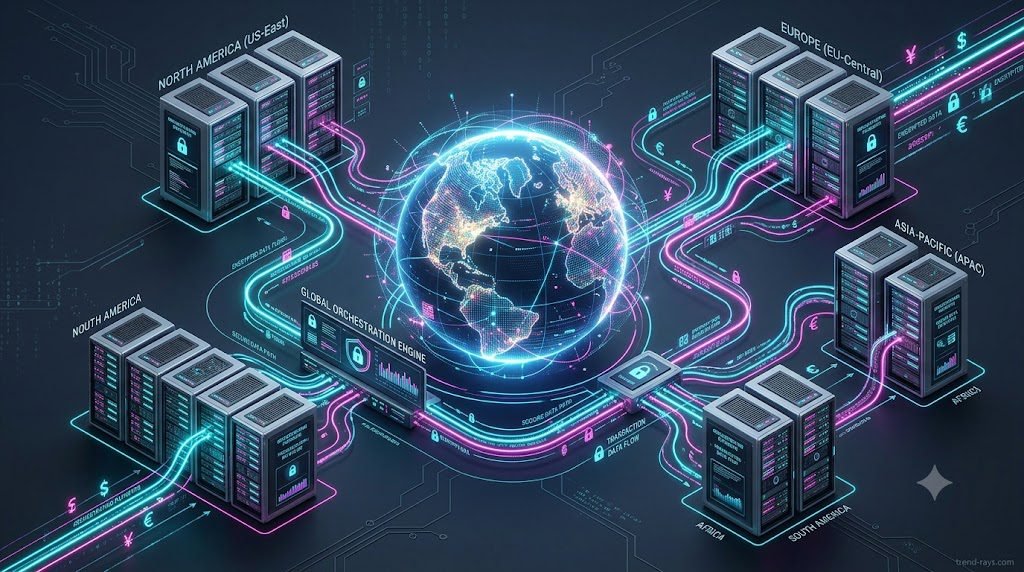
The core difference lies in legal liability. A Merchant of Record (MoR) legally buys your software and resells it to the end-user, assuming 100% of global tax compliance (VAT/GST), chargeback liability, and fraud risk. Payment Orchestration is purely an infrastructure layer; it dynamically routes transactions across multiple underlying gateways (like Stripe or Adyen) to optimize fees and prevent outages, but leaves all legal and tax liability strictly with your SaaS company.
When a local startup begins acquiring international users, celebrating global traction often masks a looming operational crisis. Selling a digital software subscription across borders is not just a payment routing issue; it is a complex legal and regulatory event.
If your US-based SaaS platform sells a $50/month subscription to a customer in Berlin, you instantly trigger European Union VAT laws. If you sell to a user in Texas, you trigger state-level economic sales tax nexus. Ignorance of these laws does not protect you from the audits, penalties, and back-taxes that can bankrupt a scaling company.
To survive global expansion, SaaS architects must choose between two distinct FinTech infrastructures: offloading the liability entirely to a Merchant of Record (MoR), or building a highly optimized, multi-gateway Payment Orchestration API layer.
The Cross-Border Tax Nightmare for Bootstrapped SaaS
The traditional approach to accepting payments—plugging in a single gateway like Stripe or Braintree—leaves the SaaS founder as the legal seller. This means your internal finance and engineering teams are responsible for:
- Tax Rate Calculation: Dynamically calculating exact VAT, GST, or state sales tax based on the customer’s real-time IP address and billing zip code.
- Global Remittance: Filing tax returns and remitting collected taxes to dozens of foreign governments.
- Chargeback Management: Fighting international fraud and absorbing the financial hit of disputed transactions.
For a lean, bootstrapped engineering team, building custom tax calculation logic and API bridges to regional tax authorities is a massive distraction from core product development.
The Merchant of Record (MoR) Architecture
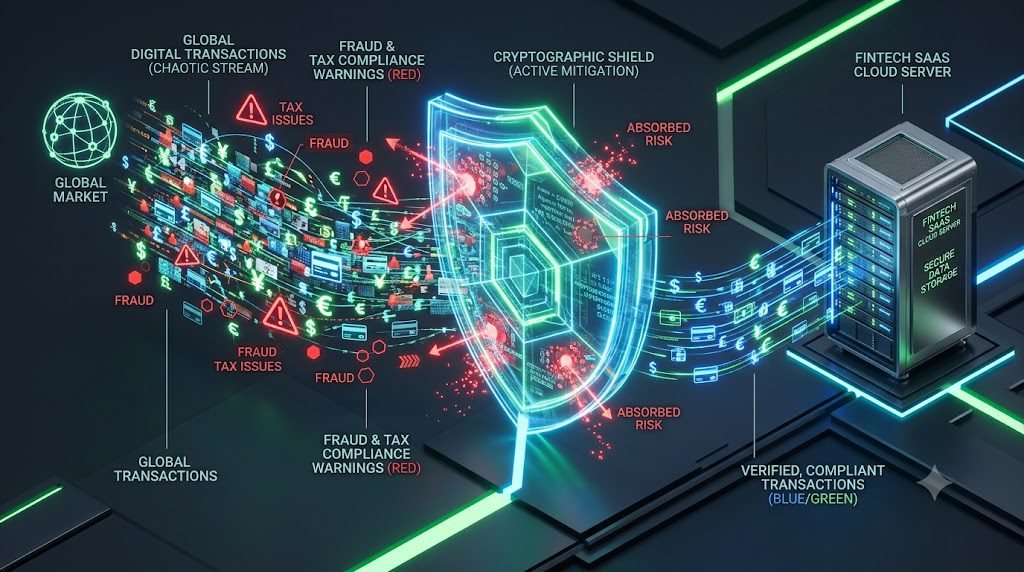
For startups prioritizing speed and legal safety over transaction margins, the Merchant of Record (MoR) is the definitive architectural choice. Leading MoR platforms include Paddle, FastSpring, and Lemon Squeezy.
How the MoR Infrastructure Works
An MoR is a specialized B2B architecture where the platform legally buys your software in real-time and instantly resells it to the end-user.
Because the MoR is technically the entity making the sale, they assume 100% of the tax compliance, fraud liability, and chargeback risk. Your SaaS company simply receives a clean, post-tax payout.
Before migrating to a custom multi-gateway API layer, enterprise security teams must audit the underlying vector storage architecture. Ensure your infrastructure meets compliance by reviewing the Enterprise LegalTech Security Models framework.
- The Advantage: Instant global compliance. You can sell to 150+ countries without registering a single foreign tax entity or hiring international accountants.
- The Disadvantage: High processing fees. MoRs typically charge between 5% and 6% per transaction (plus a fixed fee), which becomes painfully expensive as you scale past $5M in Annual Recurring Revenue (ARR).
Payment Orchestration: The Funded Startup Route

Once a SaaS platform secures venture funding and scales its transaction volume, the 5% MoR fee becomes a multi-million-dollar revenue drain. At this stage, CTOs transition away from MoRs and build a Payment Orchestration Layer.
Payment Orchestration Platforms (POPs)—such as Primer or Spreedly—sit above your gateways. They provide a single unified API that dynamically routes transactions to different underlying processors based on real-time logic.
| Feature Comparison | Merchant of Record (MoR) | Payment Orchestration (POP) |
| Legal Seller of Record | The MoR Platform (e.g., Paddle) | Your SaaS Company |
| EU VAT / Tax Remittance | Fully Automated & Filed by MoR | Requires separate API (e.g., Avalara) |
| Transaction Routing | Static (Tied to the MoR’s acquiring bank) | Dynamic (Routes to cheapest/fastest gateway) |
| Cost Structure | High Flat Fee (~5% + $0.50) | Low Gateway Interchange + API SaaS Fee |
| Ideal Company Stage | Bootstrapped / Scaling ($0 to $5M ARR) | Venture-Backed / Enterprise ($10M+ ARR) |
Why Enterprise FinTech Demands Orchestration
- Dynamic Transaction Routing: If a customer in Japan tries to buy your software, the Orchestration API detects their location and routes the payment to a local Japanese acquiring bank, rather than a US bank. This dramatically lowers cross-border interchange fees and boosts authorization rates.
- API Failover: If your primary gateway experiences a regional cloud outage, the Orchestration API instantly reroutes the transaction to a secondary backup gateway without the user ever noticing, saving thousands of dollars in lost checkouts.
- Modular Compliance Integration: Because you are no longer using an MoR, you must integrate a dedicated, enterprise-grade tax compliance API (like Avalara or Anrok) directly into the orchestration flow to handle global VAT calculation.
Calculating the Total Cost of Payments (TCP)
When deciding when to transition from an MoR to an Orchestration API, FinTech architects must model the Total Cost of Payments (TCP) at scale. The financial tipping point is reached when the high volume of transactions makes the operational overhead of orchestration cheaper than the MoR’s flat percentage.
$$ \text{TCP}{\text{MoR}} = \left( V{\text{global}} \times F_{\text{MoR_Rate}} \right) $$
$$ \text{TCP}{\text{Orchestration}} = \left( V{\text{global}} \times F_{\text{Interchange}} \right) + C_{\text{POP_API}} + C_{\text{Tax_Software}} + L_{\text{Compliance_Ops}} $$
Where $V_{\text{global}}$ is the total international transaction volume, $F$ represents processing fees, $C$ represents monthly SaaS licensing costs, and $L$ represents the internal labor cost of managing compliance operations. When $\text{TCP}_{\text{Orchestration}} < \text{TCP}_{\text{MoR}}$, the startup must migrate its architecture.
Interactive Tool: SaaS Expansion Assessor
If you are a startup founder or CTO deciding between an MoR and building an Orchestration Layer, use this assessment tool to analyze your current revenue profile and calculate your optimal infrastructure path.
SaaS Global Expansion Assessor
Evaluate your optimal infrastructure: MoR vs. Payment Orchestration.
FAQ
Does using Stripe make them my Merchant of Record?
No. Stripe is a Payment Service Provider (PSP) and a payment gateway, not a Merchant of Record. When you use standard Stripe, your company remains the legal seller and retains 100% of the liability for filing international taxes and managing chargebacks.
Can I use Payment Orchestration and an MoR at the same time?
Generally, no. Most Merchant of Record platforms are closed ecosystems that do not allow external orchestration routing, because the MoR must tightly control the transaction to assume the legal and tax liability. You must choose one architecture or the other.
At what ARR should a SaaS company stop using an MoR?
Most enterprise FinTech architects recommend transitioning away from an MoR when a SaaS company reaches $10M in ARR. At this volume, the 5% MoR processing fees vastly exceed the internal cost of hiring a tax compliance team and deploying a Payment Orchestration API.
What is a SaaS Sales Tax Nexus?
A Sales Tax Nexus is the legal threshold where your SaaS business has established enough of a physical or economic presence in a specific state or country that you are legally required to register, collect, and remit local sales tax on digital subscriptions sold to users in that region.
How does a Merchant of Record handle EU VAT?
An MoR legally purchases the software subscription from you and instantly resells it to the European customer. Therefore, the MoR assumes 100% of the EU Value-Added Tax (VAT) liability. They calculate the tax, charge the customer, and file the returns with the European tax authorities on your behalf.
What is the difference between a Payment Gateway and a Payment Orchestration Platform (POP)?
A payment gateway (like Braintree) is a single connection to an acquiring bank to process a transaction. A Payment Orchestration Platform is an API layer that sits above multiple gateways, allowing a company to intelligently route transactions to different global processors to maximize approval rates and bypass outages.
When should a SaaS company switch from an MoR to Payment Orchestration?
A SaaS company should transition when the Total Cost of Payments (TCP) favors orchestration. Typically, when a company scales past $10M in ARR, the 5% to 6% MoR fee exceeds the internal cost of deploying dedicated tax compliance software, engineering a multi-gateway POP, and managing regional compliance operations internally.