
The Operational Strain on Legacy School Infrastructure
Educational institutions today face an invisible financial drain: fragmented, legacy Student Information Systems (SIS) and archaic enterprise resource planning (ERP) tools. Administrative teams spend hundreds of billable hours manually stitching together school timetables, tracking down delayed tuition fees, and reacting to sudden drops in student enrollment after the damage has already been done.
In a hyper-competitive educational landscape, operational efficiency directly dictates institutional survival and profit margins. Modernization requires moving past basic database logging and adopting predictive, automated backend SaaS infrastructure.
The Selection Criteria
When evaluating the best AI software for school administrative automation, institutional buyers must prioritize platforms that feature three core machine learning engines: predictive enrollment analytics to systematically mitigate student churn, algorithmic constraint-satisfaction scheduling for automated timetable generation, and unified cloud-native financial pipelines to eliminate administrative billing leaks.
Predictive Enrollment Analytics & Student Churn Mitigation
Traditional student retention models are purely reactive. Schools discover a student is leaving only when a parent requests a transfer certificate (TC). AI-driven administrative software transforms this pipeline by introducing predictive machine learning models that identify student churn risks months before the academic year ends.
These enterprise engines continually analyze passive, non-academic behavioral and financial indicators across the school’s digital ecosystem:
- Engagement Decay Tracking: The algorithm monitors subtle drops in parent-teacher portal app logins, unread newsletter communications, and skipped optional school events.
- Financial Friction Anomalies: Machine learning models cross-reference historical payment data. Sudden transitions from automated billing to delayed, manual payment processing are heavily weighted as leading indicators of financial stress or institutional dissatisfaction.
- Sentiment Analysis: Natural language processing (NLP) models evaluate communication touchpoints—such as the tone of parental emails or support tickets raised in the school ERP—to flag escalating frustration levels before they reach board-level disputes.
By consolidating these telemetry points, the software assigns a real-time “Retention Risk Score” to every student profile. This provides admissions directors with a proactive data-driven window to intervene, patch enrollment pipelines, and optimize baseline classroom capacity.
Algorithmic Timetable Generation & Resource Optimization
Manual scheduling is one of the most resource-heavy bottlenecks in educational operations. Administrative staff are forced to juggle an immense matrix of variables, including teacher shift preferences, strict classroom physical capacities, overlapping student subject electives, and limited hardware lab facilities.
Modern institutional SaaS platforms solve this multi-variable equation by applying Constraint Satisfaction Algorithms (CSAs).
   [Variable Input Matrix] ───► [Constraint Satisfaction Algorithm] ───► [Conflict-Free Master Timetable]
   • Faculty Availability       • No Overlapping Teacher Shifts        • Optimized Space Utilization
   • Room Physical Capacities   • Lab Hardware Requirements            • Minimized Open Hours Slots
   • Student Subject Electives  • Maximum Consecutive Classes          • Drastically Reduced Labor
Instead of weeks of manual spreadsheet trial-and-error, the system processes thousands of institutional constraints simultaneously to generate conflict-free master schedules in seconds.
The financial return is immediate. Optimal asset allocation ensures that campus real estate is utilized efficiently, reducing energy overhead on underutilized wings. Furthermore, eliminating scheduling conflicts decreases teacher burnout caused by fragmented, poorly spaced teaching blocks, lowering recruitment and onboarding expenses.
Automated Financial Pipelines & Eliminating Revenue Leakage
Manual invoicing, physical check tracking, and fragmented point-of-sale systems inevitably result in revenue leakage and restricted institutional cash flow. Cloud-native administrative ERPs close these gaps by deploying end-to-end automated smart billing routes.
- Dynamic Fee Tiering: The system automatically recalculates localized invoices based on customized student configurations, including transport distances, extracurricular add-ons, or sibling discounts.
- Triggered Gateway Remediation: Instead of administrative staff sending manual payment reminders, the software utilizes automated hooks to send targeted email and SMS payment gateways directly to parents based on real-time balance sheets.
- Gateway Protection Controls: Because school financial portals process high-stakes transactions, they are primary targets for automated malicious scripts. To safeguard these payment gateways and shield the school from devastating automated bot nets and SMS Toll Fraud, IT infrastructure teams must enforce strict rate-limiting, request token binding, and frictionless CAPTCHAs at the portal registration layers.
The Multi-Stakeholder Advantage: Modernization Across All Levels

Adopting an AI-driven school administration ERP is not just a backend IT upgrade; it completely reshapes the daily operational experience for everyone within the institutional ecosystem.
For Students: Frictionless, Personalized Ecosystems
- Algorithmic Pathing: Students operate within a balanced environment where timetable conflicts are eliminated, ensuring access to chosen elective streams without academic compromises.
- Rapid Feedback Loops: Automated grading and assessment routing mean students receive immediate insights into their performance, allowing for real-time adjustments before high-stakes exams.
For Parents: Seamless, Transparent Communication
- Unified Digital Hubs: Instead of managing fragmented WhatsApp groups, emails, and paper circulars, parents have a single source of truth for live bus tracking, real-time fee balances, and granular academic progress reports.
- Friction-Free Payments: Instant, secure mobile payment gateways with auto-reminders eliminate the stress of manual fee tracking and late penalties.
For Teachers: Eliminating Administrative Burnout
- Automating the Mundane: By automating routine tasks like roll-call attendance logging, report card compiling, and basic lesson structure generation, teachers reclaim up to 15 hours per week.
- Data-Driven Pedagogy: Teachers receive automated cohort analytics that instantly flag which concepts a classroom is struggling with, allowing them to focus on human mentorship rather than manual data entry.
For Principals: Total Operational Visibility
- Real-Time Dashboards: Principals move away from siloed weekly paper updates. Centralized dashboards display real-time insights into teacher attendance, classroom asset utilization, and daily incident reports.
- Instant Logistical Adjustments: If a teacher is absent, the system’s predictive scheduling engine can instantly suggest optimal substitute allocations based on matching subject expertise and free periods.
For School Founders & Owners: Long-Term Capital Preservation
- Predictive Financial Forecasts: Founders receive macro-level data models detailing projected fee collections, enrollment pipelines, and structural maintenance needs years in advance.
- Resource Maximization: Automated tracking ensures that every piece of physical infrastructure—from school buses to lab equipment—is utilized at full capacity, maximizing the return on capital expenditures (CapEx).
Driving Top-Line Revenue with a Lean Workforce
The traditional school growth model assumes that to double enrollment, you must double your administrative headcount. Modern SaaS architecture breaks this linear scaling limitation, allowing schools to grow revenue exponentially while maintaining a lean, highly optimized workforce.
       [ Legacy Model ]                     [ Modern SaaS Model ]
 Higher Enrollment = More Staff       Higher Enrollment = Lean Staff
  (High Payroll Overhead / OpEx)       (Automated Scaling / High Margin)

- Human Capital Optimization: By automating repetitive data-entry loops, automated billing cycles, and system-wide notifications, a lean core team can comfortably manage an institution that has doubled in student capacity. This vastly reduces recurring operational expenditures (OpEx) on payroll.
- Eliminating Fee Collection Leakage: Automated software ensures that no fee component is missed, miscalculated, or unbilled. Smart billing triggers enforce collection timelines systematically, dramatically reducing the school’s Bad Debt margin and accelerating cash flow velocity.
- Unlocking Premium Monetization Channels: School management tools provide the structural foundation to track, scale, and charge for premium extracurricular electives, hyper-personalized remote evening tracks, or advanced digital bootcamps without adding physical administrative friction.
Elevating Educational Excellence: Providing the Best Education
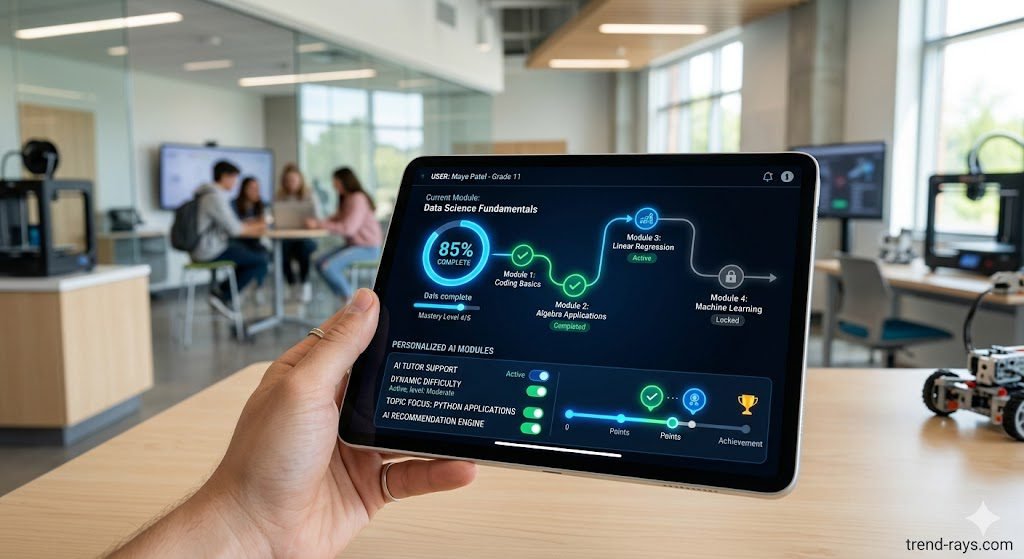
True educational modernization happens when technology enables deep, personalized learning that a standard, uniform classroom setting cannot provide.
- Transitioning to Adaptive Learning Tracks: When administrative software connects directly to student-facing learning management systems (LMS), data algorithms customize the pacing of assignments. Students who master concepts quickly are automatically served advanced acceleration modules, while struggling students receive targeted remediation loops.
- Institutional Data-Driven Curricula: The software monitors aggregate performance trends across specific grades and sections. If the data shows a systemic drop in a cohort’s comprehension of a particular physics or math module, the academic board can pinpoint the exact pedagogical bottleneck and update teaching strategies mid-semester, rather than waiting for annual board exam results.
Transforming Brand Reputation and Institutional Equity
In the modern education market, a school’s technology stack is a primary driver of public perception, authority, and brand equity.
- The “Tech-Forward” Parent Magnet: High-income, forward-thinking parents heavily prioritize digitally mature campuses. A school that operates on premium, frictionless mobile apps, automated security check-ins, and future-proof AI-literacy infrastructure establishes an immediate competitive edge over legacy institutions.
- Organic Word-of-Mouth Scaling: When a school provides an entirely friction-free experience—where parents never have to argue over billing errors, buses are always tracked accurately, and student retention is managed with care—the organic referral loop scales naturally. High institutional trust minimizes student churn, solidifies the school’s local reputation, and ensures the campus constantly operates at full tuition capacity.
Architectural Evaluation Matrix for Institutional Buyers
When vetting top-tier AI school management software, enterprise buyers should move past surface-level marketing features and audit the foundational cloud architecture:
| Software Evaluation Pillar | Critical Technical Requirement | Institutional Business Impact |
| Data Interoperability | Native, bi-directional API integrations with existing legacy frameworks. | Eliminates manual data entry; establishes a single secure source of truth across the entire campus network. |
| Scalability & Deployment | Cloud-native microservices architecture backed by robust content delivery networks (CDNs). | Guarantees zero latency and system uptime during high-traffic, peak enrollment cycles. |
| Access Security | Cryptographic Role-Based Access Control (RBAC) paired with enterprise Single Sign-On (SSO). | Restricts high-value financial, enrollment, and personal student data strictly to authorized administrative clearance levels. |
The Compliance Imperative: Securing Administrative Ecosystems
Deploying advanced administrative automation requires a foundational commitment to data security. Before integrating any third-party predictive analytics engine or cloud-based ERP platform into your campus network, your IT department must establish a rigorous student data privacy framework for AI tools. Ensuring your vendors utilize audited zero-retention APIs and maintain local data sovereignty boundaries is paramount to preventing catastrophic compliance leaks, protecting sensitive student data, and avoiding regulatory penalties.
FAQ
How does predictive analytics improve K-12 school enrollment?
Predictive analytics engines evaluate historical behavioral patterns, portal engagement frequencies, and billing touchpoints to flag students with a high statistical probability of churning, allowing admissions teams to systematically optimize retention strategies before losing tuition revenue.
Can AI school management software automate complex academic timetables?
Yes. By leveraging constraint satisfaction algorithms, modern school SaaS can process hundreds of institutional variables—including room capacities, teacher shifts, elective cross-matching, and lab hardware dependencies—to generate conflict-free timetables instantly.
What is the average ROI of migrating to an automated school administration ERP?
Institutions migrating to centralized cloud-based administrative SaaS typically see a 20% to 35% reduction in operational overhead due to minimized administrative hours, eliminated paper invoicing leaks, and optimized campus asset deployment.