The Unseen Privacy Risk in Modern Classrooms
The rapid adoption of Generative AI has created a severe “Shadow IT” crisis within educational institutions. While teachers use large language models (LLMs) to grade papers and students use them for tutoring, highly sensitive behavioral notes, academic records, and personally identifiable information (PII) are being fed into unvetted, public AI networks.
The Short Answer: A modern student data privacy framework for AI must enforce three non-negotiable pillars: absolute data isolation (ensuring student inputs are never used to train commercial models), strict alignment with statutory laws (like DPDP, GDPR, or FERPA), and cryptographic access controls integrated into the school’s existing IT infrastructure.
Without this framework, schools risk catastrophic data leaks, legal penalties, and the permanent exposure of minor-aged student profiles.
Why Consumer AI Tools Violate School Data Compliance
Consumer-grade AI applications are fundamentally incompatible with educational data compliance. Allowing staff or students to use standard, free-tier AI accounts introduces two massive technical vulnerabilities:
- Data Leakage via Model Training: By default, free LLMs ingest user prompts to train and refine future iterations of their base models. If an educator pastes a student’s essay or a specialized education plan (IEP) into a consumer chatbot, that data permanently enters the public domain. It can potentially be regurgitated in future outputs to unauthorized users globally.
- Lack of Institutional Oversight: Enterprise-grade EdTech Software-as-a-Service (SaaS) agreements legally mandate zero-retention policies and provide administrators with immutable audit logs. Consumer tools operate in a black box, offering IT departments zero visibility into what data is leaving the school’s network.
The Legal Anchors: Aligning with Privacy Regulations
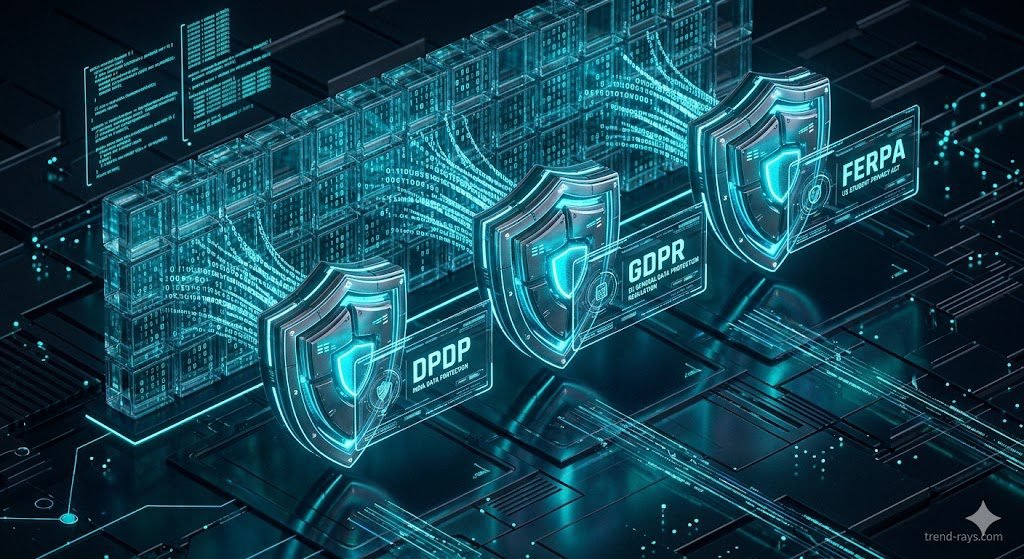
Search engines and regulatory bodies require schools to anchor their technology stacks to strict privacy laws. A robust framework must satisfy the specific mandates of the institution’s operating jurisdiction.
| Jurisdiction | Key Legislation | Core Requirement for School AI Implementations |
| India | Digital Personal Data Protection (DPDP) Act | Requires verifiable, documented parental consent for minors; mandates zero processing that causes potential harm or tracking of children. |
| Global / EU | General Data Protection Regulation (GDPR) | Enforces the “Right to Erasure” and places strict cryptographic limits on automated student profiling and algorithmic decision-making. |
| United States | FERPA & COPPA | Prohibits the unauthorized disclosure of PII and requires vendors to prove they do not build commercial profiles of children under 13. |
Step-by-Step Blueprint: Building Your Institutional AI Architecture
To successfully deploy AI without compromising security, school IT administrators and board members must transition from reactive blocking to proactive, heavily engineered data governance.
Phase 1: API Vetting & Endpoint Auditing
Before authorizing any third-party EdTech vendor, the IT department must execute a rigorous vendor assessment.
- Audited Zero-Retention: Demand contractual proof that the vendor operates via an enterprise API that inherently bypasses model training. Session data must be purged from the vendor’s servers immediately upon cache clearance.
- Differential Privacy Implementation: Ascertain if the vendor utilizes differential privacy algorithms (injecting cryptographic “noise” into datasets) to ensure that if a database is breached, the algorithmic weights cannot be reverse-engineered to identify a specific student.
Phase 2: Role-Based Access Control (RBAC) & SSO Integration
AI tools cannot be universally accessible across the campus network. Access must be systematically siloed.
- Identity and Access Management (IAM): Integrate approved AI tools exclusively through the school’s Single Sign-On (SSO) provider (such as Google Workspace for Education or Microsoft Entra ID).
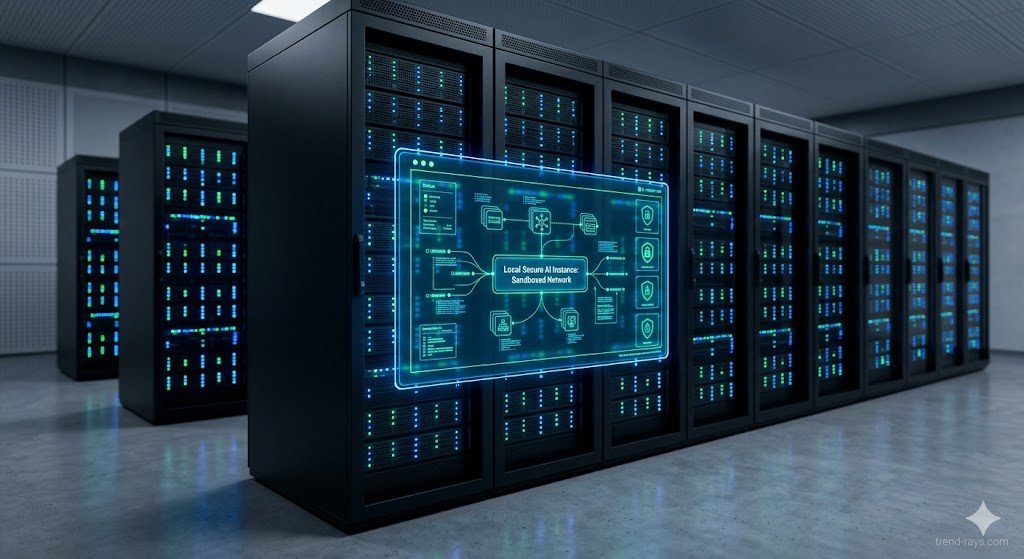
- Granular Provisioning: Predictive enrollment software and administrative AI must be restricted strictly to management VLANs. Student-facing AI tutors must operate within a “sandboxed” environment where inputs are anonymized before leaving the local network.
Phase 3: The Transition to Local Data Sovereignty
For maximum security, progressive K-12 institutions are moving away from third-party cloud APIs entirely.
- Self-Hosted LLMs: Schools are deploying open-weight models (such as customized Llama 3 or Mistral instances) hosted locally on private, on-premise school servers. Because the model operates entirely within the school’s physical intranet, there is zero risk of third-party compliance breaches or unauthorized external data extraction.
Template: School AI Acceptable Use Policy (AUP)
Creating a technical barrier is only half the solution; human behavioral guidelines must be explicitly defined. Below is a foundational policy template that school boards can immediately integrate into faculty handbooks.
Institutional K-12 AI Usage Directive
1. Data Minimization & Input Restrictions: Staff and faculty are strictly prohibited from entering Personally Identifiable Information (PII)—including but not limited to student names, roll numbers, medical history, or granular grading rubrics—into any unauthorized Generative AI platform. All data must be fully de-identified prior to prompt execution.
2. Human-in-the-Loop (HITL) Mandate: AI is an assistive engine, not an autonomous proxy. All AI-generated lesson plans, parent communications, and grading assessments must undergo manual verification by a certified educator for algorithmic bias, factual hallucinations, and pedagogical accuracy before deployment.
3. Authorized Ecosystems: Staff may only utilize AI tools that have passed the IT Department’s Vendor Risk Assessment and have an active, signed Data Privacy Agreement (DPA) verifying compliance with [Insert Regional Law, e.g., DPDP/FERPA].
The Financial Case: ROI, Cost Reduction, and Revenue Optimization
1. Operational Efficiency: Turning Administrative Overhead into Direct Savings
Implementing centralized educational SaaS infrastructure directly slashes a school’s operating budget by automating thousands of resource-heavy manual tasks.
- Administrative Labor Reduction: Traditional school operations dedicate hundreds of billable hours to manual timetable creation, sections matching, bus route optimization, and inventory tracking. Algorithmic SaaS ERP platforms can generate optimized schedules and zero-waste transport routes in minutes, allowing schools to reallocate administrative staff to high-impact retention roles.
- Infrastructure Consolidation: Shifting from fragmented legacy on-premise servers to unified cloud infrastructure eliminates expensive annual local maintenance fees, dedicated hardware cooling costs, and specialized local IT payroll.
- Paperless Financial Ecosystems: Digital automated billing, fee collection, and digital report cards reduce annual printing, postage, and manual auditing costs by up to 85%.
2. The 360-Degree Experience: Improving Teacher, Student, and Parent Retention
Software adoption directly mitigates the cost of stakeholder churn. Attracting a new student is significantly more expensive than retaining an existing one.
                  Unified SaaS Campus Experience
                               │
       ┌───────────────────────┼───────────────────────┐
       ▼                       ▼                       ▼
    Teachers                Parents                 Students
  (AI Grading)         (Real-time Portal)      (Adaptive Paths)
       │                       │                       │
       └───────────────────────┼───────────────────────┘
                               ▼
                   Higher Institutional Trust
- For Teachers (Preventing Burnout): AI-powered grading assistance, automated attendance trackers, and lesson-planning copilots save educators an average of 10 to 15 hours per week. By eliminating administrative fatigue, schools reduce teacher turnover—saving massive recruitment and onboarding budgets.
- For Parents (Frictionless Transparency): Modern parents expect instant, real-time access. A single, clean mobile dashboard showing fee payment reminders, live bus tracking, homework updates, and performance analytics builds high institutional trust and removes friction from fee collection.
- For Students (Hyper-Personalized Pacing): Adaptive learning software provides immediate feedback loops. Students are neither bored by slow pacing nor left behind by fast instruction, which dramatically improves academic outcomes and keeps enrollment retention rates close to 100%.
3. The Revenue Angle: Modernization as a Competitive Monetization Engine
Modern software infrastructure isn’t just a cost-cutter; it acts as a direct driver of new top-line revenue.
- Predictive Enrollment Funnels: B2B school management software utilizes predictive analytics to track open house leads, optimize target marketing spend, and spot early warning signs of student churn before the academic year ends. This keeps classrooms optimized at full capacity.
- Premium Tech-Driven Electives: By integrating cutting-edge AI, prompt engineering, and advanced coding SaaS platforms directly into the curriculum, schools can offer these specialized tracks as premium, optional monetization channels. Parents are historically willing to pay a premium for verifiable, future-proof digital literacy skills.
- Scalable Virtual Classrooms: Utilizing high-end learning management systems (LMS) allows brick-and-mortar schools to expand their geographical reach without expanding their physical campus footprint. Schools can launch hybrid or fully remote evening certificate programs, unlocking a completely new, borderless revenue stream.
B2B Value Comparison Matrix
| Expense Type | Legacy Operational Model | Modern Tech/SaaS Model | Bottom-Line Impact |
| Fee Collection | Manual cash/cheques, high leakage, late collection cycles | Automated payment gateways, instant auto-reminders | Predictable, accelerated operational cash flow |
| Staff Workload | High administrative burnout, manual spreadsheet scheduling | AI-assisted planning, automated workflows | Reduced recruitment costs, higher staff retention |
| Data Security | Scattered paper records, insecure local hard drives | Centralized, role-based cloud encryption | Elimination of regulatory fines and legal liabilities |
The Financial Impact: Protecting the School Ecosystem
Securing an AI privacy framework is not just about regulatory compliance—it is about protecting the institution’s budget and infrastructure.
Poorly configured, unvetted AI tools and public-facing school portals frequently feature exposed APIs (such as unprotected login or OTP gateways). If a school fails to implement rate limiting, frictionless behavioral CAPTCHAs, and token binding, malicious actors will abuse these endpoints. This inevitably leads to sophisticated bot attacks, SMS toll fraud, and severe network latency.
A finalized AI privacy framework ensures that innovation in the classroom does not compromise the security, legality, or financial stability of the school district.
FAQs
Q1: Can schools legally use free AI tools like ChatGPT for student grading and lesson planning?
Answer: No, utilizing free, consumer-grade AI tools for grading or processing student assignments generally violates student privacy laws like the DPDP Act, GDPR, or FERPA. Free-tier AI platforms ingest prompt data to train public models, meaning any student-specific information uploaded permanently enters the public domain. Schools must strictly use enterprise-grade AI tools that feature signed Data Processing Agreements (DPAs) and explicitly guarantee zero data retention.
Q2: What should be included in a school’s AI Acceptable Use Policy (AUP)?
Answer: A comprehensive school AI Acceptable Use Policy must include four critical components:
- Data Minimization Mandates: Explicit rules prohibiting staff from entering personally identifiable information (PII) into AI prompts.
- Human-in-the-Loop Oversight: A requirement that all AI-generated teaching materials and student evaluations be audited by a human educator before deployment.
- Bias and Hallucination Verification: Frameworks for detecting factual inaccuracies in automated outputs.
- Vendor Compliance Checks: A protocol ensuring that any tool used in the classroom has been vetted and approved by the institution’s ICT department.
Q3: What security features should a school board look for in an EdTech SaaS platform?
Answer: When evaluating an EdTech SaaS platform, school boards should prioritize four non-negotiable security features:
- Single Sign-On (SSO) Integration: Ensures access can be instantly revoked and monitored via central enterprise identity managers like Google Workspace or Microsoft Entra ID.
- Data Encryption at Rest and in Transit: Protects student data from intercept or server breach vectors using modern cryptographic standards (AES-256 and TLS 1.3).
- Role-Based Access Control (RBAC): Restricts high-stakes administrative financial data strictly to management, ensuring students and general faculty operate in sandboxed user environments.
- Audited Zero-Retention Infrastructure: Contractual clauses ensuring user logs are wiped instantly upon session completion.
Q4: How much money can a school realistically save by migrating to a cloud-based SaaS management system?
Answer: Transitioning to a unified cloud-based school ERP or SaaS system can reduce a school’s operational overhead by 20% to 35% annually. These savings are achieved by automating resource-heavy administrative workflows like timetable generation and bus routing, eliminating paper-based fee processing expenses, and removing the need for costly on-premise local server maintenance and dedicated IT hardware infrastructure.