
For years, the standard IT advice for surviving a cyberattack was simple: “Don’t pay the ransom; just restore from your backups.” In 2026, that advice is not just outdated—it is financially fatal.
Modern Ransomware-as-a-Service (RaaS) cartels do not simply break in and encrypt your files on day one. They act as Advanced Persistent Threats (APTs), dwelling silently inside your corporate network for weeks or months. During this dwell time, their primary objective is to locate, corrupt, or silently delete your shadow copies and backup servers. By the time the red ransom note appears on your employees’ screens, your traditional backups are already gone.
Surviving a modern breach requires a shift from simple IT troubleshooting to high-level crisis management. In this playbook, we break down the chronological steps for enterprise ransomware recovery, from deploying “Cleanroom” architecture to navigating the legal minefield of cyber insurance and extortion.

The 2026 Reality: “Double Extortion” and Compromised Backups
Before initiating a recovery protocol, security leaders must understand the exact nature of the threat. The paradigm has shifted from operational disruption to massive data weaponization.
Today’s threat actors practice double extortion ransomware mitigation. Before they deploy the encryption payload that locks your servers, they silently exfiltrate terabytes of your highly sensitive corporate data—client financial records, proprietary source code, and employee PII. The ransom demand is no longer just for the decryption key to unlock your systems; it is a blackmail demand to prevent them from leaking your confidential data to the dark web or directly to your competitors.
Because attackers actively hunt cloud backups, legacy storage is insufficient. Enterprises must implement an air-gapped data architecture—a physical and logical separation where the ultimate backup repository is entirely disconnected from the primary corporate network, making it invisible and inaccessible to the ransomware payload.
Phase 1: Triage, Containment, & The “Kill Switch”
If an active infection is detected, the immediate goal is to stop lateral movement. Do not attempt to investigate the malware yourself. Execute these steps immediately:
- Disconnect, Do Not Reboot: The most common mistake IT admins make is rebooting the infected servers. Rebooting destroys volatile RAM data containing critical forensic evidence and the decryption keys the attackers may have temporarily stored in memory. Unplug the physical ethernet cables and disable Wi-Fi adapters to sever the network connection.
- Sever Cloud Ties: Instantly revoke all global access tokens for your cloud environments (AWS, Azure, Microsoft 365) via your identity provider (like Okta). You must assume the attacker has compromised an administrator’s session token.
- Engage EDR Isolation: Utilize your Endpoint Detection and Response platform to issue a global “Network Isolate” command. If your organization has already upgraded its security stack (as detailed in our guide on EDR vs. Traditional Antivirus: Defending Against AI Malware), the EDR can autonomously sever infected nodes while keeping the management console open for security analysts.
Phase 2: The Cyber Insurance Legal Trigger
Recovering from ransomware is a legal and financial operation, not just a technical one. If your company holds a cyber liability policy, you must freeze IT remediation immediately after containment.
Before you attempt to restore a single file, you must formally activate your cyber insurance incident response retainer. If your internal IT team begins tampering with encrypted servers, wiping drives, or attempting to negotiate with the attackers without the insurance provider’s authorized forensic team present, the insurer can legally void your multi-million dollar policy due to “spoliation of evidence.” Your CFO and legal counsel must guide the IT department’s actions from this moment forward.
Phase 3: Immutable Storage & Cleanroom Recovery
Once the legal parameters are established and the forensic team gives the green light, the actual data restoration begins. This is where modern SaaS procurement proves its ROI.
The foundation of modern recovery is immutable backup storage SaaS (provided by vendors like Rubrik, Cohesity, or Veeam). Immutability means that once data is written to the backup server, it mathematically cannot be altered, encrypted, or deleted by anyone—not even a compromised Super Admin account—for a predetermined retention period.
However, you cannot simply restore this clean data onto the infected hardware. The RaaS cartel likely left hidden backdoors or rootkits deep within your infrastructure. Restoring immediately will just trigger a secondary encryption event.
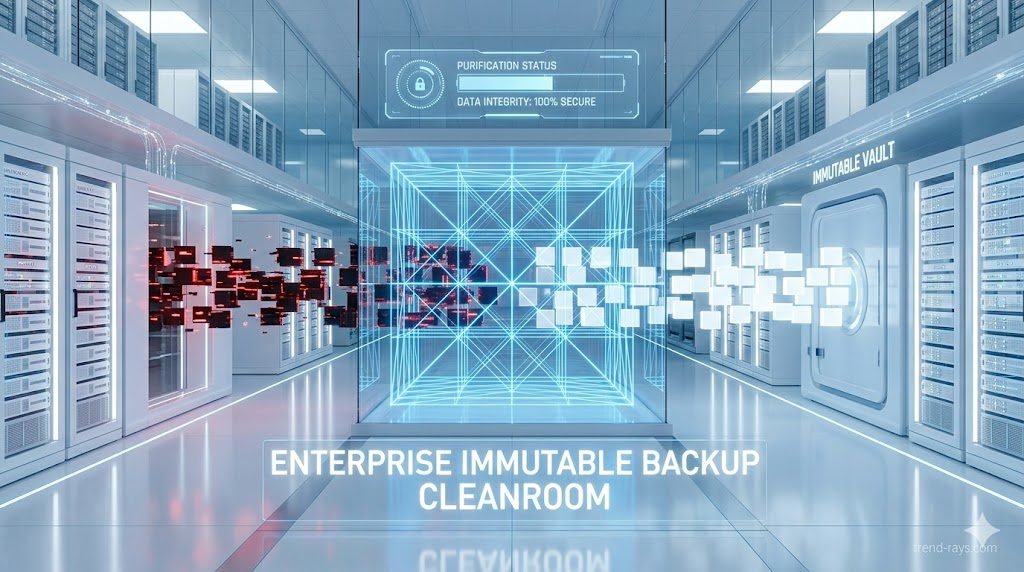
Instead, enterprises must utilize cleanroom ransomware recovery.
- The Process: The immutable backup provider spins up an isolated, secure cloud environment (the “Cleanroom”). Your backups are restored into this sterile environment and aggressively scanned by next-generation threat hunters to ensure no dormant malware was backed up alongside your files. Only after the data is purified in the Cleanroom is it pushed back to your newly wiped, bare-metal corporate servers.
- The Metric: This process drastically improves your Recovery Time Objective (RTO) vs. Recovery Point Objective (RPO). RTO is how fast you get back online; RPO is how much data you lose. Cleanroom automation turns what used to be weeks of manual server rebuilding into hours of automated cloud recovery.
The Dilemma: Should You Hire Ransomware Negotiators?
What happens if the worst-case scenario occurs? Your backups were not immutable, the data is gone, and the cartel is threatening to leak your clients’ social security numbers in 24 hours.
In this scenario, enterprises turn to professional ransomware negotiation firms. These are highly specialized incident response units—often staffed by former FBI agents or military cyber intelligence officers.
- Their Role: They establish secure communications with the threat actors on the dark web. They do not just blindly pay the ransom. They demand “Proof of Life” (verifying the attackers actually have the data and a working decryption key). They analyze the specific cartel’s reputation to ensure they actually honor their agreements, and they utilize psychological negotiation tactics to frequently reduce the crypto payout demand by 40% to 60%.
Essential Recovery Technologies & Metrics (Deep Dive)
To successfully navigate a breach and satisfy cyber insurance auditors, your IT and executive teams must have absolute clarity on the specific technologies and metrics governing the recovery process.
Deploying an Air-Gapped Data Architecture
Standard cloud backups are vulnerable because they are continuously connected to your primary network. If a threat actor gains administrative privileges, they will traverse the network and delete the backups. An air-gapped data architecture solves this by physically and logically disconnecting the backup repository from the production environment. Data is synced on a strict schedule, and the connection is immediately severed, ensuring the ransomware payload literally cannot reach the backup servers.
Investing in Immutable Backup Storage SaaS
Air-gapping is the physical defense; immutability is the software defense. Immutable backup storage SaaS is a cloud-based storage solution where the data is mathematically locked via a “Write-Once-Read-Many” (WORM) protocol. Even if a cartel hacker steals the ultimate “Super Admin” credentials for your backup software, the system will reject any command to delete, encrypt, or alter the backup files until the pre-determined time lock expires.
Double Extortion Ransomware Mitigation
Traditional ransomware only encrypted your files. Today’s cartels steal your sensitive data first and threaten to publish it online—meaning even if you have perfect backups, you are still being held hostage. Double extortion ransomware mitigation requires robust Data Loss Prevention (DLP) tools and strict database encryption at rest. If the attackers manage to exfiltrate your SQL databases, the data they steal remains encrypted and useless to them, neutralizing their blackmail leverage.
Recovery Time Objective (RTO) vs. Recovery Point Objective (RPO)
When negotiating your incident response Service Level Agreements (SLAs), the CFO and CISO must align on two critical metrics:
- Recovery Point Objective (RPO): How much data can the company afford to lose? If your RPO is 4 hours, your systems must back up every 4 hours.
- Recovery Time Objective (RTO): How long can the company survive being offline? If your RTO is 24 hours, your IT team must be able to spin up the Cleanroom and restore operations within that window. High-end recovery SaaS drastically lowers your RTO from weeks to hours.
The Role of Ransomware Negotiation Firms
When immutable backups fail and a ransom must be considered, executives should never communicate directly with the cartel. Specialized ransomware negotiation firms employ former cyber intelligence officers to act as intermediaries. They utilize blockchain forensics to verify if the cartel is sanctioned by the OFAC (which would make paying them a federal crime), demand “proof of life” for the decryption keys, and actively stall the attackers to buy the IT team more time to attempt a manual recovery.
Post-Breach: Rebuilding a Zero-Trust Architecture
Once the fire is out and operations are restored, the autopsy begins. A ransomware attack is the ultimate symptom of a broader architectural failure. To ensure you are never a victim again, you must eliminate the specific vulnerabilities that allowed the initial breach.
- Audit Software Supply Chains: Ransomware often begins with an employee inadvertently downloading obfuscated payloads. To close this gap, IT must aggressively monitor shadow IT. Read our technical breakdown on How to Detect Repackaged “Flat-Pack” Malware on Corporate Endpoints to isolate these initial threats.
- Harden Human Verification: The attacker likely gained initial access by socially engineering a low-level employee or helpdesk worker. As threat actors increasingly use synthetic media to bypass MFA and human verification, deploying deepfake guardrails is mandatory. Learn how to secure your communications in our guide on the Best Enterprise AI Voice Cloning SaaS for Corporate Training.
Frequently Asked Questions (Enterprise Ransomware Recovery)
What is the difference between air-gapped data architecture and immutable backup storage?
An air-gapped data architecture is a physical or logical defense; it disconnects your backup servers from the main network so ransomware cannot reach them. Immutable backup storage SaaS, on the other hand, is a software defense. It uses a “Write-Once-Read-Many” (WORM) protocol to ensure that even if hackers compromise the storage environment, the backup files cannot be encrypted, altered, or deleted.
How does cleanroom ransomware recovery work?
You should never restore backups directly onto infected hardware. Cleanroom ransomware recovery spins up a highly secure, isolated cloud environment. Your IT team restores the backups into this sterile “cleanroom” to aggressively scan them for dormant malware and rootkits before pushing the clean data back to your production servers.
What is a standard Recovery Time Objective (RTO) vs. Recovery Point Objective (RPO) for enterprises?
An enterprise Recovery Point Objective (RPO)—the amount of acceptable data loss—should ideally be under 4 hours, requiring continuous backup syncing. A strong Recovery Time Objective (RTO)—the acceptable system downtime—should be under 24 hours. Achieving these metrics requires automated recovery SaaS rather than legacy tape backups.
Will my cyber insurance incident response retainer cover ransom payouts?
It depends entirely on your specific policy and the sanctions listed by the government. You must activate your cyber insurance incident response retainer immediately after a breach. Your insurer will then deploy their approved forensic teams and professional ransomware negotiation firms to handle communications. Attempting to negotiate or pay the attackers yourself can void your policy and potentially violate federal laws.
How do you handle double extortion ransomware mitigation?
Double extortion ransomware mitigation requires preventing the initial data theft, not just stopping the encryption. This means deploying strict Data Loss Prevention (DLP) tools, utilizing database encryption at rest, and implementing Endpoint Detection and Response (EDR) to catch the threat actors while they are attempting to exfiltrate your files.
Conclusion & Next Steps
Enterprise ransomware recovery is no longer an IT function; it is a critical business continuity strategy. The days of relying on an on-premise backup server are over. By investing in immutable cloud storage, cleanroom recovery environments, and maintaining an active cyber insurance IR retainer, CISOs can transform a potentially company-ending ransomware event into a manageable, albeit stressful, operational hiccup.
Your recovery architecture is now mapped out. The next step is ensuring your broader infrastructure is fortified.