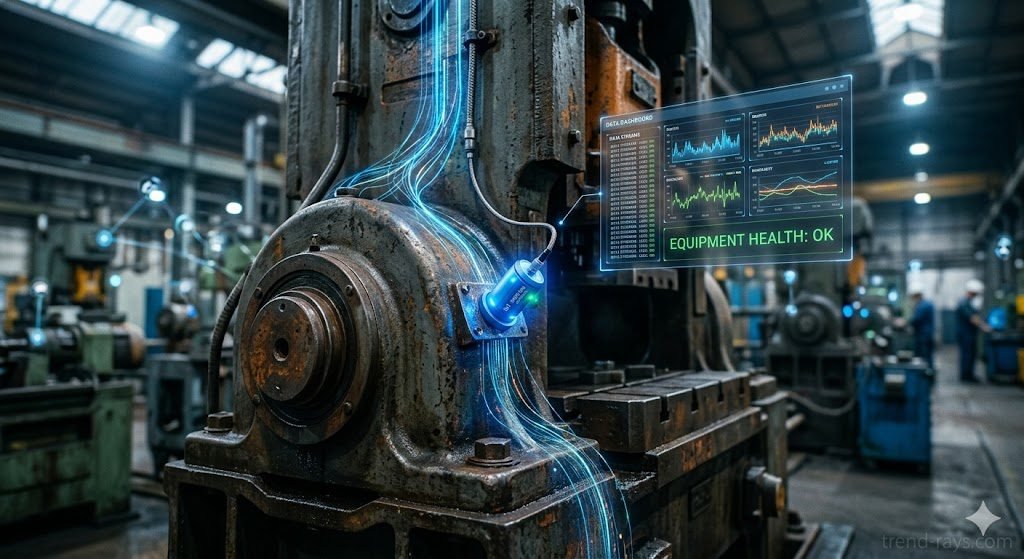
European manufacturers are currently caught in a multi-million-euro dilemma. The pressure to digitize operations and achieve “Industry 4.0” efficiency is higher than ever. However, replacing heavy, reliable legacy machinery—like a perfectly functioning 30-year-old stamping press or industrial lathe—is entirely cost-prohibitive.
Factory owners do not want to spend millions replacing iron that still works just because it lacks a Wi-Fi connection. The solution isn’t to buy new machines; the solution is to give your old machines new eyes and ears. Through non-invasive IoT retrofitting, manufacturers can bridge the gap between 20th-century heavy metal and 21st-century AI analytics, unlocking powerful predictive maintenance without taking their lines offline.
Can you put IoT sensors on old machines?
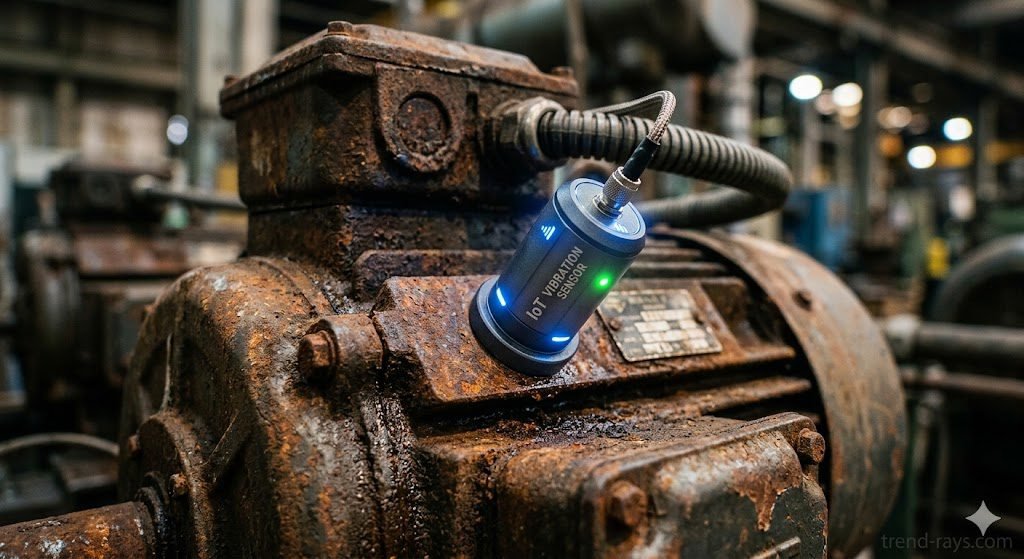
Yes, you can put IoT sensors on old machines using a process called non-invasive retrofitting. Instead of trying to write new software for outdated, closed-loop legacy Programmable Logic Controllers (PLCs), modern IoT sensors are physically attached to the outside of the machine. They monitor external physical outputs—like vibration, surface temperature, and acoustics—and transmit that data wirelessly to an Edge AI gateway, completely bypassing the machine’s internal, outdated computer systems.
This means you do not have to rewrite legacy code, risk corrupting old systems, or void the warranties on your existing equipment.
The Core Content Gap: Preventative vs. Predictive Maintenance
To understand the ROI of IoT retrofitting, we must clearly separate the “old way” from the “new way.”
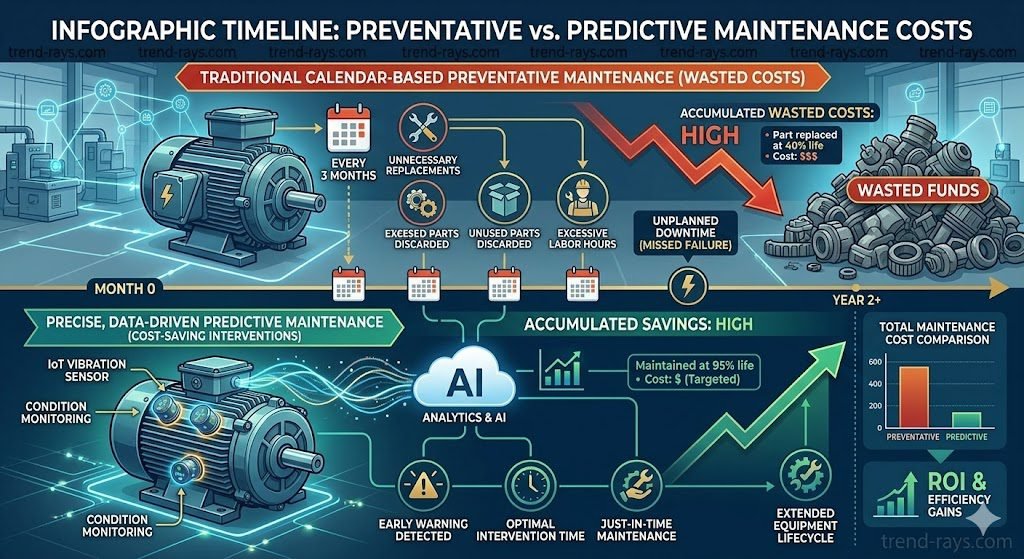
- Preventative Maintenance (The Old Way): This is calendar-based maintenance. A technician changes a motor belt every six months because the manual dictates it. This results in wasting money replacing perfectly good parts, or worse, suffering a catastrophic breakdown at month five because the manual couldn’t account for a sudden spike in production volume.
- Predictive Maintenance (The IoT Way): This is condition-based maintenance. An IoT sensor continuously monitors the micro-vibrations of the motor. The machine’s data tells you exactly when the belt begins to fray, allowing your team to replace it hours before it snaps, utilizing the full lifespan of the part while guaranteeing zero unplanned downtime.
What sensors are used for predictive maintenance?
Retrofitting a legacy machine doesn’t require a massive suite of complex tools. B2B buyers typically focus on four core types of clamp-on sensors:
- Vibration Sensors (Accelerometers): The gold standard for rotating equipment like motors, pumps, and gearboxes. These sensors detect imbalances, misalignment, or bearing wear months before a human operator would notice a physical shaking.
- Acoustic Emission Sensors: These “listen” to the machine. They detect the high-frequency friction of metal-on-metal grinding or the ultrasonic hiss of pressurized gas and air leaks that human ears cannot hear.
- Thermal / Infrared Sensors: Clamp-on thermal monitors are attached to electrical cabinets and high-friction joints. They detect overheating circuits before they cause a factory fire or sudden short-circuit.
- Current Clamps (Power Monitoring): These clamp around the power cables feeding a machine. A sudden spike in electrical draw usually means the motor is working significantly harder to overcome unseen mechanical resistance.
How much does predictive maintenance save manufacturers?
The financial savings from predictive maintenance (PdM) are driven primarily by eliminating Unplanned Downtime. In industries like automotive manufacturing or packaging, a halted assembly line can cost thousands of euros per minute.
Furthermore, IoT retrofitting drastically improves Overall Equipment Effectiveness (OEE). Extending the functional lifespan of a €2 million machine by an extra decade—simply by spending a few thousand euros on sensors—yields a massive, immediate Return on Investment (ROI). Maintenance labor costs also drop, as technicians are deployed only when a specific machine requires intervention, rather than performing unnecessary routine checks.
4 Steps to Retrofit Legacy Equipment with IoT (Without Causing Downtime)
Deploying this technology is faster than most plant managers realize.
- Identify the “Bottleneck” Asset: Do not attempt to retrofit the entire factory floor at once. Start with the single machine that, if broken, stops the entire production line.
- Deploy Non-Invasive Sensors: Utilize magnetic, epoxy-mounted, or strap-on sensors. These take less than 15 minutes to physically install and require zero drilling or welding on the legacy equipment.
- Connect via Edge Gateways: These sensors must transmit their data securely. Utilizing GDPR compliant edge AI computing solutions ensures that your factory floor’s operational data is processed locally and securely, converting raw machine vibrations into anonymous, actionable alerts without exposing your proprietary processes to the public cloud.
- Map to a Local SCADA Dashboard: The raw data is translated into a simple interface. Maintenance crews do not need to read complex vibration wave charts; they simply monitor a dashboard that uses a Green (Healthy), Yellow (Warning), and Red (Critical) traffic light system.
Furthermore, many modern industrial dashboards now integrate seamlessly with enterprise AI chatbots and SaaS platforms, allowing the system to instantly ping a technician’s mobile device the second a vibration threshold is breached.
Overcoming “Dirty Data” and Factory Connectivity Challenges
A major concern for legacy factories is connectivity. Heavy metal machinery, thick concrete walls, and electromagnetic interference often block standard Wi-Fi signals.
To overcome this, industrial IoT sensors utilize low-frequency protocols like LoRaWAN (Long Range Wide Area Network) or Private 5G networks. These specialized networks are designed to penetrate harsh industrial environments, ensuring that sensor data reliably reaches the edge gateway even from the deepest, most shielded corners of the factory.
Additionally, because legacy factory grids can suffer from micro-blackouts that disrupt these sensitive edge gateways, maintaining local uptime with heavy-duty portable power stations ensures continuous data transmission even during electrical fluctuations.
Frequently Asked Questions (FAQs)
Will retrofitting IoT sensors void my legacy machine’s warranty?
No, provided you use non-invasive sensors. Because clamp-on sensors (using magnets or industrial adhesives) do not tap into the machine’s internal wiring, alter its physical structure, or interfere with its original PLC programming, they do not violate existing equipment warranties.
How long does it take to see an ROI on IoT predictive maintenance?
In many manufacturing environments, ROI is achieved in less than six months. Because the cost of non-invasive sensors is relatively low, preventing just one major instance of unplanned downtime or avoiding one catastrophic motor failure often pays for the entire IoT implementation.
Do we need to hire data scientists to understand the sensor outputs?
No. While the backend AI algorithms analyzing vibration and acoustics are highly complex, the frontend user interfaces are designed for maintenance technicians, not data scientists. Modern industrial dashboards automatically translate the data into plain-language alerts (e.g., “Main Conveyor Motor Bearing: 85% wear, replace within 14 days”).
Can these sensors survive in harsh, high-heat factory conditions?
Yes. Industrial-grade IoT sensors are built with high IP ratings (IP67 or IP68), meaning they are entirely sealed against heavy dust, metal shavings, and water ingress. Specialized high-temperature sensors are also available for foundries or chemical processing plants.
Conclusion: Your Blueprint for Industry 4.0
Ultimately, achieving predictive maintenance on legacy manufacturing equipment does not require a multi-million-euro facility overhaul or risking your existing warranties. The core takeaway is simple: you do not need to replace your old machines; you just need to bypass their outdated computers.
By deploying non-invasive IoT sensors—such as clamp-on vibration and acoustic monitors—you can extract real-time health data from 20th-century machinery and process it securely using Edge AI gateways.
The financial ROI of this approach is undeniable. By shifting your factory from calendar-based preventative maintenance (guessing when a part might break) to condition-based predictive maintenance (knowing exactly when it will break), you achieve three critical business goals:
- Eliminate Unplanned Downtime: Fix the machine hours before it actually fails.
- Maximize Asset Lifespan: Safely squeeze another decade of production out of expensive heavy iron.
- Optimize Labor: Send maintenance technicians only to the machines that actually need them.
Your Actionable Next Step: Do not attempt to digitize your entire factory floor at once. Start with a single, highly focused pilot program. Identify your most critical “bottleneck” machine—the one asset that halts your entire production line if it goes down. Equip that single machine with a vibration sensor and an edge gateway, and monitor the dashboard for 30 days. The immediate data insights will easily provide the business case you need to scale IoT across your entire facility.
(Ensure your newly digitized factory floor remains legally compliant by reviewing our guide on How the EU AI Act Impacts IoT Device Manufacturers in 2026).