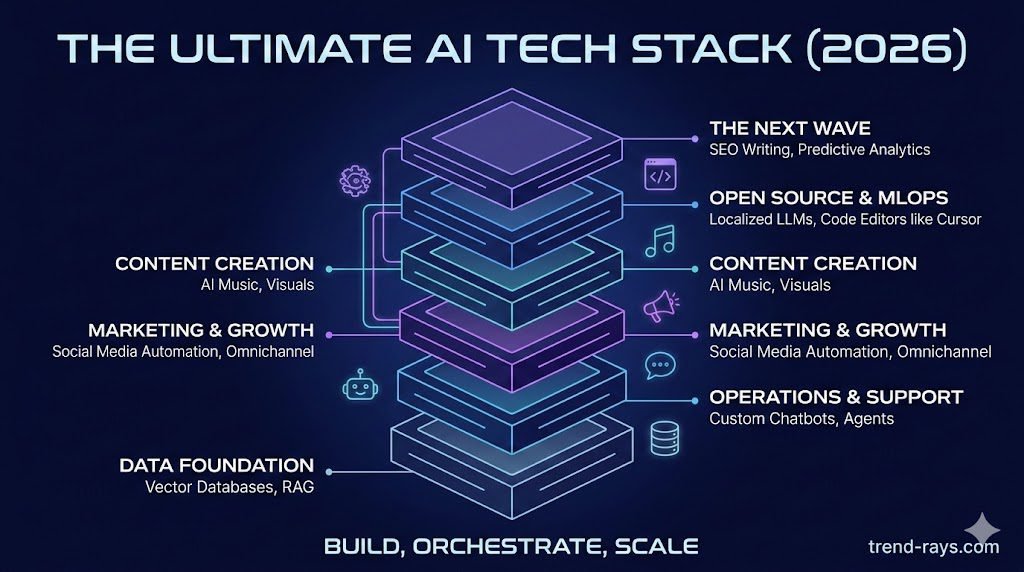
Throwing random artificial intelligence apps at your business will not make you more efficient; it will just create digital chaos. To actually scale revenue and cut hours from your workweek, you need a cohesive AI tech stack.
But the landscape has split. A modern tech stack in 2026 looks vastly different depending on whether you are a non-technical founder automating a local business, or a developer building a proprietary machine learning model.
This definitive guide breaks down exactly how AI is transforming the economy, the most profitable startup ideas right now, and the exact frameworks, SaaS wrappers, and MLOps tools you need to build your empire.
How AI Is Transforming Businesses in 2026
We have moved past the “hype” phase of AI. In 2026, AI is no longer a parlor trick that writes funny poems; it is the core infrastructure of modern commerce.
- From Reactive to Predictive: Businesses no longer wait for a customer to complain. AI CRMs analyze email sentiment and user behavior to predict churn before it happens, automatically dispatching retention offers.
- The Death of the “Blank Page”: Content creation, from marketing copy to legal contracts, now begins at the 80% mark. Generative AI provides the first draft instantly, leaving the human to act as an editor rather than a creator.
- Hyper-Personalization at Scale: E-commerce stores no longer show the same homepage to everyone. AI agents dynamically rewrite website copy, rearrange product displays, and adjust pricing in real-time based on the specific user’s browsing history.
Why You Should Adopt AI to Transform Your Business Now (The Cost of Waiting)
Many founders treat AI as a “nice-to-have” upgrade for next year’s roadmap. In 2026, this is a fatal mistake. Adopting AI is no longer about gaining a competitive advantage; it is about surviving the new baseline of business efficiency.
- The Margins Game: If your competitor uses an AI agent to handle 80% of their customer support, their operating margins are significantly higher than yours. They can afford to lower prices, spend more on ads, and acquire your customers, simply because their overhead is a fraction of yours.
- The 24/7 Expectation: Consumers now expect instant, accurate resolutions at 2:00 AM on a Sunday. If a user has to wait until Monday morning for a human to answer an email, while your competitor’s AI resolves the issue instantly, you lose the lifetime value of that customer.
- Compounding Data Advantage: AI models get smarter the more data they process. A business that implements AI today will have a proprietary, highly trained data engine a year from now. If you wait, you are starting from zero while your competitors are running at full speed.
While general AI assistants are great for marketing, healthcare professionals and specialized consultants must prioritize data privacy by integrating HIPAA-compliant AI dictation tools into their daily tech stack.
AI Business Ideas: Profitable Startup Opportunities in 2026
If you are looking to build a business rather than just optimize an existing one, the AI gold rush is still in its early stages. The most profitable opportunities in 2026 do not require you to build the next OpenAI; they require you to apply AI to boring, underserved niches.
- AI Automation Agencies (AAA): Local businesses (plumbers, dental clinics, law firms) know they need AI but have no idea how to implement it. Building custom Zapier/Make.com workflows and deploying custom AI chatbots for small businesses is a massive, high-ticket B2B service.
- Micro-SaaS “Wrappers”: Find a highly specific industry problem and solve it with a specialized UI connected to an LLM API. (e.g., An AI tool specifically designed to write real estate listing descriptions, or using ChatGPT to generate custom, hyper-specific schedules formatted for a specific niche).
- AI-Driven Personal Branding Studios: Professionals are ditching expensive photoshoots. Offering digital branding packages powered by AI is highly lucrative. You can see the margins in our breakdown of AI Headshots vs. Traditional Photography in Europe.
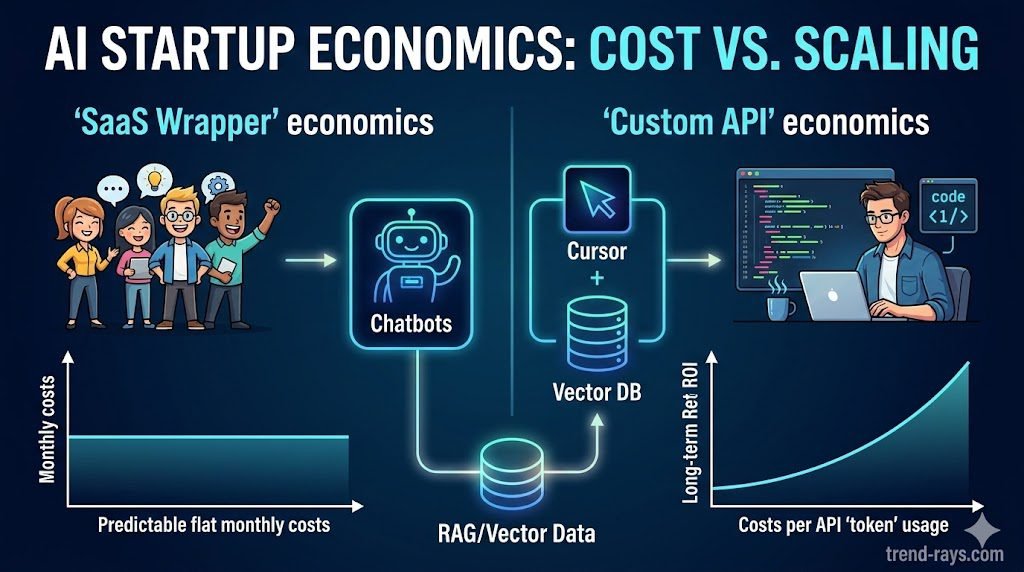
The Economics: The Real Cost of Adopting AI for Startups
Before launching an AI-based startup, you must understand the unit economics. AI businesses do not scale the same way traditional software does.
- The Wrapper Cost (SaaS): If you use off-the-shelf “SaaS wrappers” to run your agency or micro-startup, your costs are highly predictable. You might pay $49/month for Chatbase and $15/month for ManyChat. This is perfect for bootstrapping, but it eats into your margins as you scale to thousands of clients.
- The API Cost (Tokenomics): If you build a custom app using the OpenAI or Anthropic API, you pay per “token” (roughly pieces of words). A simple text generation might cost $0.002. However, if your app goes viral, your API bill can jump from $10 to $10,000 overnight. You must have a monetization strategy (like a strict subscription paywall) in place before launching an API-based tool.
- The Open-Source Cost (Compute): Using free, open-source models means you don’t pay API fees, but you do pay for the massive cloud servers (AWS or Google Cloud) required to run them. This is often the most expensive route upfront, costing hundreds or thousands of dollars a month in server fees, making it strictly for well-funded startups.
Tip: As voice cloning becomes more accessible, small businesses must integrate specialized cybersecurity SaaS for voice protection to prevent business email compromise and fraudulent wire transfer requests.
How to Choose the Right Tech Stack for Your Startup in 2026
The biggest mistake founders make is choosing a tech stack that is too complex for their current revenue stage.
If you are validating an idea, use No-Code SaaS. If you are building a proprietary software product, use custom MLOps.
The Ultimate AI Tech Stack Comparison Matrix
| Stack Type | Ideal For | Technical Skill Required | Primary Cost Structure | Core Advantage | Example Setup |
| No-Code / SaaS | Agencies, E-commerce, Solo Consultants | Low (Visual drag-and-drop) | Monthly Subscriptions ($50 – $300/mo) | Speed to market; zero maintenance. | Chatbase, ManyChat, Zapier, Shopify. |
| Low-Code API Orchestration | Scaling Startups, Operations Teams | Medium (Webhooks, API keys, JSON) | Pay-per-usage (API tokens) + Platform fee | High customization without server costs. | Voiceflow, Make.com, OpenAI API, Airtable. |
| Custom MLOps / Open Source | Tech Startups, Enterprise, Privacy-Strict | High (Python, React, Node.js) | Server compute costs (AWS, GCP) + Dev salaries | Complete data ownership; IP creation. | LangChain, Hugging Face, Bielik LLM, Pinecone. |
The Hidden Costs: Subscription Fatigue vs. API Scaling
When choosing your tech stack, the table above gives you the framework, but you must evaluate the hidden financial traps of each path.
The SaaS Trap (Subscription Fatigue): A non-technical founder often buys a tool for every problem. $50 for a chatbot, $30 for a social media scheduler, $99 for an email AI. Suddenly, you are burning $500+ a month on disparate tools that don’t talk to each other. The Solution: Audit your stack quarterly. If an AI tool is not directly saving you more money than its monthly fee, cancel it.
The API Trap (Uncapped Scaling): Technical founders often build custom workflows using APIs to save on monthly SaaS fees. But a poorly coded loop in an AI script can accidentally trigger an API 10,000 times in an hour. The Solution: Always set hard billing limits in your OpenAI, Anthropic, or Make.com dashboards to prevent runaway costs.
The Non-Technical Founder’s Stack: Operations & Growth
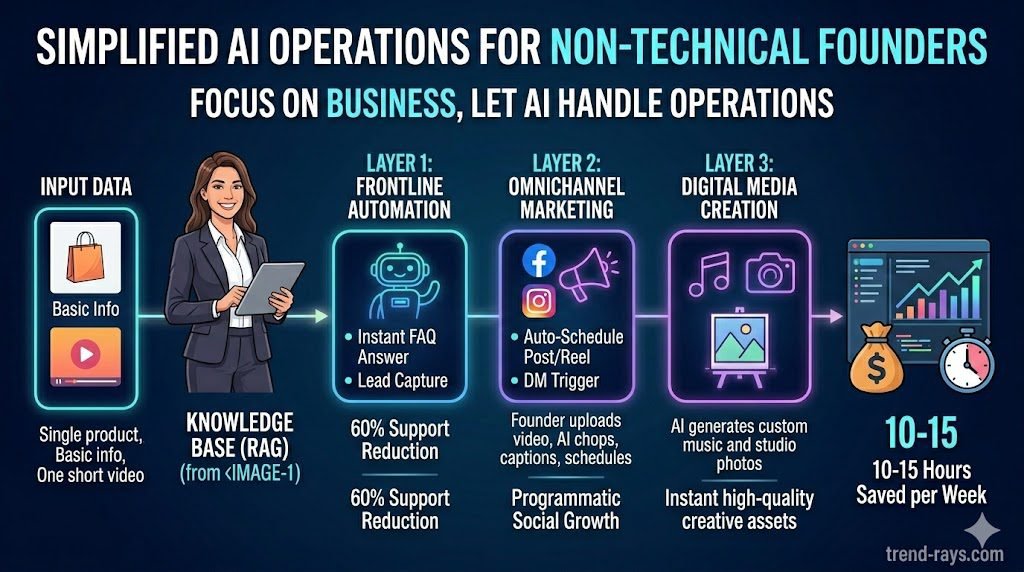
If you fall into the “No-Code / Low-Code” category above, your stack should be built around pre-packaged SaaS tools that talk to each other.
- Layer 1: Frontline Automation: Deploy intelligent agents to handle the top of your funnel.
- Layer 2: Omnichannel Marketing: Stop posting manually. Use the Best AI Social Media Management SaaS Tools to schedule content and trigger automated DMs.
- Layer 3: Digital Media Creation: Replace stock audio and video with tailored, generated media using the 5 Best Royalty-Free AI Music Generator SaaS.
The Reality Check: DIY vs. Hiring an AI Automation Agency
If you are a non-technical founder—say, the owner of a marketing agency or a local clinic—the hardest question isn’t what tools to use, but who should set them up.
- The DIY Route (Time vs. Money): No-code tools are marketed as “easy,” but they still require hours of learning. If your personal time is worth $100/hour, and it takes you 40 hours to learn Voiceflow and build a functional AI agent, that “free” bot just cost you $4,000 in lost productivity. DIY is only recommended if you have more time than capital.
- Hiring an AI Freelancer/Agency: For established businesses, hiring a specialist to build your tech stack is the highest ROI move. You pay a one-time setup fee (typically $1,000 to $5,000 depending on complexity), and they deliver a fully integrated system. They understand webhook errors, API limits, and system prompts so you don’t have to.
Beyond just writing and images, businesses are now utilizing synthetic audio to save thousands on marketing costs, a move that is currently disrupting the traditional voiceover industry by providing high-quality narration in seconds.
Deep Dive: Layer 1 & Layer 2 Operations
To operate efficiently, a non-technical founder must understand how these first two layers actually function in the real world.
Layer 1: Frontline Automation (The Defensive Shield)
This is not just a widget on your website; it is your defensive shield against time-wasting tasks.
- How it works deeply: A user visits your site and asks, “Where is my order?” Instead of your team manually checking Shopify, your custom AI chatbot uses an API to securely query your Shopify database, retrieves the tracking number, and replies instantly.
- The Benefit: It reduces your support ticket volume by up to 60%, allowing you to operate a 7-figure business with a single human customer service rep.
Layer 2: Omnichannel Marketing (The Offensive Engine)
This is how you grow without hiring a dedicated social media manager.
- How it works deeply: You record one long-form video. You feed it into your AI Social Media SaaS tool. The AI chops it into 5 viral shorts, writes the captions tailored for TikTok, LinkedIn, and Instagram, and schedules them. When a user comments “Send Link” on the IG reel, a tool like ManyChat instantly drops the sales link in their DMs.
- The Benefit: You achieve the content output of a 5-person marketing team for roughly $100 a month in software subscriptions, driving inbound leads 24/7.
Layer 3: Digital Media & Brand Asset Creation (The Creative Engine)
This is where you stop paying exorbitant fees for stock assets, studio time, and licensing, taking full control of your brand’s visual and audio identity without needing a production crew.
- How it works deeply: Instead of renting a studio to shoot lifestyle product photos or spending hours designing YouTube thumbnails, you use generative AI. You can upload a raw, basic photo of your product, and the AI instantly places it on a sunlit mountain peak or a modern kitchen counter with perfect lighting. If you are producing video ads, cinematic travel reels, or podcasts, you completely bypass the headache of YouTube copyright strikes by generating custom, mood-specific background tracks using the 5 Best Royalty-Free AI Music Generator SaaS. For your team’s “About Us” page or professional networking, you completely eliminate the logistical nightmare of scheduling photographers by using the tools we covered in our AI Headshots vs. Traditional Photography guide.
- The Benefit: You slash your creative production budget by over 90% and reduce turnaround times from weeks to literally seconds. More importantly, this speed allows you to A/B test ten different visual ad creatives or video hooks in the time it used to take to shoot and edit just one.
AI Tech Stack 2026: Frameworks, MLOps & IDEs Guide
If you are a developer or a technical founder building an actual AI product, SaaS wrappers won’t cut it. You need a robust MLOps (Machine Learning Operations) pipeline.
1. The Model Layer (Foundation & Open Source)
You no longer have to rely solely on OpenAI. The open-source community has caught up.
- Proprietary APIs: OpenAI (GPT-4), Anthropic (Claude 3), Google (Gemini). Best for general reasoning.
- Open-Source Local Models: Meta Llama 3, Mistral. Best for privacy and cost control. In European markets, developers are heavily evaluating regional LLMs like Bielik and PLLuM for specialized tasks to comply with GDPR.
2. The Orchestration & Framework Layer
How do you make an LLM actually do something?
- LangChain & LlamaIndex: These are the essential frameworks that allow your LLM to connect to external data sources (like your database) and execute multi-step logic.
- Vector Databases (RAG): Pinecone, Weaviate, or Milvus. These databases store your proprietary data in a way that AI can search and “understand” instantly to prevent hallucinations.
3. The IDE & Developer Experience (DevEx)
The way code is written has fundamentally changed.
- Cursor: The undisputed king of AI IDEs in 2026. It is a fork of VS Code with deeply integrated AI that can write, debug, and refactor entire codebases autonomously.
- GitHub Copilot Workspace: Essential for team collaboration and predictive code completion.
The Modern Stack in Web Development (AI-Enhanced)
If you are building the web app that houses your AI, the traditional LAMP stack (Linux, Apache, MySQL, PHP) is a relic. The modern web development stack is heavily component-based and serverless.
Why the Traditional Web Stack is Dead for AI Startups
Looking at the comparison table is one thing, but understanding why the industry has aggressively abandoned the old LAMP stack (Linux, Apache, MySQL, PHP) is crucial for anyone building software today.
1. The “Streaming Text” Problem (Why We Use React/Next.js) If you use ChatGPT, you notice the text types out word-by-word instantly. This is called “streaming.” Traditional websites built on PHP or old WordPress setups wait for the entire answer to generate before showing it to the user. In AI, this means the user stares at a blank loading screen for 15 seconds. Modern frameworks like React and Next.js are built to handle asynchronous streaming, giving users that instant, magical AI feeling.
2. The Server Crash Dilemma (Why We Use Vercel/Serverless) In the past, if you bought a cPanel server and your app went viral, the server would overload and crash. Modern AI apps use “Serverless” hosting (like Vercel or AWS Lambda). This means your app doesn’t live on one computer; it lives in the cloud and scales infinitely and automatically the second traffic spikes. You only pay for the exact milliseconds of compute power you use.
3. Vector Databases (Why We Can’t Just Use MySQL) A traditional database (like MySQL) is basically a giant Excel spreadsheet. It looks for exact keyword matches. But AI doesn’t think in keywords; it thinks in concepts and context. We now use Vector Databases (like Pinecone or Supabase’s pgvector). If a user asks your AI, “Do you have tops for chilly weather?”, a traditional database fails because the keyword is “sweater,” not “chilly tops.” A Vector Database understands the meaning behind the words and instantly retrieves the right product.
Traditional vs. Modern Web Dev Stack
| Component | Traditional Stack (Outdated) | Modern AI-Enhanced Stack (2026) | Why It Matters Now |
| Frontend | Vanilla HTML/CSS/jQuery | React / Next.js | Allows for instant, dynamic rendering of AI chat interfaces and streaming text. |
| Backend/Hosting | Dedicated cPanel Servers | Vercel / Netlify | Serverless functions scale instantly when an AI app goes viral, without crashing. |
| Database | MySQL (Relational only) | Supabase / Firebase + pgvector | Supabase offers traditional databases plus vector storage for AI memory built right in. |
| Styling | Custom CSS Files | Tailwind CSS / Shadcn UI | AI coding assistants (like Cursor) are exceptionally good at writing Tailwind, speeding up UI design by 10x. |
Conclusion: Stop Researching, Start Building
The “ultimate” AI tech stack is the one that gets your product to market or solves your most expensive operational bottleneck today.
If you run a local business, start by replacing your website contact form with a Custom AI Chatbot. If you are a developer, spin up a Next.js frontend, connect it to Supabase, and start calling the Claude API. The tools have never been cheaper or more accessible.