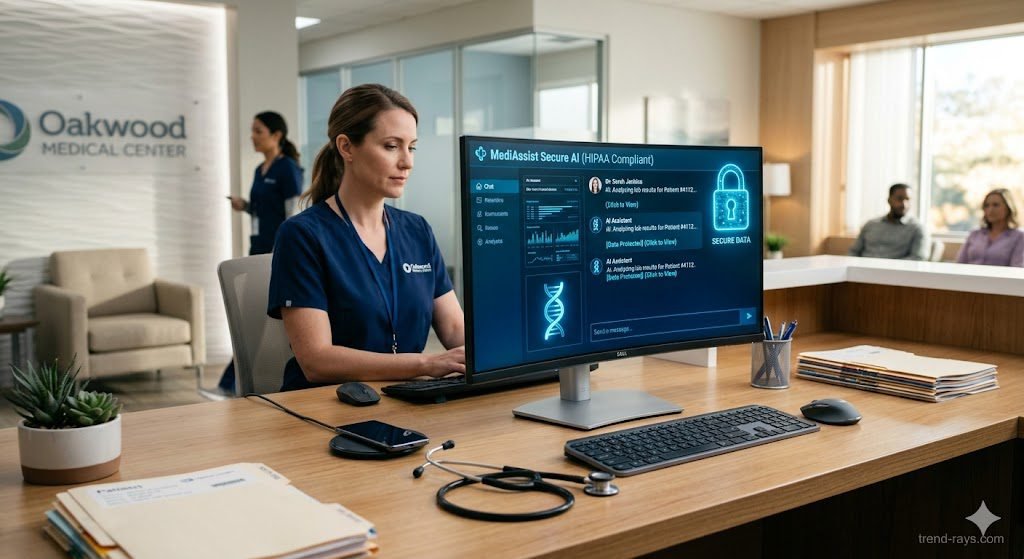
While doctors increasingly rely on ambient AI medical scribes to reduce charting time, hospital IT departments face massive HIPAA compliance risks when routing cloud-based AI data into legacy EHR systems like Epic. The Solution: To securely bridge this gap, Healthcare IT Directors must exclusively deploy AI tools backed by a Business Associate Agreement (BAA) with strict zero-retention policies. The integration must be routed through the SMART on FHIR framework, allowing the AI to push formatted clinical notes into Epic as a draft, requiring a mandatory “Human-in-the-Loop” physician sign-off before committing to the patient’s official medical record.

The COVID-19 Catalyst: Breaking the On-Premise Walled Garden
To understand the current integration nightmare, we have to look at the architectural shift caused by the COVID-19 pandemic. Prior to 2020, hospital IT networks operated as impenetrable “walled gardens.” The Epic EHR database sat on physical servers in the hospital basement, entirely cut off from the outside internet.
The pandemic forced an overnight shift to telehealth. Hospitals had to rapidly punch holes in their firewalls to allow Zoom, Microsoft Teams, and remote-working physicians to access patient records. This massive, forced modernization proved that cloud connectivity in healthcare was possible, but it left the door wide open for shadow IT. Today, doctors expect the same seamless, cloud-based AI tools they use at home to work inside the clinic, forcing IT departments to retroactively build secure cloud pipelines for technologies the hospital network was never designed to handle.
The Healthcare IT Crisis: Shadow IT vs. Physician Burnout
The healthcare industry is facing a massive technological collision. On one side, physician burnout is at an all-time high, with doctors spending up to two hours on EHR documentation for every one hour of patient care. On the other side is the hospital IT department, legally bound to protect Electronic Protected Health Information (ePHI) under strict HIPAA regulations.
Because IT is notoriously slow to approve new software, doctors are increasingly engaging in “Shadow IT”—downloading unvetted consumer AI transcription apps on their personal smartphones to record patient encounters.
This is a catastrophic security risk. If an unapproved AI uploads a patient’s medical history to a public Large Language Model (LLM) server, the hospital faces multi-million dollar federal fines. Hospital IT Directors cannot simply ban AI; they must build a sanctioned, secure pipeline that routes compliant AI data directly into enterprise EHRs like Epic Systems or Cerner.
The CFO’s Perspective: The ROI of Sanctioned AI Scribes
From a financial perspective, deploying an enterprise-grade AI medical scribe is not an IT expense; it is a revenue multiplier.
When a hospital forces its doctors to type their own notes, it severely limits clinical throughput. By integrating an ambient AI scribe directly into the EHR, health systems are actively reclaiming up to 15 hours of physician time per week.
For the CFO, the math is straightforward:
- Increased Billable Encounters: Doctors who are no longer bogged down by charting can see an average of 2 to 3 additional patients per day.
- Mitigated Audit Fines: Sanctioned, integrated AI eliminates the Shadow IT risk, protecting the hospital’s operating margin from OCR (Office for Civil Rights) HIPAA violation penalties.
- Optimized Coding: Advanced medical AI produces more detailed, structured notes than exhausted humans, which directly leads to more accurate medical billing and higher insurance reimbursement rates.
Essential Integration Architecture (Deep Dive)
To securely integrate third-party artificial intelligence with a heavily guarded system like Epic, IT architects must rely on standardized, modern healthcare protocols. Here is the technical breakdown of the required architecture.
Mandating BAA (Business Associate Agreement) AI Tools
A software vendor cannot simply claim to be “HIPAA Compliant.” Before a single byte of audio is recorded, the hospital must sign a strict BAA (Business Associate Agreement) with the AI vendor. This legally binding contract transfers federal liability to the AI company, legally forbidding them from using the hospital’s ePHI to train their internal machine learning models or sharing it with third-party advertising networks.
Enforcing Zero-Retention Medical Audio
The highest-tier security standard for clinical AI in 2026 is zero-retention medical audio. This means the AI processes the doctor-patient conversation in volatile RAM, generates the clinical text, and immediately deletes the original audio file. The audio is never saved to a physical hard drive, ensuring that even if the AI vendor suffers a catastrophic data breach, there are no patient recordings to steal.
Executing HL7 FHIR Integration AI Scribe
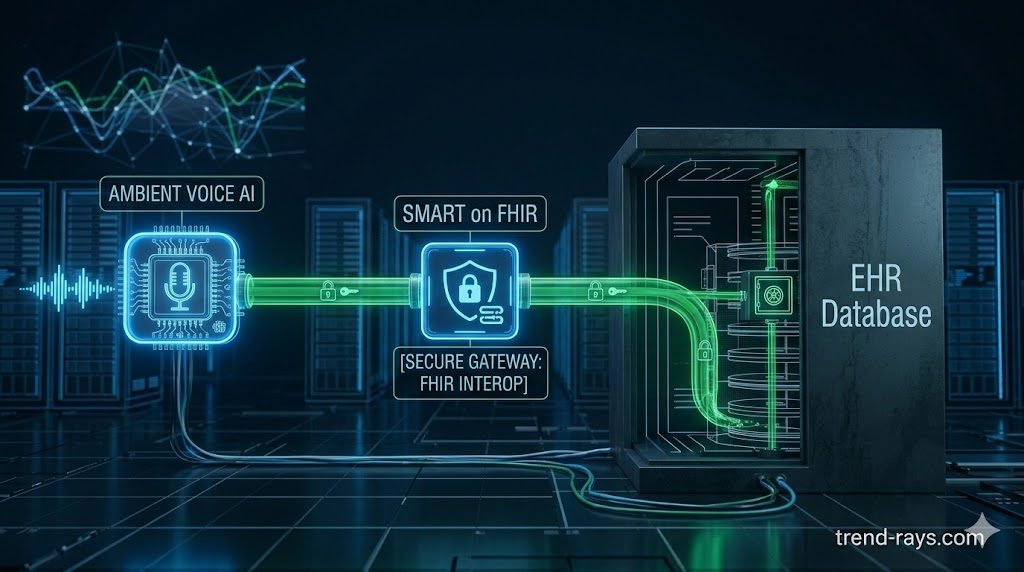
Legacy healthcare data transfer relied on HL7v2, a clunky, text-based messaging standard from the 1980s. Modern AI integration requires HL7 FHIR (Fast Healthcare Interoperability Resources). FHIR uses standard RESTful web APIs (JSON over HTTP), allowing the AI scribe to securely query the Epic database for specific patient context (like current medications) and precisely push the generated SOAP note into the correct data fields within the patient’s chart.
Leveraging Epic Systems SMART on FHIR
Epic does not allow random cloud applications to write data to its core database. To build a secure bridge, IT must utilize Epic Systems SMART on FHIR. “SMART” acts as the security layer (using OAuth 2.0 and OpenID Connect). It ensures that the AI scribe application is properly authenticated and only possesses the exact permissions (Scopes) authorized by the IT department—such as “Write-Only” access to the Clinical Notes section, preventing the AI from viewing the rest of the patient’s record.
Step-by-Step: The Epic Integration Workflow
Once the legal frameworks (BAA) and technical protocols (FHIR) are established, the actual clinical workflow must be engineered to protect patient safety.
- The Ambient Encounter: Using ambient clinical voice AI, the application passively listens to the natural conversation between the doctor and patient via a secure mobile app or microphone. No wake words (like “Hey Siri”) or manual dictation are required.
- Cloud Processing & Zero-Retention: The audio stream is encrypted end-to-end, processed in a HIPAA-compliant cloud environment, converted into a structured clinical note, and the source audio is instantly destroyed.
- The API Push: The AI uses SMART on FHIR to authenticate with the hospital’s Epic server and pushes the structured text into the patient’s active encounter file.
- The “Human-in-the-Loop” Sign-Off (Critical): The AI must not commit the note to the permanent medical record. Instead, the API pushes the text into Epic as an “Unsigned Draft.” The attending physician must review the draft, correct any AI hallucinations, and physically click “Sign” to finalize the chart.
Frequently Asked Questions (Healthcare AI Integration)
What is ambient clinical voice AI?
Unlike traditional dictation software (like legacy Dragon Medical) where a doctor must speak like a robot and verbally state punctuation (“Patient presents with a cough period“), ambient clinical voice AI passively listens to the natural, conversational dialogue between the doctor and the patient and uses natural language processing to intelligently extract the medical facts into a formatted SOAP note.
Can an AI scribe train its models on our hospital’s patient data?
Under a standard commercial terms of service, yes. However, under a strict BAA (Business Associate Agreement) for AI tools, the vendor is legally prohibited from using your ePHI for model training, analytics, or product improvement.
Why is SMART on FHIR required for Epic EHR integration?
Epic Systems SMART on FHIR is required because it combines the modern data formatting of FHIR with the strict identity authentication of SMART (Substitutable Medical Applications, Reusable Technologies). It ensures the third-party AI app is securely authenticated via OAuth 2.0 and can only interact with the specific patient records the doctor is currently viewing.
Beyond Scribes: Future-Proofing for Modern AI Infrastructure
Securing the pipeline for an AI medical scribe is not just a one-off IT ticket; it is the foundational architecture for the hospital of the future.
Once your IT department successfully establishes a strict BAA and a secure SMART on FHIR gateway for clinical documentation, you have built a reusable, HIPAA-compliant “highway” to the cloud. This exact same infrastructure will soon be required to route other advanced integrations, including:
- Clinical Decision Support Systems (CDSS): AI models that read the patient’s chart in real-time and alert the doctor to potential adverse drug interactions before they write a prescription.
- Predictive Diagnostics: Cloud-based machine learning algorithms that analyze thousands of past EHR entries to flag patients at high risk for sepsis or heart failure hours before symptoms appear.
- Automated Prior Authorization: AI agents that instantly parse the doctor’s notes and send the exact required medical evidence to insurance companies, bypassing the manual billing department entirely.
By doing the hard work of securing the Epic AI integration today, IT Directors are future-proofing their health systems for the next decade of medical advancement.