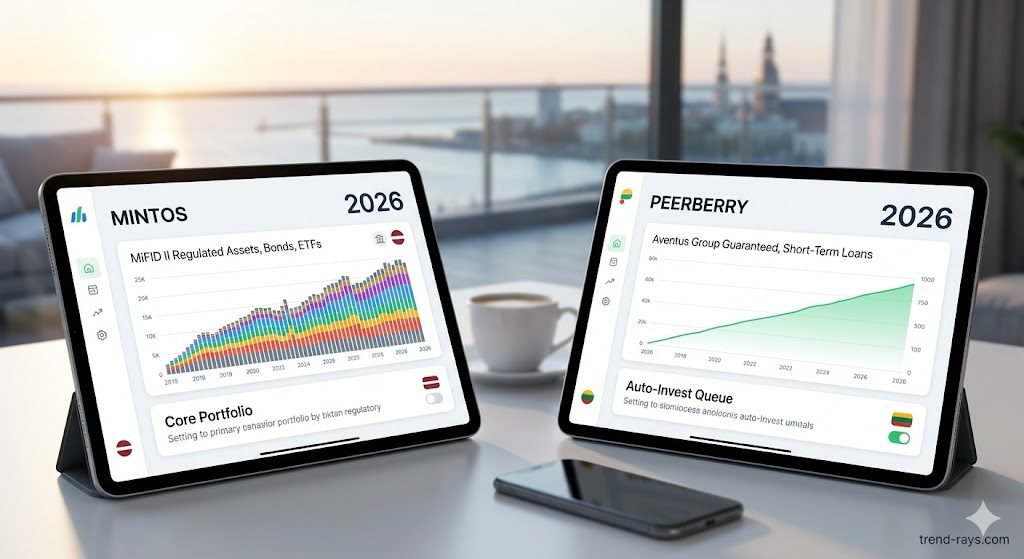
Generating passive income through Peer-to-Peer (P2P) lending has become a staple of modern European portfolios. In 2026, the Baltic P2P market continues to mature, and two platforms stand out as the undisputed leaders: Mintos and PeerBerry.
For beginners, setting up an Auto-Invest strategy is the most efficient way to participate. But choosing between the highly-regulated giant (Mintos) and the agile, high-yield challenger (PeerBerry) requires understanding their distinct approaches to risk, regulation, and taxation.
Why Start P2P Investing in 2026? (A Perspective for Every Investor)

Before comparing platform features, it is crucial to understand why P2P lending has become a mandatory pillar of wealth building in the 2020s. With traditional bank savings accounts struggling to outpace inflation, P2P lending offers a modernized, accessible route to double-digit yields.
However, the strategy you adopt depends entirely on your current stage of life.
The University Student: Starting with Micro-Capital
When you are a student, your greatest asset isn’t money—it’s time. The power of compound interest means that every euro invested in your early twenties is worth exponentially more than a euro invested in your forties.
- The P2P Advantage: Traditional real estate or stock index funds often require high minimum deposits or charge percentage-based broker fees that eat up small portfolios.
- The Strategy: Platforms like PeerBerry allow you to start Auto-Investing with just €10. By automatically funneling a fraction of a part-time job paycheck into short-term (1-30 day) loans, students can build a foundational passive income stream without locking up cash they might need for tuition or rent.
The New Professional: Combating Lifestyle Creep
Landing your first salaried job is a critical financial crossroads. The sudden influx of disposable income often leads to “lifestyle creep”—upgrading your apartment, car, and habits until your bank account is empty at the end of the month, despite a higher salary.
- The P2P Advantage: Auto-Invest features act as a behavioral safeguard. By paying your future self first, you remove the temptation to overspend.
- The Strategy: A new professional should look toward Mintos. By setting up a monthly direct debit on payday, you instantly move €100 to €500 into a diversified portfolio of consumer loans and fractional bonds. Because Mintos requires a slightly higher minimum (€50) and has a regulated structure, it trains young professionals to treat their P2P portfolio as a serious, long-term wealth vehicle rather than a speculative gamble.
The Business Owner / Entrepreneur: Putting Idle Cash to Work
Entrepreneurs and freelancers often keep large sums of cash sitting in corporate bank accounts to cover upcoming taxes, payroll, or future expansion. In a zero-interest corporate checking account, inflation silently destroys the purchasing power of that capital.
- The P2P Advantage: P2P lending offers a highly liquid way to generate yield on corporate treasury funds.
- The Strategy: Using a corporate entity (especially under the tax-advantaged Estonian OÜ structure) changes the game. Business owners can deploy idle cash into highly liquid, short-term loans on either Mintos or PeerBerry. Earning 10% annualized on €50,000 of idle business cash generates €5,000 a year—enough to cover premium software subscriptions, a part-time virtual assistant, or offset local business taxes.
The Short Answer: Which Platform is Right for You?
If you are looking for a quick summary, here is the bottom line:
Mintos is best for investors who want a heavily regulated platform with diverse assets (loans, bonds, ETFs) and are willing to accept complex tax withholding. PeerBerry is ideal for investors seeking high-yield, short-term loans with zero fees, no withholding taxes, and a proven track record of honoring buyback guarantees.
2026 Platform Comparison Table
| Feature | Mintos | PeerBerry |
| Average Yield | 9.5% – 12% | 10.5% – 11.5% |
| Minimum Investment | €50 | €10 |
| Regulation | Yes (MiFID II, Latvian FCMC) | Applied for Lithuanian license |
| Buyback Guarantee | Varies by Loan Originator | Yes (Plus Aventus Group Guarantee) |
| Secondary Market | Yes (Highly active) | Yes (Recently launched) |
| Fees | Small inactivity/secondary market fees | 0% |
| Tax Withholding | Yes (5% – 20% depending on residency) | No (0% withheld at source) |
Understanding Mintos Auto-Invest in 2026
Mintos has evolved far beyond its wild-west P2P origins. Today, it is a strictly regulated MiFID II broker overseeing hundreds of millions of euros. It operates as a financial hub offering not just consumer loans, but Fractional High-Yield Bonds, Real Estate, and ETFs.
How to Configure a Beginner Strategy on Mintos
Instead of manually picking loans, Mintos offers “Core” automated portfolios or a Custom Auto-Invest setup. For beginners wanting higher yields without excessive risk, a Custom setup is ideal:
- Interest Rate Minimums: Set your minimum acceptable interest rate to 9.5% to ensure inflation doesn’t eat your returns.
- Loan Originator Selection: Utilize the Mintos Risk Score. Uncheck any originators with a score below 6.0 to filter out companies with weak balance sheets.
- Diversification Settings: Cap your exposure to any single loan originator at 10% to 15% of your total portfolio.
- Loan Terms: Stick to 1-to-12-month loans to maintain liquidity, or use the active secondary market if you need to liquidate longer terms.
Pros & Cons of Mintos
- Pros: Heavy regulation provides peace of mind against platform fraud; massive diversification across different asset classes; excellent secondary market liquidity.
- Cons: The platform is legally required to withhold taxes; you may encounter minor inactivity fees (€4.90/month) if you stop investing; past crises have left some funds in long-term “recovery” status.
Understanding PeerBerry Auto-Invest in 2026
Backed primarily by the Aventus Group, PeerBerry has built an exceptional reputation. Despite global crises (including the Ukraine/Russia conflict), PeerBerry has maintained a flawless track record of shielding investors from permanent capital loss via its group guarantees.
How to Configure a Beginner Strategy on PeerBerry
PeerBerry’s Auto-Invest works on a queuing system (First-In, First-Out). Because short-term loans are funded incredibly fast, beginners must configure their strategy to avoid “cash drag” (funds sitting uninvested).
- Keep it Broad: Select all loan originators backed by the Aventus Group and Gofingo Group.
- Term Lengths: Select loans from 1 to 60 days. Short-term consumer loans are PeerBerry’s specialty.
- Maximum Investment per Loan: Keep this low (e.g., €10 to €50) so your portfolio spreads across hundreds of different loans.
- Loyalty Program: If you scale your portfolio above €10,000, you automatically unlock Silver status, granting a +0.5% interest bonus on all future investments.
Pros & Cons of PeerBerry
- Pros: Absolutely 0% fees for the investor; a reliable track record of honoring buyback guarantees; simple interface; 100% of interest is paid out (no tax withheld).
- Cons: Not yet regulated by a major financial supervisory authority; heavy reliance on a single parent entity (Aventus Group); the secondary market is still in its infancy compared to Mintos.
The “Buyback Guarantee” Explained: Reality vs. Marketing
Both platforms heavily market their “Buyback Guarantees”—the promise that if a borrower is 60 days late, the loan originator will buy the loan back and pay you the principal plus accrued interest.
The Reality: A guarantee is only as solvent as the company issuing it.
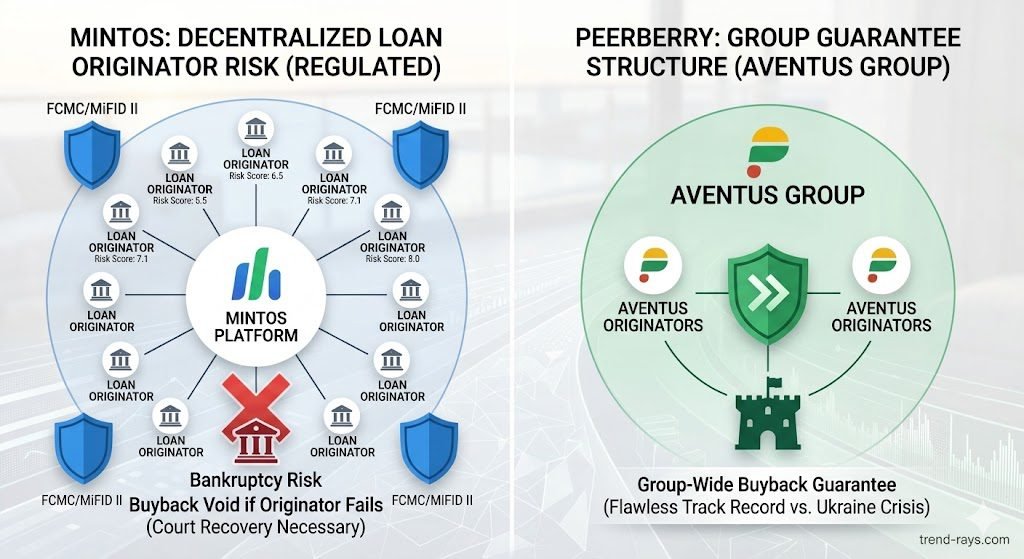
- On Mintos, you are exposed to dozens of independent loan originators. If one goes bankrupt, their buyback guarantee becomes worthless, though Mintos will fight for recovery through the courts.
- On PeerBerry, the guarantee is reinforced by a “Group Guarantee.” If an individual originator fails, the broader Aventus Group steps in to cover the loss. This has worked flawlessly so far, but it concentrates your risk into a single corporate umbrella.
Tax Implications for Baltic Investors (Crucial Local Intent)
When running an Auto-Invest strategy, your actual Return on Investment (ROI) is dictated by your net yield after taxes. Because Mintos operates as a regulated investment firm in Latvia and PeerBerry operates without withholding taxes at the source, your tax residency drastically changes which platform is more efficient for your portfolio.
Estonia: The Power of the OÜ for P2P Lending
For Estonian tax residents, the approach depends entirely on your legal entity:
- Investing as an Individual: You are subject to the standard income tax rate (currently rising to 22% for 2025/2026) on all earned interest. Crucially, Estonia does not allow private individuals to deduct P2P loan defaults (bad debt) from their taxable gains.
- Investing via an OÜ (Private Limited Company): This is the ultimate Baltic tax strategy for P2P lending. Under Estonia’s corporate tax system, reinvested profits are completely tax-exempt. By funneling your Mintos or PeerBerry Auto-Invest portfolio through an OÜ, you experience zero “tax drag” while your funds compound. You only pay corporate tax when you eventually distribute dividends.
Latvia: Mintos’s Home-Turf Withholding Rules
Because Mintos is a licensed financial institution regulated by the Latvian central bank (Latvijas Banka), it is legally obligated to act as a tax withholding agent. PeerBerry, by contrast, pays out gross interest and leaves the declaration entirely to the investor.
- Mintos Withholding Tax: If you are a Latvian tax resident, Mintos automatically withholds 20% of your interest income. The benefit is convenience—you do not need to manually calculate and pay this specific tax later. The downside is that it slightly reduces the capital available for immediate compounding within your Auto-Invest loop.
- The PeerBerry Difference: PeerBerry deducts €0 in taxes. You receive 100% of your yield upfront to reinvest, maximizing your compound interest. However, you bear the strict legal responsibility of declaring this income to the State Revenue Service (VID) and paying the applicable 20% tax annually out of pocket.
Lithuania: The 0% Mintos Exemption and the €500 Rule
Lithuania offers highly favorable P2P tax conditions, provided you handle the paperwork correctly.
- The €500 Tax-Free Allowance: Lithuanian residents can earn up to €500 in P2P interest per year completely tax-free. Any interest exceeding this threshold is subject to the standard 15% Personal Income Tax (PIT).
- The 0% Mintos Withholding Advantage: By default, Mintos withholds 20% (or 5% for general EU residents). However, due to the specific Double Taxation Treaty (DTT) between Latvia and Lithuania, Lithuanian tax residents who upload a valid Tax Resident Certificate (issued by the VMI) to their Mintos dashboard will have their withholding tax legally reduced to 0%.
- PeerBerry in Lithuania: PeerBerry will not withhold any taxes. You keep 100% of the interest for your Auto-Invest strategy and apply your €500 exemption manually when filing your annual VMI income declaration.
The Ultimate 2026 Beginner Strategy: Why Not Both?
The savviest investors in 2026 do not choose just one platform. Systemic platform risk—the chance that the platform itself faces regulatory hurdles or bankruptcy—is the biggest threat to your capital.
Platform Diversification is the answer. A robust beginner strategy involves splitting your initial capital 50/50. Use Mintos to gain exposure to regulated fractional bonds and diverse European originators. Simultaneously, use PeerBerry to capture high-yield, short-term liquidity with zero tax drag at the source.
Frequently Asked Questions (FAQ)
Is PeerBerry safer than Mintos?
Neither is inherently “safer,” as they carry different risk profiles. Mintos is safer from a regulatory standpoint (MiFID II licensed, overseen by the Latvian Central Bank). PeerBerry has historically been safer regarding default rates, honoring 100% of its buyback obligations via the Aventus Group.
How do I avoid cash drag on PeerBerry?
To avoid cash drag, broaden your Auto-Invest parameters. Include more loan originators, expand your acceptable loan term length (e.g., 1 to 60 days instead of just 1 to 15), and ensure your minimum interest rate requirement isn’t set unrealistically high.
Does Mintos charge fees for Auto-Invest?
Mintos does not charge fees to set up or run an Auto-Invest strategy. However, they do charge a 0.85% fee if you sell your loans early on the Secondary Market, and an inactivity fee of €4.90 per month if you hold unused funds without investing for an extended period.
How are Mintos and PeerBerry taxed in the Baltics?
Mintos automatically withholds tax at the source (5% to 20% depending on your residency and submitted tax certificates). PeerBerry does not withhold taxes; investors receive gross interest and are responsible for declaring and paying taxes to their local authorities.
What is the minimum investment for Mintos vs PeerBerry?
The minimum investment on Mintos is €50 per set of notes or fractional bonds. The minimum investment on PeerBerry is €10 per loan, making it more accessible for extreme beginners.
Conclusion
Building a passive income portfolio through Mintos or PeerBerry is not a get-rich-quick scheme; it requires patience, continuous compounding, and a clear understanding of the risks. By setting up a logical Auto-Invest strategy that filters out low-tier originators and maximizes your local tax advantages, you can safely generate double-digit yields.
Ready to get started? Let us know in the comments which platform you plan to fund first, or if you prefer the 50/50 split approach!