For Malaysian manufacturing companies, 2026 marks the definitive end of the “cheap labor” era. The Ministry of Home Affairs (KDN) has instituted a notoriously tight “Special Application Window” (January 19 to March 31, 2026) for foreign worker quotas. Applications submitted outside this window face almost certain rejection.
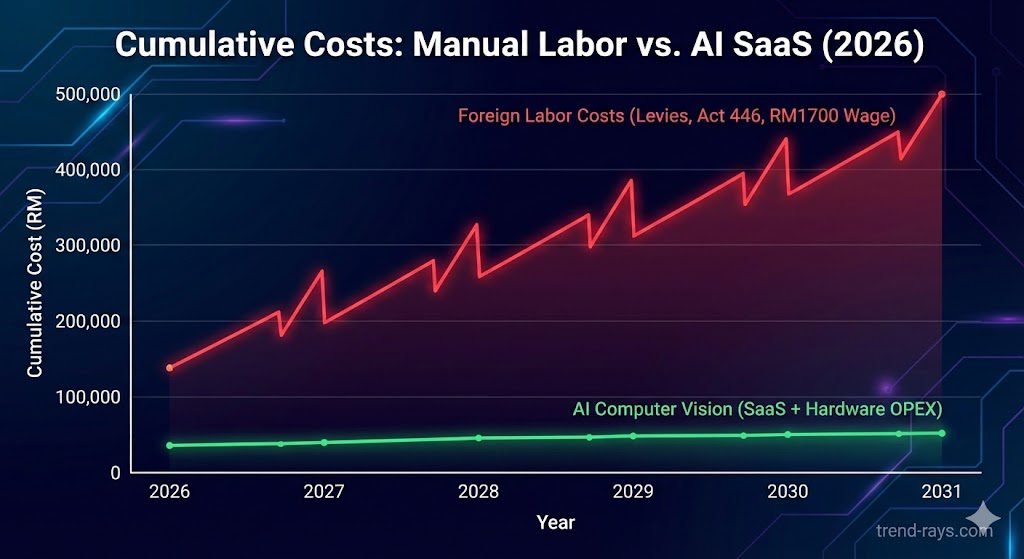
Simultaneously, the new national minimum wage of RM 1,700 is strictly enforced, and the highly anticipated Multi-Tier Levy Mechanism (MTLM) is penalizing companies that refuse to modernize. The government’s message, driven by the New Industrial Master Plan (NIMP) 2030, is undeniable: stop relying on low-skilled foreign labor and start automating.
For MSMEs and mid-tier factories, the solution isn’t fighting the government bureaucracy—it is bypassing it entirely. By implementing Computer Vision AI, you can drastically reduce your headcount, eliminate recruitment headaches, and instantly stabilize your operational costs while actually increasing your factory’s revenue capacity.
The 2026 Labor Reality for Malaysian Factories
Before looking at the technology, you must understand the financial penalties of maintaining the status quo. Hiring a foreign worker today involves far more than just a monthly salary.
- The Multi-Tier Levy Mechanism (MTLM): Under this new structure, the levy you pay is directly proportional to your dependency on foreign labor. If your factory floor is heavily reliant on foreign low-skilled workers, you will be pushed into the highest, most expensive levy tier.
- Act 446 (Hostel Compliance): The government heavily audits worker accommodations. Providing compliant housing, utilities, and transportation in industrial hubs requires massive capital expenditure.
- The Hidden Onboarding Costs: Between recruitment agency fees, FOMEMA medical screenings, Visa With Reference (VDR) processing, and security bonds, the upfront cost to bring a single worker into the country often exceeds RM 5,000 before they even touch a machine.
What is Computer Vision AI in Manufacturing?
Computer Vision is a subset of Artificial Intelligence that enables computers and industrial cameras to “see,” identify, and process visual data exactly like a human—but faster, 24/7, and without fatigue.
In a smart factory, you position high-definition optical sensors (cameras) over your assembly lines. These cameras stream live video to an edge computing device or a cloud SaaS platform. The AI analyzes every frame in milliseconds, identifying patterns, measuring dimensions, and spotting anomalies that the human eye would miss.
How AI Replaces Low-Skilled Dependency
Factory owners often assume they need physical robots with mechanical arms to replace human labor. In reality, the most labor-intensive jobs in a Malaysian factory are inspection and monitoring. Computer Vision AI eliminates the need for these specific roles:
1. The End of Manual Quality Control (QC)
In a traditional factory, you might have a dozen workers staring at a conveyor belt, manually inspecting products. Humans suffer from eye fatigue, leading to a natural drop in accuracy after just two hours.
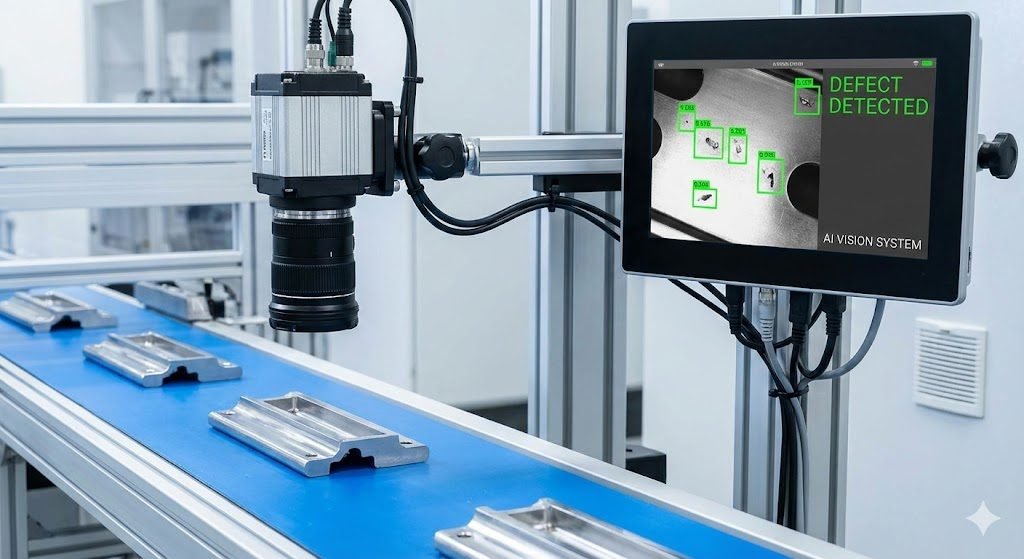
- The AI Solution: A single high-speed camera integrated with Computer Vision AI can inspect 100% of products in milliseconds. It instantly detects microscopic cracks or color variations, automatically triggering a mechanical arm to eject the defective product. One camera system easily replaces multiple manual QC inspectors per shift.
2. Automated SOP and Safety Enforcement
Floor supervisors spend half their day ensuring workers are wearing Personal Protective Equipment (PPE) and following Standard Operating Procedures.
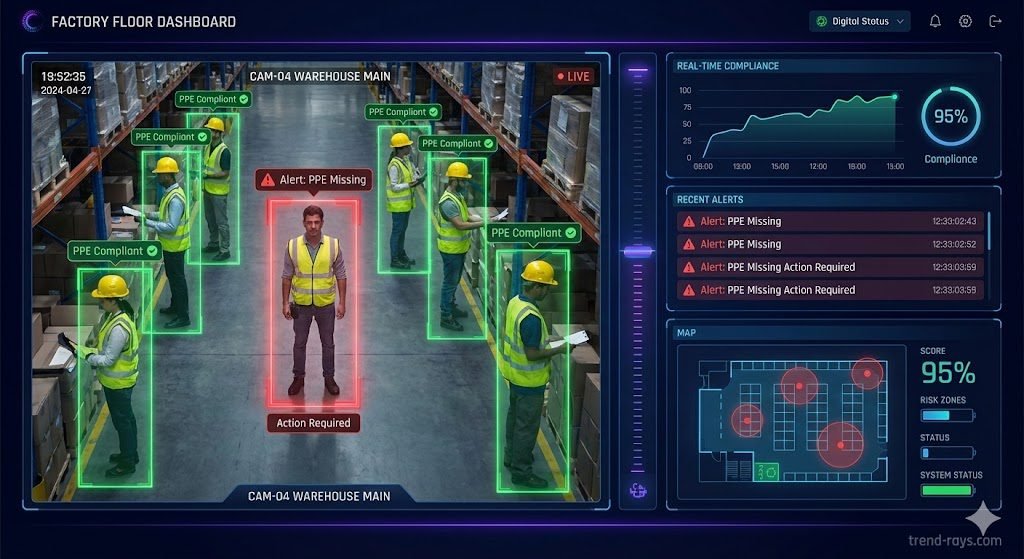
- The AI Solution: Your existing CCTV infrastructure can be upgraded with AI software. The system automatically scans the floor. If a worker enters a hazardous zone without a safety helmet, the AI instantly sends an alert to the manager’s phone.
The Economics of Perfection: Saving Time and Money
Replacing the worker is only the first layer of ROI. The true financial power of Computer Vision lies in eliminating the Cost of Poor Quality (COPQ).
When a tired human inspector misses a defect and that flawed product is shipped to a client, the financial fallout is catastrophic. You pay for reverse logistics, material waste, rework labor, and risk losing the client altogether.
- Time Savings at Line Speed: Human inspectors require assembly lines to run at slower speeds or rely on “batch sampling” (only checking 1 out of every 50 items). Computer Vision AI processes images in milliseconds. You can run your conveyor belts at maximum machine capacity while achieving 100% inspection rates.
- Slashing Material Waste: AI doesn’t just catch defects at the end of the line; it catches them instantly. If a stamping machine goes out of alignment, the AI detects the first bad part and halts the machine immediately, saving you from wasting expensive raw materials on a bad production run.
The Revenue Multiplier: Scaling Without Headcount
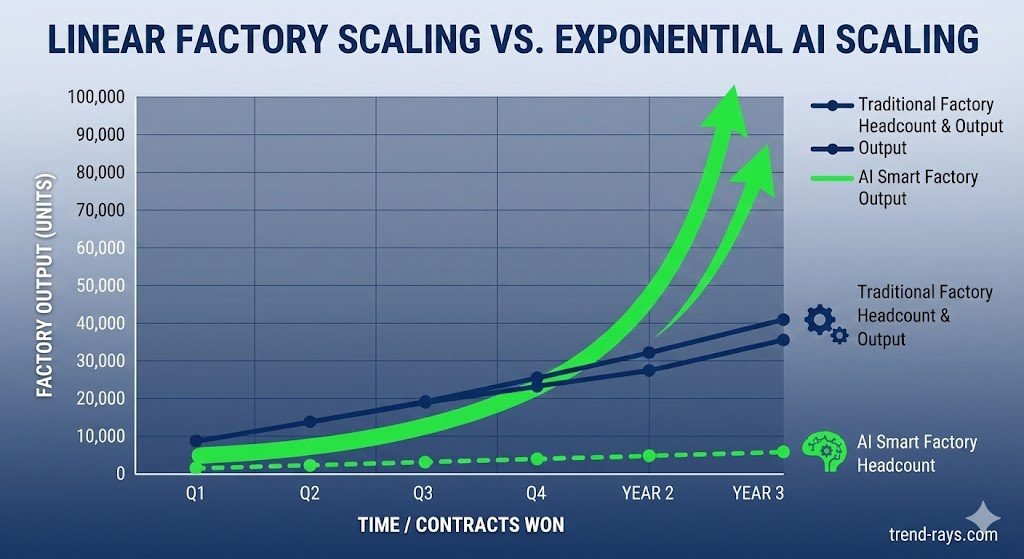
The most significant bottleneck for Malaysian SMEs trying to grow is the inability to fulfill large orders due to labor shortages. If you win a major contract, you cannot wait six months for KDN to approve a new batch of foreign worker visas.
Computer Vision AI unlocks non-linear scaling.
- The 24/7 Workforce: Human workers require 8-hour shifts, mandatory breaks, public holiday pay, and overtime premiums. An AI vision system operates 24/7 at a fixed SaaS subscription cost. To double your production output, you simply run a night shift without needing to double your QC headcount.
- Winning Premium MNC Contracts: Multinational Corporations (MNCs) demand strict quality guarantees. When you bid for a contract against a legacy factory, you can offer the MNC mathematical, automated proof of a near-zero defect rate backed by AI data. This technological edge allows you to win premium contracts and command higher margins.
The “Data Asset” Advantage
When a human inspector removes a defective part, they throw it in a bin. The knowledge of why it was defective disappears.
When an AI vision system flags a defect, it logs a high-resolution image, the timestamp, and the exact dimensional error into a cloud database. Over time, this transforms into a massive data asset. Your operations team can look at the dashboard and realize, “70% of all microscopic scratches are happening on Machine B between 2:00 PM and 4:00 PM.” This perfectly bridges the gap into [Predictive Maintenance], allowing you to fix the root cause of the problem upstream before it ruins more products.
Upskilling Locals: The NIMP 2030 Alignment
The goal of implementing AI is not just to cut costs; it is to create high-value jobs for Malaysians.
When you replace foreign manual inspectors with an AI camera, you now need a local technician to manage the software dashboard and analyze the data trends. You can utilize your HRD Corp claimable funds to train your existing Malaysian staff to become “AI Vision Operators.” This aligns perfectly with the government’s mandate to transition to a knowledge-based economy and makes your company highly eligible for matching tech grants like the MIDA SAG MADANI.
Frequently Asked Questions (FAQ)
What happens if I miss the March 2026 foreign worker quota deadline?
Applications submitted after the KDN deadline will generally not be processed. Failing to secure your quota means you will face a severe labor shortage for the remainder of the year, making AI automation an immediate operational necessity to keep your lines running.
How does the Multi-Tier Levy Mechanism (MTLM) impact my bottom line?
The MTLM penalizes companies based on their ratio of foreign to local workers. Exceeding sector-specific dependency ratio ceilings places you in a higher tier, resulting in a drastically more expensive levy per worker, which eats directly into your profit margins.
Can I use my existing CCTV cameras for AI Computer Vision?
Yes. Many modern AI vision SaaS platforms are hardware-agnostic. They can integrate directly into your existing IP cameras via an edge-computing gateway, drastically reducing the upfront installation costs.
Is it difficult to train an AI model for my specific factory products?
No. Modern AI Vision SaaS platforms use “few-shot learning.” You do not need to be a programmer. You simply take 20 to 50 pictures of a “good” product and a few pictures of “defective” products, and the AI trains itself to understand your specific quality standards within hours.