
For British gardeners, pruning is often the most anxiety-inducing task of the year. Cut a hydrangea at the wrong time, and you lose an entire summer of blooms. Prune a rose too early in Yorkshire, and a late frost will destroy the new shoots.
The problem with traditional gardening books and generic online calendars is that they treat the UK as one single climate. A gardener in Cornwall experiences a vastly different spring than a gardener in the Scottish Highlands.
This is where Artificial Intelligence becomes an invaluable tool. By giving ChatGPT the right context about your specific location and the exact plants in your garden, you can generate a highly customized, RHS-aligned pruning schedule that takes the guesswork out of garden maintenance.
Pruning is only one part of spatial management. If you are struggling with a narrow layout, try using an AI landscape design app for small backyards to visualize the space.
Here is exactly how to prompt ChatGPT to act as your personal head gardener.
Why Generic Pruning Advice Fails in the UK
The Royal Horticultural Society (RHS) divides plants into dozens of complex pruning groups based on whether they flower on “old wood” (last year’s growth) or “new wood” (this year’s growth).
If you ask a generic Google search, “When should I prune my hydrangea?”, you will likely get a conflicting answer. Mophead hydrangeas need light tidying in early spring, while climbing hydrangeas must be pruned in late summer right after flowering.
ChatGPT can cross-reference your specific plant species with your local UK climate zone, ensuring you never accidentally chop off next year’s flower buds.
When pruning out dead wood, always inspect the stems for disease. You can use an AI pest identifier app to check if those black spots are fungal or insect damage.
The “Master Prompt” for Your Whole Garden
Mastering hyper-specific prompts for local tasks is the first step toward launching new AI startup opportunities in niche markets that others are overlooking.
![A clean, modern infographic graphic. The background is a soft sage green. In the center is a stylized digital text bubble that contains the text of a "Master Pruning Prompt" for AI. Key phrasing like "[Insert Region]" and "[Insert Plant Type]" are highlighted in a bright, contrasting color like deep orange to show the user exactly where to fill in the blanks. The overall style is flat, corporate, and highly readable.](https://trend-rays.com/wp-content/uploads/2026/02/unnamed-21-1.jpg "How to Generate a Custom UK Pruning Calendar Using ChatGPT 2")
To get the best results, you need to stop treating ChatGPT like a search engine and start treating it like an employee. You must give it a “Role,” a “Context,” and a “Task.”
Copy and paste this exact prompt into ChatGPT, filling in the bracketed information with your own details:
The Master UK Pruning Prompt: “Act as an expert British horticulturist who follows Royal Horticultural Society (RHS) guidelines. I live in [Insert your County/Region, e.g., North Yorkshire], where our last frost is typically in [Insert month, e.g., late April].
I have the following plants in my garden:
- [E.g., David Austin shrub roses]
- [E.g., Mophead hydrangeas]
- [E.g., Buddleja davidii]
- [E.g., Apple tree]
Please generate a month-by-month pruning calendar for my specific garden. For each plant, tell me exactly when to prune it based on my local climate, how hard to cut it back, and why I am pruning it at that time. Please format the output as a clean, easy-to-read table.”
Why This Prompt Works:
By specifying your county and frost dates, the AI knows to delay the standard “February rose pruning” advice to late March if you live in the North. Asking for a table format makes the output instantly printable so you can pin it up in your potting shed.
Troubleshooting Specific UK Plants with AI
Sometimes, you need to dig deeper into a single, complicated shrub. Here are the specific prompts to use for the UK’s most beloved (and confusing) plants.
1. The Rose Pruning Prompt
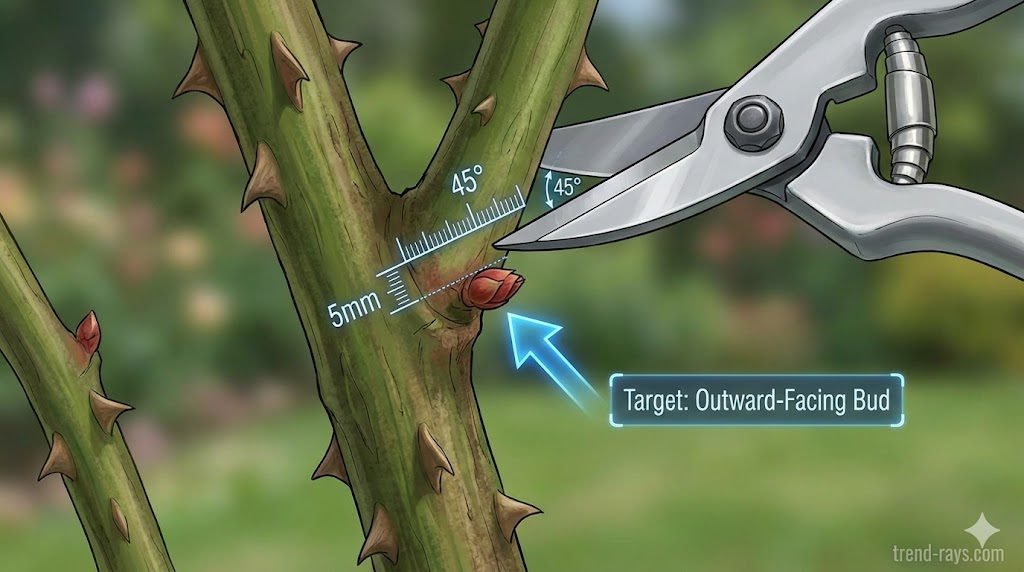
Roses are heavily dependent on their classification (Climbing, Rambling, Floribunda, or Shrub).
- The Prompt: “I have an overgrown [Insert rose type, e.g., climbing rose] in my UK garden. It has thick, woody, grey stems at the base. Give me a step-by-step guide on how to safely do a ‘renovation prune’ this winter without killing the plant. Explain exactly where to make the cuts (e.g., above an outward-facing bud).”
2. The Hydrangea Rescue Prompt
Hydrangeas are the most commonly mis-pruned shrubs in the UK.
- The Prompt: “I live in the UK and I don’t know what type of hydrangea I have, but it has large, round pink flower heads. It currently looks like a mass of dead twigs with dried flower heads on top. Should I cut the dead flower heads off now in winter, or wait? Tell me exactly how far down the stem I should cut when the time is right, according to RHS best practices.”
3. The “Chelsea Chop” Prompt
The ‘Chelsea Chop’ is a classic British gardening technique performed around the time of the RHS Chelsea Flower Show (late May) to control the size of herbaceous perennials and delay flowering.
- The Prompt: “I want to perform the ‘Chelsea Chop’ on my [Insert plant, e.g., Sedums and Phlox] to stop them from flopping over in late summer. Explain exactly how much foliage I should remove, and how doing this will affect the timing and size of the flowers.”
Refining Your AI Schedule
If ChatGPT gives you advice that seems odd, challenge it! AI can sometimes default to American hardiness zones. If it tells you to prune a tender plant in December, reply with: “Are you sure? In the UK, winter pruning might expose the fresh cuts to severe frost damage. Please revise this based on the UK climate.”
By taking five minutes to feed your garden’s inventory into ChatGPT, you will save yourself hours of research and guarantee a stronger, healthier, and more floriferous garden this summer.
Frequently Asked Questions (FAQ)
1. Can ChatGPT replace RHS guidelines? No, ChatGPT is a tool to synthesize RHS guidelines. It is always best practice to prompt ChatGPT to “act as an RHS expert” so it pulls from British horticultural data rather than generic global advice.
2. Why does my location in the UK matter for pruning? The UK has varying microclimates. Gardeners in the South East can often prune roses in late February, while those in Scotland should wait until late March or April to avoid late frosts destroying the newly stimulated growth.
3. Will ChatGPT know when my last frost date is? ChatGPT has a general understanding of UK weather patterns, but it is always safer to explicitly state your region (e.g., “I live in the Scottish Borders”) so the AI adjusts the timeline accordingly.
4. How do I ask ChatGPT to format my gardening schedule? Simply add “Please output this information in a table format sorted by month” to the end of your prompt. This gives you a clean, scannable calendar rather than a wall of text.
5. Is AI reliable for identifying what type of hydrangea I have? If you are unsure of your hydrangea type, use a visual AI tool (like Google Lens or PictureThis) to identify the specific variety first, and then feed that exact name into ChatGPT to get the correct pruning instructions.
6. Can ChatGPT tell me how to prune fruit trees? Yes. Fruit trees (like apples and pears) have strict pruning rules to protect the “fruit spurs.” Prompt ChatGPT with the specific type of fruit tree and ask for a “winter formative pruning guide.”
7. What if ChatGPT gives me American gardening advice? If ChatGPT mentions “USDA Hardiness Zones” or “fall” instead of autumn, simply reply: “Please rewrite this strictly for a UK gardener using UK terminology and RHS pruning groups.”
8. Can I use AI to plan when to prune evergreen hedges? Absolutely. Ask ChatGPT for a “bird-safe hedge trimming schedule” and it will remind you to avoid pruning between March and August to comply with UK wildlife protection laws regarding nesting birds.
9. How do I save my ChatGPT pruning calendar? Once ChatGPT generates your perfect table, you can copy and paste it into a Word document or spreadsheet, print it out, and hang it in your greenhouse or shed for easy reference.
10. Do I need a paid version of ChatGPT for gardening advice? No, the free version of ChatGPT is more than capable of generating highly accurate, text-based gardening schedules and step-by-step pruning instructions.