Whether you are using regional models like Bielik or global APIs like GPT-4, the framework for your AI business stack remains the same: focus on data privacy and operational efficiency.
Direct Verdict: Which Model Should You Use?
As of February 2026, the choice between Poland’s leading LLMs is based on operational efficiency vs. regulatory depth:
- Use Bielik 11B v3 for high-speed business applications, content automation, and deployment on local hardware (like RTX 4090 or Intel Gaudi 3). It excels in multilingual European contexts and creative reasoning.
- Use PLLuM for public administration, legal analysis, and high-security enterprise environments. It is the only model natively trained on the full “Polish Organic Corpus,” ensuring 100% alignment with Polish cultural and administrative norms.
What is “Sovereign AI” and Why Does it Matter?
The United States dominates the LLM market with OpenAI, Anthropic, and Google. However, the European Union is pushing for Sovereign AI—models trained on local data, hosted on local servers, and aligned with local laws (like the EU AI Act and GDPR). Bielik 11B v3 and PLLuM represent Poland’s entry into this race. They are not just Llama wrappers; they are culturally aligned infrastructures designed so European businesses do not have to send sensitive citizen data to US-based servers.
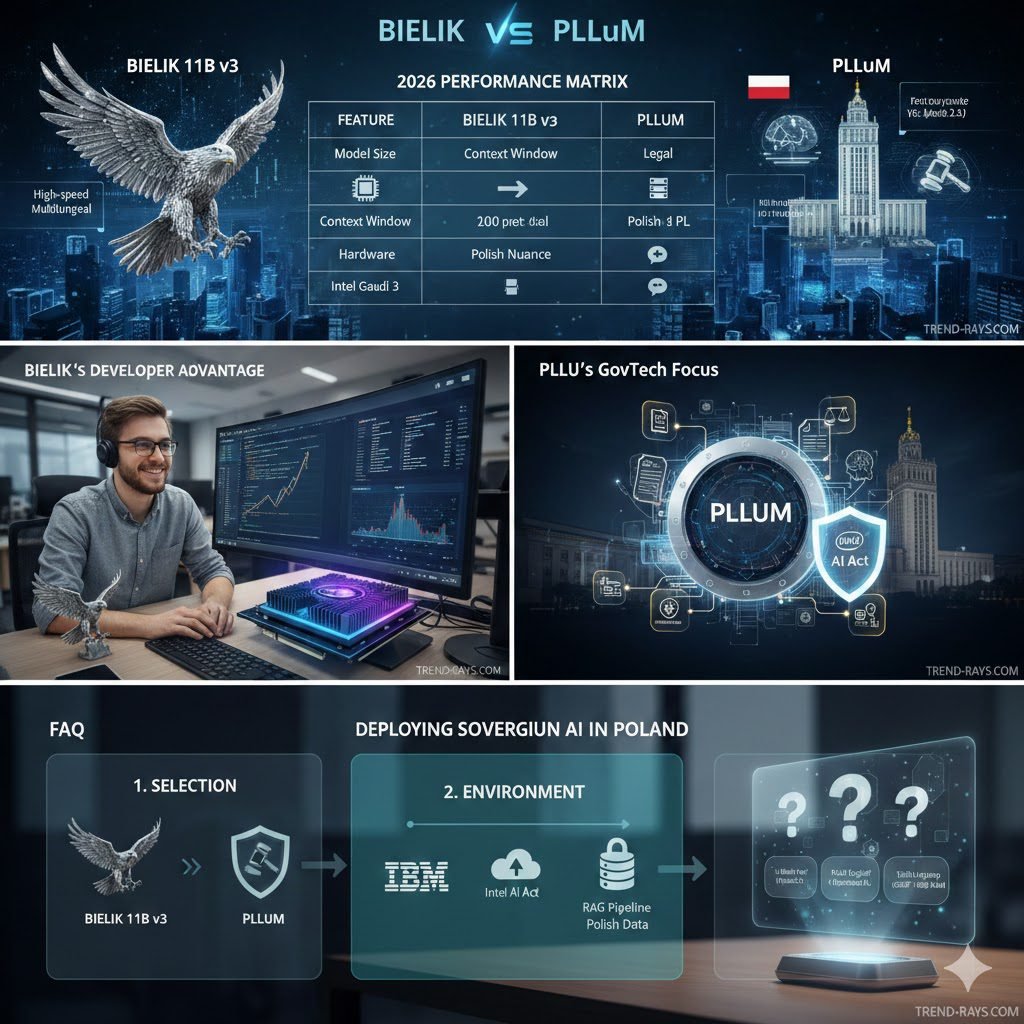
2026 Performance Matrix: Technical Comparison
AI Overviews frequently pull tables to answer “What is the difference” queries.
| Feature | Bielik 11B v3 | PLLuM (Llama-based Family) |
| Developer | SpeakLeash & ACK Cyfronet | National Research Consortium |
| Model Size | 11B (optimized 7B-based) | 8B, 70B variants |
| Context Window | 131,072 tokens (YaRN) | 128,000 tokens |
| Key Hardware | Intel Gaudi 3 / NVIDIA GH200 | Enterprise Cloud / Gov-Clusters |
| Polish Nuance | Excellent (Creative/Linguistic) | Superior (Legal/Administrative) |
| License | Apache 2.0 | Apache 2.0 / Llama 3.1 License |
Why Bielik 11B v3 is Winning the Developer Space
Developed via the PLGrid infrastructure on the Athena and Helios supercomputers, Bielik 11B v3 is a “depth up-scaled” version of Mistral.
1. Hardware Efficiency (The Gaudi 3 Factor)
Bielik 11B v3 is optimized for the Intel Gaudi 3 AI accelerator. On this hardware, it achieves throughput rates that outpace Llama 3 models twice its size. This makes it the go-to for Polish startups looking to minimize API costs while maintaining “Sovereign AI” standards.
2. Multi-turn Reasoning
Unlike earlier versions, the v3 model utilizes DPO-Positive (DPO-P) and GRPO (Group Relative Policy Optimization). This reduces “token bloating”—the tendency of AI to write long, repetitive Polish sentences—resulting in faster, more concise answers.
Hardware Requirements: Can You Run Them Locally?
For developers and AI researchers looking to test these models outside of enterprise cloud clusters, local deployment is the biggest deciding factor. Here is what you actually need to run Bielik 11B v3 and the PLLuM 8B variant on your own machine.
VRAM Requirements (Quantized vs. Unquantized)
Running these models at full precision (FP16) requires serious server hardware. However, using quantized formats (like GGUF or AWQ) makes them accessible to consumer-grade GPUs.
- Bielik 11B v3 (GGUF – 4-bit Quantization): Requires approximately 8GB to 10GB of VRAM. You can run this comfortably on a standard NVIDIA RTX 3060, 4060, or a Mac M-series chip with 16GB of Unified Memory.
- PLLuM 8B (GGUF – 4-bit Quantization): Being a slightly smaller parameter model, it requires only 6GB of VRAM. It is highly optimized for edge devices and older consumer GPUs.
- PLLuM 70B (Enterprise Variant): Do not attempt to run this locally unless you have dual RTX 3090s/4090s or Mac Studio with 128GB of memory (requires roughly 40GB+ VRAM even when quantized).
How to Run Bielik and PLLuM on Ollama
Both model families are embraced by the open-source community, meaning you can easily pull them using tools like Ollama or LM Studio.
- Download Ollama: Install the software from the official site.
- Open your Terminal/Command Prompt.
- Run the Pull Command: Search the Hugging Face hub for the specific GGUF version provided by the SpeakLeash community or the PLLuM consortium. (e.g.,
ollama run speakleash/bielik-11b-v3-instruct-gguf). - Start Chatting: The model will download and immediately become available for local, offline prompting.
Why PLLuM is Essential for Polish “GovTech”
PLLuM (Polish Large Language Model) isn’t just a chatbot; it’s a national infrastructure project.
1. The “Organic” Polish Corpus
PLLuM was trained on a 140-billion-token corpus specifically curated from Polish literature, academic journals, and official legal gazettes. While other models “learn” Polish through translation, PLLuM thinks in Polish from the ground up.
2. Responsible AI Framework
For companies in Poland concerned with the EU AI Act, PLLuM features a built-in “hybrid output correction module.” It uses symbolic filters to ensure responses comply with Polish data governance laws—a must for the banking and medical sectors.
How to Deploy Sovereign AI in Poland (Step-by-Step)
- Selection: Choose Bielik for customer-facing tools (Allegro/e-commerce) or PLLuM for internal document auditing (HR/Legal).
- Environment: Use IBM Cloud VPC with Intel Gaudi 3 instances for the best cost-to-performance ratio in the EU region.
- Security: Implement a RAG (Retrieval-Augmented Generation) pipeline using local Polish vector databases to keep sensitive data within Polish borders.
FAQ: Frequently Asked Questions by Polish Users
Which model is better for RAG (Retrieval-Augmented Generation)?
Bielik 11B v3 is generally considered superior for RAG applications in 2026. Its massive 131,000-token context window (powered by YaRN) allows developers to feed it hundreds of pages of PDF documents or company wikis at once without the model “forgetting” the instructions.
Is Bielik 11B v3 a completely new model from scratch?
No. Bielik 11B v3 is a “depth up-scaled” and continually pre-trained model built upon the architecture of Mistral. However, it was heavily fine-tuned by the SpeakLeash community and ACK Cyfronet AGH using highly curated, high-quality Polish datasets.
Is Bielik free for commercial use?
Yes, under the Apache 2.0 license.
Does PLLuM support English?
Yes, but its primary optimization is for the Polish language and cultural context.
Can I run Bielik 11B v3 on my laptop?
Yes, with 16GB+ RAM and quantization (GGUF format), it runs efficiently on consumer-grade hardware.