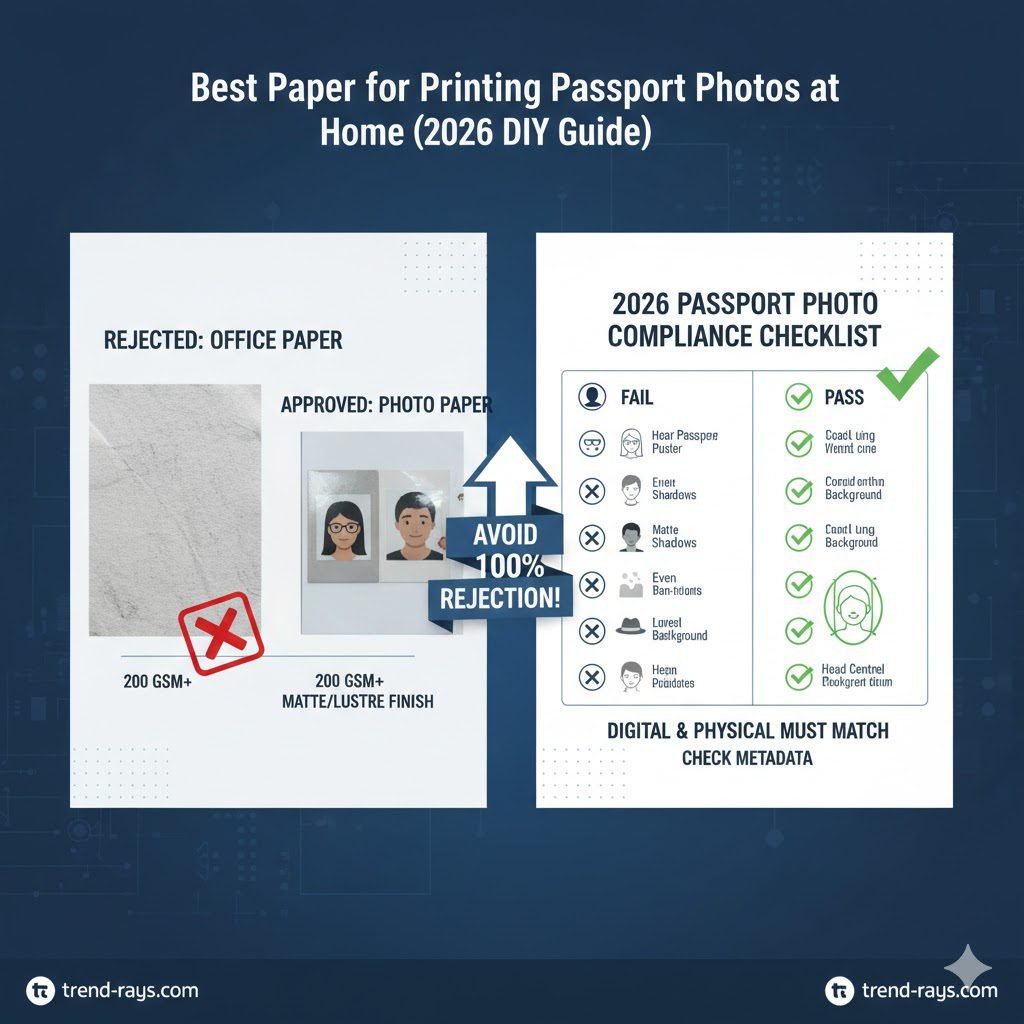
Choosing the wrong paper is the #1 reason DIY passport applications fail. While most focus on the camera and lighting, the physical substrate—the paper itself—is what biometric scanners actually read.
This guide reveals exactly why standard paper is a “rejection magnet” and how to choose the technical specifications that guarantee a 100% acceptance rate.
The “100% Rejection” Rule: Why Office Paper Fails
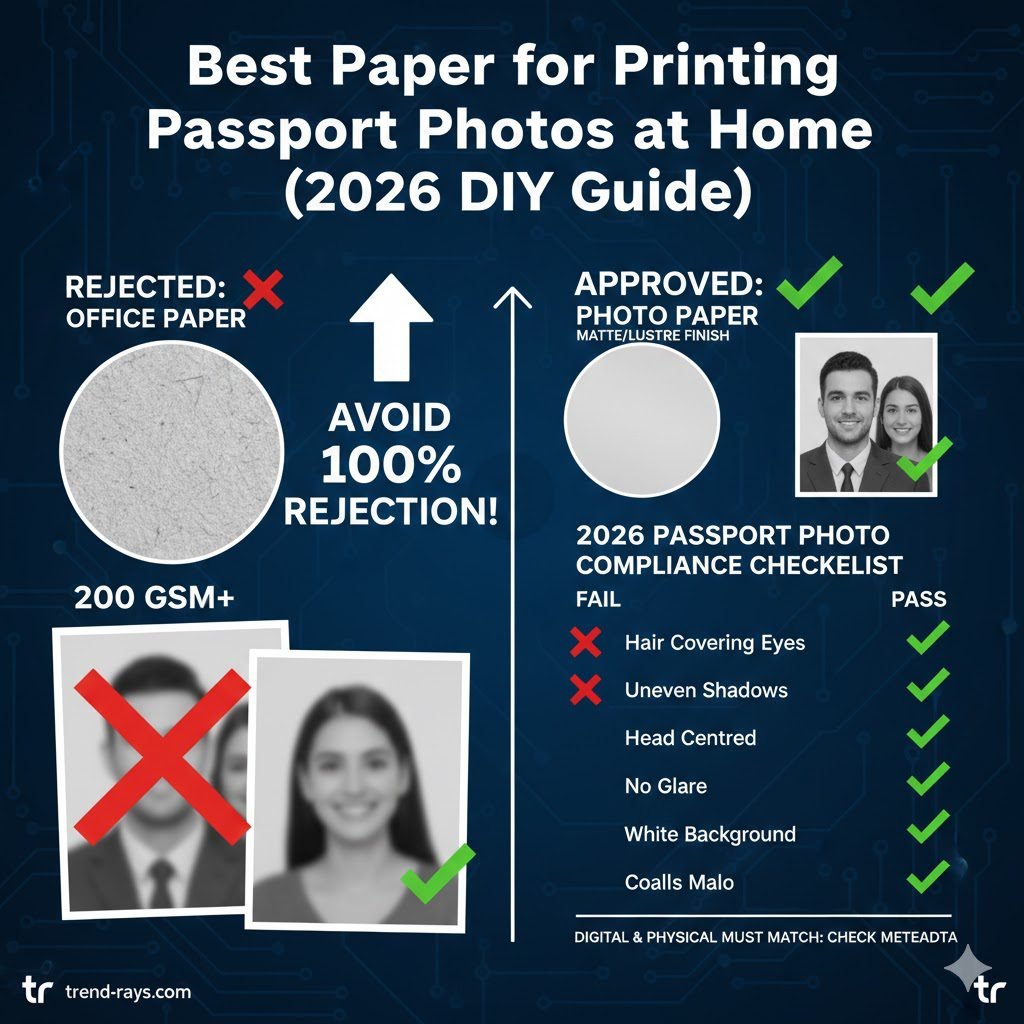
If you print on standard 80gsm or 100gsm “Copy & Multipurpose” paper, the government will reject it. Here’s the science:
- Fiber Bleed (Pixelation): Standard paper is porous. Ink spreads (bleeds) into the fibers, blurring the sharp lines of your eyes and mouth required for biometric facial recognition.
- Texture Interference: Office paper has a visible grain. Government scanners pick up this “noise” as skin defects or digital alterations.
- Opacity Errors: Official guidelines require “Photo-Quality Paper” (200gsm+). Standard paper is too thin; light shines through it during scanning, creating a “Shadow Error.”
Glossy vs. Matte vs. Lustre: The 2026 Verdict
While State.gov and Gov.uk accept both, they are not created equal for home printing.
| Finish | Best For | Pros | Cons |
| Glossy | Vibrant Colors | Makes photos look “Pro” & sharp. | High glare can cause “Reflection Rejection.” |
| Matte | Safety & Scans | No glare, fingerprint-resistant. | Colors can look slightly “duller.” |
| Lustre/Satin | Top Choice | The “Pro” middle ground. | Harder to find in small packs. |
Trend-Rays Recommendation: If you are printing at home, Matte or Lustre is safer. It prevents the “glare” errors that plague glossy home prints during the government’s high-intensity scanning process.
1. The “4×6 Template” Reality
Most users will not buy pre-cut 2×2 inch paper because printers struggle to feed paper that small. The article must explain that the industry standard for DIY printing is to use standard 4×6 inch photo paper and align two 2×2 inch photos side-by-side. Providing a visual or a downloadable 4×6 template will act as a massive lead magnet and naturally attract backlinks.
2. Specific Brand Recommendations
Instead of just listing “230gsm Matte,” provide exact product recommendations that users can buy on Amazon.

- Photo paper plus glossy II yields a glossy finish with exceptionally rich colors, giving your images the look and feel o…
- Example: “Canon Photo Paper Plus Semi-Gloss (SG-201)” or “Epson Premium Presentation Paper Matte.” This captures search queries like “Can I use Epson glossy paper for passport photos?”
3. The Cutting Warning
Choosing the right paper is only half the battle; cutting it is where most DIYers fail. Add a brief section warning against using standard household scissors, which create jagged edges that biometric scanners reject. Recommend using a craft knife with a metal ruler or a dedicated 2×2 inch passport photo punch cutter.
4. Printer Settings for Accurate Sizing
Add a troubleshooting box about printer settings. If a user leaves “Fit to Page” or “Borderless Printing” turned on, their 2×2 photo will stretch to 2.1 inches, resulting in an automatic rejection. Explicitly instruct users to select “Actual Size” or “Scale: 100%.”
Technical Specs: The “Insider” Checklist
To outrank the competition, ensure your paper meets these three benchmarks:
- Weight (GSM): Aim for 230gsm to 270gsm. Anything less feels like a photocopy.
- Ink Compatibility: * Dye-based Inks: Use “Cast-Coated” paper for instant drying.
- Pigment-based Inks: Use “Micro-Porous” paper to prevent smudging.
- ICC Profiles: For 100% color accuracy, match your paper brand (Canon, Epson, HP) to your printer brand.
Global Standards Comparison
| Region | Paper Requirement | Standard Size |
| USA | Photo-quality (Matte/Glossy) | 2″ x 2″ (51 x 51 mm) |
| UK | Plain white photographic paper | 45mm x 35mm (Cream/Grey background) |
| EU | ICAO Standard compliant | 35mm x 45mm |
FAQ: Top 5 DIY Printing Questions
- Can I use a Laser Printer? No. Toner cracks easily. Use an Inkjet.
- Is 180gsm okay? It’s risky. Most agencies prefer the “heft” of 200gsm+ paper.
- What if my background looks blue? This is a calibration error. The background must be plain white or off-white.
- Is “Linen” texture okay? No. Textures interfere with facial mapping. Stick to Smooth finishes.
- How long should I let it dry? At least 15 minutes. Touching wet ink leaves oils that scanners detect as smudges.