For therapists, speech-language pathologists (SLPs), and private practice owners, clinical documentation is the leading cause of burnout. You likely spend hours every week typing up SOAP notes, evaluations, and patient summaries long after the clinic has closed.
While generic artificial intelligence has revolutionized many industries, healthcare professionals face a massive legal roadblock: strict data privacy laws. As we discussed in our detailed breakdown of ChatGPT’s HIPAA compliance for private practices, feeding Protected Health Information (PHI) into free consumer AI tools is a direct violation of federal law, carrying devastating financial penalties.
You cannot use the free version of ChatGPT, Otter.ai, or standard Google Docs voice typing for patient notes. You need specialized, HIPAA-compliant AI medical scribes that will sign a Business Associate Agreement (BAA).
Here are the top 5 HIPAA-compliant AI dictation and ambient scribe tools you can safely use in your private practice right now.
The Danger of Searching for a “Free HIPAA Compliant AI”
If you are a solo practitioner on a budget, you have likely searched for a “free HIPAA compliant AI scribe.” Here is the harsh reality in 2026: Truly free AI tools do not sign BAAs. When a SaaS company offers a 100% free AI dictation app, they are usually monetizing the user by using the recorded audio data to train their public language models. Feeding Protected Health Information (PHI) into a free app without a Business Associate Agreement is a direct HIPAA violation resulting in massive fines.
The Safe “Free” Alternative: Instead of risking your license on unvetted free software, look for enterprise-grade tools that offer “Freemium” tiers or extended free trials. For example, Freed AI and DeepCura offer free trial periods where they will sign a BAA during the trial phase, allowing you to test the ambient scribe legally before committing to a monthly subscription.
What Makes an AI Dictation Tool Actually HIPAA Compliant?
Before looking at the software, it is critical to understand what separates a legal medical tool from a risky consumer app. A truly compliant AI SaaS must provide:
- A Signed BAA: The software provider must be willing to sign a Business Associate Agreement, legally binding them to protect your patients’ PHI.
- Zero-Retention Policies: The AI must not store your audio recordings or use your patients’ data to train its future public language models. The AI must not store your audio recordings. With the rise of deepfakes and audio scams that cybersecurity SaaS is actively fighting, ensuring your patients’ raw voice data is never retained on public servers is critical for ethical compliance.
- End-to-End Encryption: Data must be encrypted both in transit (while recording) and at rest (when saved on their servers).
The Transformative Benefits of AI Dictation Tools
Why are thousands of healthcare professionals migrating to AI scribes in 2026? It goes far beyond simply typing faster. Integrating a compliant AI dictation tool into your practice offers three massive operational benefits:
- Ending “Pajama Time”: The healthcare industry notoriously suffers from “pajama time”—the hours spent writing clinical documentation at home late at night. AI scribes automate up to 80% of this workload, allowing you to leave work at work.
- Restoring Patient Eye Contact: When you are furiously typing on a laptop or writing on a clipboard, you lose the crucial human connection with your patient. Ambient AI scribes run silently in the background, allowing you to maintain active listening and eye contact, which drastically improves the patient experience and clinical outcomes.
- Standardized, Audit-Proof Documentation: Humans get tired; AI does not. At the end of a long Friday, your manual notes might become brief or sloppy. AI ensures that every single session is documented with the exact same high level of detail, formatting (like SOAP or DAP), and professional medical terminology, keeping you perfectly safe during insurance audits.
Top 5 HIPAA-Compliant AI Medical Scribes for 2026
If you are looking to automate your clinical paperwork legally, these specialized SaaS platforms are leading the industry. Here is a breakdown of how they work and the specific benefits they offer.
Understanding the Tech: Ambient AI Scribes vs. Dictation Software
When choosing your software, it is important to know the difference in workflow:
- Traditional AI Dictation (e.g., Dragon Medical): You speak into a microphone after the patient leaves, and the AI types your words exactly as you say them, translating complex medical jargon perfectly.
- Ambient AI Scribes (e.g., Freed AI, Nabla): The software runs quietly in the background during your patient visit. It listens to the natural conversation, filters out the small talk, and automatically generates a structured SOAP note when the visit ends.
1. Freed AI (Best for Solo Practitioners & Therapists)
Freed AI is a dedicated “ambient scribe” that listens to your natural conversation and magically formats it into a structured clinical note. This tool is perfect for behavioral health and acts as an essential AI time-saving hack for Speech Language Pathology by actively filtering out irrelevant small talk.
- Compliance: Full HIPAA compliance with a BAA available upon subscription. Zero audio retention after the note is generated.
- How to Use It: Open Freed on your phone or laptop browser, click “Capture,” and place the device on your desk. Conduct your therapy or medical session normally. When finished, click “Stop,” and Freed instantly generates a SOAP note. You then copy and paste the text into your EHR (Electronic Health Record) system.
- The Specific Benefit: It actively filters out irrelevant “small talk” (like discussing the weather) and only extracts the clinically relevant data, saving solo therapists 1-2 hours daily.
2. Nabla Copilot (Best for Clinical EHR Integrations)
Nabla is a highly respected clinical AI assistant designed for speed and seamless integration directly into web-based EHR systems.
- Compliance: Strict privacy protocols. Audio is never stored, transcripts are deleted immediately, and they offer a BAA.
- EHR Compatibility: Nabla is built to overlay seamlessly on top of major clinical platforms like Epic, Cerner, Athenahealth, and web-based therapy EHRs like SimplePractice and Jane.
- How to Use It: Install the Nabla Chrome extension. When you open your patient’s chart, Nabla hovers as a small widget. Conduct the session, and Nabla will generate the note and auto-fill the text directly into the correct fields of your EHR without you having to copy-paste.
- The Specific Benefit: Frictionless workflow. Because it syncs directly with heavy-duty hospital EHRs, you don’t have to change your daily habits or juggle multiple windows.
3. DeepCura AI (Best for Customization & Specialists)
If you need highly specific templates beyond a basic SOAP note (such as complex SLP evaluations or specialized psychiatric assessments), DeepCura is a powerhouse.
- Compliance: HIPAA compliant, provides a BAA, and utilizes secure, private server environments.
- How to Use It: Before a session, you set up “Custom AI Prompts.” You tell the AI exactly what headers, assessment scales, or billing codes to look for. During the session, the ambient scribe listens. Afterward, it processes the transcript through your custom prompt to generate a highly specialized document.
- The Specific Benefit: Flexibility. It prevents specialists from having to manually edit generic AI notes to fit their niche requirements.
4. Dragon Medical One (Best for Traditional Dictation)
If you prefer traditional dictation (speaking your notes out loud after a session) rather than an “ambient” listening scribe, Nuance’s Dragon Medical One remains the industry gold standard.
- Compliance: Enterprise-grade HIPAA compliance used by major hospital networks worldwide.
- EHR Compatibility: Natively integrates deeply into heavy enterprise software like Epic and Cerner, as well as Windows-based medical billing platforms.
- How to Use It: Open your EHR and place your cursor in the text field. Press the record button on your specialized PowerMic or smartphone app and speak your clinical note out loud. The text appears on the screen instantaneously with near-100% medical vocabulary accuracy.
- The Specific Benefit: Immediate control. You are actively dictating the exact phrasing you want, which is preferred by veteran physicians who are already used to dictaphone workflows.
5. HIPAA-Compliant Zoom / Microsoft Teams (Best for Telehealth)
If you run a purely telehealth practice, you might not need a separate dictation tool at all.
- Compliance: Must be on a specific Healthcare/Enterprise plan with a signed BAA (free consumer versions are NOT compliant).
- How to Use It: Start your secure video call. Enable the “Live Transcription” or AI meeting summary feature built directly into the enterprise platform. After the call, extract the transcript and paste it into your EHR.
- The Specific Benefit: It consolidates your software stack, saving you from buying a separate AI scribe if you already pay for enterprise telehealth software.
The ROI of AI Scribes: Why the Subscription is Worth It
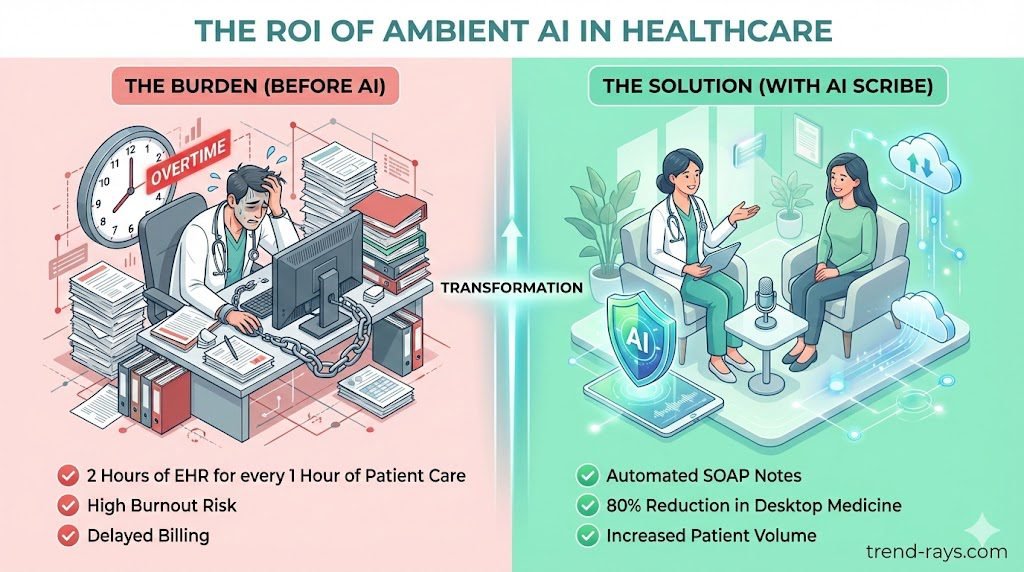
Private practice owners often hesitate at adding a $100/month SaaS subscription to their overhead. However, looking at the return on investment (ROI) from different professional angles reveals that an AI scribe is one of the highest-leverage investments you can make.
1. For the Solo Freelance Therapist
Time is your only inventory. If an AI scribe saves you just one hour of documentation time per day, that is five hours a week. If your billable rate is $150 per hour, you are freeing up $750 worth of billable time every single week. The software pays for its monthly fee in the first two days of the month. You can use that extra time to take on 3-4 more clients per week or focus on marketing your practice.
You can use that extra time to take on 3-4 more clients per week, or focus on marketing your clinic’s website using the best AI SEO writing SaaS tools to rank on Google and attract local patients.
2. For the Growing Group Practice or Clinic
If you manage multiple clinicians, your ROI comes from scale and quality control. Hiring a human medical scribe or transcriptionist can cost $3,000 to $4,000 a month. Deploying an AI scribe across 5 clinicians costs roughly $500 a month. Furthermore, it standardizes the note quality across your entire staff, ensuring faster insurance reimbursements and fewer denied claims due to missing documentation.
Deploying an AI scribe standardizes note quality, allowing your front desk to spend less time chasing paperwork and more time managing patient intakes—such as setting up a custom WhatsApp link in your clinic’s Instagram bio to streamline new patient bookings.
3. The Unquantifiable ROI: Mental Health
Burnout in the medical and therapy fields is at an all-time high. The true ROI of an AI dictation tool is eating dinner with your family without a laptop open on the table. It is the mental relief of knowing your charts are completed the moment the patient walks out the door. You cannot put a price tag on career longevity.
Frequently Asked Questions (FAQ)
Is Otter.ai HIPAA compliant?
The free and standard Pro versions of Otter.ai are not HIPAA compliant. Otter only offers HIPAA compliance and a BAA on their expensive “Enterprise” tier, which is usually out of budget for solo practitioners.
Can I use Google Docs Voice Typing for patient notes?
No. Unless your practice subscribes to Google Workspace with a signed BAA covering all core services, standard free Google Docs does not meet federal PHI privacy standards.
Does an AI scribe replace my EHR?
No. These tools are designed to work alongside your Electronic Health Record system. They generate the text of the note, which you then review, approve, and copy into your official EHR (like SimplePractice, Jane, or Theranest).