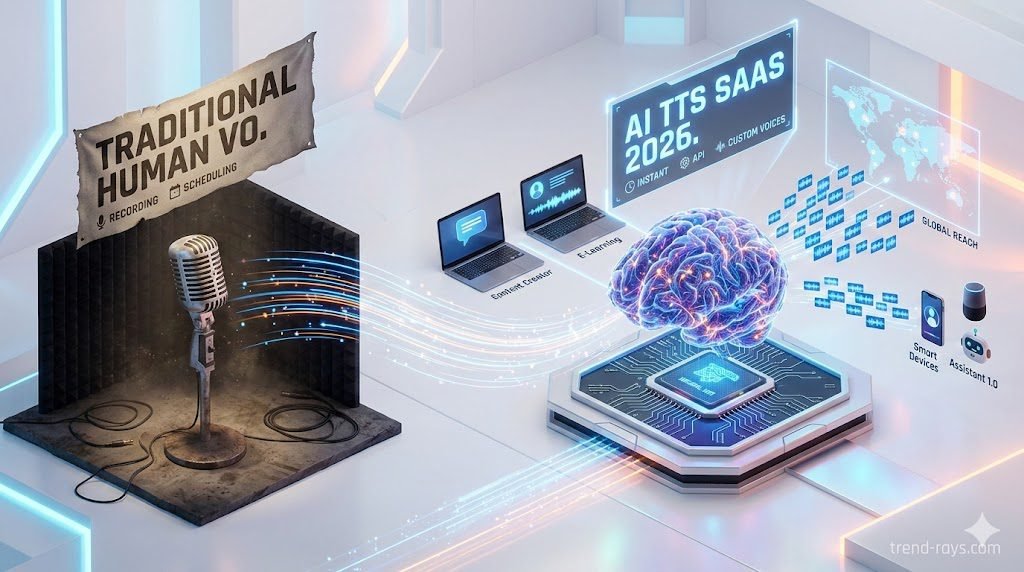
Just a few years ago, AI-generated voices were mostly known for internet novelties—powering automated prank calls, meme videos, and robotic-sounding virtual assistants. Fast forward to 2026, and AI text-to-speech (TTS) software has transitioned from an experimental playground into core, mission-critical infrastructure for global businesses.
The global AI voice market is experiencing explosive growth. Driven by enterprise-grade AI voice generator SaaS platforms, projections estimate the industry will exceed $50 billion by 2030.
Whether you are a creator, an enterprise marketer, or a developer, understanding how AI is disrupting the voiceover industry is no longer optional. Here is a deep dive into the shift toward synthetic audio, the industries being transformed, and the top SaaS tools leading the charge.
The Shift to “Synthetic” Production: Why Businesses are Adapting
The transition from human to synthetic production is moving rapidly, driven by three massive operational advantages:
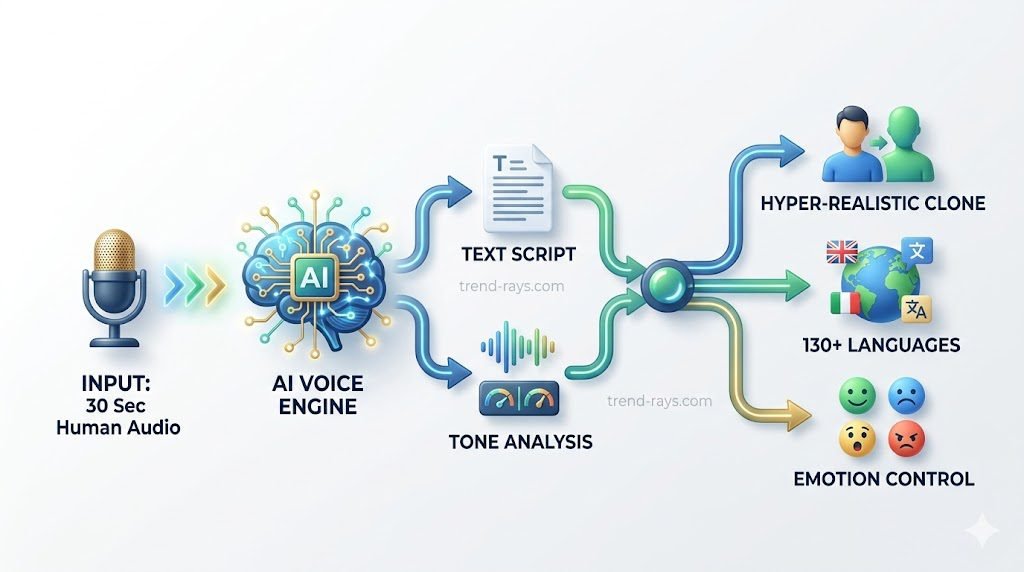
- Drastic Cost Reduction: Producing high-quality, professional audio content traditionally meant paying for voice actors, studio time, and audio engineers. Today, AI enables businesses to generate the same volume of audio at a fraction of the cost. Estimates report that companies see 30-40% savings in their first year of adopting AI text-to-speech software.
- Unmatched Speed and Scalability: Timelines have vanished. Projects that previously took days or weeks—such as recording 100+ hour audiobooks, massive e-learning courses, or thousands of lines of gaming dialogue—can now be generated in minutes.
- The “Zero-Shot” Cloning Revolution: Modern enterprise voice cloning technology is remarkably efficient. AI can now clone a specific, recognizable human voice from just 30 seconds of sample audio. This allows brands to create, or securely license, a unique “signature” voice that belongs entirely to their company.
Benefits vs. Disadvantages of Synthetic Voice Production
To understand the full scope of this shift, businesses must weigh the pros and cons before entirely replacing their audio pipelines.
| Feature | The Benefits (Pros) | The Disadvantages (Cons) |
| Operational Efficiency | 24/7 availability; no need to schedule studio time or handle human delays. | Requires technical training to master the software and phonetic tuning. |
| Financial Impact | Predictable monthly SaaS subscription costs instead of high hourly rates. | High initial cost if developing a custom, enterprise-level cloned voice. |
| Global Reach | Instant translation into 130+ languages while maintaining the original brand voice. | Nuances in regional dialects or cultural slang can sometimes be missed by the AI. |
| Brand Perception | Consistent, reliable audio quality across all brand touchpoints (IVR, ads, training). | The “Trust Threshold”: If the voice sounds slightly inauthentic, 79% of consumers report a negative brand perception. |
| Security & Ethics | Easy to update and control internal IP. | Susceptible to deepfakes, voice theft, and requires strict adherence to voice watermarking laws. |
Just as modern productivity software tools have streamlined office management, transitioning to a cloud-based AI voice platform eliminates the need to manage heavy, localized studio equipment.
Major Industries Being Impacted
The ripple effects of this technology are completely overhauling how audio is deployed across major sectors. The rapid A/B testing is becoming a core pillar of modern social media growth strategies, allowing brands to test different emotional deliveries to see which voice yields the highest engagement.
- E-Learning and Corporate Training: AI voices deliver consistent, high-fidelity narration for corporate training modules. When a company policy changes, the audio can be instantly updated by editing text.
- Marketing and Advertising: Digital marketers are using AI to create personalized, localized, and multi-lingual ads in real-time. This allows for rapid A/B testing of different voices, tones, and inflections to see what converts best.
- Customer Service (IVR): In 2026, 80% of businesses are integrating AI call center software into their customer service pipelines. AI agents can now handle routine, high-volume inbound calls with genuine emotional intelligence.
- Gaming and Entertainment: Game developers are utilizing AI for dynamic dialogue generation, allowing non-player characters (NPCs) to respond to players in real-time with unique, context-aware voices.
What Remains Unimpacted (The Human Solution)
With all this disruption, it is crucial to note what isn’t changing. Human voice actors are not entirely obsolete; instead, they are shifting to a “hybrid” model.
AI excels at volume, but it still struggles with raw, unpredictable human empathy. The solution for high-end media is to reserve human actors for “Hero Content.” When deep nuance, sorrow, complex humor, and cultural context are critical—such as in feature films, premium audiobooks, Super Bowl advertisements, and the main protagonists of AAA video games—the human voice remains the undisputed gold standard. AI handles the background noise; humans handle the soul.
The Top AI Voice SaaS Tools Driving the Change (And How to Use Them)
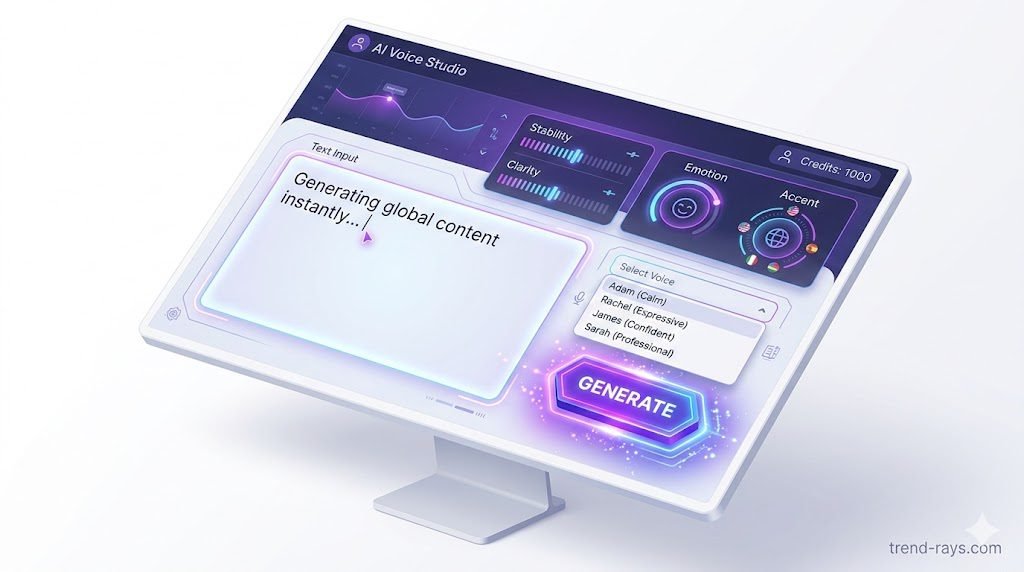
If your business is looking to leverage this disruption, these three platforms have established themselves as industry leaders.
1. ElevenLabs
ElevenLabs remains the dominant player for hyper-realistic, emotionally nuanced delivery. Their platform excels at zero-shot cloning, making it a favorite for both individual creators and enterprise media companies.
- Best for: Audiobooks, premium content creation, and highly expressive enterprise voice cloning.
- How to Use It: 1. Navigate to the VoiceLab to either clone your own voice (by uploading a clean 1-minute audio sample) or build a completely new voice by adjusting parameters like age, gender, and accent.2. Head to the Speech Synthesis dashboard and paste your script.3. Use the Voice Settings sliders to adjust “Stability” (how consistent the voice is) and “Clarity + Similarity” (how closely it matches the original clone).4. Hit generate and download your broadcast-ready MP3 or WAV file.
2. WellSaid Labs
WellSaid Labs built its reputation by focusing heavily on the B2B sector. Their platform is tailored for corporate teams, offering excellent collaboration tools and highly professional, consistent voice avatars.
- Best for: Corporate e-learning, internal training videos, and corporate presentations.
- How to Use It:
- Create a new “Project” within the WellSaid Studio and invite your team members.
- Browse their Voice Avatars library, which is categorized by professional use cases (e.g., Narration, Promo, Conversational).
- Paste your script into the text editor. WellSaid excels at complex pronunciations, so you can use their built-in Respelling tool (e.g., typing “A I” instead of “AI”) to ensure the avatar pronounces industry acronyms perfectly.
- Render the audio directly into your timeline for corporate video presentations.
3. OpenAI (Voice Engine / API)
OpenAI provides the backend infrastructure that many developers use to build their own voice applications. Their programmable voice APIs are incredibly powerful for companies wanting to integrate real-time conversational AI directly into their own software.
- Best for: Developers, AI call center software integrations, and custom SaaS building.
- How to Use It:
- This tool requires coding knowledge. Developers must generate an API Key from the OpenAI platform.
- Using Python or Node.js, make an API call to the
audio/speechendpoint. - You will define three parameters in your code: the Model (e.g.,
tts-1for speed ortts-1-hdfor high quality), the Voice (choosing from their preset options like Alloy, Echo, or Fable), and the Input (your actual text string). - The API instantly returns a high-quality audio file that your application can stream directly to your user.
The Double-Edged Sword: Ethics, Security, and Multilingual Domination
As AI text-to-speech technology reaches near-perfect human parity, it brings a complex mix of unprecedented global opportunities and severe security threats. The sheer ease of cloning a voice has triggered a frantic race between cybercriminals exploiting the tech and cybersecurity SaaS platforms fighting to contain it.
The Dark Side of Voice Cloning: Deepfakes and Audio Fraud
This has led to a massive spike in audio-based social engineering, including corporate voice phishing (Vishing) to authorize fraudulent wire transfers, and political deepfakes designed to manipulate public opinion.
The same technology that allows a marketing agency to legally license a celebrity’s voice also allows bad actors to weaponize it. All it takes is 30 seconds of scraped audio from a YouTube video to create a highly convincing digital replica. This has led to a massive spike in audio-based social engineering, including corporate voice phishing (Vishing) to authorize fraudulent wire transfers, and political deepfakes designed to manipulate public opinion.
The SaaS Solution: Watermarking and Detection Software
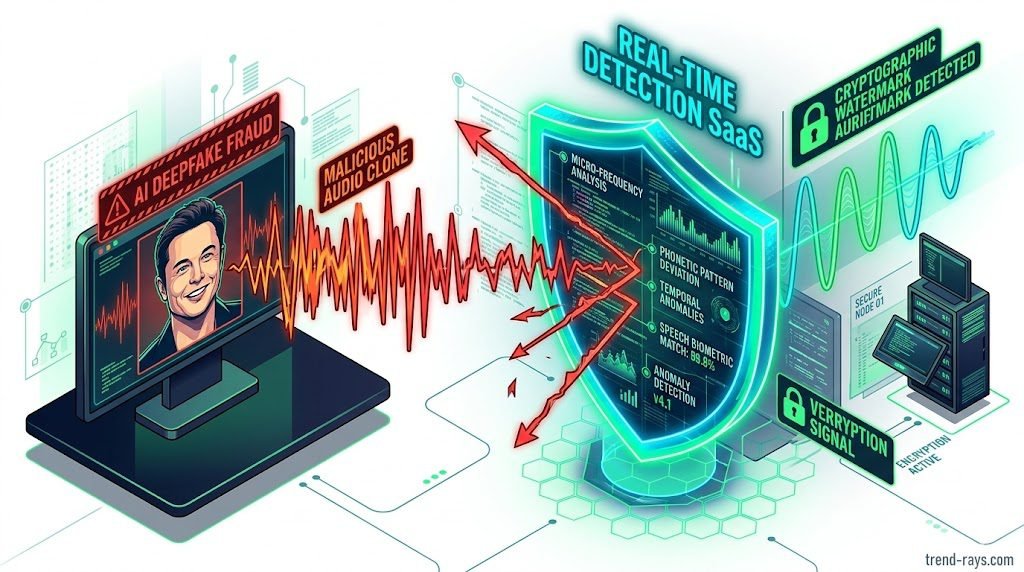
The enterprise software world has responded to these threats by creating a booming sub-industry: AI Audio Cybersecurity.
To combat fraud and maintain brand trust, developers and businesses are adopting strict security measures:
- Cryptographic Audio Watermarking: Top-tier SaaS platforms now embed imperceptible cryptographic watermarks directly into the audio files they generate. These acoustic signatures cannot be heard by the human ear but allow software to instantly verify if an audio clip is synthetic and trace it back to the exact platform that created it.
- Real-Time Deepfake Detection APIs: Telecom companies and enterprise call centers are integrating deepfake detection software into their inbound call routing. These tools analyze the micro-frequencies and phonetic breathing patterns of a caller in real-time, flagging synthetic voices before a human agent even picks up the phone.
The legal framework around AI voices is undergoing a massive overhaul. A person’s voice is increasingly being treated as legally protected intellectual property (IP). SaaS platforms now require verified “active consent” before allowing users to clone a voice, and voice actors are signing smart contracts to license their digital voices, earning royalties every time a company generates a sentence using their specific vocal clone.
Multilingual Domination: The Global Opportunity
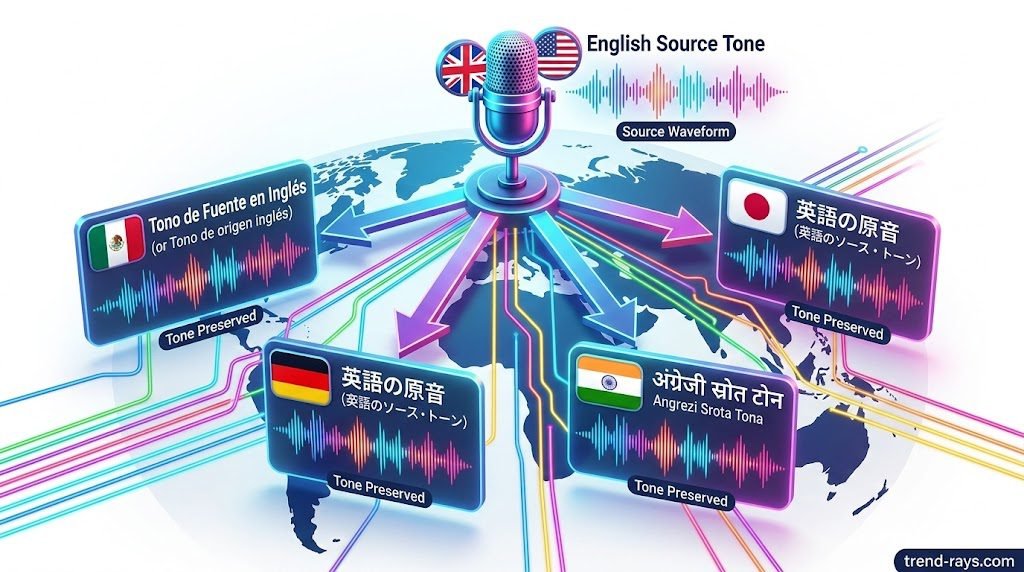
Despite the security hurdles, the ethical application of this technology is breaking down geographical barriers at an unprecedented scale. Multilingual AI dubbing has become the ultimate growth hack for content creators and global enterprises.
Modern AI TTS can instantly translate an English script into over 130 languages while applying the exact tonal inflections, pacing, and excitement of the original English speaker. Brands can now run hyper-localized global campaigns simultaneously, launching a single video ad where the spokesperson natively speaks to every demographic in their own language.
Frequently Asked Questions (FAQs) About AI Voice Technology
Will AI completely replace human voice actors by 2026?
No. While AI text-to-speech has commoditized high-volume, functional audio (like e-learning and IVR menus), human voice actors remain the gold standard for high-stakes media. The industry has adopted a hybrid model, reserving human talent for “hero content” that requires deep emotional nuance, complex humor, and cultural empathy.
What is the best AI voice generator SaaS for enterprise use?
The best AI voice SaaS depends on your business needs. ElevenLabs is the industry leader for hyper-realistic, emotional voice cloning. WellSaid Labs is highly recommended for B2B corporate training and team collaboration. For developers looking to build custom conversational AI apps, the OpenAI Voice API is the top choice.
Is it legal to clone someone’s voice using AI?
In 2026, a person’s voice is increasingly protected as intellectual property. It is illegal to clone a voice without explicit permission for commercial use. Reputable AI SaaS platforms now require verified “active consent” (such as a live video reading of a specific script) before allowing a user to generate a custom voice clone.
How do you detect an AI-generated voice or audio deepfake?
As deepfakes become more realistic, detection relies on AI cybersecurity software. Enterprise platforms use real-time deepfake detection APIs that analyze phonetic breathing patterns and micro-frequencies. Additionally, top AI generators embed imperceptible cryptographic audio watermarks into their files, allowing software to instantly verify if the audio is synthetic.
Can AI text-to-speech translate audio into other languages?
Yes. Modern AI voice software can instantly translate and dub an English script into over 130 languages. The breakthrough in 2026 is that the AI maintains the original speaker’s exact tonal inflections, pacing, and emotional excitement, allowing brands to run hyper-localized global campaigns using a single voice clone.
The rapid advancement of AI text-to-speech in 2026 presents a classic double-edged sword for businesses and creators. On one side, the ROI is undeniable: the ability to slash production costs by 40%, scale content instantly, and achieve multilingual global reach is a competitive advantage you simply cannot ignore. Tools like ElevenLabs, WellSaid Labs, and OpenAI have democratized studio-quality audio.
However, diving in without a strategy carries significant risk. Over-relying on synthetic voices can trigger the “Trust Threshold,” alienating audiences who crave genuine human connection. Furthermore, the rising threat of audio fraud means your digital identity is more vulnerable than ever.
The Strategic Recommendation: The most successful brands in 2026 are adopting a strict hybrid approach.
- Deploy AI for Scale: Use synthetic voices for high-volume, functional tasks. Let AI power your e-learning modules, automate your IVR customer service, and instantly translate your marketing campaigns into 130+ languages.
- Retain Humans for Soul: Reserve real human talent for your core brand identity and high-stakes “hero” content. When deep nuance, empathy, and storytelling are non-negotiable, the human voice remains undefeated.
- Prioritize Security: Only invest in enterprise SaaS platforms that enforce strict consent protocols and embed cryptographic audio watermarking to protect your intellectual property.
AI hasn’t killed the voiceover industry; it has simply forced it to evolve. The businesses that win in this new era will be the ones that leverage AI for operational dominance while fiercely protecting the authentic, human elements of their brand.
developers are also utilizing programmable voice APIs for entertainment. Check out our breakdown of how modern prank call websites utilize similar automated voice routing technology to see these APIs in action.