For Malaysian manufacturers, 2026 is not just another fiscal year; it is a regulatory cliff. The era of treating Environmental, Social, and Governance (ESG) reports as a PR exercise—filled with glossy photos of tree-planting events and vague sustainability claims—is officially over.
Spearheaded by the Securities Commission Malaysia and the Advisory Committee on Sustainability Reporting (ACSR), the National Sustainability Reporting Framework (NSRF) is fundamentally changing how businesses operate. By enforcing the globally recognized ISSB Standards (IFRS S1 and S2), the government is demanding that sustainability data be treated with the exact same rigor, accuracy, and auditability as financial data.
For the average factory owner relying on scattered Excel spreadsheets, this mandate is an operational nightmare. Here is an in-depth look at why manual reporting is failing, and how Artificial Intelligence (AI) is the only scalable way to survive the 2026 NSRF requirements.
What is the NSRF (and Who is Affected in 2026)?
The NSRF mandates that large companies in Malaysia disclose climate-related financial risks and opportunities. It removes the guesswork by forcing companies onto a standardized global baseline.
The implementation is phased, but the deadlines are aggressive:
- Group 1 (2025): Main Market listed issuers with a market capitalization of RM 2 Billion and above.
- Group 2 (2026): All other Main Market listed issuers. (This is the current critical wave).
- Group 3 (2027): ACE Market listed issuers and Large Non-Listed Companies (NLCos) with annual revenues of RM 2 Billion and above.
To comply, companies must eventually submit their data through Bursa Malaysia’s Centralised Sustainability Intelligence (CSI) platform. The goal is “finance-grade” reporting, meaning your carbon output must be as mathematically accurate as your balance sheet.
The Spreadsheet Nightmare: Why Manual Reporting Fails
If your current ESG strategy involves a designated sustainability officer manually emailing department heads for electricity bills and human resources for employee turnover rates, your business is at severe risk.
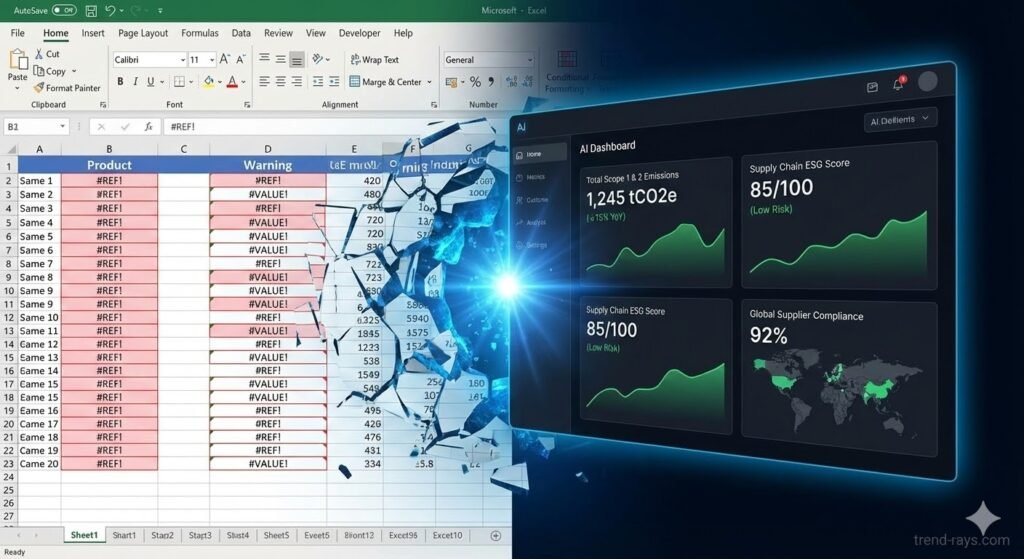
Here is why manual workflows will fail under the 2026 NSRF mandate:
1. The Scope 3 “Black Hole”
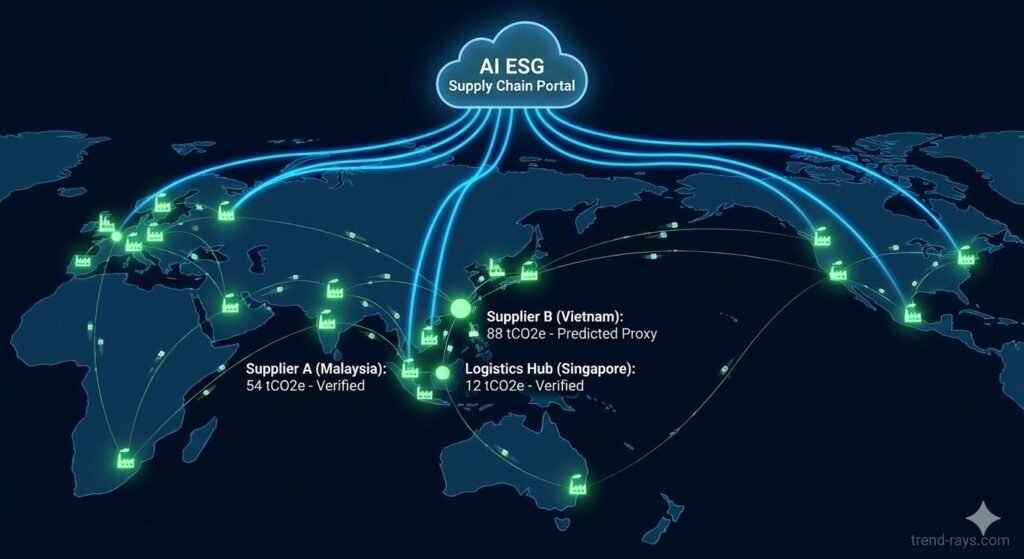
The NSRF requires the eventual disclosure of Scope 1 (direct), Scope 2 (indirect/electricity), and Scope 3 greenhouse gas (GHG) emissions. Scope 3 covers your entire value chain—everything from the carbon footprint of the raw steel you buy to the emissions of the third-party logistics trucks delivering your product. Tracking your own factory’s electricity bill in Excel is easy. Tracking the emissions of 50 different SME suppliers who do not track their own data is impossible without automated intervention.
2. The EU CBAM Threat
Malaysia’s export story is fundamentally a supply chain story. In 2026, the European Union’s Carbon Border Adjustment Mechanism (CBAM) enters its definitive phase. If you export goods like aluminum, steel, or machinery to Europe, your buyers will require verified carbon data to avoid heavy EU carbon taxes. Manual “guesstimates” will lead to your products being rejected at European ports.
How AI Transforms ESG from a Burden to a Business Asset
Artificial Intelligence is the bridge between chaotic factory data and the rigid requirements of the NSRF and IFRS S1/S2 standards. Transitioning to an AI-driven ESG SaaS platform provides three distinct advantages:
1. Automated Data Ingestion via NLP
AI eliminates manual data entry. Using Natural Language Processing (NLP) and Optical Character Recognition (OCR), modern ESG software can “read” your raw utility bills, fuel receipts, and waste manifests. You simply upload the PDF, and the AI automatically extracts the consumption data, matches it to the correct local emission factor (e.g., Malaysia’s specific grid carbon intensity), and calculates the exact GHG equivalent instantly.
2. Supply Chain Data Portals
To solve the Scope 3 nightmare, AI platforms utilize automated supplier portals. Instead of emailing suppliers, the software sends them automated digital surveys. If a supplier is too small to know their exact carbon output, the AI uses predictive carbon modeling based on their industry average and spend data to generate a highly accurate proxy, ensuring your final report doesn’t have fatal data gaps.
3. Anomaly Detection and “Audit-Readiness”
The ACSR aims to mandate “reasonable assurance” (external auditing) of sustainability information. Auditors will scrutinize your ESG data just like your financial data. AI algorithms continuously scan your data pipeline in the background. If one of your facilities reports a sudden, unexplained 40% drop in energy usage compared to historical averages, the AI flags it as an anomaly before it ends up in your final report, saving you from regulatory penalties and embarrassing public retractions.
The Synergy: Smart Factories and ESG
There is a massive strategic overlap between upgrading your factory operations and surviving the NSRF.
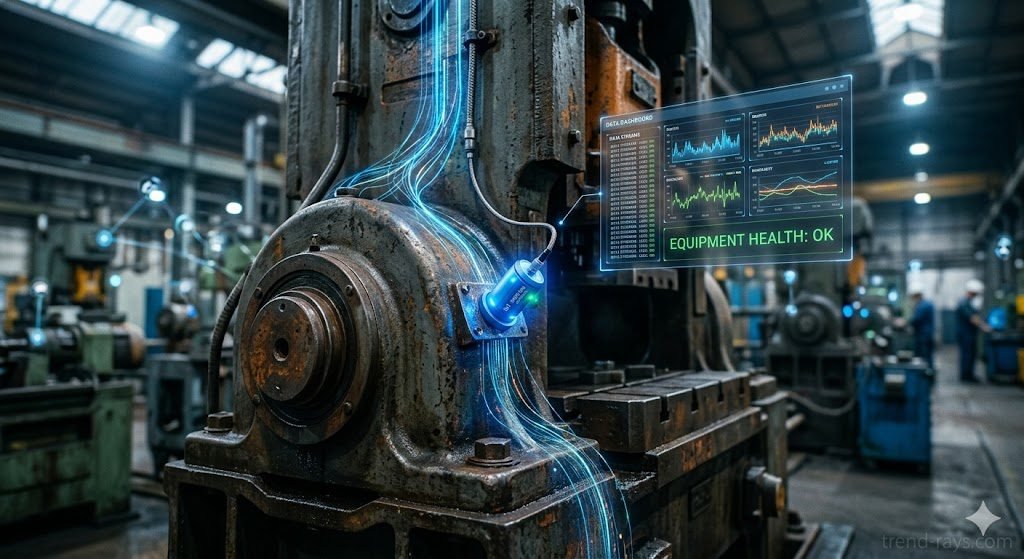
If you have already implemented Industrial IoT sensors for Predictive Maintenance (as discussed in our previous guides), you already have the infrastructure for automated ESG reporting. The exact same IoT sensors that monitor machine health can automatically stream real-time energy consumption data directly into your ESG reporting software. You no longer have to guess how much power a specific production line uses; the machines tell the AI directly.
The Growth Catalyst: Scaling Financially and Globally with ESG Data
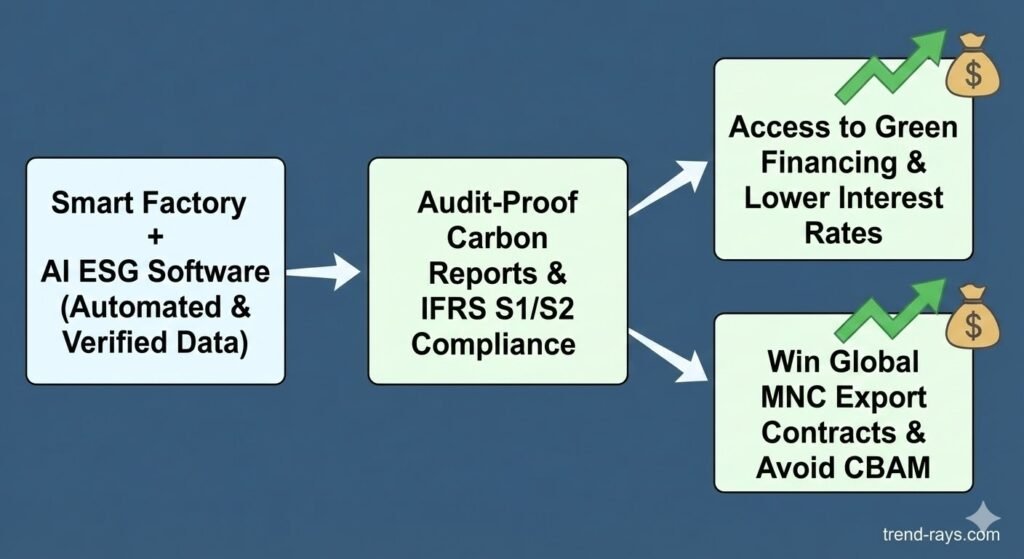
For startups and growing SMEs, the conversation around ESG often feels like a burden reserved for massive corporations. However, adopting AI-driven ESG reporting and Smart Factory IoT is actually one of the most powerful growth hacks for scaling a manufacturing business in 2026.
When your factory’s data is automated, verified, and transparent, it unlocks financial and global scaling opportunities that traditional factories simply cannot access.
1. Unlocking “Green Financing” and Cheaper Capital
Financial institutions in Malaysia, such as Maybank and CIMB, alongside government bodies, are aggressively pushing “Green Financing” and ESG-linked loans. These financial products offer significantly lower interest rates for companies that can prove they are reducing their carbon footprint.
- The Smart Factory Advantage: A traditional factory cannot easily prove its energy reductions without hiring expensive auditors. A Smart Factory using AI ESG software can instantly generate audit-proof emission reports, allowing startups and SMEs to secure cheaper capital to fund their expansion.
2. The “Fast-Track” to Global Supply Chains
As mentioned, global Multinational Corporations (MNCs) in the US and Europe are under immense pressure to report their Scope 3 (supply chain) emissions. When Apple, Tesla, or Siemens look for manufacturing partners in Southeast Asia, they now include ESG data readiness in their Request for Proposal (RFP) requirements.
- The Smart Factory Advantage: If you are a 50-person manufacturing startup in Penang bidding against a 500-person legacy factory, you can win the contract simply by offering automated API integration of your carbon data into the MNC’s dashboard. AI reporting gives small businesses a massive competitive edge to secure global export contracts.
3. Higher Valuations for Tech-Enabled Startups
If you are a hardware or advanced manufacturing startup looking to raise Venture Capital (VC) or Private Equity, your valuation is heavily tied to future risk. Investors view manual compliance and high carbon dependency as massive liabilities.
- The Smart Factory Advantage: Startups built from day one with AI and IoT-integrated ESG reporting are viewed as “future-proof.” They command higher valuations because investors know they are immune to upcoming carbon taxes and regulatory fines.
Frequently Asked Questions (FAQ)
What is the penalty for non-compliance with the NSRF in Malaysia? While the Securities Commission and Bursa Malaysia are taking a developmental approach initially, non-compliance or poor-quality reporting can lead to severe reputational damage, loss of institutional investors, and regulatory scrutiny. For exporters, poor data leads directly to lost contracts under international frameworks like CBAM.
Does the NSRF apply to SMEs in Malaysia? Directly, no. Group 1, 2, and 3 specifically target listed issuers and massive non-listed companies (RM 2 Billion+ revenue). Indirectly, yes. Large companies must report their Scope 3 emissions, meaning they will demand that their SME suppliers provide ESG data. If an SME cannot provide this data, the large corporation will simply switch to a supplier who can.
What is the difference between Bursa’s CSI platform and AI ESG Software? Bursa’s Centralised Sustainability Intelligence (CSI) platform is the destination—it is where you submit your final data. AI ESG software is the engine—it is the internal tool your company uses to gather, clean, calculate, and verify the data throughout the year before you upload it to the CSI platform.
Can government grants subsidize AI ESG software? Yes. Companies looking to digitize their operations, including the adoption of cloud-based AI reporting tools, should actively explore matching grants like the MIDA SAG MADANI, which heavily subsidizes the shift from manual labor to automated SaaS solutions.