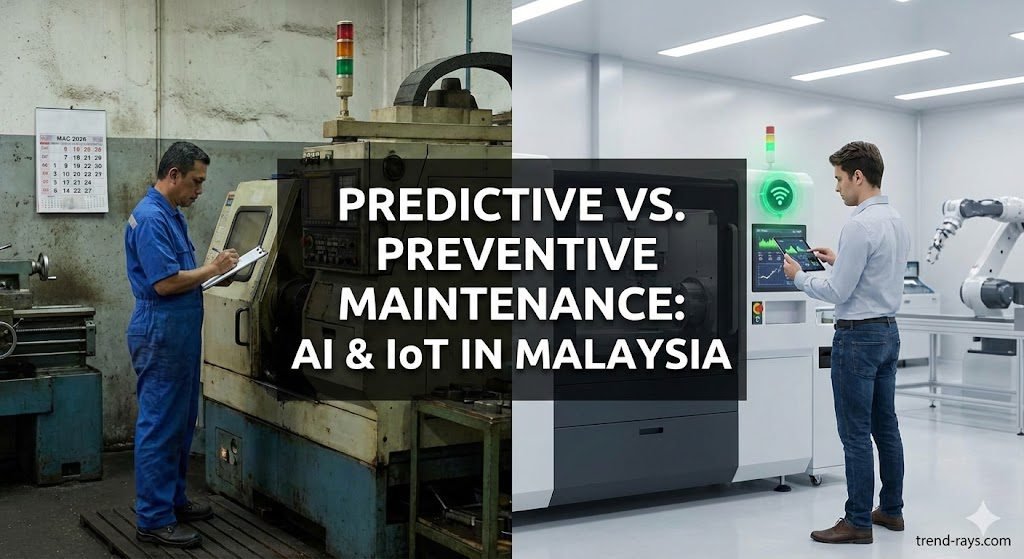
For decades, Malaysian manufacturing—from the semiconductor hubs in Penang to the heavy machinery plants in Johor—has relied on a simple rule: Fix it before it breaks. This time-based approach, known as Preventive Maintenance (PM), was the industry standard. However, as Malaysia aggressively transitions into Industry 4.0 under the New Industrial Master Plan (NIMP) 2030, the standard has shifted. Relying on calendar dates to service machinery is no longer enough to stay globally competitive.
Today, the most profitable factories are transitioning to Predictive Maintenance (PdM)—a data-driven strategy powered by Artificial Intelligence (AI) and the Industrial Internet of Things (IIoT).
Here is a deep-dive comparison of predictive vs. preventive maintenance, and why upgrading your maintenance strategy is the most lucrative operational decision your factory can make this year.
What is Preventive Maintenance (PM)?
Preventive maintenance is a proactive, scheduled approach to equipment care. It operates on a fixed calendar or usage-based interval (e.g., servicing a CNC machine every 6 months or after every 10,000 production cycles), regardless of the actual condition of the machine.
Think of it like changing the oil in your car every 5,000 kilometers. You do it to prevent engine failure, even if the oil is technically still clean.
The Advantages:
- Predictability: Maintenance budgets and labor schedules are easy to plan out months in advance.
- Reduces Major Breakdowns: It is significantly better than a reactive “run-to-failure” strategy.
The Disadvantages:
- Over-Maintenance: You end up replacing perfectly good parts and wasting skilled labor hours. Industry data shows that up to 30% of preventive maintenance activities are performed unnecessarily.
- Blind Spots: PM cannot predict sudden, unexpected failures that occur between scheduled service intervals.
What is Predictive Maintenance (PdM)?

Predictive maintenance is a condition-based strategy. Instead of guessing when a machine might fail based on a calendar, PdM uses real-time data to know exactly when a component is degrading, triggering an intervention only when absolutely necessary.
This is made possible by the integration of three core technologies:
- IoT Sensors: Attached directly to the machinery to continuously monitor metrics like vibration, temperature, acoustic emissions, and oil pressure.
- Edge/Cloud Computing: Gateways that securely transmit this massive influx of machine data to a centralized dashboard.
- AI & Machine Learning: Algorithms that analyze the real-time data against historical failure models to predict exactly when a breakdown will occur (e.g., “Motor B will fail in 72 hours due to bearing degradation”).
The Advantages:
- Maximum Uptime: By predicting failures, repairs are scheduled during planned off-hours, virtually eliminating unplanned downtime.
- Cost Efficiency: You only buy spare parts and deploy technicians when the AI confirms it is necessary.
- Extended Asset Lifespan: Catching microscopic anomalies (like a slight temperature increase) prevents cascading damage that destroys entire machines.
The 2026 Comparison: Predictive vs. Preventive
To understand the operational shift, here is a direct comparison of how the two strategies stack up on the factory floor.
| Feature | Preventive Maintenance (PM) | AI Predictive Maintenance (PdM) |
| Trigger Mechanism | Time-based or usage-based (Calendar/Cycles). | Condition-based (Real-time AI data alerts). |
| Data Usage | Relies on historical averages and OEM manuals. | Relies on live sensor data and Machine Learning. |
| Initial CAPEX | Low (Requires basic scheduling software/CMMS). | Higher (Requires IoT sensors, AI software, and network infrastructure). |
| Long-Term OPEX | High (Wasted parts and unnecessary labor). | Low (Interventions happen only when required). |
| ROI Impact | Baseline stability; marginal improvements over time. | High impact; 25-30% reduction in overall maintenance costs. |
The Financial Reality: Why Make the Shift Now?

The primary barrier to adopting AI-driven Predictive Maintenance has historically been the high upfront Capital Expenditure (CAPEX) required for sensors and software integration. However, in 2026, this hurdle has been removed for Malaysian SMEs.
Through government initiatives like the MIDA Smart Automation Grant (SAG MADANI), manufacturing companies can claim up to a 70:30 matching grant (capped at RM 1 Million) to fund their digital transformation. Because PdM software is now largely delivered as a Cloud SaaS, companies can utilize the grant to cover the first year of their AI software subscriptions, effectively shifting the massive CAPEX to a subsidized Operational Expenditure (OPEX).
Is Adopting AI and IoT a Good Decision for Small Businesses and Startups?
When small to medium-sized enterprises (SMEs) or hardware startups hear terms like “Predictive Maintenance,” the immediate assumption is that these technologies are reserved for massive multinational corporations.
In 2026, this is a dangerous misconception. Adopting AI and IoT is no longer just a “good decision” for small businesses—it is the ultimate equalizer. Because modern AI and IoT solutions are delivered via cloud-based SaaS, the barrier to entry has never been lower. You simply pay a monthly subscription and attach wireless sensors to your existing machines.
The Unique Advantages for Startups and SMEs
Smaller operations actually have a distinct advantage over legacy corporations when adopting smart factory tech:
- Zero Technical Debt: Startups don’t have to spend years untangling outdated legacy software. You can implement a modern, cloud-native AI maintenance system from Day 1, scaling faster than older competitors.
- The “Pilot Program” Agility: A small business can purchase just three IoT vibration sensors for their most critical machine, connect them to a SaaS dashboard, and see an ROI within weeks. Large corporations take months just to get board approval for the same test.
- Competing Above Your Weight Class: A 20-person startup equipped with computer vision AI for quality control can deliver the same defect-free output as a 200-person factory relying on manual human inspection.
- Attracting Modern Talent: The younger generation of engineers expects to work with modern tech. Implementing AI and IoT dashboards makes your small business an attractive, forward-thinking workplace.
How to Start Small
If you are a startup with tight cash flow, do not attempt to digitize your entire factory overnight. Start with a Micro-Deployment. Identify your “bottleneck” asset that costs you the most money when it breaks down. Install IoT sensors solely on that machine. Once the AI successfully predicts a failure and saves you from a day of costly downtime, the system effectively pays for itself, proving the business case to expand.
The Macro View: Why Upgrade Your “Normal” Factory to a Smart Factory?

Before diving into specific maintenance strategies, it is crucial to understand the larger industrial shift happening across Southeast Asia.
A “normal” or legacy factory relies on isolated machines, paper-based tracking, and human intuition. A Smart Factory (Industry 4.0) connects every machine, inventory pallet, and energy meter to a centralized cloud dashboard using IoT and AI.
But why should a profitable, traditional Malaysian factory go through the trouble of upgrading? The answer comes down to survival in the 2026 global market.
Here are the three macro-economic forces forcing the upgrade:
1. Capitalizing on the “China+1” Strategy
Global multinational corporations (MNCs) are actively diversifying their supply chains away from a single point of failure. They are looking to Malaysia, Vietnam, and Thailand for manufacturing partners. However, these MNCs now demand supply chain visibility. If Apple or Tesla wants to contract your Penang facility to build components, they expect to see real-time, cloud-based data on your production yields and defect rates. A “normal” factory relying on end-of-week Excel reports simply will not win these lucrative international contracts.
2. The End of Cheap Manual Labor
For decades, the Malaysian manufacturing model was built on access to low-cost foreign labor. With continuous minimum wage hikes and stricter government quotas on foreign worker permits, this model is mathematically breaking down. Upgrading to a Smart Factory replaces physical bodies with automation and computer vision AI, stabilizing your operational costs and immunizing your business against sudden labor shortages.
3. The New ESG Compliance Laws
In 2026, sustainability is no longer just a PR buzzword; it is a legal requirement. Under Malaysia’s National Sustainability Reporting Framework (NSRF) and global mandates like the EU’s Carbon Border Adjustment Mechanism (CBAM), factories must prove their carbon footprint. A normal factory has to hire consultants to guess their energy waste. A Smart Factory uses IoT sensors to automatically calculate exact energy consumption per machine, instantly generating audit-proof ESG reports.
The Scaling Multiplier: How AI and IoT Take You Global
For a traditional manufacturing business in Malaysia, scaling up is painful. Historically, if you wanted to double your output to take on a massive new international client, you had to undergo linear scaling: rent twice as much floor space, buy twice as many machines, and navigate the bureaucratic nightmare of hiring twice as many foreign workers.
Adopting AI and Industrial IoT unlocks non-linear scaling. This means your revenue and production capacity can grow exponentially while your operational footprint and headcount remain relatively stable. Here is how smart tech makes you a global player:
1. Unlocking “Hidden” Factory Capacity
Before you buy a new facility to scale, you must ask: Are my current machines actually running at 100% efficiency? Usually, the answer is no. Due to micro-stoppages, unplanned breakdowns, and manual changeovers, a “normal” factory often operates at only 50-60% Overall Equipment Effectiveness (OEE). By implementing AI-driven Predictive Maintenance, you eliminate the blind spots. You can push your existing machinery to 85% or 90% OEE. You effectively “unlock” a second factory’s worth of production capacity without buying a single new machine or expanding your real estate.
2. Winning Global MNC Contracts with “Data Trust”
If you want to scale globally and become a Tier-1 supplier for multinational corporations (MNCs) in the US, Europe, or Japan, you must prove your reliability. Global brands will not risk their supply chain on a Malaysian SME that tracks quality control on paper. When you use AI and IoT, you can provide prospective global clients with a live, cloud-based dashboard of your operations. Showing a global buyer mathematical, real-time proof of your 99.9% uptime and AI-verified defect rates instantly builds the trust required to win multi-million-Ringgit international contracts.
3. Rapid Replication Across Multiple Sites
Once you have perfected the AI and IoT framework in your primary facility (e.g., in Selangor), scaling to a second facility (e.g., in Vietnam or Indonesia) becomes incredibly fast. Because the “brain” of your factory is in the cloud via SaaS, you do not need to retrain a massive management team for the new location. You simply install the IoT sensors in the new facility, connect them to your central AI dashboard, and you can instantly monitor and optimize a multi-country manufacturing empire from your phone in Kuala Lumpur.
Frequently Asked Questions (FAQ)
What is the difference between predictive and preventive maintenance AI?
Preventive maintenance relies on static schedules, whereas predictive maintenance uses AI to analyze live data from IoT sensors. The AI identifies hidden patterns (like microscopic vibration changes) to forecast exactly when a machine will fail, allowing you to fix it just before it breaks.
Does predictive maintenance completely replace preventive maintenance?
No. The most successful factories use a Hybrid Strategy. Predictive maintenance is applied to highly critical, expensive assets where a breakdown would halt production. Preventive maintenance is retained for low-value, non-critical assets (like changing air filters) where installing expensive IoT sensors wouldn’t yield a high ROI.
What are common examples of predictive maintenance techniques?
Modern smart factories utilize several PdM techniques, including:
- Vibration Analysis: Detecting imbalances or misalignments in rotating motors.
- Thermal Imaging: Using infrared cameras to spot overheating electrical circuits before they catch fire.
- Ultrasonic Acoustic Monitoring: “Listening” to friction in bearings or detecting microscopic gas leaks in pressurized pipes.
How much does an AI predictive maintenance system cost in Malaysia?
Costs vary wildly based on factory size. However, with the rise of SaaS-based CMMS and drop-in IoT sensors, pilot programs for a single production line can start as low as RM 15,000 to RM 30,000 annually. For enterprise-wide deployment, costs easily exceed RM 200,000, which is why utilizing government grants is highly recommended.
Ready to Build a Smart Factory?
Transitioning to AI-driven maintenance isn’t just about buying software; it’s about fundamentally changing how your factory operates.
If you are a Malaysian MSME looking to fund this transition, your first step is securing government funding. Read our Complete 2026 Guide to the MIDA SAG MADANI Grant to learn how to claim up to RM 1 Million to subsidize your predictive maintenance rollout today.