The “Big Three” Have Changed
If you are searching for a portable power station, you have likely stumbled upon Reddit threads from 2023 debating battery chemistry. Here is the problem: those debates are ancient history.
In 2026, the landscape of portable power has shifted completely. The days of “Jackery uses bad batteries” are largely over. All three giants—Anker, EcoFlow, and Jackery—have updated their flagship models.
But they are not the same. One is built like a tank, one is a software masterpiece, and one is the king of portability. We broke down the specs, the hidden flaws, and the real-world performance to help you decide.
1. The “Battery Myth” (Debunked for 2026)
The biggest argument you will read online is: “Don’t buy Jackery; they use short-life batteries.”
This is no longer true.
- The Standard: The industry standard is now LiFePO4 (LFP) batteries. These are safer and last for 3,000+ cycles (about 10 years of daily use) before dropping to 80% capacity.
- Anker & EcoFlow: Have used LFP in almost all models (Solix and Delta 2 series) for years.
- Jackery: Finally caught up. The new Explorer 1000 v2, 2000 Plus, and 3000 Pro models now use LFP batteries.1
- ⚠️ Warning: If you buy a used or older model (like the original Explorer 1000 or 300), you are getting old NMC tech that dies after 500 cycles. Only buy the “v2” or “Plus” models.
2. Head-to-Head: The “1kWh” Battle
The 1000Wh (1kWh) size is the “Goldilocks” zone—big enough for a blackout, small enough to carry camping. Here is how the current champions stack up.
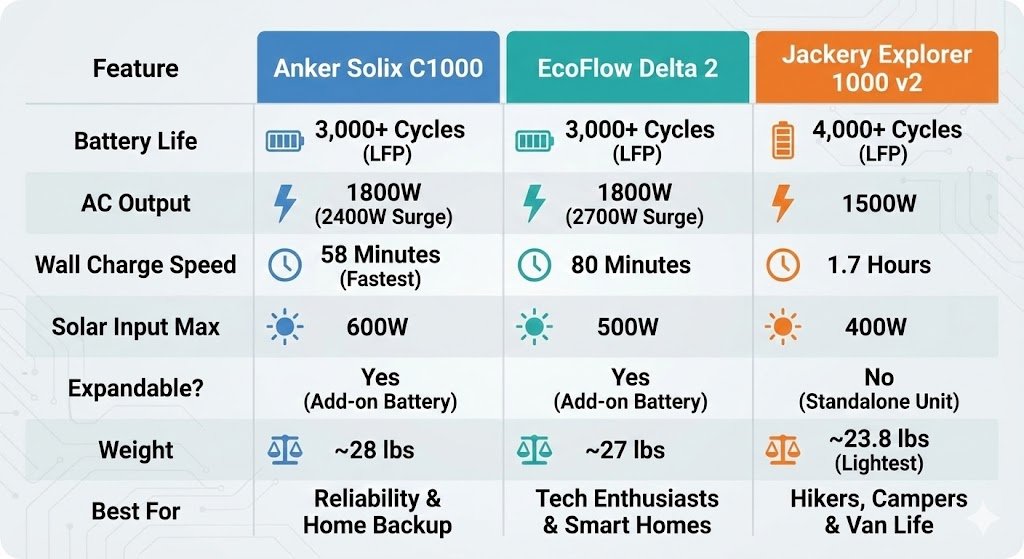
| Feature | Anker Solix C1000 | EcoFlow Delta 2 | Jackery Explorer 1000 v2 |
| Battery Life | 3,000+ Cycles (LFP) | 3,000+ Cycles (LFP) | 4,000+ Cycles (LFP) |
| AC Output | 1800W (2400W Surge) | 1800W (2700W Surge) | 1500W |
| Wall Charge Speed | 58 Minutes (Fastest) | 80 Minutes | 1.7 Hours |
| Solar Input Max | 600W | 500W | 400W |
| Expandable? | Yes (Add-on Battery) | Yes (Add-on Battery) | No (Standalone Unit) |
| Weight | ~28 lbs | ~27 lbs | ~23.8 lbs (Lightest) |
| Price | Mid-Range | Often Lowest | Often Highest |
The Takeaway:
- Anker is the speed demon (charges fully in under an hour).
- EcoFlow offers the most surge power (great for starting fridges/ACs).
- Jackery is significantly lighter but charges slower and has less solar capacity.
3. Brand Deep Dive: Pros & Cons
Anker (The Solix Series)
- Best For: Reliability & Home Backup.
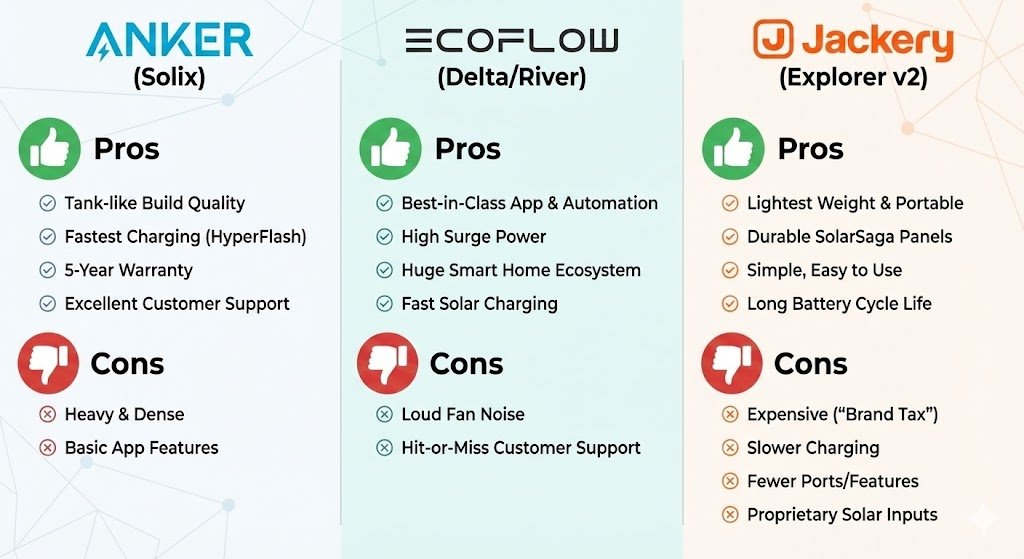
- The Good: Anker builds these units like tanks. They feature a “Uni-body” drop-proof design and generally offer the best warranty in the business (5 Years). Their “HyperFlash” technology is genuinely useful—plug it in for a quick lunch break, and it’s full.
- The Bad: They are dense and heavy. Also, the app is functional but basic compared to EcoFlow.
EcoFlow (Delta & River Series)
- Best For: Tech Enthusiasts & Smart Homes.
- The Good: The EcoFlow App is lightyears ahead. You can set charging limits (e.g., “Stop at 80%” to save battery health), view real-time solar graphs, and automate speeds. They also have a massive ecosystem of smart generators and portable ACs that link together.
- The Bad: Fan Noise. The Delta 2 sounds like a jet engine when fast-charging. Additionally, their customer support has a mixed reputation online for slow responses.
Jackery (Explorer v2 / Plus Series)
- Best For: Hikers, Campers & Van Life.
- The Good: Portability. Jackery understands that people actually have to carry these things. The folding handles and lighter build make a huge difference if you have to walk 100 yards to a campsite. Their “SolarSaga” panels are also widely considered the most durable portable panels on the market.
- The Bad: The “Brand Tax.” You often pay more for fewer features (fewer ports, slower charging, no Bluetooth on smaller models) just for the orange name.
4. The Hidden “Gotchas” (What Specs Don’t Tell You)
A. The Solar Input Trap
If you plan to use solar panels you already own, be careful.
- EcoFlow & Anker: Use standard XT-60 connectors and have wide voltage ranges (11-60V). They play nicely with almost any cheap 3rd-party panel.
- Jackery: Often uses proprietary 8mm DC connectors. While they include adapters in newer models, they are notoriously picky about voltage. You are often “locked in” to buying expensive Jackery panels.
B. UPS (Uninterruptible Power Supply)
Do you want to keep your WiFi router running during a blackout?
- Anker & EcoFlow: Excellent choice. They have <20ms switchover times and act as a pass-through UPS.
- Jackery: The newer v2 models can do this, but many older models cannot. Check the fine print.
Troubleshooting
Final Verdict: Which One Wins in 2026?
🏆 Winner: The Best All-Rounder
Anker Solix C1000.
It hits the perfect sweet spot. It charges the fastest, has a 5-year warranty, excellent customer support, and enough power to run a microwave or portable AC. If you don’t know what to pick, pick Anker.
🥈 Runner Up: The Power User’s Choice
EcoFlow Delta 2.
If you love data, apps, and home automation, EcoFlow is unbeatable. Just be prepared for the loud fan noise.
🥉 Honorable Mention: The Camper’s Choice
Jackery Explorer 1000 v2.
If every pound matters (e.g., you are hauling gear to a remote cabin), the weight savings of the Jackery are worth the extra cost.
Comparison Table: The 2026 Lineup
This table provides a quick, side-by-side look at the key specifications for the flagship 1kWh models from each brand.
Pros & Cons Summary
For a more qualitative look at what it’s like to live with these units, this infographic summarizes the real-world strengths and weaknesses of each brand’s ecosystem.