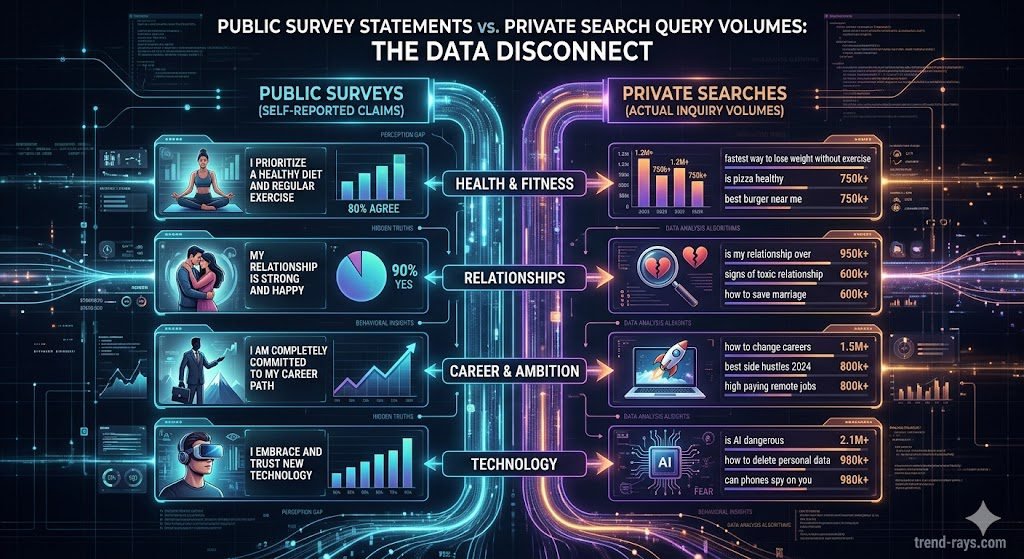
Publicly, European enterprise surveys paint a picture of technological optimism. Corporate reports highlight efficiency gains, streamlined workflows, and the promise of a hyper-productive generative AI economy. However, anonymous search engine queries and chatbot interaction data reveal a starkly different reality—a “dark funnel” of anxiety surrounding workplace surveillance, automated terminations, and professional obsolescence.
This research breaks down what European workers are actually asking search engines in 2026, contrasting the curated public narrative with the raw data of private fears. By analyzing macro-economic trends alongside localized search data, we can map exactly how AI is reshaping the IT sector, why corporations are pivoting their hiring models, and what technical skills are required to survive the transition.
Methodology: Tracking the “Dark Funnel” of AI Anxiety
To map the true sentiment of the European workforce, this analysis aggregates localized search intents, natural language chatbot queries, and cross-border demographic data from Q1 2025 through mid-2026. By isolating long-tail semantic queries (e.g., questions structured as full sentences to AI agents) rather than generic keywords, we can bypass survey bias and access unfiltered user intent regarding AI implementation in the workplace.
The Three Hidden Fears Driving European Search Volume
Search trends indicate a massive shift in how the workforce views the AI threat. The anxiety has evolved from a simple fear of replacement to complex concerns regarding algorithmic governance and data privacy.
1. Algorithmic Management & Workplace Surveillance
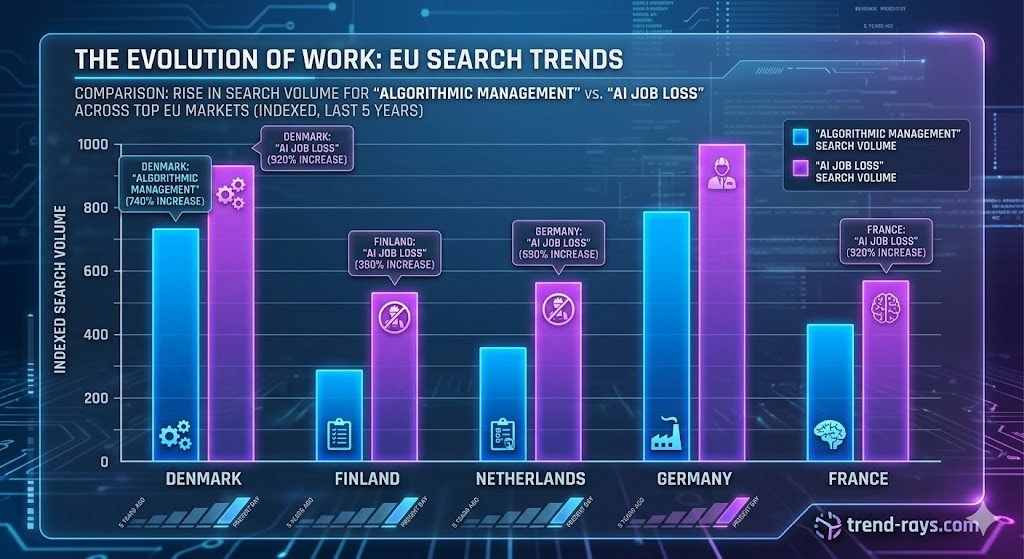
European workers are highly protective of their labor rights. The highest velocity of technical HR queries revolves around the legality of AI-driven oversight.
- Search Intent: “Can my employer use AI to track my screen?”, “Is AI monitoring legal in Germany?”, “DPIA requirements for employee tracking.”
- The Reality: 63% of the workforce is highly concerned about employers using AI to monitor daily work and assess performance continuously. The search volume for “shadow AI tracking” has outpaced general “AI job loss” queries in major hubs like Berlin and Paris.
2. The Obsolescence Horizon: From Displacement to Degradation
Workers are no longer just researching if they will be fired; they are researching if their roles will be stripped of cognitive value.
- Search Intent: “Which human skills cannot be replaced by AI?”, “Will AI turn coders into just reviewers?”
- The Reality: This reflects a fear of “job degradation.” Highly skilled professionals are searching for ways to avoid being downgraded to mere operators or fact-checkers of AI outputs, seeking strategies to maintain leverage in a heavily automated workflow.
3. Automated Terminations: The Fear of the Algorithm
The fear of being managed—and fired—by a machine is a primary driver of chatbot queries regarding labor law.
- Search Intent: “Can an AI fire you?”, “How to appeal an AI performance review.”
- The Reality: 78% of workers engaged in these search clusters express worry about automated firings. This directly correlates with the growing public awareness of GDPR Article 22 and the right to human intervention.
The Architectural Divide: EU vs. US AI Compliance
For B2B SaaS platforms handling employee data, the search data reflects a critical regulatory reality. Deploying HR AI tools across international borders requires navigating two fundamentally opposed architectures.
The following compliance matrix outlines the operational constraints for automated management tools, highlighting why European searchers are distinctly focused on legal protections.
| Operational Domain | EU (GDPR & AI Act 2026) | US (Federal & State Patchwork) |
| Automated Hiring/Firing | Restricted under GDPR Art. 22; classified as “High-Risk” under AI Act Annex III. | Generally permitted; subject to fragmented state-level bias audits. |
| Human-in-the-Loop | Mandatory. The SCHUFA ruling establishes that AI scoring heavily relied upon by a human is still an automated decision. | Optional but recommended to mitigate federal Title VII discrimination liability. |
| Screen Monitoring | Highly restricted. Requires a Data Protection Impact Assessment (DPIA) and often fails proportionality tests. | Broadly permitted on employer-owned hardware with no federal limits. |
| Emotion Recognition | Explicitly prohibited in the workplace under the EU AI Act’s “unacceptable risk” tier. | Unregulated federally; some state biometrics laws require consent but do not ban usage. |
| Lawful Basis | Employee consent is invalid due to power imbalances; must pass a “Legitimate Interest” balancing test. | Blanket consent is routinely enforced via at-will employment agreements. |
The Demographic Divide: Who is Actually Afraid?
Search behavior is not uniform. Cross-referencing query data with demographic profiles reveals distinct splits in AI anxiety across the continent.
- The Usage Gap: Non-users of Generative AI are nearly twice as likely to execute panic-based search queries compared to those who use it occasionally.
- Age Discrepancy: A consistent 10-point gap exists across Europe between those under 30 (searching for AI upskilling) and those over 30 (searching for displacement statistics).
- Class & Role: 58% of working-class and routine-administrative respondents trigger threat-based search intents, compared to just 32% of middle/upper-class knowledge workers, who are more likely to search for “AI workflow automation.”
The Sectoral Shift: How AI is Rewiring the IT Industry and Beyond
The impact of AI is heavily fractured across different industries. While early narratives focused on blue-collar automation, the reality shows that cognitive and knowledge-based roles are bearing the brunt of the transition.
- The IT and Tech Industry: Software engineering, DevOps, and Quality Assurance (QA) are experiencing a radical restructuring. AI coding assistants and automated testing suites are “flattening” engineering departments, disproportionately eliminating middle-management and junior QA roles. The demand has shifted from pure coders to Machine Learning Engineers and AI-Human Collaboration Specialists.
- Healthcare & Finance: These sectors are seeing massive productivity gains through “Vertical AI.” In finance, AI risk modeling is replacing entry-level analysts, while in healthcare, AI diagnostic tools are creating entirely new categories of digital health technicians.
- The Safe Havens: Home-based services, highly complex physical trades, and creative roles requiring genuine human nuance remain largely insulated.
The Macro-Economic Equation: $1.9 Trillion at Stake
For the European economy, the integration of AI presents a high-stakes balancing act between unprecedented productivity and widening inequality.
The Advantages (The Productivity Boom)
The economic upside is staggering. A 2026 McKinsey Global Institute report estimates that Europe could capture up to $1.9 trillion in economic value by 2030 through human-machine collaboration. Furthermore, recent data indicates that AI adoption increases labor productivity by 4% across enterprises, often without immediately triggering short-term job losses, as companies prioritize output expansion over immediate layoffs.
The Disadvantages (The Squeeze on the Middle)
AI is creating a “barbell effect” in the labor market. High-skilled workers who leverage AI become exponentially more productive, and low-skill manual jobs remain untouched. It is the middle-skill, routine knowledge workers (data entry, basic administrative, mid-level analytics) who face severe job displacement. The OECD warns that occupations at the highest risk of automation account for about 28% of all jobs.
The Corporate Calculus: Why Employers Prefer AI Fluency
Why are European companies aggressively prioritizing AI software over expanding their manual human workforce? The answer lies in scalability and data velocity.
- The Wage Premium of Productivity: Companies are willing to pay significantly more for a single AI-fluent worker than multiple manual workers. Data shows workers with advanced AI skills command wage premiums up to 56% higher than their peers.
- Combating the Skills Deficit: Europe is facing a severe digital skills gap. Companies are deploying AI to bridge this gap, automating routine tasks so their limited pool of highly skilled human capital can focus strictly on strategic problem-solving.
- Predictability and Compliance: In heavily regulated European markets, automated systems—once properly audited for GDPR and EU AI Act compliance—provide a level of standardized output, traceability, and continuous operation that manual workflows cannot match.
The Survival Guide: Skills for the AI Era
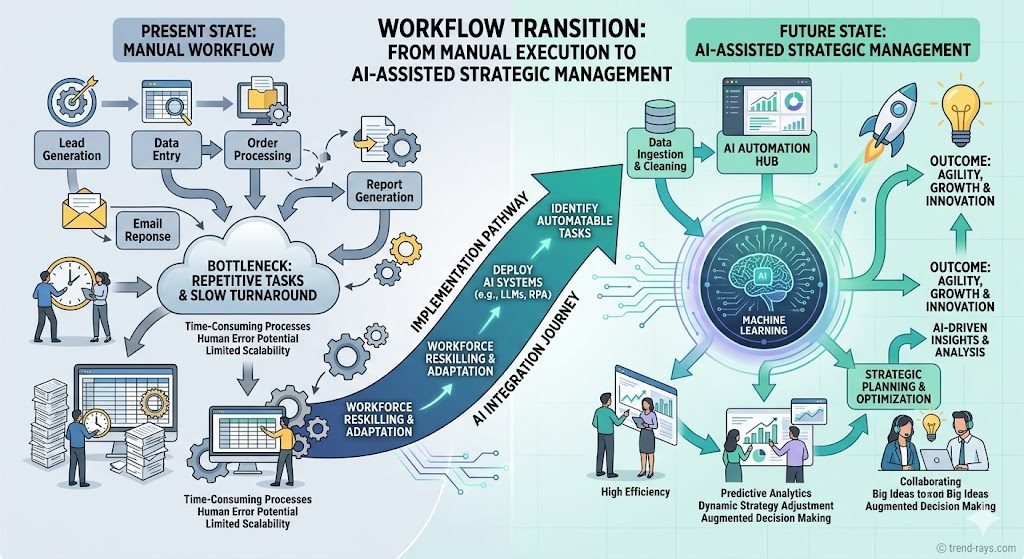
The transition from fear to adaptation requires proactive upskilling. The conversation has shifted from “Will AI take my job?” to “How do I use AI to do my job better?”
For Corporate Employees
Survival in the corporate sector requires moving from a “doer” to a “reviewer and strategist.”
- Master Automated Workflows: Actively using AI tools halts the fear of replacement. Moving from passive anxiety to active utilization of SaaS tools and secure cloud identity infrastructure is the most effective future-proofing strategy.
- Understand Algorithmic Rights: Knowledge of GDPR-ready compliance and the 2026 AI Act is no longer just for legal teams. Professionals who understand the limits of automated decision-making maintain leverage.
- Pivot to High-Context Skills: Technical SEO, Generative Engine Optimization (GEO), and nuanced digital strategy remain highly resistant to automation.
For Freelancers and Individual Contributors
Freelancers are highly vulnerable to AI displacement because clients often view them as transactional labor.
- Become an “Agency of One”: A freelance copywriter must become an “AI Content Strategist.” Use AI to scale your output (research, drafting, formatting) so you can offer clients comprehensive campaigns rather than single deliverables.
- Focus on Context, Not Just Execution: AI can write code and generate images, but it struggles with deep, client-specific context and industry nuance. Freelancers must sell their strategic industry expertise, using AI merely as the execution engine.
Conclusion: The Path Forward Under the EU AI Act
The enforcement of the EU AI Act will likely stabilize the search anxieties currently plaguing the European workforce. By mandating transparency and restricting high-risk algorithmic management, the regulatory framework acts not as a bottleneck, but as a necessary safeguard. As organizations adapt to these new architectures, the workforce must pivot to high-context, AI-fluent roles, eventually aligning the private realities of job security with public technological optimism.