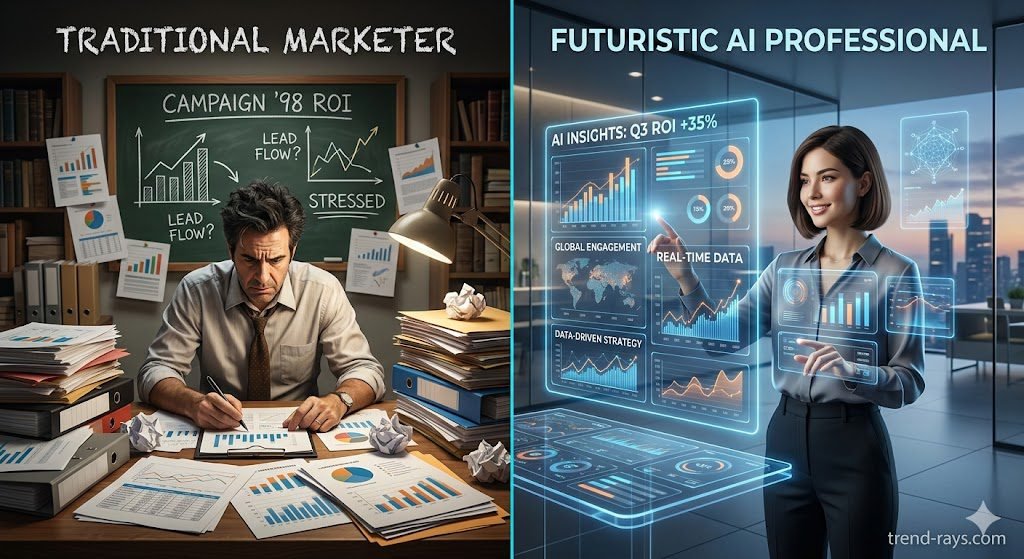
The marketing world has crossed a permanent tipping point. What began as a chaotic experiment with generative chatbots just a few years ago has evolved into a multi-billion dollar foundational industry in 2026.
Today, integrating artificial intelligence into your daily workflow is no longer a fun productivity hack—it is a matter of financial survival. A massive divide is opening up across the digital landscape: while basic adoption is near-universal, meaningful business impact and revenue generation are concentrated among a small minority of high-performers who truly understand how to orchestrate these tools.
If you are a digital agency owner, a B2B marketing director, or a solo freelancer, the rules of client acquisition, ad spend, and content creation have fundamentally changed.
Here is the unfiltered truth about what AI marketing actually is today, how it is transforming agency revenue, and what it means for the future of digital employment.
What Exactly is AI Marketing in 2026?
A major misconception is that AI marketing simply means “using generative AI to write blog posts.” In reality, that is only a tiny fraction of the ecosystem.
AI marketing is the utilization of artificial intelligence technologies—including machine learning, natural language processing (NLP), and predictive analytics—to make automated decisions based on data collection, data analysis, and observations of audience or economic trends.
In 2026, a mature AI marketing tech stack includes:
- Generative AI: Creating hyper-personalized text, image, and video assets at scale without human bottlenecks.
- Predictive Analytics: Simulating ad campaign performance and forecasting customer churn before spending a single dollar.
- Programmatic Ad Tech: AI systems that actively bid on ad space and adjust creative targeting in real-time, accounting for the vast majority of all digital display transactions.
- Sentiment Analysis: Scraping the web to understand how consumers emotionally react to a brand launch or PR event in real-time.
The Revenue Perspective & Cost-Effectiveness
Why are B2B software companies and enterprise brands pouring billions of dollars into AI infrastructure? Because the math is undeniable.
Traditional marketing relies heavily on trial and error (A/B testing), which burns through valuable ad budgets during the “learning phase.” AI flips this model by predicting the winner before the test even runs.
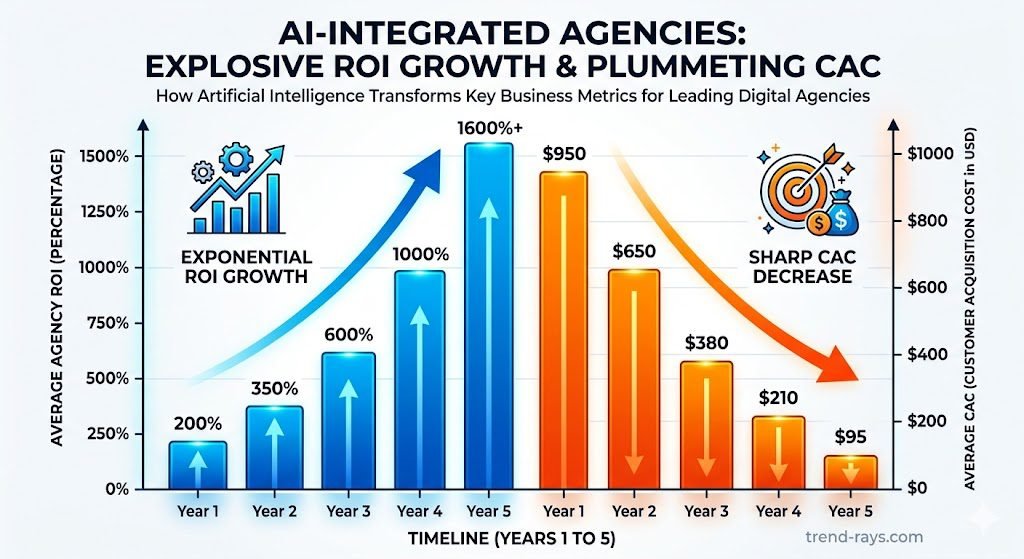
- Skyrocketing ROI: Recent benchmark studies reveal that deeply integrated AI-driven marketing campaigns are generating an average of 300% higher Return on Investment (ROI) compared to traditional manual campaigns.
- Plummeting Acquisition Costs: By optimizing ad spend minute-by-minute and dynamically altering landing pages to match user intent, businesses are seeing massive reductions in Customer Acquisition Costs (CAC).
- The Efficiency Metric: Marketing teams using AI report significantly higher productivity rates, saving an average of 11 to 15 hours per week per employee on manual data aggregation and reporting.
For a business, cutting 15 hours of manual work per week per account manager means you can take on 30% more clients without increasing your headcount. That is pure profit margin.
The Importance and Benefits for Digital Agencies
For digital marketing agencies, AI is the ultimate leverage tool. The traditional agency model was historically bottlenecked by human output: you could only produce as many ad creatives or write as many SEO articles as your team had hours in the day.
AI shatters that ceiling, offering massive scaling benefits:
1. Hyper-Personalization at Scale
Agencies can now generate 50 different variations of a video ad, dynamically altering the script, background, and voiceover to perfectly match 50 different micro-audiences. What used to take a production team three weeks now takes an AI orchestration tool three hours.
2. Instant, Automated Reporting
Instead of spending the last three days of the month building client reports, AI tools pull data directly from Google Analytics, Meta, and CRM platforms to generate comprehensive, written executive summaries in seconds. This allows account managers to spend their time on strategy, not data entry.
3. Closing the Talent Gap
Junior copywriters and strategists armed with enterprise AI orchestration tools can now produce work that rivals senior talent. By using AI to check for brand voice consistency, market positioning, and structural flow, agencies can deliver premium work at lower internal costs.
The Freelancer’s Point of View: The Great Equalizer
While large agencies are using AI to scale their margins, freelancers are using it to survive and thrive.
Historically, a solo freelance marketer could not easily compete with a 50-person agency. They simply could not offer technical SEO, graphic design, paid media management, and high-level copywriting all at once. AI has leveled the playing field.
Today, a single strategic freelancer acts as an “Orchestrator.” Using a stack of specialized AI tools, one person can research a market, generate a complete 30-day content calendar, design the ad creatives, and deploy the tracking code.
The Freelance Pivot: The most successful freelancers in 2026 have stopped selling execution (e.g., “I will write 4 blog posts a month for $500”) and have started selling strategy and business outcomes (e.g., “I will build an automated AI lead-gen engine for your SaaS for $5,000”).
The Employment Angle: Is AI Replacing Marketers?
This is the most anxiety-inducing question in the industry. The blunt answer is: AI is not replacing marketers. Marketers using AI are replacing marketers who don’t.
There is a massive misconception that AI allows companies to fire their marketing departments and run everything on autopilot. Industry data completely disproves this. Fully autonomous AI output often performs poorly, lacks nuanced brand voice, and carries high hallucination risks. The highest performing model is “Human-AI Co-creation”—where a skilled marketer guides the AI—which drastically outperforms fully automated systems.
- The Skill Premium: Marketing job listings requiring AI orchestration skills have skyrocketed, with AI-proficient professionals commanding 20% to 30% higher salaries than their non-technical peers.
- The Shift in Roles: We are seeing an explosion of entirely new job titles, such as “AI Prompt Engineer,” “Generative Creative Director,” and “AI Compliance & Data Sovereignty Officer.”
The execution jobs (entry-level data entry, basic SEO regurgitation) are shrinking rapidly, but high-level strategic, editorial, and creative direction roles are booming.
If you are a marketing agency operating in the European Union, Switzerland, or the UK, the rules of the game have officially changed.
We analyzed the top-ranking compliance data from industry leaders like PostHog, Mopinion, and SecureSlate, and the consensus is clear: the era of recklessly plugging third-party APIs into your client workflows is over. Regulators are actively auditing agencies for data sovereignty, “human-in-the-loop” controls, and cookie consent violations.
To outpace your competitors without risking devastating fines, you must build a tech stack around Data Sovereignty. Here is the ultimate 2026 breakdown of the 7 best GDPR-compliant AI tools that will automate your agency’s growth while keeping your client data strictly within European borders.
1. PostHog (Best for AI-Driven Product Analytics)
Traditional analytics tools have become a massive GDPR liability due to third-party cookies and US data routing. PostHog has emerged as the definitive all-in-one alternative for agencies looking to track user behavior securely.
- Why it wins: PostHog combines web analytics, session replays, and feature flags into one platform. Most importantly, it offers native EU Data Hosting (servers in Frankfurt, Germany) and a self-hosted open-source version.
- The AI Advantage: PostHog’s newest AI features allow you to query your data using natural language, making it incredibly fast to pull conversion funnels and user paths without writing SQL.
- Compliance Check: Cookieless tracking by default, full data ownership, and open-source transparency.
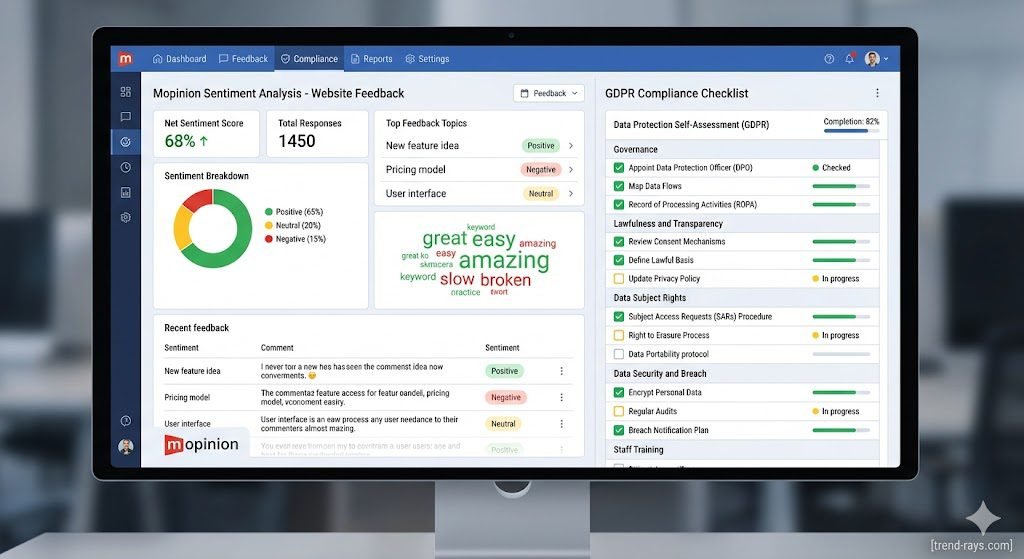
2. Mopinion (Best for AI Customer Feedback & Zero-Party Data)
Since GDPR came into effect, collecting zero-party data (information a customer intentionally shares) is the safest way to build marketing audiences. Mopinion is the undisputed European leader in digital customer feedback.
- Why it wins: Based in the Netherlands, Mopinion is ISO 27001 certified and stores all customer feedback data within the EU. They even offer a multi-cloud strategy, allowing agencies to use European cloud providers like Scaleway to completely avoid the US CLOUD Act.
- The AI Advantage: Mopinion uses AI-powered sentiment analysis to automatically categorize thousands of open-text survey responses, instantly identifying friction points in your client’s customer journey.
- Compliance Check: GDPR-compliant by design, European data centers, and secure handling of Personally Identifiable Information (PII).
3. Langdock (Best for GDPR-Compliant Generative AI)
Agencies love using ChatGPT and Claude to generate copy, but pasting client data or proprietary strategy documents into public LLMs is a massive compliance violation. Langdock solves this.
- Why it wins: Based in Germany, Langdock provides a single, GDPR-compliant interface that lets your team access multiple models (GPT-4, Claude, Gemini) securely.
- The AI Advantage: You get all the power of the world’s best generative AI models, but Langdock acts as a secure proxy. Data is never used to train the base models, and data governance is centralized.
- Compliance Check: Enterprise-controlled data isolation, zero-retention policies with LLM providers, and EU-based infrastructure.
4. SegmentStream (Best for Cookieless AI Attribution)
With the death of third-party cookies and the tightening of consent banners, traditional marketing attribution is broken. SegmentStream uses predictive AI to solve the “missing data” problem.
- Why it wins: Instead of relying on invasive user tracking, SegmentStream analyzes first-party data, impressions, and CRM inputs using machine learning to predict the true contribution of every marketing channel.
- The AI Advantage: It uses predictive AI to model complex customer journeys, allowing agencies to optimize cross-channel ad budgets accurately even when users reject tracking cookies.
- Compliance Check: Eliminates the need for cross-site tracking cookies, relying entirely on compliant first-party data modeling.
5. SecureSlate (Best for Agency GRC & Compliance Automation)
Managing Governance, Risk, and Compliance (GRC) for multiple enterprise clients using scattered spreadsheets is a recipe for a data breach.
- Why it wins: SecureSlate acts as a centralized command center for your agency’s compliance. It automates the tracking of regulatory changes and incident response workflows.
- The AI Advantage: Modern GRC platforms like SecureSlate incorporate predictive analytics to flag potential compliance risks before they result in a penalty, cutting operational compliance costs by up to 40%.
- Compliance Check: Automated audit trails, policy lifecycle management, and real-time GDPR adherence monitoring.
6. Improvado (Best for Privacy-Focused Data Integration)
Agencies spend hundreds of hours manually pulling data from Meta, Google, and LinkedIn. Improvado automates this ETL (Extract, Transform, Load) process while maintaining strict data governance.
- Why it wins: Improvado pulls data from over 500 marketing platforms and harmonizes it into a secure, centralized data warehouse.
- The AI Advantage: It uses AI to automate data mapping and issue real-time alerts for metric anomalies or brand safety drips.
- Compliance Check: It acts as a secure pipeline. It does not store your client’s data indefinitely; it simply prepares and loads it securely into your own compliant European data warehouse (like Snowflake or BigQuery EU regions).
7. DeepL Pro (Best for Multi-Lingual Campaigns)
European agencies frequently run campaigns across multiple languages. While Google Translate or standard LLMs are useful, they often store your translated text.
- Why it wins: DeepL is a German AI company globally recognized for having the most accurate contextual translation models on the market.
- The AI Advantage: DeepL’s neural networks understand local dialects, slang, and highly technical B2B jargon far better than its American competitors.
- Compliance Check: DeepL Pro offers a strict “Zero Data Retention” policy. The moment your client’s ad copy or internal document is translated, the text is permanently deleted from their servers.
How AI is Changing the Future of Digital Marketing
Looking ahead, the very fabric of how consumers discover products and services is shifting.
The biggest transition happening right now is the death of traditional search. With the dominance of Google’s AI Overviews and answer engines like Perplexity, users no longer click through ten different websites to find an answer. The AI reads the websites and synthesizes one definitive response.
This means the future of digital marketing relies heavily on Generative Engine Optimization (GEO). Brands can no longer survive by churning out generic, low-quality content. To get cited by AI engines, marketers must publish highly dense, proprietary data, expert opinions, and original research—the exact things an AI cannot invent on its own.
The Bottom Line
AI marketing is no longer a futuristic concept; it is the baseline operational standard of 2026. Agencies that embrace it will see unprecedented profit margins. Freelancers who master it will command premium rates and win enterprise contracts. And businesses that ignore it will simply become too slow and expensive to compete.
The question is no longer if you should adopt AI, but how fast you can integrate it before your competitors out-scale you.