If you are still optimizing your content exclusively for Google’s traditional ten blue links, you are playing a game that ended two years ago.
We are currently witnessing the most significant SEO reform since the invention of the search engine. With the rollout of Google’s AI Overviews, AI Mode, and the massive adoption of tools like Perplexity and ChatGPT, over 60% of searches now end without a traditional website click. Users are getting synthesized, immediate answers directly on the results page.
This shift has birthed the most critical marketing framework of the decade: Generative Engine Optimization (GEO).
Whether you run a local brick-and-mortar store, a B2B SaaS enterprise, or a freelance blogging business, understanding GEO is no longer optional. It is the only way to maintain brand visibility in a “zero-click” search environment. Here is the ultimate guide to adapting your strategy, capturing high-intent traffic, and dominating AI search results.
The AI Search Matrix: AEO vs. GEO vs. LLMO
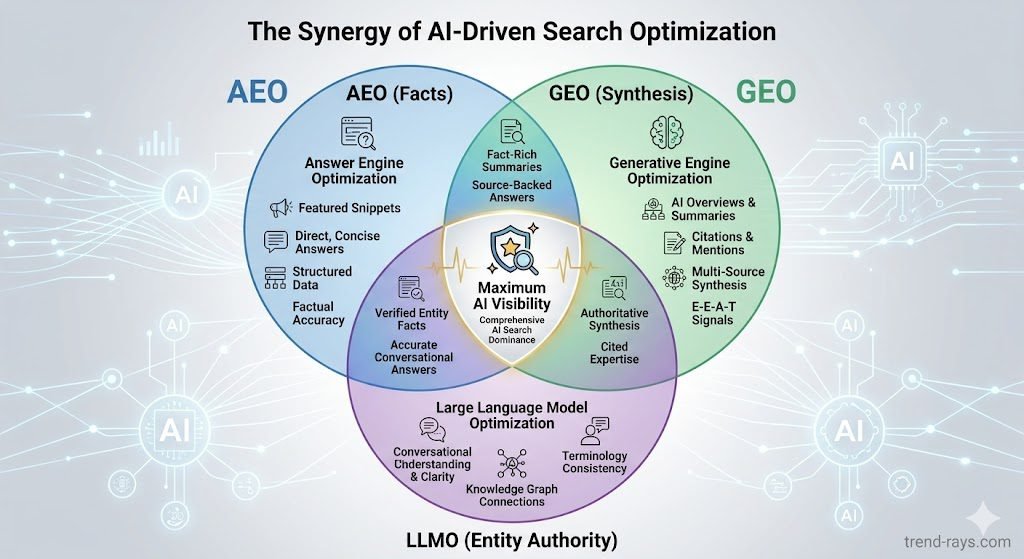
Leading SEO expert Neil Patel and the NP Digital team recently broke down how the modern search landscape has fractured. To succeed, marketers must stop treating all AI search the same. You need a unified strategy that addresses three distinct optimization pillars:
| Strategy | Target Environment | Best Used For | Content Style |
| AEO (Answer Engine Optimization) | Featured snippets, Google “People Also Ask,” Voice Search | Quick, definitive answers to “What is” or “How to” queries. | Structured, scannable sections, strict FAQs, clear definitions. |
| GEO (Generative Engine Optimization) | Google AI Overviews, Generative Summaries | Complex topics requiring deep context and synthesis from multiple sources. | Long-form, high-depth content with heavy citations, data, and E-E-A-T signals. |
| LLMO (Large Language Model Optimization) | ChatGPT, Claude, Gemini conversational threads | Being cited as a brand authority in open-ended AI conversations. | Consistent entity-building, original research, and proprietary frameworks. |
As Patel notes, you do not choose between these; you layer them. You use AEO to capture quick answers, GEO to become the source material for AI Overviews, and LLMO to ensure AI tools mention your brand by name.
The 3 Pillars of AI Search: AEO vs. GEO vs. LLMO
One of the biggest mistakes marketers make in 2026 is treating all AI search as a single entity. Optimizing for a Google AI Overview is entirely different from optimizing for an open-ended chat with ChatGPT.
To build a bulletproof strategy, you must divide your efforts across three distinct pillars: Answer Engine Optimization (AEO), Generative Engine Optimization (GEO), and Large Language Model Optimization (LLMO).
Here is exactly what they mean, how they differ, and where to apply them.
1. AEO (Answer Engine Optimization)
The Goal: Provide the fastest, most accurate answer to a direct question.
AEO is the evolution of traditional Voice Search and Featured Snippets. It targets highly specific, single-intent questions (e.g., “What is the CPC for B2B SaaS?” or “Does [Software X] integrate with Salesforce?”). Answer Engines do not want to hold a conversation; they want to extract a fact and deliver it instantly.
Real-World Applications of AEO:
- E-Commerce Product Specs: If an AI assistant is asked, “Which running shoes have a 4mm drop and wide toe box?”, AEO ensures your product page’s structured data feeds that exact answer to the engine.
- Local Business Triage: Optimizing your “Contact Us” or FAQ pages so AI voice assistants can instantly tell drivers, “Yes, the hardware store on 5th Street is open until 9 PM and carries masonry drill bits.”
- B2B Glossary Pages: Creating dedicated definition pages for industry jargon so that your brand becomes the default cited source when a junior marketer asks an AI, “What is a Customer Data Platform?”
2. GEO (Generative Engine Optimization)
The Goal: Become the primary cited source when AI synthesizes a complex, multi-layered research topic.
While AEO answers “What,” GEO answers “How” and “Why.” Generative Engines like Perplexity or Google’s advanced AI Overviews are used for heavy research. Users ask multi-variable prompts like, “Compare the top three email marketing platforms for an agency with 50 clients, factoring in deliverability rates and white-labeling costs.”
To win here, you need immense factual density, deep context, and authoritative formatting.
Real-World Applications of GEO:
- The “Versus” Hub: Building comprehensive comparison pages (e.g., “YourBrand vs. Competitor A vs. Competitor B”) packed with comparison tables, pricing matrices, and G2 review data. LLMs love scraping dense tables to formulate comparison answers.
- Original Research Reports: Publishing annual industry surveys. When a user asks an AI to write a marketing proposal, the AI will pull statistics directly from your GEO-optimized report, citing your brand in the footnotes.
- Complex “How-To” Architecture: Structuring a 3,000-word tutorial with strict semantic HTML5, ensuring every step is a numbered H3, so the AI can easily extract your process into a bulleted list for the user.
3. LLMO (Large Language Model Optimization)
The Goal: Influence the foundational knowledge of the AI itself so your brand is inherently recognized as a trusted entity.
LLMO is the hardest, but most lucrative, pillar. Models like ChatGPT, Claude, and Gemini are trained on massive datasets (Common Crawl, Wikipedia, news sites). If your brand is not mentioned in those foundational datasets, the AI simply does not know you exist. LLMO is essentially AI-focused Digital PR. It is less about tweaking your own website and more about dominating the internet’s broader conversation.
Real-World Applications of LLMO:
- Digital PR and Off-Page Mentions: Aggressively pitching your brand’s executives to be quoted in Forbes, TechCrunch, or high-tier industry blogs. The more the AI sees your brand associated with “SEO expertise” across the web, the more it cements that relationship in its neural network.
- Proprietary Frameworks: Coining a unique term or framework (like HubSpot did with “Inbound Marketing”). If you push a new concept hard enough on social media and guest blogs, the LLM eventually learns it and attributes the concept entirely to your brand.
- Review Platform Dominance: LLMs heavily weight consensus. Ensuring your brand has a high volume of positive, detailed reviews on third-party sites like Capterra, Trustpilot, or Yelp guarantees the AI will speak favorably of you in conversational prompts.
The Science of GEO: What Top SEO Experts Are Seeing
To win at GEO, we have to look at how these AI models actually retrieve and rank information. Recent data from the industry’s top minds reveals exactly what generative engines prefer.
1. Neil Patel’s NP Digital Query Study (The 6–10 Word Rule)
If you want to appear in Google’s AI Overviews, keyword length matters. NP Digital analyzed 10,000 AI-generated overviews and found that AI heavily favors mid-length queries.
- The Data: AI Overviews appear in 36.1% of queries that are 6–10 words long. Conversely, short queries (1–2 words) only trigger AI results 12.4% of the time.
- The Takeaway: Stop targeting broad terms like “marketing automation.” Optimize for highly specific, mid-length conversational queries like, “What is the best marketing automation software for a B2B agency?”
2. Semrush’s Factual Density Experiment
A recent Semrush study analyzed 10,000 real-world AI queries and found a massive correlation between hard data and AI visibility.
- The Data: Pages containing specific quotes, statistics, and unique data points had 30% to 40% higher visibility in AI responses compared to fluff-heavy content.
- The Takeaway: AI models are designed to extract facts. If your article relies on generic adjectives instead of hard numbers, the AI will ignore it in favor of a competitor who provides concrete data.
3. Neil Patel’s “Search Everywhere” Optimization
Patel warns that focusing purely on Google is a dying strategy. Users are utilizing parallel search behaviors.
- The Strategy: Your brand’s “entity” must be established everywhere. This means optimizing your YouTube video captions (which AI engines scrape), your local directory listings, and your social media profiles. If an AI engine cross-references your website claims with a highly rated Amazon product or a well-reviewed Yelp page, its confidence in citing your brand skyrockets.
The Paradigm Shift: How GEO is Rewriting the Rules of Traditional SEO
For over twenty years, the rules of search were dictated by information retrieval algorithms. Google’s crawlers looked for keyword relevance, site speed, and the quantity of inbound links.
Generative Engine Optimization fundamentally rewrites that architecture. AI models do not retrieve lists of links; they synthesize raw data into original responses. Here is exactly how GEO is changing the foundational pillars of traditional SEO, and what you must adopt to survive.
1. The Shift: From Keyword Matching to Contextual Intent
- Traditional SEO: Marketers obsessed over search volume and keyword density. If you wanted to rank for “best CRM software,” you made sure that exact phrase appeared in your H1, URL, and meta description.
- The GEO Reality: AI engines use Natural Language Processing (NLP) to understand the intent behind the words, not just the words themselves. A user might prompt an AI with: “I run a 15-person real estate agency, my team is terrible at follow-ups, and I need a cheap tool to fix it.” The AI will recommend a CRM, even if the user never typed the letters “CRM.”
- What You Must Adopt: Stop writing for keywords and start writing for “jobs to be done.” You must adopt Semantic Topic Clusters. Map out the entire ecosystem of problems your customer faces and create content that explicitly solves those specific, conversational problems rather than just targeting broad industry terms.
2. The Shift: From Backlinks to Entity Authority
- Traditional SEO: Backlinks were the ultimate currency. A link from a high Domain Authority (DA) site was essentially a “vote” that pushed your page up the rankings.
- The GEO Reality: Generative models prioritize “Entity Resolution.” They evaluate whether your brand is a recognized, credible entity within its training data. A high volume of positive, unlinked brand mentions on Reddit, G2, or industry forums carries just as much weight—if not more—than a traditional hyperlink. If the AI consensus is that your brand is an authority, you get cited.
- What You Must Adopt: You must adopt Digital PR and Brand Sentiment Tracking. Actively manage your brand’s presence on third-party review sites. Participate in podcasts and industry interviews where your brand name is transcribed. You are no longer just building links; you are building a ubiquitous digital footprint.
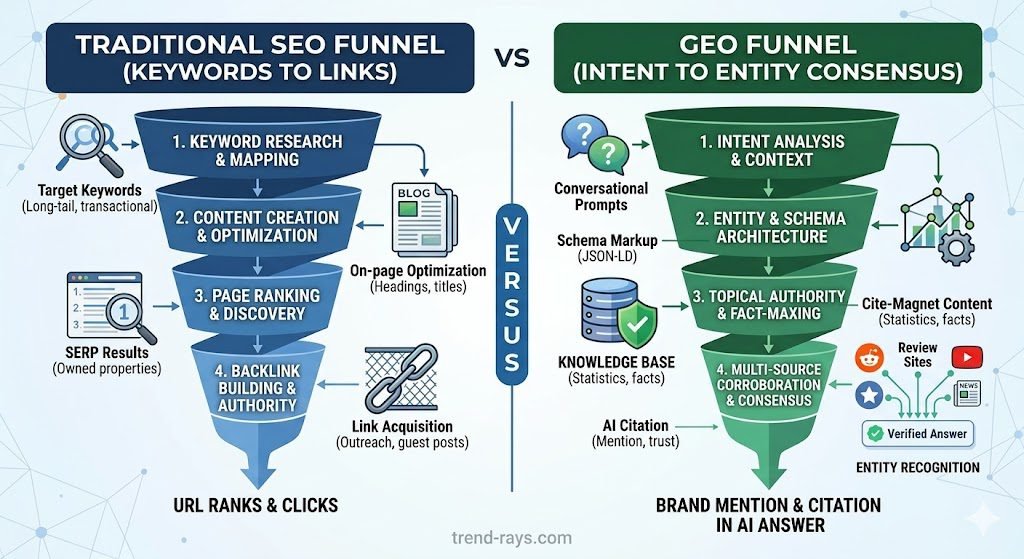
3. The Shift: From “10 Blue Links” to the Zero-Click Ecosystem
- Traditional SEO: The goal was to secure the #1 spot on page one to maximize Click-Through Rate (CTR).
- The GEO Reality: In 2026, the majority of informational queries end without a single click to a website. The AI provides the answer directly in the interface. If your content is purely informational (e.g., “What is the history of marketing?”), you will lose your traffic to the AI summary.
- What You Must Adopt: You must adopt a strategy of Information Gain and First-Party Data. AI cannot synthesize what does not exist. To force a user to click through to your site, you must offer proprietary data, original templates, interactive calculators, or highly opinionated expert perspectives that the AI cannot legally or functionally replicate in a short summary.
4. The Shift: From Unstructured Text to Machine-Readable Data
- Traditional SEO: As long as a page looked good to a human and had the right keywords, it could rank. Formatting was secondary to content length.
- The GEO Reality: AI tokenizers struggle to extract facts from massive walls of narrative text. They favor highly structured data.
- What You Must Adopt: You must adopt Strict Semantic Architecture. This means aggressive use of JSON-LD schema markup (telling the AI exactly what a page is about in code), utilizing HTML tables for data comparisons, and embracing the “Bottom Line Up Front” (BLUF) writing style so the AI finds your answer in milliseconds.
How GEO Works Across Different Business Models
The tactics you use to optimize for AI change entirely depending on your business model. Here is how to apply GEO to your specific angle.
1. GEO for Local SEO & Small Businesses
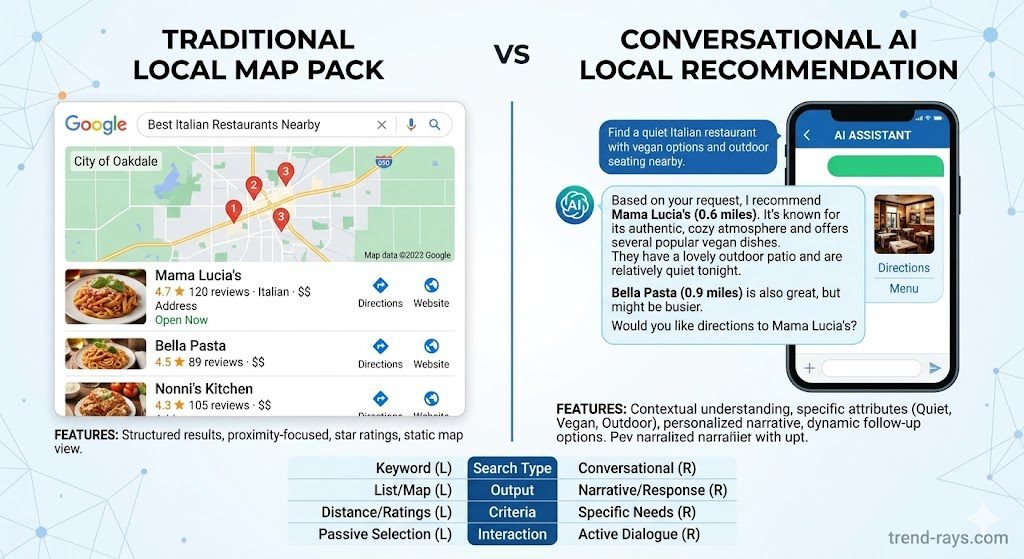
Local search has shifted from typing “plumber near me” to conversational voice prompts like, “Who fixes heat pumps near me today and has good reviews?”
- Hyper-Local Schema Markup: Small businesses must spoon-feed their data to LLMs using JSON-LD schema. Implement
LocalBusiness,Service,Review, andFAQPageschema to explicitly tell the AI your operating hours, service radius, and pricing. - AEO Focus: Local businesses should lean heavily into Answer Engine Optimization. Build FAQ sections that mirror exact human phrasing.
2. GEO for B2B & Enterprise Websites
For B2B SaaS and enterprise companies, GEO is all about dominating the research phase. Buyers use tools like Perplexity to compare software before ever booking a demo.
- Format for Easy Extraction: B2B content often gets bloated with marketing jargon. Strip it back. Use comparison tables, bulleted feature lists, and clear product limitations. The easier an LLM can parse your specs, the more likely it is to recommend you in a “Versus” query.
- Target “Query Fan-Out”: Modern AI Mode doesn’t just answer one question; it breaks a query into subtopics. Your enterprise content must comprehensively cover a topic from all angles (pricing, implementation, integrations) on a single, well-structured hub page so the AI doesn’t have to look elsewhere.
3. GEO for Individual Blogs & Freelancers
If you are a solo creator, you cannot out-publish the AI or out-spend enterprise brands. Your unique advantage is Information Gain—bringing net-new, human experiences to the table.
- The “Anti-Regurgitation” Rule: Neil Patel frequently emphasizes that AI takes what is on the web and regurgitates it. To rank, you must provide what AI cannot: first-hand experience, proprietary data, and strong opinions.
- Digital PR and Guest Quoting: Pitch yourself as an expert on platforms like HARO or Qwoted. Getting your name published on high-authority sites signals to generative engines that you are a trusted consensus voice in your industry.
The Cost of Inaction: What Happens If You Ignore GEO?
While the transition to Generative Engine Optimization requires an investment of time and resources, the consequences of ignoring this shift are severe. If you treat AI search as a passing trend and stick exclusively to traditional SEO, you are effectively handing your best leads to your competitors.
Here is exactly what happens to a brand that fails to adapt to GEO in 2026.
1. The “Zero-Click” Invisibility Trap
In the traditional search era, ranking on page two or three of Google still brought a trickle of traffic. In the AI era, there is no page two. Recent industry data shows that nearly 60% of searches now end without a single click to a website. If a user asks an AI, “What is the best marketing automation software for a 50-person agency?”, the engine synthesizes a definitive answer. If your content lacks factual density and semantic structure, the LLM will bypass it completely. You do not just rank lower; you become entirely invisible in the buyer’s research journey.
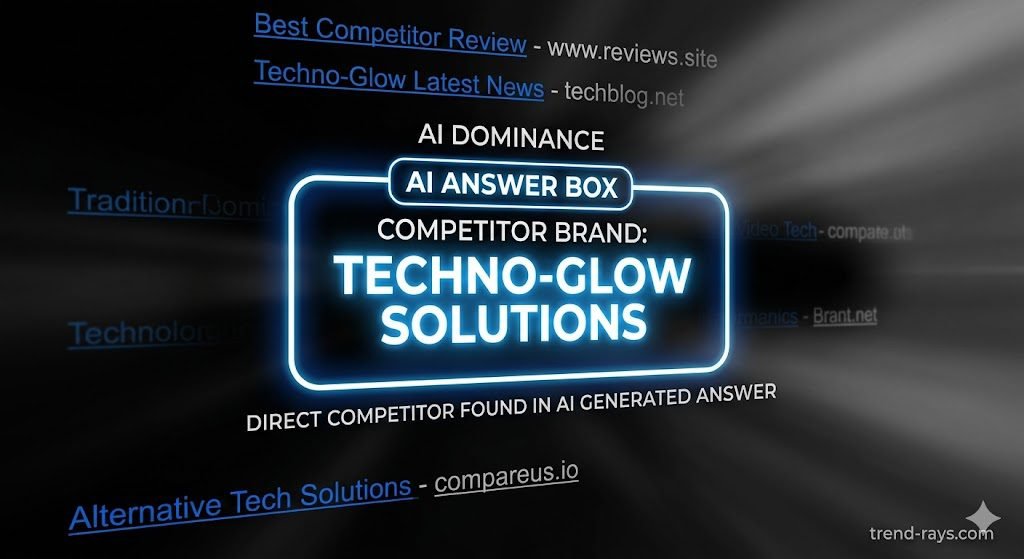
AI models are designed to build consensus from the web. When an AI repeatedly cites a competitor who has optimized for generative search, that competitor becomes the “default” trusted entity in the model’s neural network. This creates a compounding advantage: the more the AI cites them, the more structural authority they gain. By ignoring GEO, you allow your competitors to permanently cement themselves as the industry standard in the AI’s foundational knowledge, making it exponentially harder and more expensive for you to break in later.
3. The Hallucination Risk and Brand Misrepresentation
If you do not explicitly spoon-feed AI engines clear, structured data about your products, pricing, and services through schema markup and concise content, the AI will try to guess. This leads to models “hallucinating” incorrect features about your software or recommending your brand for the wrong use cases. GEO is not just a traffic generation tactic; it is a critical brand control and reputation management strategy.
4. Skyrocketing Customer Acquisition Costs (CAC)
Organic search has historically been the most cost-effective way to drive high-intent traffic. As your traditional organic visibility decays and AI engines refuse to cite your unstructured content, your inbound pipeline will dry up. To compensate for this massive drop in organic leads, marketing teams will be forced to buy expensive PPC ads and sponsored placements. Ignoring GEO doesn’t just hurt your traffic—it directly erodes your profit margins.
The 5-Step GEO Implementation Framework
If you want to capture high-CPC traffic from AI platforms, implement these five structural changes immediately.
Step 1: Target Mid-Length, High-Intent Prompts
Abandon 2-word keywords. Use tools like AnswerThePublic to find the exact 6-to-10-word questions your audience is asking, and make those exact phrases your H2s and H3s.
Step 2: Front-Load the “Bottom Line Up Front” (BLUF)
AI models process information sequentially. Answer the primary question of your article within the first 100 words in a crisp, 60-120 word block. Use the rest of the article to provide deep context, expert quotes, and data.
Step 3: Engineer Semantic HTML Structure
Return to strict semantic HTML5. Wrap your lists in proper <ul> or <ol> tags. Use <table> tags for data. This provides the AI tokenizer with a crystal-clear map of your content.
Step 4: Maximize Factual Density and Information Gain
Remove the fluff. Replace generic adjectives with hard numbers. Instead of writing, “Many marketers saw great results,” write, “Our 2026 survey of 500 marketers showed a 42% increase in ROI.” Inject original A/B test results and internal case studies.
Traffic volume is no longer the sole indicator of success. Clicks from generative engines are often lower in volume but massively higher in conversion rate. Shift your metrics to track Citation Frequency (how often your brand appears in AI answers) and Brand Sentiment.
The Bottom Line
The transition to Generative Engine Optimization is not a trend; it is a fundamental architectural shift in how human beings access information. As experts like Neil Patel have proven, search is no longer about matching keywords to web pages—it is about providing the trusted data that powers the world’s AI assistants.
By structuring your content for machine readability, proving your real-world expertise, and targeting the precise mid-length queries AI loves, you will capture the absolute trust of the algorithm in 2026.