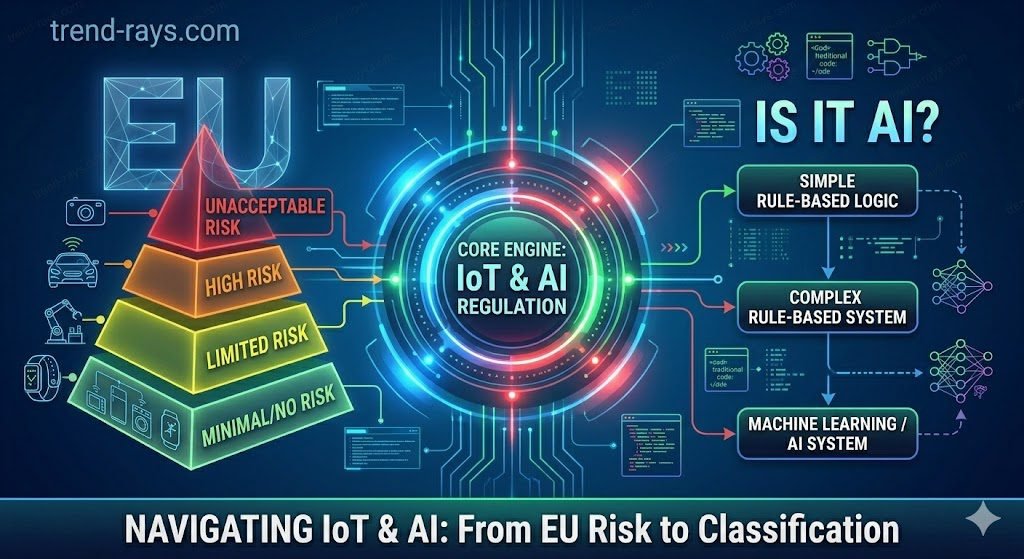
The era of unregulated smart devices in Europe is officially over. With the EU AI Act now actively phasing in, the legal, technical, and economic landscape for IoT manufacturers has fundamentally shifted.
While early 2025 brought bans on prohibited AI practices and mandated AI literacy, the impending August 2026 and August 2027 deadlines are what will truly transform embedded systems and smart hardware. For manufacturers, ignorance of the law is no longer a defense. Even if a company doesn’t consider itself an “AI company,” utilizing data-driven predictive logic in firmware might legally classify an IoT product as an AI system.
However, this regulatory shift isn’t just a compliance burden—it is a massive revenue opportunity. Companies that achieve early compliance are already commanding premium pricing in the B2B sector, while a new wave of startups is securing heavy funding to solve these exact regulatory bottlenecks.
The Driving Force: Why Modern Manufacturing Cannot Survive Without AI and IoT
To understand the weight of the EU AI Act, one must look at the sheer scale of AI and IoT adoption across the European industrial sector. The transition to “Industry 4.0” has made smart, connected devices the lifeblood of modern manufacturing. Facilities that fail to digitize are rapidly losing ground to global competitors due to higher operational costs and lower yields.
The integration of edge AI and IoT sensors is no longer optional for European factories; it is a critical necessity driven by several core factors:
- Predictive Maintenance: Traditional manufacturing relies on scheduled maintenance, which often results in replacing perfectly good parts or suffering catastrophic, unexpected breakdowns. IoT sensors constantly monitor vibration, temperature, and acoustic anomalies in heavy machinery. When paired with AI, these systems predict exact failure windows, allowing repairs to happen only when necessary and eliminating costly unplanned downtime.
- Supply Chain Resilience and Digital Twins: Recent global disruptions have forced manufacturers to seek total visibility over their operations. By using IoT devices, factories create “Digital Twins”—exact virtual replicas of their physical assembly lines. This allows plant managers to run AI simulations to optimize workflows, test new supply chain routes, and adapt to material shortages in real-time.
(Note: Remember to apply your trend-rays.com watermark to this image to protect your visual asset before publishing.)
- Automated Quality Control: High-speed, AI-driven machine vision cameras at the edge of the network can inspect microscopic defects on assembly lines at a speed and accuracy that human workers simply cannot match. This drastically reduces waste and prevents defective products from ever reaching the consumer.
- Aggressive Sustainability Goals: Europe’s strict environmental mandates mean factories must aggressively cut carbon emissions. IoT networks provide granular, second-by-second data on power and resource consumption, while AI dynamically adjusts HVAC, lighting, and machine power states to optimize the factory’s carbon footprint.
Because the economic incentives of Industry 4.0 are so massive, hardware manufacturers cannot simply back away from the European market due to new regulations. Instead, navigating the AI Act correctly has become the ultimate competitive advantage.
Does the EU AI Act apply to smart home devices?
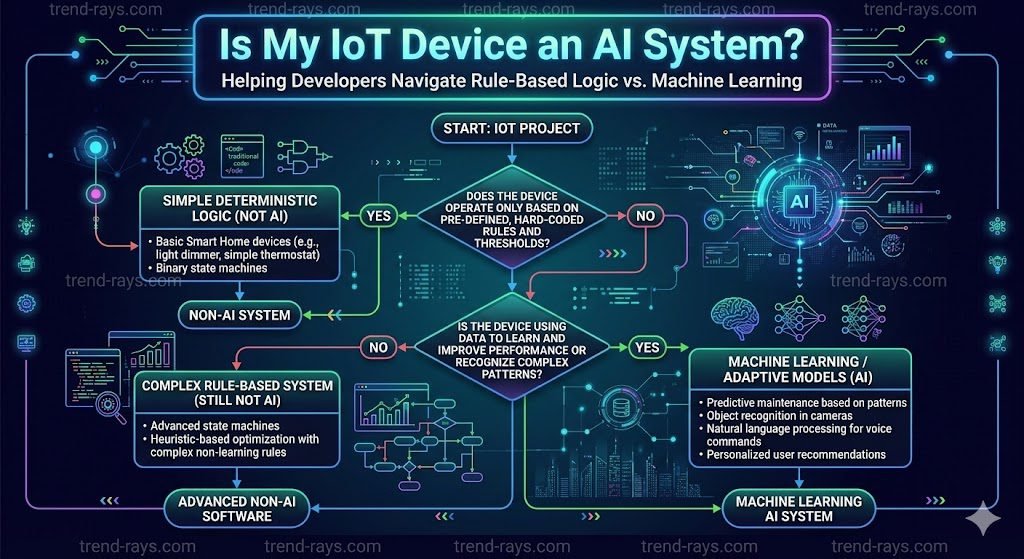
Yes, the EU AI Act applies to smart home devices if they utilize machine learning, predictive logic, or data-driven inference to operate. While basic rule-based automation (like a manually programmed thermostat) does not qualify as AI, devices that adapt to user behavior, utilize biometric data, or act as safety components fall squarely under the Act’s regulatory scope.
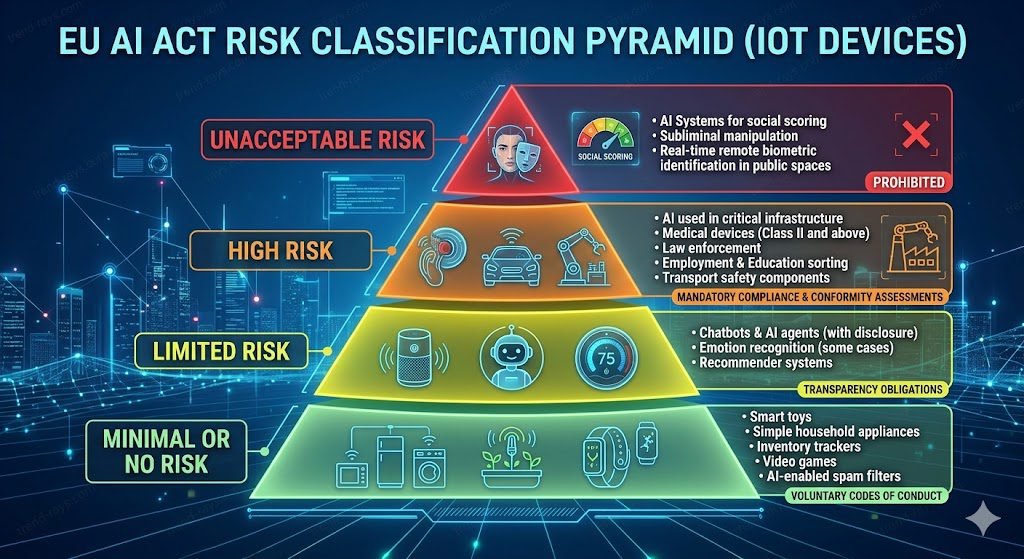
The impact depends entirely on the device’s risk categorization:
- Minimal/Limited Risk: Devices like smart speakers or standard smart lighting. These mainly require transparency—users must be clearly informed they are interacting with AI, and any AI-generated media must be labeled.
- High-Risk: Home security systems with facial recognition, AI-driven energy grid management tools, or health-monitoring wearables. These face stringent compliance audits, mandatory human oversight, and continuous post-market monitoring.
When Does Your Embedded System Legally Become “AI”?
The technical distinction between a standard IoT device and an “AI system” comes down to how decisions are made. Traditional embedded software relies on hard-coded thresholds and human-written rules (e.g., “If temperature > 180°C, turn off the motor”).
AI, under the European framework, involves systems that infer how to achieve a given set of objectives using machine learning or logic-based approaches.
The Firmware and Backend Analytics Trap
Products often unintentionally enter the AI Act’s scope during routine development. Upgrading a legacy IoT product from simple rule-based logic to machine learning—perhaps to improve battery life, run self-diagnostics, or predict user habits—suddenly triggers the Act’s strict requirements. Manufacturers must audit their Over-The-Air (OTA) firmware updates carefully; a single software patch can instantly change a device’s legal risk classification from unregulated hardware to a regulated AI system.
The “Provider vs. Deployer” Trap in the IoT Supply Chain
A major misconception among hardware teams is the assumption that utilizing third-party AI absolves them of legal responsibility.
Under the Act, a Deployer is an entity using an AI system in a professional context. A Provider is the entity that develops an AI system and places it on the market under its own name or trademark.
If you manufacture a smart home hub and integrate a third-party machine learning chip or an external API for voice recognition, and then sell that hub under your brand name, you are legally classified as the Provider. You inherit the regulatory burden. Relying on a third-party vendor’s compliance claims does not exempt your brand from coverage or potential fines.
The Business Opportunity: Turning Compliance into Revenue
Rather than viewing the EU AI Act as a roadblock, forward-thinking IoT manufacturers and startups are using it as a growth engine.
1. Premium Pricing for “Secure-by-Design” B2B Hardware
European enterprises, municipal governments (Smart Cities), and healthcare providers are currently overhauling their procurement processes to exclusively buy hardware that comes with guaranteed EU AI Act conformity. Manufacturers who secure their CE markings early can charge a premium for “compliance-ready” edge AI devices, capturing massive B2B contracts from competitors who are lagging behind.
2. The Rise of “Compliance-as-a-Service” Startups
A highly lucrative startup ecosystem has emerged in Europe to bridge the gap between hardware engineering and legal compliance. Startups offering AI auditing software, automated conformity assessment tools, and synthetic data generation (to train AI without violating GDPR) are seeing massive venture capital funding.
3. Energy Efficiency and Grid Services
The AI Act intersects with the Energy Performance of Buildings Directive (EPBD). Compliant AI-driven Building Energy Management Systems (BEMS) can reduce energy consumption by 15-30%. By adhering to AI and data regulations, property owners can monetize these efficiency gains through demand-response grid services.
The Human Impact: Why the EU is Regulating the IoT Ecosystem
To understand the business implications of the AI Act, manufacturers must understand the human impact that triggered it. The rapid integration of AI into daily life has moved IoT from passive convenience (like turning on a light) to active decision-making that affects human safety, rights, and livelihoods.
- Protecting Physical Safety: As IoT expands into medical wearables, autonomous mobility, and industrial robotics, a software glitch is no longer just an inconvenience; it is a physical hazard. The AI Act ensures that high-risk edge AI devices have mandatory human fail-safes.
- Preventing Algorithmic Bias in Daily Life: Imagine a smart building’s access control system that uses facial recognition but struggles to accurately identify certain ethnicities, or an AI-driven smart grid that inadvertently deprioritizes heating in low-income neighborhoods. The Act strictly regulates these biometric and infrastructure applications to protect fundamental human rights.
- The Macro-Business Perspective: Trust as a Currency: From a macro-economic standpoint, the EU is betting that trust will be the defining competitive advantage of the next decade. Consumers and businesses are becoming deeply skeptical of “black box” AI. By forcing manufacturers to be transparent, the EU is effectively creating a global gold standard. IoT brands that embrace this transparency will see a massive boost in consumer brand loyalty, positioning themselves as ethical leaders rather than just hardware vendors.
Critical Compliance Deadlines for IoT Manufacturers
- August 2, 2026 (Annex III High-Risk Systems): Enforcement begins for standalone high-risk AI systems, such as those used in critical infrastructure, biometrics, or employment sorting.
- August 2, 2027 (Annex I Regulated Hardware): The crucial deadline for AI systems embedded as safety components in already-regulated hardware, such as medical devices (MDR), aviation, cars, or industrial machinery.
5 Steps to EU AI Act Compliance for IoT Devices
To protect market share and avoid disruptions, manufacturers must take immediate action:
- Conduct a Risk Classification Audit: Map your entire product portfolio against Annex I and Annex III of the AI Act to identify which devices fall into the “High-Risk” category.
- Implement “Secure-by-Design” Data Governance: Ensure the datasets used to train your device’s AI are representative, error-free, and unbiased.
- Establish Human Oversight Protocols: Build in fail-safes. This is mandatory for high-risk applications like industrial IoT, where a human must be able to override AI-powered decisions.
- Ensure Transparency and Logging: High-risk systems must maintain a traceable, automated record of data processing activities and decision-making logs.
- Prepare for Conformity Assessments: Engage Notified Bodies early to acquire your CE marking. Severe bottlenecks are expected as the 2026 and 2027 deadlines approach.
The Connected Compliance Web: AI Act, CRA, and PSIRT
The AI Act doesn’t exist in a vacuum. IoT manufacturers need a unified compliance roadmap that accounts for the broader European digital strategy:
- Cyber Resilience Act (CRA): Mandates lifecycle cybersecurity updates and vulnerability handling for connected devices. Because AI systems present unique attack vectors, having a dedicated Product Security Incident Response Team (PSIRT) is transitioning from a best practice to a legal necessity.
- EU Data Act: Requires manufacturers to design products so users can securely access, use, and share the raw data their connected devices generate.
Conclusion
The cost of non-compliance with the EU AI Act is catastrophic: fines can reach up to €35 million or 7% of global annual turnover, alongside the risk of having products permanently pulled from the EU market. However, those who move swiftly to align their IoT devices with these new standards will not only mitigate risk—they will secure a dominant, highly profitable position in the European tech landscape.